GIRLS OF ANDROMEDA · BOOK ONE
A novel
Illustrated edition · 144 plates
JACK ABBOTT
March · Calderveil
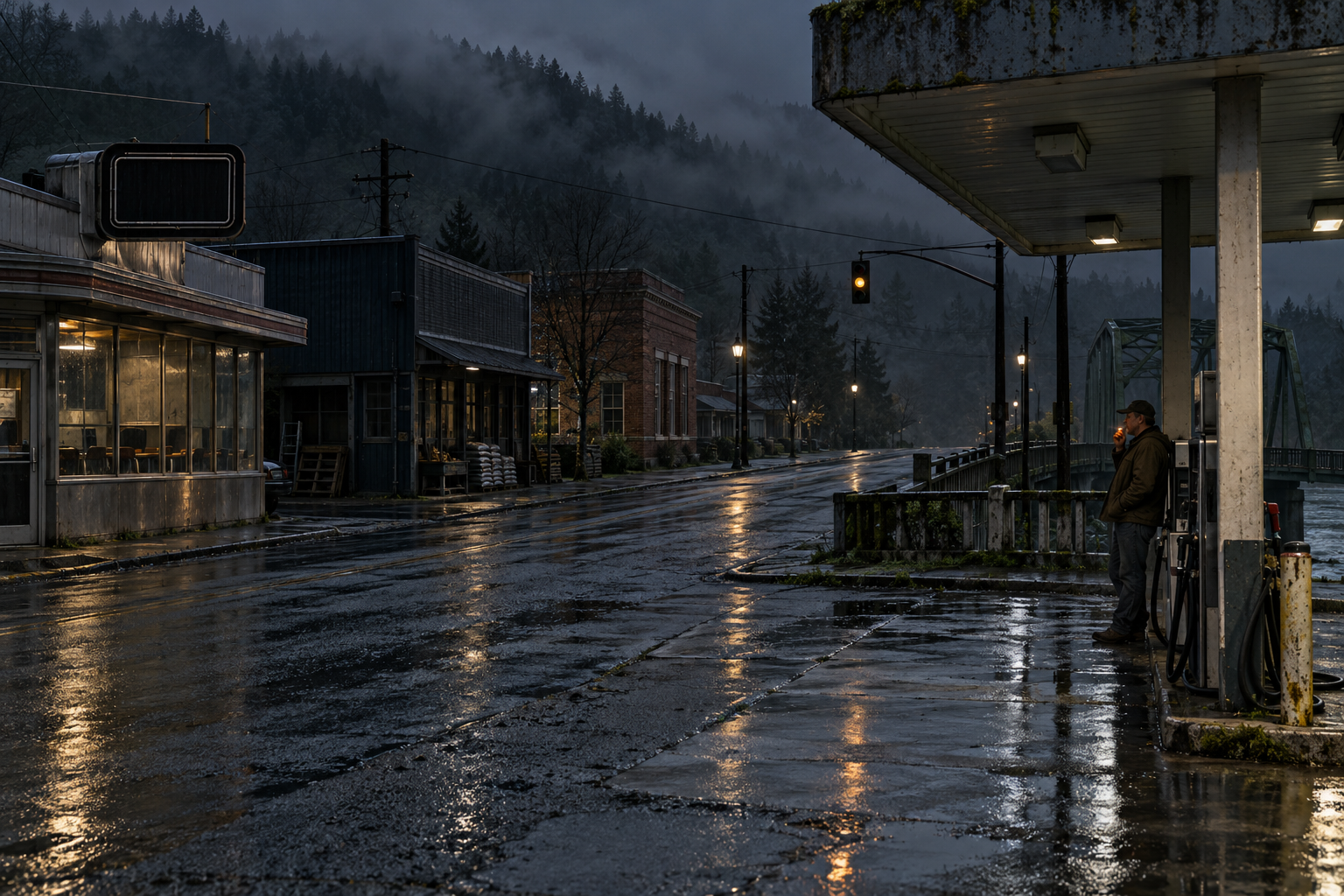
The town shut at nine.
Not gradually, the way a city goes quiet a street at a time. Calderveil did it all at once, like a man getting up from a table. The diner on Route 9 turned its sign at nine. The gas station by the bridge switched off its pumps at nine and its owner stood in the forecourt in the dark and smoked one cigarette, every night, as if it were part of the lock. There was a bar called the Elk, which closed at nine on weeknights because the man who owned it liked to watch television in his own house, and nobody in Calderveil had ever thought this strange.
The library stayed open until nine on Thursdays. Kyra had worked out by the second week that this made Thursday the town’s late night, and that the reason for it was a woman who did not need sleep in the way the town supposed, and who had looked at the old opening hours on her first morning behind the desk and simply moved them.
· · ·
They had come in the autumn, with the leaves going, in two cars.
Val had found her house first. It was small and plain and stood at the end of a road where the town began to give up, with a porch whose roof let the rain through in exactly one place, onto exactly one board, which Val had noted on the first wet day and decided to live with. She had signed for it under her own name, in her own hand, and by the end of the first week every lamp in it was burning, and it stayed that way.
Kyra’s was across town, on a street with a sidewalk down one side of it and a dog that barked at the mail. It had a front room with a deep old couch, and an upstairs, and a kitchen window over the sink that looked straight into a neighbor’s apple tree.
Two houses had been Val’s idea, the way the arrangements generally were. Two women who arrive together and live together are a story. Two women who arrive together and live at opposite ends of a small town are friends, and nobody tells stories about friends. Kyra had argued for one house for about a day, the way she always did, and then gone and signed for hers. They had done it in other towns. You got good at the drive.
Val was behind the library desk inside a month. The old librarian had been looking for a reason to retire for years, and Val had a way of being exactly what a position wanted, so that people who had met her twice could not afterward remember the place without her. Kyra walked into the fire hall in her second week, found a man with a clipboard, and told him she could find people. He asked what she meant. She said she meant people who had gone the wrong way up a mountain, and that she could find them in the dark and carry them down if she had to, and he looked at her for a while and gave her a pager.
By the first snow she was running the Salt Fork trail on her days off, learning where it lied. By midwinter the man with the clipboard was calling her when the call was bad.
· · ·
The trouble was the evenings.
Kyra had been a great many things in her life. She had been cold, and frightened, and poor, and furious, and in love, and lost in three languages, and once for an entire afternoon a nun. She had never been bored. There had always been something — a city with its lights still on, a fight in the street below, a sick neighbor, a war, a job, a woman across the table who could be provoked into an argument about anything at all.
Calderveil had a diner and a feed store and a post office and a grange hall and a river, and at nine o’clock it had none of them.
She tried. She drove up to the basalt shelf above Hallam Lake on clear nights, which they had been coming back to for longer than the town had been a town, and sat on the warm rock and looked at the sky until she started to feel the other thing she felt when she looked at the sky, and drove home. She watched everything there was to watch on her phone, which could show her anything in the world, and by February she had watched most of it. She learned to bake bread and then lost interest in bread. She read the books Val brought her, and was told off for reading the endings first.
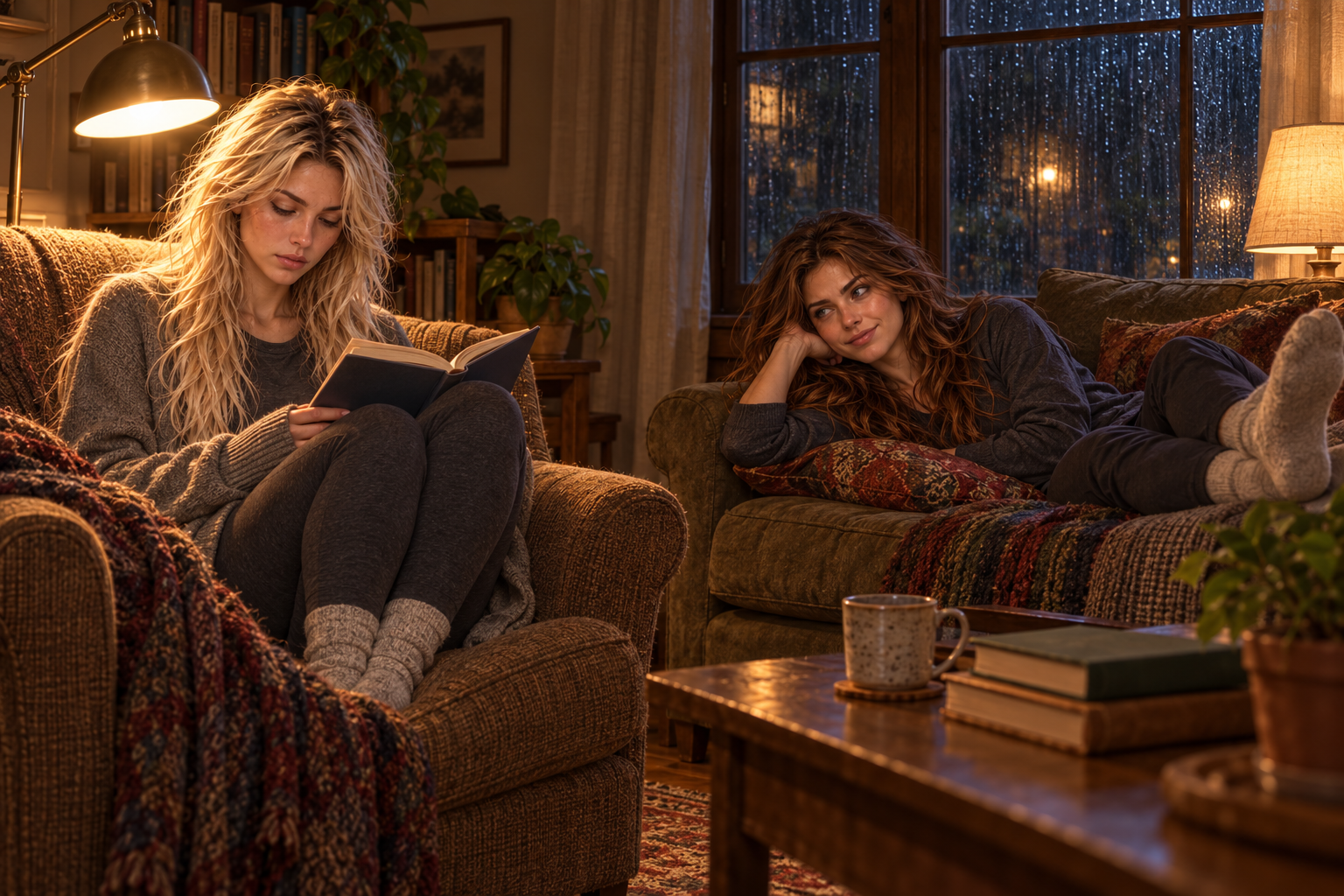
And one night in March, at a quarter past nine, on Val’s couch with the rain coming down and every lamp in the house on, she looked across the room and caught Val turning back a page.
“You’re bored,” Kyra said.
“I’m reading.”
“You’ve read that page twice.”
“It’s a dense page.”
“It’s a novel about a lighthouse.”
Val did not look up. “It’s a dense lighthouse.”
· · ·
Kyra put her feet up on the arm of the couch, which Val disliked, and lay back and looked at the ceiling.
“Name one thing open in this town.”
“The hospital in—”
“In this town.”
Val turned a page she had not read. “The fire hall. You have a key.”
“That’s not open. That’s me.” Kyra counted on her fingers. “The diner’s shut. The Elk’s shut. The gas station man is standing in the dark smoking his one cigarette. The library’s shut, because its librarian is on her couch pretending to read about a lighthouse.”
“It’s Tuesday. The library has hours.”
“You made the hours.”
“I improved the hours.” Val turned another page. “Thursday is very popular.”
“Thursday is three teenagers and the schoolteacher.”
“The schoolteacher is building a collection.”
“The schoolteacher is building an excuse.” Kyra rolled her head on the cushion to look at her. Val was in the armchair under the good lamp, in a gray cardigan with her sleeves down over her wrists and her feet tucked under her, and the pale of her hair loose down her back and gone the color of honey where the lamp got at it. Loose, as it always was in the house. Nobody in Calderveil had ever seen it any other way.
“There’s one thing open,” Kyra said.
Val looked at her over the top of the book.
It was not a long look. It did not need to be. They had been reading each other across rooms since before rooms had glass in the windows, and Kyra could read that one with her eyes shut: the thing that happened at the corner of Val’s mouth, and did not become a smile, and did not need to.
Val closed the book on her finger.
“It’s a quarter past nine,” she said.
“Everything else is shut.”
· · ·
Val got up first. She always did, when it was going to be her idea; she set the book down on the arm of the chair, spine up, which she would never have allowed anyone else to do to a book, and went out into the hall without a word.
Kyra followed her as far as the foot of the stairs.
Val was three steps up. She turned, and came back down one, so that for once their faces were level, and put her hand on the back of Kyra’s neck — the cool, certain weight of it — and drew her in.
That was how Val began things. It had always been how Val began things, on stairs, in doorways, in the narrow halls of a great many rented houses, and it still went through Kyra like the first warm day of the year. Val kissed the way she did everything that mattered, slowly, with no interest at all in getting anywhere, and Kyra stood on the bottom step with her hands in the front of that gray cardigan and let her, and the rain came down on the porch roof, and somewhere at the front of the house it found its one board.
“Upstairs,” Val said, against her mouth.
“Here.”
“Upstairs. The stairs are a terrible surface.”
“You’ve got a terrible surface.”
“I have a very good bed,” said Val, “and you know it,” and went up, and Kyra went up after her laughing, the way she had been going up stairs after that woman all her life.
· · ·
Every lamp in the bedroom was on, too.
Val did not turn them off. She never did, in this house, with Kyra. It was the one room on the planet where she let them stay on, and she undressed in the full light of them with the unhurried indifference of a woman taking off a coat, and then stood a moment by the bed and undid Kyra’s hair from its tie, because that was hers to do and always had been.
They were laced inside a quarter of an hour. Kyra would have been ready in a minute — she was always ready in a minute, she had been born that way and had never seen the point of apologizing for it — but Val took the long road, as Val’s body always took it, and Kyra had long ago stopped wanting to go any other way. She lay on her side with her mouth against Val’s shoulder and her hand in the thick dark warmth below the pale, finding the way, patient, unhurried, talking softly about nothing — the man with the pager, the dog that barked at the mail, the lighthouse — until something under her fingers thickened and lengthened and came up through all that dark to meet her, and curled, and took hold.
And then they were hip to hip and turned in to each other, the way they had always done it, the two of them wound together and holding, and the grip between them, small and steady and certain, said everything there was to say and did not need words to say it.
“There you are,” Kyra said.
“Don’t talk.”
“You talk.”
“I’m very quiet,” said Val, and kissed her so she couldn’t answer.
· · ·
The light came up slowly.
It began at Val’s throat this time, a faint warmth under the skin the color of nothing on this world, and then the insides of her wrists, and then along the long line of her collarbones; and in a room with every lamp burning it should have been nothing, and it was not nothing. It never was. Kyra watched it come the way she had watched it come since the snow, and felt her own eyes go, the gold coming up in them like heat through a stove door, and did not turn her face away from anything, because there was nobody in this room to turn it away from.
Val went quiet, and then quieter. That was how you knew, with Val. Not the noise. The silence getting deeper.
Kyra held on. She did not hurry anything or change anything. The grip tightened, and tightened, and Val’s breath stopped altogether for a moment — and then she came apart without a sound, all at once, the whole of her lit, with her forehead pressed hard into the hollow of Kyra’s neck and a low unbroken murmur starting up in her that was not words and had Kyra’s name strung all through it. Kyra went with her, as she always did, loudly, laughing at the end of it because she could never help that, and the rain went on outside and nobody in Calderveil heard a thing.
· · ·
Afterward they lay in the full light with the blankets kicked down and the window streaming.
“What do you suppose people here do,” Kyra said, “at a quarter past nine.”
“This, presumably.”
“Not like this.”
Val considered the ceiling. “No,” she agreed. “Not like this.”
Kyra started laughing again and could not stop for a while, and Val lay beside her and let her, with one hand resting flat and cool on Kyra’s breastbone, the way she did when she wanted something to be still and did not mind if it wasn’t.
“Do you know what I think,” Kyra said eventually.
“Seldom.”
“I think we’re bored.”
“I am never bored.”
“You read a page about a lighthouse twice.”
“I was reading it for the second time,” said Val, “on purpose. That is what a second reading is.” She turned her head on the pillow. “We are not bored. We are between things. It’s good for us. Nothing happens in a town like this. That is the entire point of a town like this.”
“That’s what worries me.”
Val did not answer. After a while her breathing slowed, and the hand on Kyra’s breastbone grew heavy, and Kyra lay awake beside her with all the lamps still on and thought about it.
It was not the town. She liked the town. She liked the man with the clipboard and the dog that barked at the mail and the diner with its bad coffee. It was that the two of them had spent a very long time being interesting for each other, there being nobody else to be interesting for, and they had got extremely good at it. The games, and the terms, and the chair in Portland, and the tape. Two women who could not leave a thing alone, forever asking each other what else.
And for the first time she could remember, lying there, she could not think of anything else.
· · ·
The fire hall held its spring fundraiser at the grange hall on the last Saturday in March, as it had every spring since before the grange hall had heating, and the whole town came, because there was nothing else to do in Calderveil in March and because Dee from the diner made the pies.
New volunteers got the raffle. Nobody else wanted it. Kyra had been given a roll of tickets and a cash box and a folding table by the door and told, by the man with the clipboard, that nobody had ever sold more than forty. By eight o’clock she had sold more than a hundred, because she talked to every single person who came through the door and could not be made to stop.
Val was across the hall behind a table of donated paperbacks, a dollar each, in a high-necked sweater, with a cash box of her own and the expression of a woman guarding a border. She had sold four, all of them to the schoolteacher.
The pie table was behind the raffle. That was how it happened. Two women stood at it with paper plates, a little after eight, with their backs half to Kyra and their voices pitched at the volume people use when they believe a crowded room is the same as a private one.
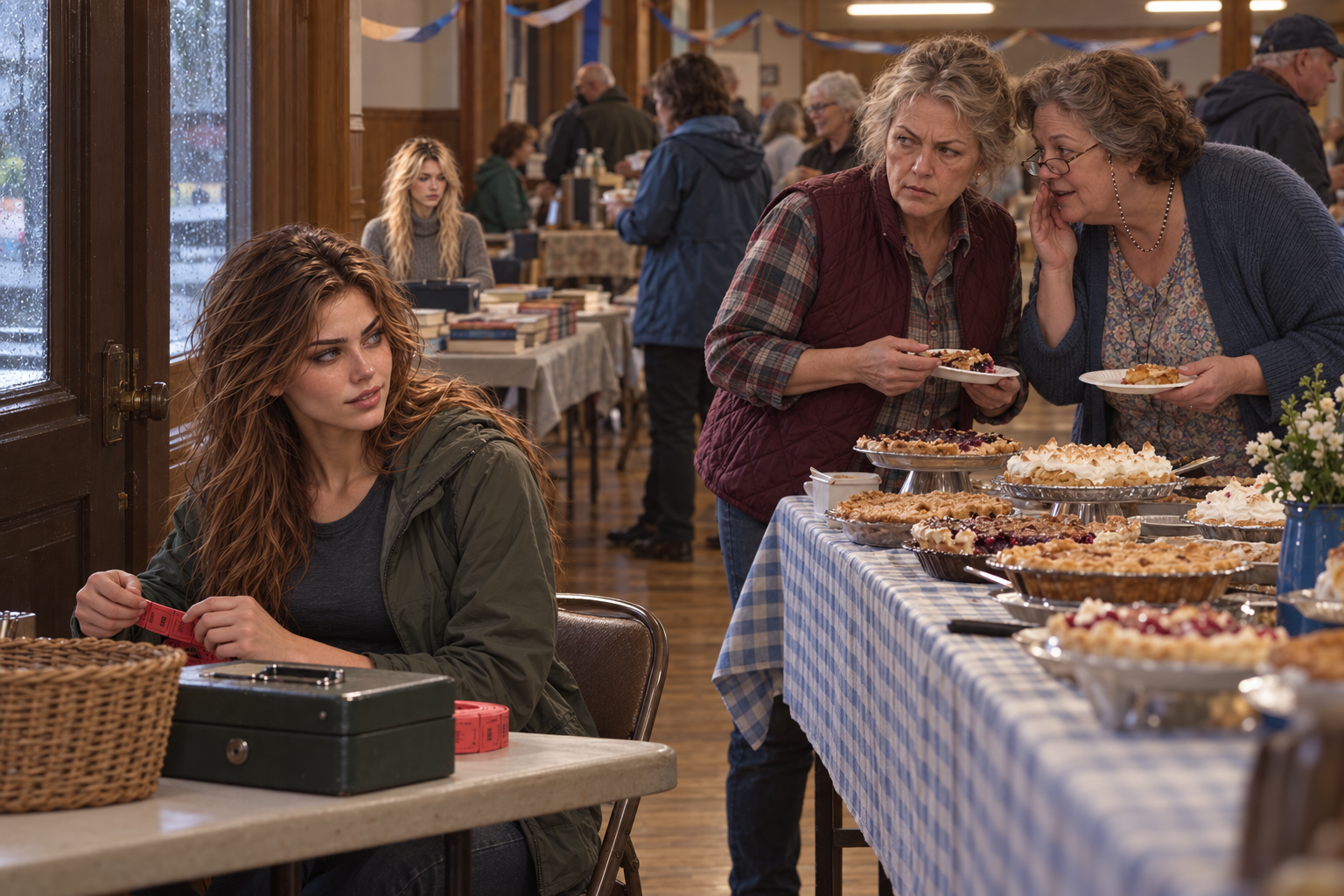
One of them was Marjorie, from the feed store, who had a face like a closed gate and missed nothing. The other Kyra knew only to nod to: a broad, pleasant woman with reading glasses on a chain, who had bought six tickets and asked whether the quilt was handmade.
“—barely out of school,” the woman with the glasses was saying, “and a ring in her nose, Marjorie, and a car that’s much too good for her. Much too good. You should see it.”
“Well.”
“And a new dishwasher for her mother. Paid for outright.”
“Well,” said Marjorie.
“She makes it online.” The woman lowered her voice, which did not make it quieter. “She showed me. On her phone. It’s all done with some kind of money that isn’t money. Computer money. It’s just numbers, I couldn’t follow it. She says nobody can trace it.”
Kyra tore off a strip of tickets for a boy and his grandfather, and did not look around.
“And what’s she doing,” said Marjorie, “to get computer money.”
There was a pause of a very particular quality, which Kyra had heard in a great many kitchens, and which always came just before the best part.
“Videos,” said the woman with the glasses.
· · ·
Kyra turned around.
She did it easily, with the roll of tickets still in her hand, as if she had only just noticed they were there. “Sorry,” she said. “I couldn’t help it. Doing what?”
Marjorie looked at her the way she looked at everybody, as though checking a delivery against the invoice.
But the woman with the glasses was the sort of person who had been waiting all evening for someone to ask, and she leaned in over the pies with the particular pride of a woman who does not entirely approve.
“Videos,” she said again, very low. “You know. For people who pay to watch. My sister’s girl, in Eugene. She wears a mask in every single one of them, the whole top half of her face, and she says that’s the whole trick of it. Nobody knows it’s her. Nobody in the family’s supposed to know at all.” She straightened. “I don’t understand any of it and I’m not going to try. But the car is paid for.”
“Goodness,” said Kyra.
“I know.”
“In a mask.”
“In every one.”
Kyra looked at her for a moment longer than the conversation needed. Then she smiled — the good one, the one that had got her out of worse rooms than this — and held up the roll of tickets.
“Five more for the quilt?” she said. “It is handmade. I asked.”
· · ·
She took two plates of pie across the hall in the lull, as she would have done any other year, and set one down in front of Val.
“You’ve sold four books,” Kyra said.
“To a very serious reader.”
“To the schoolteacher.”
“Who is a very serious reader.” Val turned her plate a quarter turn and looked up, and the look went over Kyra’s face the way it always did, taking inventory, and stopped somewhere. “You’re quiet.”
“I’m never quiet.”
“You’ve been quiet since eight o’clock. I can see the raffle from here. You laughed at the Hendersons and you didn’t mean it.”
“I’m tired. I’ve sold a hundred and twelve tickets.”
“You’ve sold a hundred and twelve tickets,” said Val, “and you are thinking about something, and you’ve decided not to tell me yet, which means you haven’t finished thinking it.”
Kyra ate a forkful of pie and did not answer, which was its own answer, and Val let it be, which was hers.
· · ·
She thought about it all the way home in the rain.
Not the money. She did not care about the money; she had never cared about money in her life, except as a thing to have enough of to stop thinking about. And not the niece, whom she had never met and was rather fond of already, with her nose ring and her car and her mother’s dishwasher.
The mask.
She thought about the mask, and a room, and somebody on the other side of a screen paying to be in it. And she did not let herself think the rest of it, not yet, because she knew herself well enough to know where it went, and she knew Val well enough to know what Val would say.
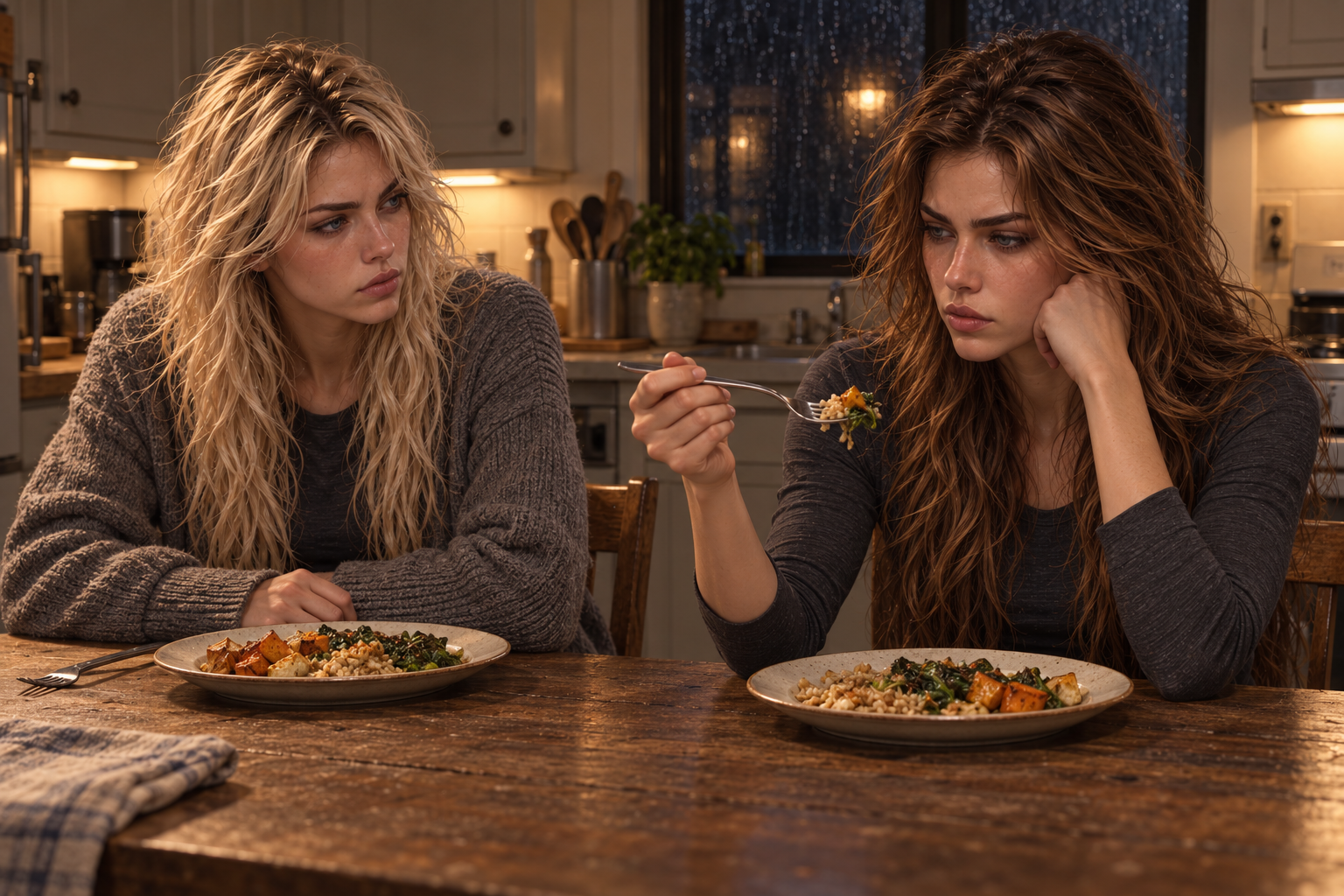
She thought about it on Sunday at the diner, while Dee put down two coffees neither of them had ordered and called them girls. She thought about it at the fire hall, rewinding a hose that did not need rewinding. She thought about it on Monday, which was the day the library was shut, when she drove across town in the late afternoon to Val’s small house with every lamp in it already lit against the coming dark, and sat down at Val’s kitchen table to a dinner Val had cooked, competently and without any joy whatsoever, as she had cooked every dinner Kyra could remember.
She picked up her fork. She put some of the dinner on it.
And then she sat there, at Val’s kitchen table, with the fork in the air and the rain starting up again against the window, and did not eat it.
· · ·
Val let it go on for some time.
Then she put her own fork down, very precisely, beside her plate.
“You’ve stopped eating,” said Val.
“I’m thinking.”
“You’re thinking with your fork in the air,” said Val, “which is a thing you do perhaps once a decade. And the last time you did it, you bought a camera.”
Kyra put the fork down.
— end of chapter one —
March · Val’s kitchen
“Funny you should say camera,” said Kyra.
Val put her hands together on the table, one on top of the other, and Kyra watched her face go into the position it goes into for a disaster that has not yet been announced.
· · ·
She told it straight, because there was no other way to tell it to Val: the grange hall, the pie table, the woman with her glasses on a chain, the niece in Eugene with the ring in her nose and the car that was much too good for her, the mask, and the money that was not money. She did it lightly and quickly and with her hands, the way she told a story about a man who had driven his truck into a creek, and Val listened to all of it without moving.
“And?” said Val, when she had finished.
“And nothing. And I thought it was funny.”
“You did not think it was funny. You thought about it for two days and then you stopped eating my dinner.”
“Your dinner’s not that good.”
“My dinner is adequate. You’ve eaten worse. You’ve eaten a belt.” Val did not take her eyes off her. “What did you think?”
Kyra put her fork down on the plate, finally, and looked at it there.
“I thought,” she said, “that the two of us would make an absolute fortune.”
· · ·
There was a silence of a very particular quality.
“No,” said Val.
“I knew you’d say that.”
“Then we’ve saved a great deal of time.”
“Val.”
“I am not going to discuss it.” Val picked her own fork back up, which was how Kyra knew she was rattled; Val did not resume a meal in the middle of an argument unless she needed something to do with her hands. “I burned a cassette in a basement because one copy of us in a drawer was too many, and you stood beside me and agreed. I went through every newspaper office in Portland once and took every photograph of you I could find and put them in a stove, and you told me not to, and I did it anyway, and I would do it again. Every other week, Kyra, I sit at this table and search every archive there is for our faces. You know I do. And you are now proposing that we send ourselves to every telephone on the planet.” She cut something on her plate that did not need cutting. “No.”
· · ·
Kyra looked at her for a long moment.
And then she did the thing she had been doing to that woman since a hallway at the Vayr, which was to change the shape of the question so that the answer was no longer available.
“I dare you,” she said.
Val’s fork stopped.
“You dare me to what.”
“I dare you not to say no for ten seconds. That’s all. Not yes. Not anything. I say it again, properly, and you sit there and you don’t say no until I’ve counted to ten.”
“That is childish.”
“It’s extremely childish. Do you accept?”
“I am not going to accept a—”
“You can’t, can you.” Kyra leaned back in her chair, delighted. “All this time, and you can’t sit still for ten seconds with a thing you don’t like in the room.”
Val put her fork down for the second time, very precisely, parallel to the knife.
“Say it again,” she said.
· · ·
“We could put on a show,” said Kyra. “The two of us. Masked. For people who’d pay to watch. One—”
“No,” said Val.
Kyra stopped counting.
They looked at each other across the table.
“That,” said Kyra, “was under one second.”
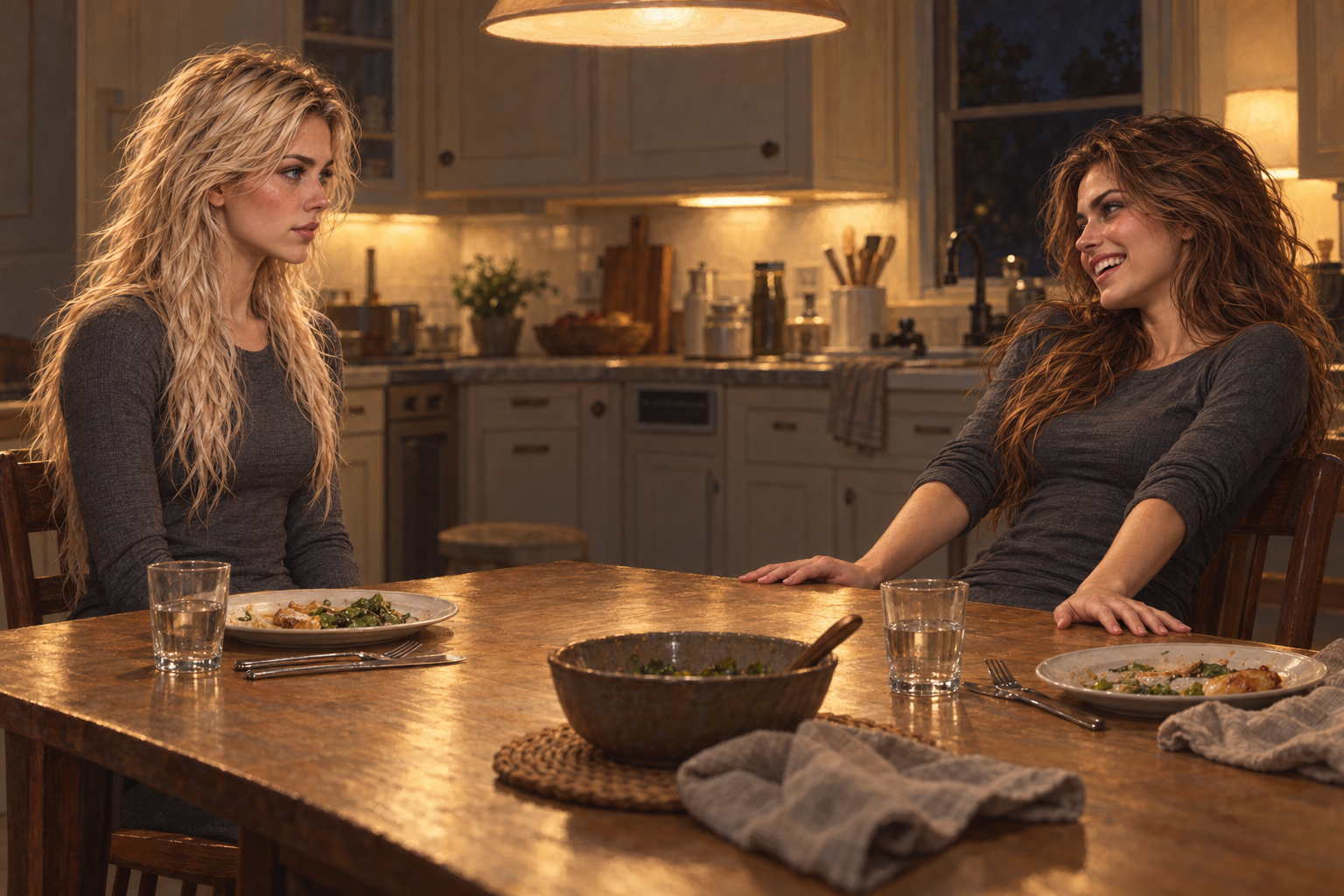
“I am aware of the interval.”
“You lost a ten-second dare in under one second.”
“I am aware of what I lost,” said Val, and Kyra watched her go faintly pink along the line of her jaw — which happened perhaps four times a decade, and was entirely ordinary blood and not the light, and was the single most satisfying thing in Kyra Davan’s world.
· · ·
What happened next Kyra had not planned, and she would say so afterward to anybody who would listen, which was nobody, because there was nobody to tell.
Val sat very straight in her chair and said, in the voice she used for ledgers:
“I am not going to lose a dare to you at my own kitchen table.”
“You already have.”
“I lost the interval. I have not lost the argument. So I am going to raise you.”
Kyra’s eyebrows went up.
“Raise me.”
“You think this can be done. I think it cannot. So: three problems. If you solve all three by Friday, I’ll do it. Once. If you can’t, you never raise it again as long as we both live, and you never mention the ten seconds either.”
“That’s two prizes for you and one for me.”
“It’s my kitchen.”
“It’s your kitchen,” said Kyra. “That’s why I’m having this conversation in it. If I’d started it in mine you’d have gone home.”
“I would have gone home very quickly.” Val did not blink. “It’s my dare, now that I’ve raised it.”
· · ·
Kyra sat and looked at her for some while, and understood perfectly what was happening. Val had built a trap out of three impossible conditions and was expecting to be released from the whole subject by Friday at the latest, having lost nothing but a second.
“Go on,” she said. “Name them.”
Val held up one finger.
“One. Our faces.”
“Masks.”
“I haven’t finished. Your eyes.” Val did not change her voice at all. “That camera got your gold perfectly. You watched it yourself, on a couch, and cried. Whatever goes on your face has to cover your eyes and still let you see out, and you will have to wear it in a room where you are not, at any point, allowed to take it off, and you have never once kept anything on your face in your life.”
Kyra opened her mouth.
“Two,” said Val, and put up a second finger. “It is a specimen. It was a specimen when it was one cassette in a drawer, and it is a specimen now, except that now there are a hundred million cameras in a hundred million pockets and every frame of it can be saved and slowed down and enlarged and sent to somebody who knows exactly what a woman’s body looks like. My light. The way we lace. Everything we have kept off every piece of paper since the snow.”
Kyra closed her mouth.
“And three.” The third finger. “The money. You said it’s not money. It is always money. Somebody pays somebody, and somewhere at the end of it there is an account with a name on it, and the name is ours.” Val put her hand flat on the table. “Three problems. Friday.”
· · ·
Kyra got up and took her plate to the sink.
“Fine,” she said, with her back to her.
“Fine?”
“Fine. Friday.” She ran the water. “You’re going to regret that raise.”
“I very much doubt it,” said Val, and went into the front room with the novel about the lighthouse, and Kyra stood at the sink and listened to her not turn a page for twenty minutes.
· · ·
The first one took her until Tuesday afternoon, and it took Portland.
There was nothing in Calderveil to buy that would do it — there was a feed store and a hardware store and a pharmacy that sold birthday cards — so on Tuesday, which was hers, she drove the two hours to the city in the rain with the wipers going and the radio off, and found what she wanted on the east side, off a street of tire shops: a narrow place that sold greasepaint and wigs and stage blood to the playhouses, with a bell over the door.
She knew the kind of shop. She had never been in one. But she had seen, a long time ago and a long way from here, what came out of one.
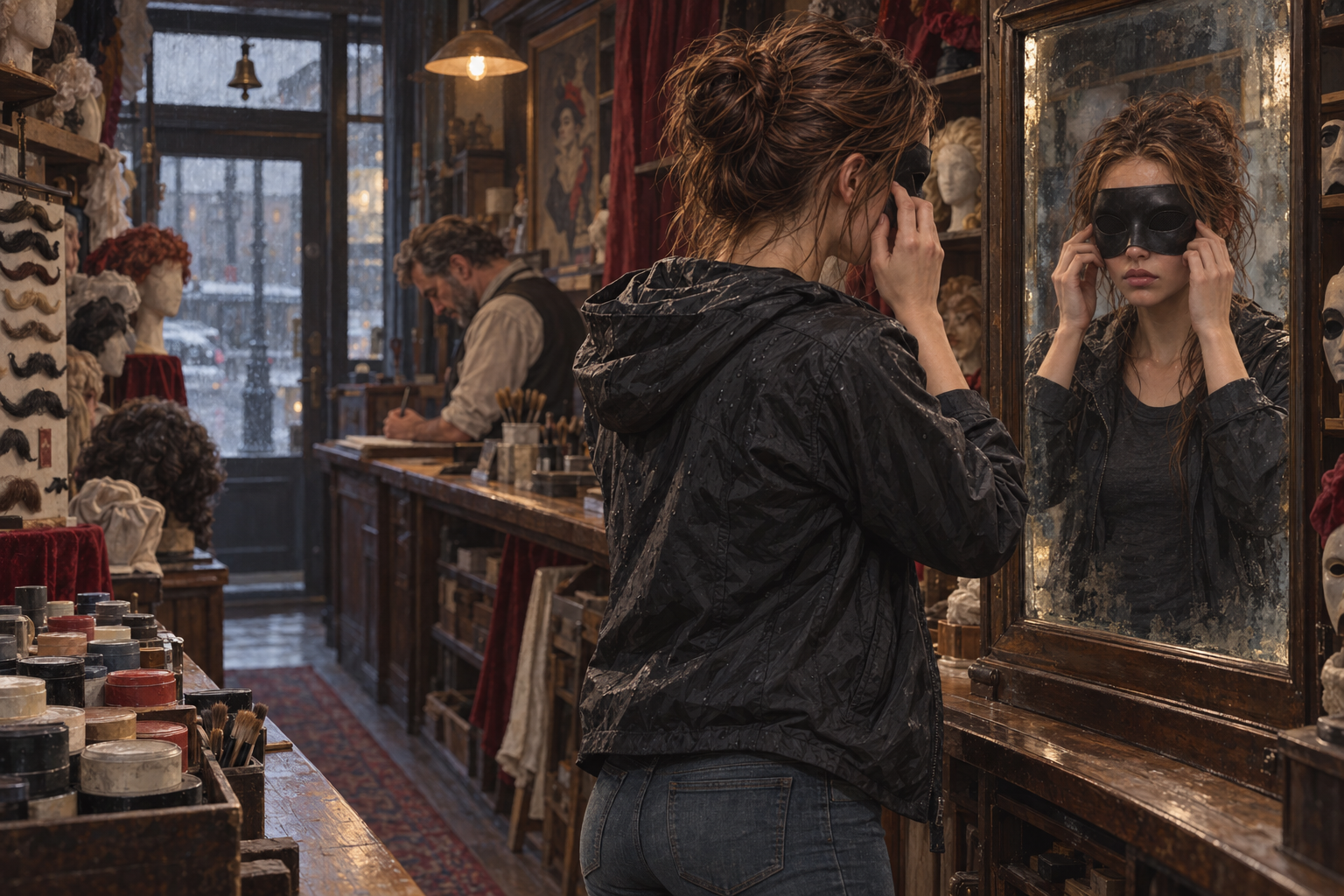
The man behind the counter did not ask anything at all. Kyra told him exactly what she needed — a mask for the upper half of the face, with something over the eyes she could see out through and nobody could see in — and he went into the back without a word and came out with a black one, light and close-fitting, with fine dark mesh set into the eyeholes.
She put it on in front of his mirror.
She could see perfectly well. She could not see her own eyes at all.
She stood there for longer than she needed to, looking at a woman in a black mask with nothing where her eyes should be, and then she bought two — one with the mesh, and one without, because Val would want to see — and then went back for a third, because Val would want a spare.
On the drive home it occurred to her that she had just agreed to keep a rule. A rule about her own face, in a room, that she could not break even when she wanted to. She had kept exactly one rule about her face in her whole life — about men, and the light switch — and here was a second one, and she found, somewhere around the turn for the river road, that she did not mind it at all.
· · ·
She put the masks on Val’s kitchen table on Tuesday evening, all three, in a row.
Val looked at them.
“One,” said Kyra.
Val picked one up and held the mesh up to the lamp and looked through it, and then turned it around and looked into it, and then put it down again exactly where it had been.
“One,” she agreed, in a voice that had lost a small amount of its confidence.
· · ·
The second one Kyra did not solve. Val solved it for her, without meaning to, and Kyra watched her do it.
It was Wednesday, and they were on Kyra’s couch in Kyra’s front room, which was where Kyra had decided this part should happen, and Kyra had her phone. She had spent most of the afternoon on it with the door locked, in a state of considerable amusement, and she had found what she was looking for.
“Read those,” she said, and handed it over.
Val looked at the screen and then at her.
“It’s not the video,” said Kyra. “I’m not asking you to watch the video. Scroll down. Read what’s underneath.”
Val scrolled down.
It was the comments. Under one video and then under the next and the next, a whole world of them: hundreds of strangers, thousands, arguing in a fury of misspelling about what they had just watched. Fake. Thats a prosthetic lol. CGI, look at the edge. Shes faking it so bad. That’s a toy, I own that toy, it’s on sale. Nobody’s body does that. Filter. Lighting. Staged. Fake fake fake.
Val read them, sitting forward, for some time.
“Nobody believes any of it,” she said eventually.
“Nobody believes anything any more. That’s the whole decade, sweetheart.” Kyra took her feet off the cushion and turned to face her. “They’ve seen everything. Every toy anyone ever made, every trick, every rig, every woman pretending. They’ve seen so much of it that if you put the real thing in front of them, they’d argue about which shop it came from.” She tapped the screen. “We wouldn’t be a specimen. We’d be a prop. Somebody would post a link to where you can buy one.”
Val did not answer.
“And you,” said Kyra, more quietly, “already know what you’ll look like. You’ve seen it. You’re a gray smudge in the shape of a woman. You’re bad lighting, Val. Two thousand people will spend a week arguing about what kind of lamp we used.”
· · ·
Val sat back.
She did not say two. Kyra watched her not say it for a full minute, and watched something else happen on her face that Kyra had seen perhaps a dozen times in their whole lives together, which was Val finding out that she wanted something.
“They’d see everything,” said Val, slowly, “except the light.”
“Except the light.”
“Every part of us. The lacing and all of it, to anybody with a telephone. And the one thing that is mine would come out gray, and nobody would know, and it would still only ever have been you who’s seen it.” She stopped. “That isn’t a reason. That is a feeling about a reason.”
“It’s a very good feeling about a reason.”
“Two,” said Val, almost inaudibly, and handed back the phone, and got up, and drove home early.
· · ·
The third one Kyra could not do at all.
She tried. She read for two days. She read about payments and accounts and companies in other countries that would pass the money through to you for a fee and swore they kept no records, and every single thing she read ended, eventually, with a form asking for a name. By Thursday night she had a headache and a list of nine things with nine lines through them, and she drove across town after the library shut and sat at Val’s kitchen table with it, and understood that Val had been right, which happened more often than she let on, and that it was over.
She did not mind as much as she had expected. It had been a very good week. She had made Val go pink, and she had a drawer with three masks in it.
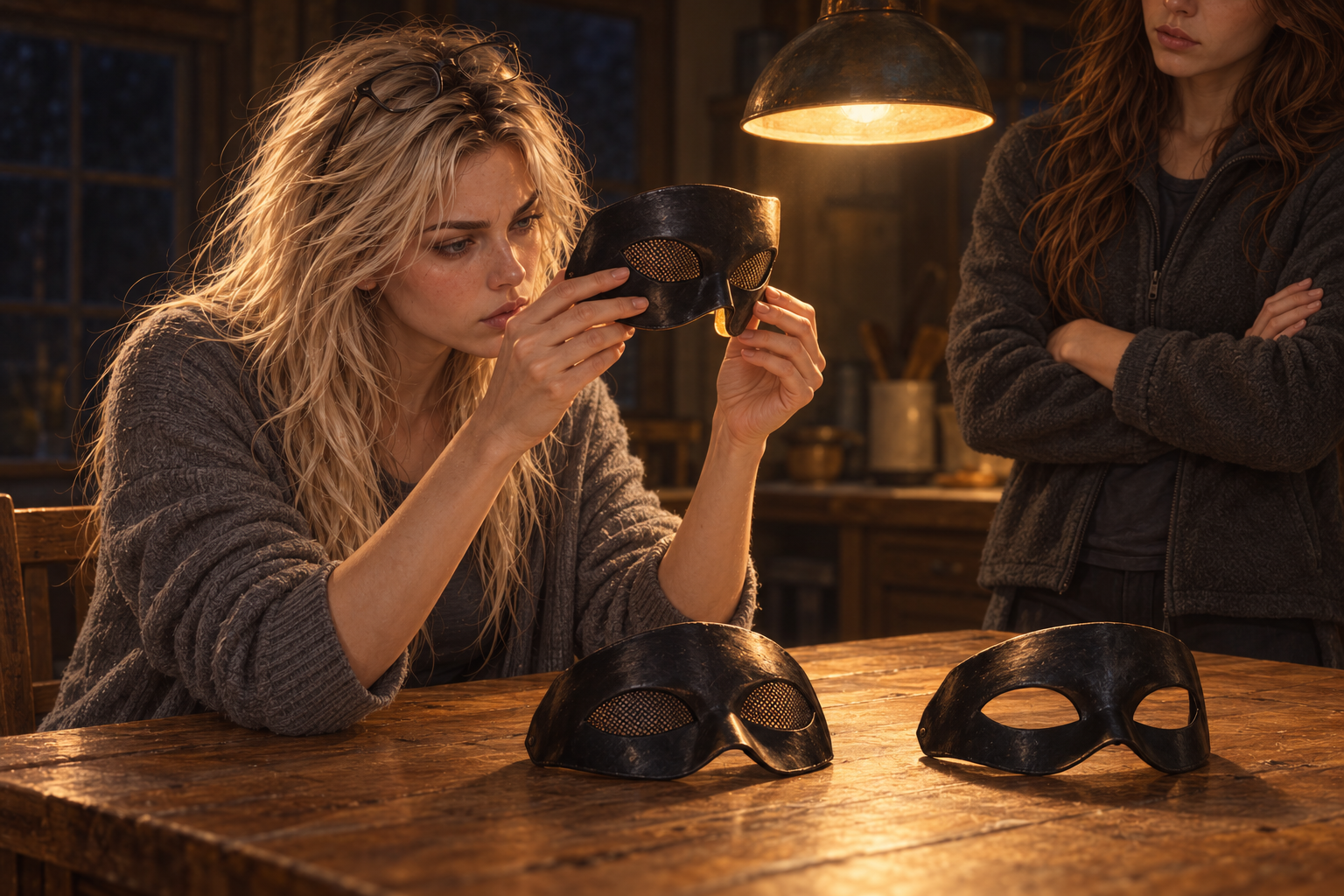
“I can’t do three,” she said, when Val came in.
Val stopped in the doorway.
“I tried. I’ve read everything. There’s always a name at the end of it.” Kyra pushed the list across the table. “You win. I’ll never mention it again, and you can have the ten seconds back.”
· · ·
Val did not come and pick up the list.
She stood in the doorway long enough that Kyra looked up properly, and saw what she was looking at, and her stomach went.
Because Val had the face. Not the disaster face. The other one. The one from a kitchen in Portland, over a stack of medical catalogs, when she had admitted to reading them for years and never once said why.
“Val.”
“Don’t.”
“Val, what have you done.”
“I have done nothing.” Val came in and sat down opposite her. “I would like that clear. I have done nothing at all. I have been reading, which is a different thing, and which I have been doing since long before we came here, for entirely unrelated reasons.”
“What reasons?”
“Intellectual ones.”
“Val.”
Val reached into the pocket of her cardigan and took out a folded document and put it on the table between them, and smoothed it flat with one hand, exactly the way she put her hand on a folder or a closed notebook or the top of Kyra’s head.
It was nine pages, printed at home, stapled once in the corner, and the margins were full of her handwriting.
· · ·
“What is that?”
“It’s a paper,” said Val. “It describes a kind of money. It was written by somebody nobody has ever identified, under a name that is not a name, and it describes a ledger.”
Kyra stared at her.
“A ledger.”
“A public one. Every transaction that has ever happened in it, written down, in order, permanently, and kept by everybody at once so that nobody can change it.” Val’s voice had gone into the register she used for instruments, the one Kyra heard only rarely and had always loved. “Complete. Unforgettable. Doesn’t leak. And there is not one single name anywhere in it. Not one. Every entry is a number paid to a number. It is the most perfect record anybody has ever designed, Kyra, and it was designed specifically so that it cannot tell you who anybody is.”
· · ·
Kyra looked at the nine pages, and at the handwriting in the margins, and at the woman across the table.
“You’ve been reading this for years.”
“I’ve been reading it since it first turned up.”
“Because it’s a ledger with no names in it.”
“Because it is the only ledger I have ever seen that does exactly what I have always wished mine would,” said Val. “It keeps everything and gives nobody away.”
“And you’ve known since Monday that it solves three.”
There was a pause.
“Since Monday evening,” said Val. “At about the time I raised you.”
· · ·
Kyra put both hands over her face and laughed until she had to stop.
“You set me three problems,” she said through her fingers, “to get out of this, and you’d already solved the third.”
“I had not solved it. I had an answer to it. Those are different.”
“You raised me with a problem you’d already solved.”
“I raised you with a problem I believed you could not solve, which was correct. You couldn’t.” Val’s mouth did the thing it did instead of smiling. “I’d like that noted. You lost three.”
“Then I lose.”
“You don’t lose.” Val turned the paper over, so the blank back of the last page was facing up, and took a pencil out of her cardigan pocket, because there was always a pencil in her cardigan pocket. “Because I can’t sit at a table with a solved problem and pretend it’s unsolved. I never have been able to. You know that about me. You’ve known it since the Vayr, and I suspect you have known it since Monday.”
Kyra took her hands off her face.
“I didn’t know about the paper.”
“No,” said Val. “But you knew about me.”
· · ·
They did the terms. It took the rest of the evening and most of a pot of tea, and Val wrote them on the back of a nine-page paper about a kind of money nobody could trace, in a hand so small Kyra had to lean in to read it.
Masks, always, from the moment the camera is on until it is off. Kyra’s with the mesh over the eyes. No exceptions, no just for a second, no gold.
No faces, no names, no voices saying either of their names. Sweetheart is permitted. Vaelith is not, under any circumstances, ever.
No room that could be identified: nothing on the walls, no window, nothing that says what town or what decade.
“And your hair,” said Kyra.
Val looked up from the paper.
“Up. Braided, pinned, anything you like. Never loose on camera.” Kyra reached across and lifted a length of it off Val’s shoulder, the pale of it gone honey in the lamplight, and let it fall. “It’s the first thing anybody on earth would know you by. Nobody in this town has ever seen it any other way.”
“That’s a sound reason.”
“It’s one reason.”
Val waited.
“The hair down is mine,” said Kyra.
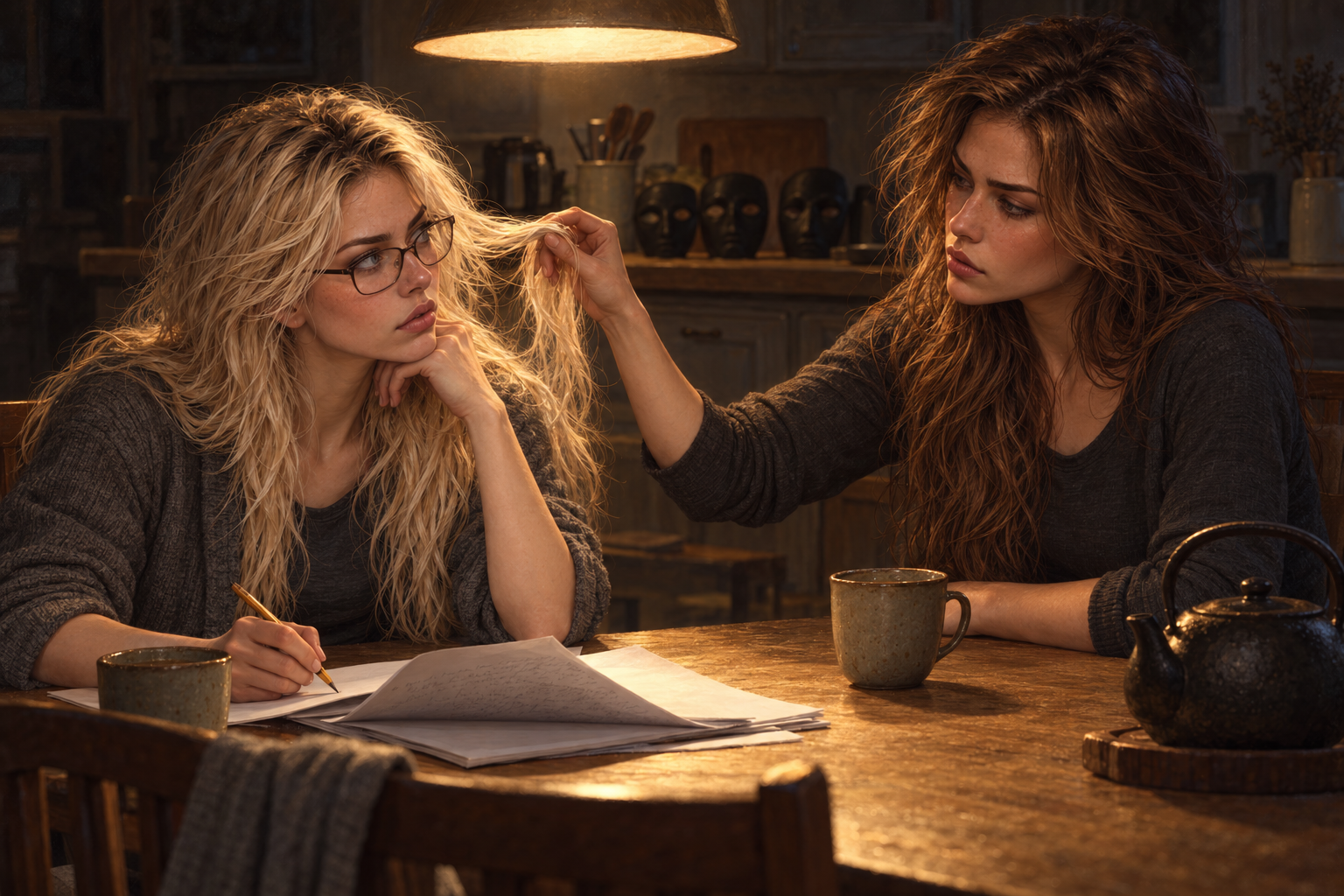
Val looked at her for a moment. Then she wrote it down, exactly as Kyra had said it, and did not ask what the other reason was, because she did not need to.
Kyra holds the camera and the phone and everything on it, because nothing in that room is Val’s. Val holds the money, because the ledger is the one thing in the arrangement that is entirely hers.
The stop works as it always has. The grip when they are laced. Two taps or gutters when they are not. And if either of them, at any point, in the room or out of it, says stove, the whole thing ends, everything comes down, and it is never mentioned again.
“Stove,” said Kyra.
“For the basement,” said Val. “In whatever house that was.”
· · ·
“And one more,” said Val, and stopped writing.
“Go on.”
Val looked at the pencil for a while.
“Why,” she said. “The real one. Not the niece and not the fortune. You don’t need a fortune, you’ve never needed anything in your life, you pull strangers out of creeks for fun. You thought about this for two days with your fork in the air. Why.”
Kyra was quiet.
“Somebody watching,” she said eventually.
Val waited.
“A room full of people along two walls. For a man I liked and didn’t love.” Kyra looked at the masks, lined up on the counter. “And all this time with you, Val, and not one person in the room. Not one. Ever.” She stopped. “I want somebody to see it. I don’t care who. I don’t want them to know who we are, I just want them to have seen it. That’s all. I want there to be a witness.”
· · ·
Val did not say anything.
She wrote one more line at the bottom of the terms, very small, and turned the page around so Kyra could read it.
Kyra gets her witnesses. Val keeps her light.
“That’s not a term,” said Kyra, and her voice had gone.
“It is the only term,” said Val. “Everything above it is procedure.”
· · ·
Later, much later, with the kitchen dark and the paper folded twice and put in an envelope that Val had marked, after some thought, gutters, Kyra lay in Val’s bed on the side of it that had been hers in every house they had ever had, with every lamp in the house still burning beyond the door, and said into the half dark:
“You know you’ve just agreed to the most dangerous thing we’ve ever done.”
“Yes.”
“Because I dared you to sit still for ten seconds.”
“Because you dared me to sit still for ten seconds,” said Val, “and I couldn’t, and then I raised you to save face, and then I couldn’t sit still with a solved problem either. I’m aware of the entire chain of causation. I would like to point out that every link in it is a fault of mine and that I am going to go through with it anyway.”
“Why?”
Val was quiet long enough that Kyra thought she had gone to sleep.
“Because you want a witness,” she said, “and I have had all this time to give you one and never managed it. And this is the first way I’ve found that I can live with.”
Kyra found her hand under the blanket.
“And because it’ll make an absolute fortune,” said Val.
“You said it wasn’t about the money.”
“It isn’t about the money. I’d simply like it noted that I’ve already drawn up the ledger.”
— end of chapter two —
April · Val’s kitchen table
Val opened a spreadsheet.
Kyra found out on the Saturday, when she came across town with a bag of groceries and a bottle of wine and let herself in by the back door, and found Val at the kitchen table in her reading glasses with the laptop open and every lamp in the house on, and on the screen a grid of little boxes that went on, as far as Kyra could tell, forever.
“What’s that?”
“Preparation.”
Kyra put the groceries down and came and looked over her shoulder. Across the top, in Val’s neat headings: Duration. Number present. Setting. Lighting. Sound. Conventions observed. Performed (Y / N / uncertain). Notes. Down the side, nothing yet. A whole empty country, waiting.
“Val.”
“One does not enter a field,” said Val, “without reading the field.”
“It’s not a field. It’s people having sex on the internet.”
“It is a field with a very large literature,” said Val, “almost none of which has been reviewed,” and pulled out the chair beside her with one foot, which was the closest Val ever came to an invitation.

· · ·
They did it in the evenings, over two weeks, at Val’s kitchen table with the blinds down.
Kyra made popcorn the first night. Val looked at the bowl as though it had been brought to a funeral, and then ate most of it without noticing, which was how Kyra knew she was nervous.
“Turn it up,” Kyra said, ten minutes in.
“The neighbors.”
“You haven’t got any neighbors. You’ve got a ditch and a field and a cow.”
“The cow,” said Val, and did not turn it up, and Kyra reached across her and turned it up herself, and Val let her, because Kyra held the remote now — that was in the terms — and arguments about volume were procedure.
· · ·
Kyra had expected to be embarrassed, and was not, and had expected Val to be embarrassed, and Val was something else entirely.
Val was interested.
She watched the way she watched anything she meant to understand — sitting forward, utterly still, the glasses down her nose, her face perfectly composed and her hands moving on the keyboard without her looking at them. She did not blush. She did not look away. She logged. Duration: eleven minutes. Number present: two. Setting: kitchen, implausible. Lighting: overhead, unflattering. Every so often she said “hm,” very quietly, and typed something in the last column that Kyra was not allowed to read.
Kyra, for her part, could not stop talking.
“Oh, she’s not. She’s not. Val, look at her face, she’s thinking about her taxes.”
“Mm.”
“He thinks he’s doing wonderfully.”
“He is doing what the camera wants,” said Val. “It’s not the same thing.”
“Why is he holding her like a suitcase?”
“For the angle. It’s all for the angle.” Val typed. “You could put a chair there and get the same shot without anybody’s back suffering.”
Kyra stopped with a handful of popcorn halfway to her mouth.
“Write that down,” she said.
“I have,” said Val.
· · ·
It was on the third night that Val began to grade them.
She did not announce it. She simply started saying a single word under her breath at a particular moment in each video, and after the fourth time Kyra realized what the word was, and what the moment was.
“False.”
A woman on the screen arched off a bed with her mouth open and made a great deal of noise.
“False,” said Val again, two videos later, about a different woman doing nearly the same thing.
Kyra paused it. “How can you possibly know?”
Val took her glasses off and folded them, which meant a lecture, and Kyra settled back in her chair to receive it.
“Her breath goes on the wrong count,” said Val. “It catches on the second. It should catch on the third — it always catches on the third, there is not a body alive where it catches on the second, it isn’t possible yet on the second. Her jaw doesn’t go first. Nothing in her hands changes. And the noise arrives before her body does. In a real one the body goes and the noise follows it, late, as though it has to be fetched. In that one, the noise goes and the body is sent after it to match.” She put the glasses back on. “And it stops when the camera wants it to. Nothing real stops when the camera wants it to.”
Kyra looked at the frozen woman on the screen for a while.
“How do you know all that?”
Val did not answer at once. She looked at the screen, and then at the keyboard, and then — briefly, the way she did it when she meant it and did not want to be caught meaning it — at Kyra.
“I’ve spent my life,” said Val, “watching one woman do it for real.”
· · ·
Kyra did not say anything to that, because there was nothing to say that would not have been smaller than it, and she reached over and pressed play so that Val would not have to sit in the quiet she had made.
They watched another. And another. Val said false and false and once, after a long pause, uncertain, and once — about a woman who was older than most of them and was not looking at the camera at all, and whose hands had gone white on the edge of a table — she said nothing, and typed N in the column, and sat back.
“There,” she said. “That one.”
“How do you know?”
“Because she has forgotten we’re here,” said Val. “Look. She doesn’t know where the camera is. She hasn’t known for some time.”
It was the only one in two weeks.
· · ·
The night after that, Kyra went quiet.
It was an ordinary video. A man and a woman in a bedroom with too many pillows, and the woman was very good at what she was doing — she was lovely, and warm, and she looked up at the man at exactly the right moments, and the noises she made were exactly the noises a man would want to hear — and somewhere in the middle of it Kyra stopped talking and did not start again.
It was not the noise. It was the kindness.
The woman was making him feel what he wanted to feel. Kyra could see it in her face, in the small, deliberate generosity of it: not a lie told for herself, but a gift handed up to somebody who needed it, so beautifully made that he would never think to ask where it came from.
Kyra had done that.
Not this. Something like this. On another world, for years, the whole time she was bonded to a good man she liked and did not love, she had lain beside him afterward and told him things — the account, the old way, a woman telling a man what had happened to him, because he could not see it for himself and never would. She had told it beautifully. She had told it with her whole heart, and with a great deal of detail, and with every kindness she had. And a good deal of what she told him had not happened at all.
She had been young, and she had frozen, and she had not known why, and there had been nothing to describe — so she had invented it, every time, and given it to him, and watched his face, and he had never once known. Her openness and her lying had always been the same faculty. She had found that out in a bed on another world, and had been finding it out at intervals ever since.
· · ·
Val stopped the video.
She did not ask. She took her hand off the keyboard and put it flat on the table, a few inches from Kyra’s, and left it there.
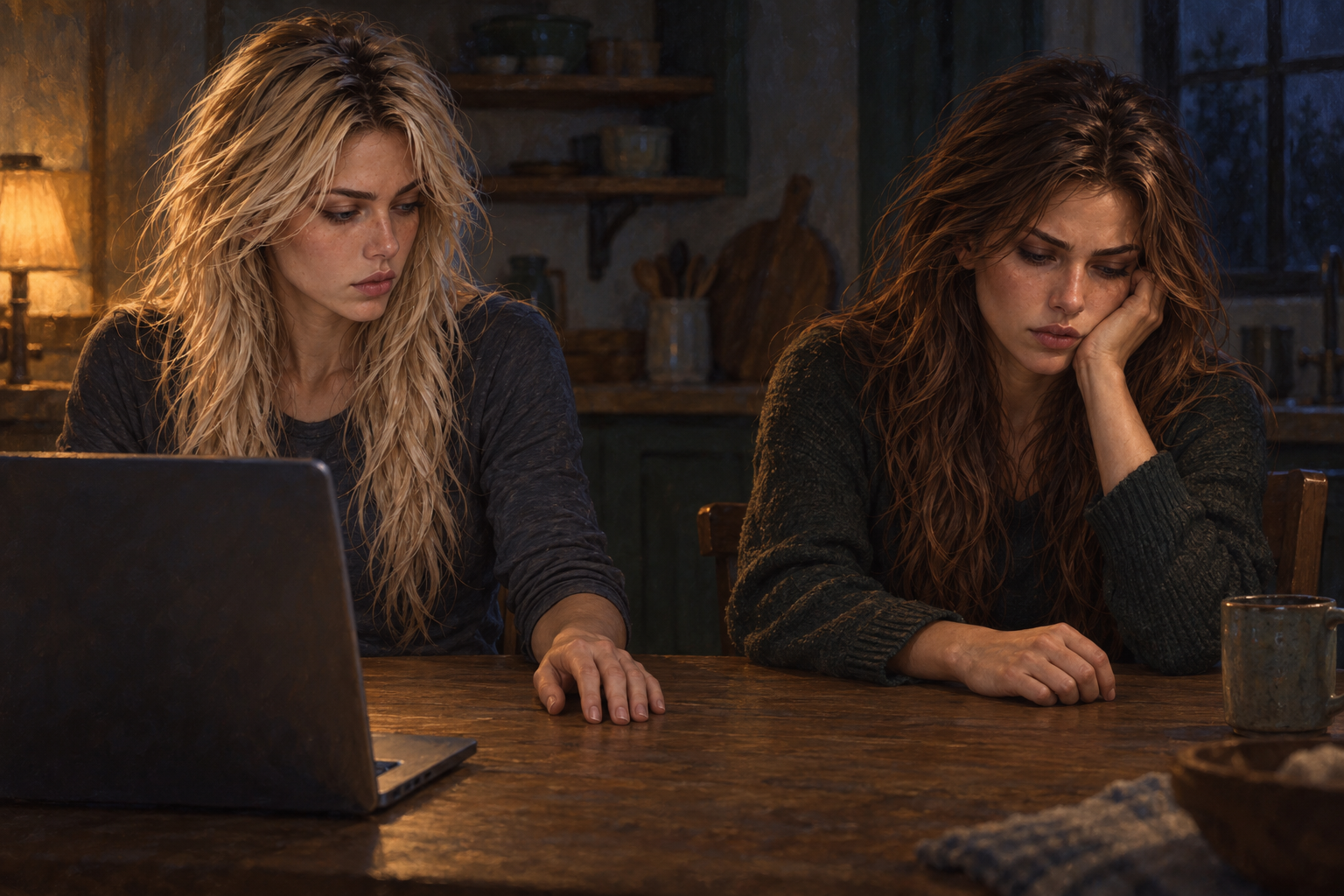
“I used to do that,” Kyra said, after a while.
“I know.”
“You never said.”
“You never asked me to,” said Val. “And it was kind. It was a terrible thing to do and it was entirely kind, and I have never been able to decide which of those is the more important, and I don’t think you have either.”
Kyra laughed, not very well.
“You worked that out.”
“I worked it out a long time ago. You described his face to me once. Not what had happened — his face, while you were telling him.” Val looked at the frozen screen. “Nobody describes a man’s face like that unless they’re watching it to see whether he believes them.”
Kyra put her hand on top of Val’s on the table, and they sat there for a minute with a stranger’s bedroom stopped on the screen in front of them, and then Kyra took her hand back and said “Next,” and Val pressed play.
· · ·
By the second week Val had nearly two hundred rows, and a summary, and Kyra had stopped bringing popcorn.
“Fast,” said Val, reading from it. “Forceful. Loud. Brief. Shot for the angle rather than the act. The same six positions in a rotation so fixed you could set a clock by them, and nearly all of them chosen because they show the most to a camera, not because they do the most for anyone in them.” She scrolled. “Almost nobody kisses. Almost nobody waits. The entire industry is in a tremendous hurry.”
“I noticed the hurry.”
“It would hurt,” said Val. “For us. Most of it would simply hurt.”
Kyra knew. They both knew; they had learned it the long way, a very long time ago, young and stupid and thinking that more was more. Once Val was out, once either of them was out, force took it away instead of giving it. Speed was the enemy. The gentlest thing in the room was always, always the most. Half of what was on that screen, done to either of them, would have ended the evening before it began.
“So we can’t do any of it,” said Kyra.
“We can’t do most of it. And we wouldn’t want to do the rest.” Val turned the laptop a little toward her. “Which means that whatever we make will look like nothing else on here at all. Slow. Long. Very quiet, on my side. Very little of it will happen where the camera expects it to.”
“Is that good or bad?”
Val considered the spreadsheet for a while.
“Everybody in this,” she said, “is racing to the end. Nobody is waiting for anybody.”
“We’re very good at waiting,” said Kyra.
Val looked at her over the top of her glasses, and said nothing, and did not need to.
· · ·
“There’s a column missing,” Kyra said, on the last night.
“There are no columns missing. I have been extremely thorough.”
“There’s no column for us.”
Val looked at the screen. Then she opened a new sheet — a fresh, clean, empty one — and turned the laptop around so that it faced Kyra, and pushed it across the table.
“Then make one.”
So Kyra did. It took her most of an hour and two glasses of wine, and Val sat back with her arms folded and watched her do it, and corrected her spelling twice, and did not otherwise interfere. At the end of it there were three columns, in Kyra’s careless capitals.
THINGS WE LOVE AND WILL SHOW THEM.
THINGS WE LOVE AND WON’T.
THINGS THAT WOULD SELL AND WE DON’T LOVE.
· · ·
The first column was long, and kept getting longer, and was mostly Kyra’s. The way Val rolled her hips. The patience. Kyra talking nonsense while she waited. The way they turned in to each other at the end. The chair, Kyra wrote, and underlined it, and Val read it upside down and said nothing, which was a yes.
The second column was short. Kyra wrote the first thing in it without asking.
Your hair down.
Then, after a moment: The word.
Val leaned over and took the laptop back, gently, and added a line of her own beneath it, in her small exact hand, and turned it around again.
Side on.

Kyra looked at it.
It was how they had always done it, in every bed in every house — hip to hip and turned in to each other, so that you could kiss the whole way through, start to finish, without stopping. It was the conversation position. It was not the one you would choose to show anybody, because there was nothing to show; it was two faces close together, talking. It was them.
“Yes,” Kyra said. “That one’s ours.”
“The grip can’t be filmed anyway,” said Val. “So that leaves the rest of it.”
“The rest of it stays here.”
“The rest of it stays here,” Val agreed, and that was a term, though neither of them said so.
· · ·
The third column was empty.
“It’ll fill,” said Val.
“I know it’ll fill.”
“It will fill faster than either of the others. It’s the column the money lives in.” Val took off her glasses and pinched the bridge of her nose. “And what we put in it — what we refuse to move out of it, however much they offer — that will be the only honest account anybody ever has of who we are. Nobody will know it but us. But it’ll be the truest thing on the page.”
Kyra looked at the empty column for a while.
“That’s a very Val thing to say.”
“It’s a very Val column,” said Val. “I’m going to keep it extremely carefully.”
· · ·
She closed the spreadsheet a little after eleven, and sat for a moment with her hands on either side of the laptop.
“Almost all of it is performed,” said Val. “That’s the finding. Nearly two hundred, and one of them was real. One woman who forgot where the camera was.” She turned her head. “Everybody else on there is acting, and everybody watching knows they’re acting, and they argue about it all day underneath, and they watch anyway.”
“So what are we?”
“Not performed.”
“That’s it?”
“That’s everything,” said Val. “In a market made entirely of acting, we would be the one thing that isn’t. We couldn’t fake it if we tried — I can’t, my light won’t let me, and you won’t, because I’d know. So we won’t. Every single thing they see will be true.” She paused. “Everything except our names, and our faces, and the room, and where we live.”
Kyra started to laugh.
“So we’re the only honest thing on the internet.”
“Under a mask,” said Val, “under false names, from a room that pretends to be nowhere.”
“Honest about the part that counts.”
Val looked at her for a moment. Then she opened the spreadsheet again, and clicked into the empty cell at the very top of the first sheet, above all the headings and all the rows, and typed three words in it, and saved, and closed the laptop.
Kyra did not need to see it to know what it said.
· · ·
They went up a little before midnight.
Kyra had watched a great many strangers in those two weeks pretending to be overwhelmed, in kitchens and on couches and once, inexplicably, on a trampoline, and she lay down in Val’s bed with every lamp in the room still burning and the rain starting up on the roof, and pulled Val down to her by the front of her cardigan, and was not pretending anything at all.
Neither, afterward, with her light going slowly down and out and her forehead pressed hard into Kyra’s shoulder and Kyra’s name still somewhere in her breathing, was Val.
“Uncertain,” said Kyra, into her hair.
Val made a sound that Kyra had heard perhaps a dozen times in their whole lives, and which in anybody else would have been called a laugh.
“Don’t,” she said. “I’ll have to add a row.”
— end of chapter three —
April · both houses
“We’ll need names,” said Val.
“Copper,” said Kyra.
It took her about three seconds. She was lying on her own couch with her feet up on the arm, which was allowed in her house, and Val was in the armchair opposite with a notebook on her knee and a pencil, and she had not finished writing the word names before Kyra had answered.
Val looked up.
“That’s a metal.”
“It’s my hair.”
“Your hair is chestnut.”
“With copper in it. Ask anyone. Ask the man at the gas station. He calls me Red, and I’m not even red, it’s the copper he’s seeing.” Kyra put her hands behind her head. “Copper. It’s short, it’s warm, nobody will ever forget it, and it tells them exactly what to look at, which is my hair and not my face.”
Val considered this for longer than it deserved.
Then she wrote Copper, and after it, in brackets, provisional, and underlined the brackets.
“And you?” said Kyra.
“I’ll need a week.”
“You’ll need a week?”
“I’ll need a week,” said Val, “because I intend to get it right,” and closed the notebook, and Kyra lay on her couch and looked at the ceiling and understood, with a great sense of peace, that she had already won.
· · ·
The platform took Val four days.
She did it the way she had done the literature: a spreadsheet, a great many columns, a long and joyless evening comparing terms of service that Kyra was not permitted to see because she would only skim them. What it charged. Where it kept its servers. Who owned it, as far as anybody could tell. Whether it would take the money that was not money. Whether, if somebody came asking, it had anything to give them.
At the end of the fourth evening she turned the laptop around on Kyra’s kitchen table.
“That one,” she said.
Kyra read the name at the top of the screen.
“SubRosa.”
“Yes.”
“It’s a flower.”
“It is a flower,” said Val. “It is also the oldest promise of keeping a secret that this language has. Sub rosa. Under the rose. In the old councils they hung a rose over the table, from the ceiling, so that everybody sitting beneath it knew that nothing said there would ever leave the room.” She touched the edge of the screen. “It has the best terms of the eleven. It takes the ledger. It keeps almost nothing about anyone. But I would be lying if I said the name was not a factor.”
“You picked it because it’s Latin.”
“I picked it because it is correct,” said Val. “It is very rare to find a company that has named itself correctly. I felt it ought to be rewarded.”
Kyra looked at her across the table, in the lamplight, with her reading glasses on and her sleeves down over her wrists and that expression of perfect seriousness, and loved her so much that for a moment she could not think of anything to say at all.
“It’s still a flower,” she said eventually.
· · ·
Kyra made the account herself, the next night, on her phone, in bed, because the phone was hers. That was in the terms.
It asked for a great many things and she gave it as few as it would take. An address that went nowhere. A password Val had made up, which was twenty characters long and had no vowels in it. And then a page with two empty boxes on it, side by side, and above them, in friendly gray letters: Stage names.
She typed Copper in the first box without thinking about it.
The second box sat there.
Kyra looked at it for a while. Then she thought about Val’s hair — loose down Val’s back in every room of every house they had ever had, the pale of it gone to honey under any lamp on this planet, so that every stranger who had ever passed her in a street had looked twice — and typed six letters, and pressed the button before she could change her mind.
There was a third box underneath, smaller, which said Tagline (optional).
Kyra filled that in too.
· · ·
Val came over on the Friday at the end of her week with a sheet of paper.
It was typed. It had a title. Kyra saw the title upside down across the kitchen table — Candidates, with Notes — and had to look at the window for a moment.
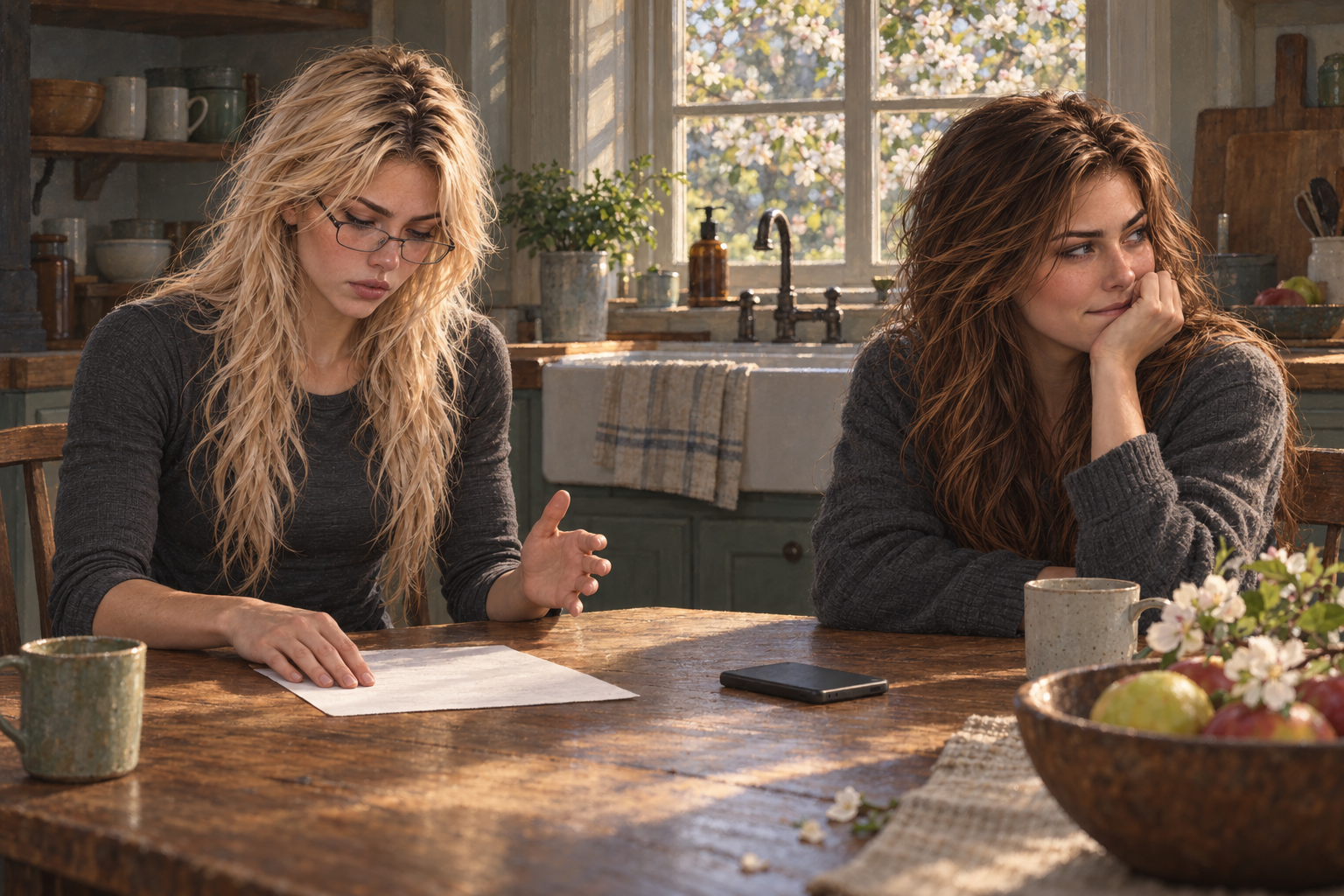
“Go on, then,” she said.
“There are eleven.” Val smoothed the paper flat with one hand. “I’ve ranked them. I’ll take you through the reasoning for the first three, and if you have objections to any of the others we can come back to them.”
“I’m sure I won’t.”
“The first,” said Val, “is Pallida.”
Kyra waited.
“It means pale. In the botanical sense. It’s used for the paler form of a species where there’s a darker one beside it — which there is, in this case, so it’s descriptive of the pair as well as of me. It’s two syllables if you’re careless and three if you’re not. It has no meaning in any modern language that I could find that would cause offense, and I checked nine.”
“It sounds like a disease.”
“It does not sound like a disease.”
“It sounds like something you’d catch from a pond.” Kyra reached for the sheet. “What’s second?”
Val held on to it.
“Before we go any further,” she said, “I should like to see the account.”
· · ·
Kyra took her phone out of her pocket and put it on the table between them, face up, and slid it across.
She did not say anything. She had found, over a very long time, that there was nothing she could say at a moment like this that would improve it.
Val looked at the screen.
At the top of it, in the plain dark letters of a page nobody had visited yet:
Copper
Blondie
And underneath, smaller:
Copper and Blondie.
· · ·
There was a silence of a very particular quality.
“I am not blonde,” said Val.
“You are on camera.”
“I have never been blonde in my life. It is not yellow, Kyra. It has never been yellow. It is not any color that has a name on this planet, it is closer to—”
“Under every lamp on this planet,” said Kyra, “you are blonde. Under the light in the diner you’re blonde. Under the light at the library you’re blonde. The schoolteacher thinks you’re blonde. The man at the county office thinks you’re blonde, and he calls you young lady. And the people who are going to look at you,” she put her finger on the phone, “are going to look at you under a lamp, through a camera, with your face covered, and the first thing they will see and the only thing they will remember is that hair, and they will call you the blonde whatever we put in that box.”
“They will call me what we tell them to call me.”
“They will not.”
“Kyra—”
“Look at your spreadsheet,” said Kyra.
· · ·
Val stopped.
It was not a long stop. It was the stop of a woman who has just been handed her own evidence and has recognized it before she has finished reading it, and Kyra had seen it on that face perhaps three times in their lives, and it was always, always worth it.
“The notes column,” said Kyra, gently. “You kept a note of what the comments called them. Every woman in every video. You told me why — you said it was so you could see whether the audience ever used the names on the page.”
“They didn’t,” said Val, slowly.
“They didn’t. Not once. Not one stranger in two hundred videos used a stage name. They called them by what they looked like. The redhead. The tall one. The one with the tattoo.” Kyra leaned back. “And every single woman in there with hair anywhere near the color of yours, whatever she called herself, whatever color it actually was underneath, what did they call her?”
Val did not answer for a moment.
Then she reached into her bag and took out the laptop and opened it, and found the spreadsheet, and scrolled — Kyra watched her scroll, and watched her face not change, which was how Kyra knew — and stopped, and read, and closed it again.
“The blonde,” said Val.
“Every time?”
“Every time.” She put her hand on the closed lid. “Including two who were very obviously wearing wigs.”
· · ·
Kyra let her sit with it. She had learned that, over the years, and it had been one of the hardest things she had ever learned.
“Pallida,” Val said eventually, to the laptop, with something in her voice that in anybody else would have been mourning.
“Pallida was beautiful. It was. It was much too good for them.”
“It was the correct name.”
“It was the correct name,” Kyra agreed, “for a woman nobody was ever going to call by it.” She reached across and turned the phone around, so the page faced Val properly. “This one’s wrong. I know it’s wrong. And it’s what they’re going to say anyway, so we might as well be the ones who said it first.”
Val looked at the six letters.
“Blondie,” she said at last, as though tasting something she had been told was a delicacy and did not believe. “Provisionally.”
“Nothing about it is provisional.”
“Everything is provisional,” said Val, “until I stop objecting to it,” and folded her list of eleven candidates with notes, carefully, into quarters, and put it in the pocket of her cardigan, where Kyra would find it years later, and keep it.
· · ·
The channel was harder.
They argued about it for a week, on and off, in both houses and once in the car on the way back from the diner, and by the end of it Kyra had a list in her phone and Val had a list in her notebook and the two lists had nothing on them in common.
“Love from Andromeda,” said Kyra, on the Thursday night, with her feet up.
“Absolutely not.”
“It’s warm.”
“It’s a greeting card.” Val turned a page of her notebook. “Two and a Half Million Light Years.”
Kyra sat up.
“That,” she said, “is the least sexy name in the history of the world.”
“It’s accurate.”
“It’s a distance, Val. Nobody’s going to pay to watch a distance.”
“It is exactly the distance,” said Val, with dignity. “To within the error of the current estimates. Which are, I would point out, considerably better than the last ones.”
· · ·
“All right,” said Kyra. “All right. What about the nuns.”
Val’s pencil stopped.
“No.”
“The Order of the North.”
“Kyra.”
“It worked in Seville. You remember. That woman downstairs who thought we were up to something and kept coming up to borrow things she didn’t need, and I told her we were nuns, from an order in the north, very strict, traveling on the bishop’s business, and she crossed herself and went white and brought us two melons.” Kyra was grinning. “Two melons, Val. For a lie. Imagine what we’d get for the truth.”
“It was sacrilege.”
“It was a good lie.”
“It was sacrilege, and it was a good lie, and I said so at the time, and you said—”
“I said we’re not even from this planet,” said Kyra.
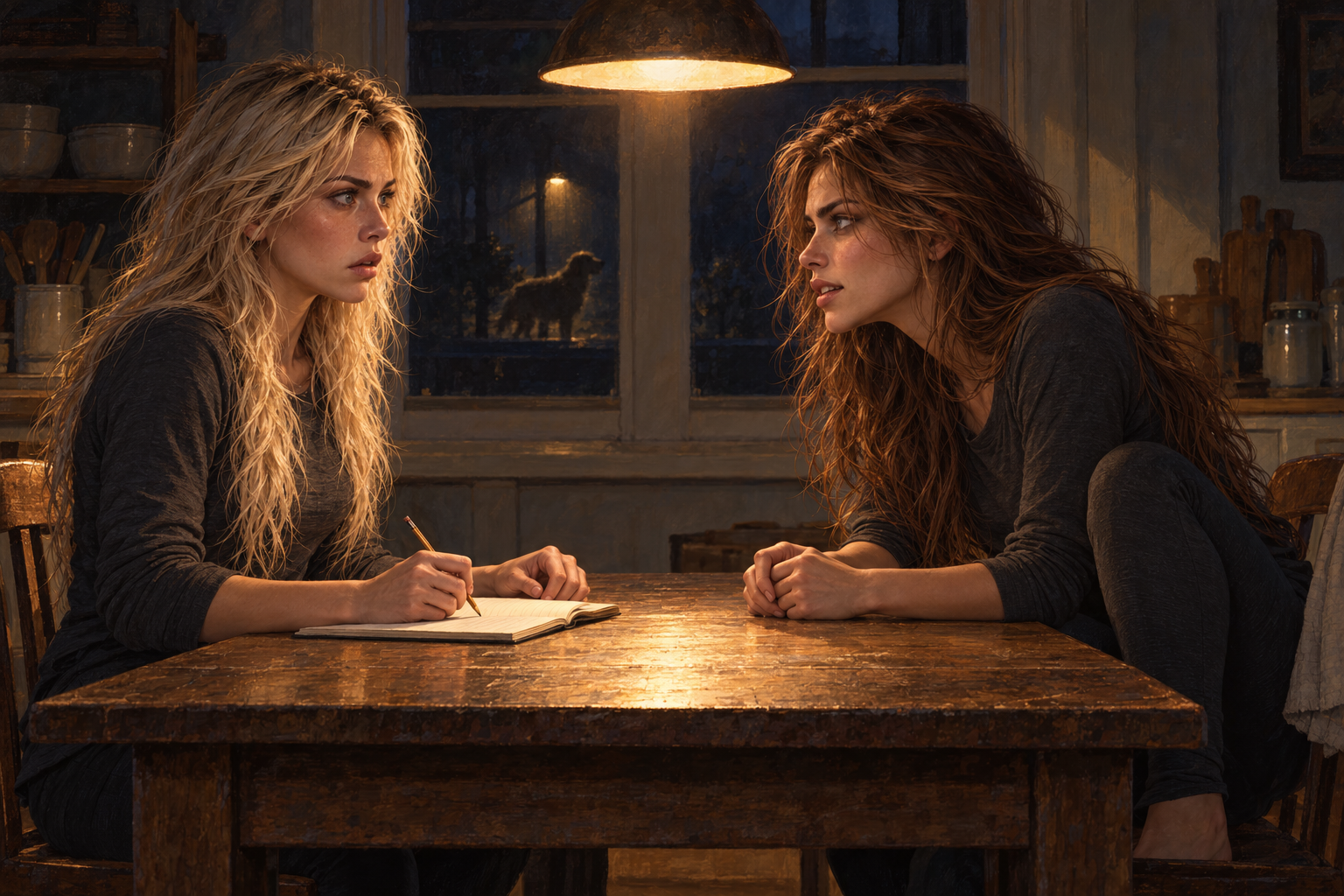
And stopped.
· · ·
The kitchen was very quiet. Outside, the dog down the street that barked at the mail barked at something else, once, and gave it up.
Kyra looked across the table at Val, and Val looked back, and Kyra watched the thought arrive in Val at exactly the same moment it had arrived in her, because that was how they had always done it, the two of them, since the Vayr: somebody said something careless, and then both of them heard it.
“No,” said Val.
“I haven’t said it.”
“You were going to say it. You were going to say we should simply put it on the page.”
“Andromeda,” said Kyra.
· · ·
She had never seen Val go that white in a kitchen.
“That is the one thing,” said Val, very quietly. “That is the one thing, Kyra. We have kept our faces off every piece of paper since the snow and our names off every record that mattered, and I search the archives for us every other week because I cannot help it, and you would like to put where we come from on a sign over the door.”
“Yes.”
“In letters.”
“In big letters,” said Kyra. “With a little spiral. Val — listen. Listen to me. Who is going to believe it?”
Val opened her mouth.
“Nobody,” said Kyra. “That’s who. Not one person. It’s the oldest joke on the internet. It’s a costume. It’s a theme. Two girls in masks from outer space — they’ve seen it a thousand times, there are probably a dozen of them on that site already. We could tell them the absolute truth, the whole of it, in the name of the channel, and every single person who read it would think it was a gimmick.”
· · ·
Val did not answer.
But she did not say no again, either, and Kyra had known her long enough to sit very still and wait.
It took a long time. Val sat with her hands on either side of her notebook and looked at nothing, and Kyra could see her doing it — taking the thing apart, the way she took everything apart, looking for the place where it would fail.
“The light,” said Val at last.
“What about it?”
“It’s gray on camera. They’ll see a glow and not know what it is.” Val’s voice was slow, careful, the voice of a woman reading figures off a page she does not quite trust. “On an ordinary channel, that’s a question. Somebody asks it. On a channel called Andromeda—”
“It’s the theme,” said Kyra. “It’s a special effect. It’s the lighting guy having fun.”
“The lacing.”
“Space thing.”
“Whatever else turns up. Whatever we haven’t thought of yet. The things that are going to go wrong in a room with a camera in it that neither of us can predict.” Val looked up. “Every one of them, on a channel with that name, is a costume before anybody has seen it.”
“Every one of them.”
“It explains us,” said Val, “in advance.”
“It explains us in advance,” said Kyra. “By telling them the truth so loudly that nobody will ever hear it.”
· · ·
Val sat back.
“One more thing,” she said. “And I want you to think about it properly, not quickly.”
“Go on.”
“Is there anyone alive on this planet who knows where we are from?”
Kyra opened her mouth to say no and closed it again, because Val had asked her to think properly, and so she did.
She went through it the way Val would have gone through it. Every town. Every name. Every friend who had got too close, and every man she had turned the light off for, and the ones who had seen something once in the dark and decided they hadn’t. She went through the things they had kept, which was nothing — they had promised each other that in the snow, nothing kept, and they had kept the promise. No letters. No photographs, not since Val and the stove. No papers in any drawer that said anything but the name of the decade.
“No,” she said at last. “Nobody. Not one person.”
“You’re certain.”
“I’m certain. There’s nobody who knows, and nobody who’d believe it if they were told.” Kyra looked at her. “You’ve already checked.”
“I check every other week,” said Val. “I wanted to hear you say it.”
· · ·
“The Girls from Andromeda,” said Kyra.
She said it in a voice — a deep, booming, ridiculous announcer’s voice, the kind that went with flying saucers on strings and women in silver bathing suits screaming at rubber monsters — and Val shut her eyes.
“It sounds like a film nobody should ever have made.”
“Exactly.”
“It sounds like a film I walked out of. I think I did walk out of it, in fact. In Portland. There was a woman in a fishbowl helmet.”
“Exactly,” said Kyra. “That’s exactly what it sounds like. That’s why it’s perfect. Nobody on earth would ever take it seriously.”
Val opened her eyes and looked at her across the kitchen table for a long time.
“The Girls from Andromeda,” she said at last, flatly, as if reading it off a label. “Copper and Blondie.”
“You hate it.”
“I hate it completely,” said Val. “It’s the safest thing either of us has ever thought of.” And she opened her notebook, and found the page headed names, and crossed out provisional after Copper, and wrote underneath it, in her small exact hand, the name of the channel, and did not cross anything out after that.
· · ·
The page went live a little after eleven, from Kyra’s phone, in Kyra’s bed, with Val lying beside her reading over her shoulder and pretending not to.
There was nothing on it yet. No video. No picture. Just a black page with a small gray spiral in the corner that Kyra had found and Val had not been consulted about, and the name across the top in white, and under that the two stage names, and under those the tagline. Zero followers. Zero subscribers. A ledger, somewhere, in a wallet only Val could open, with nothing in it at all.
“There we are,” said Kyra.
“There we are,” said Val.

Kyra looked at it for a while longer than she needed to. Then she turned the phone face down on the blanket, and turned off the lamp on her side, and lay back.
· · ·
“It’s true, you know,” said Val, in the dark, some time later. “The name. Every word of it.”
“I know.”
“That’s what I can’t stand about it.”
Kyra found her hand under the blanket.
“That’s what I love about it,” she said.
— end of chapter four —
May · Kyra’s kitchen
Val sat down at Kyra’s kitchen table on the Saturday morning and put both her hands flat on it, and Kyra, who was at the stove in her socks with a pan of eggs, turned the heat off without being asked.
The table meant a term. It had meant a term in every kitchen they had ever had.
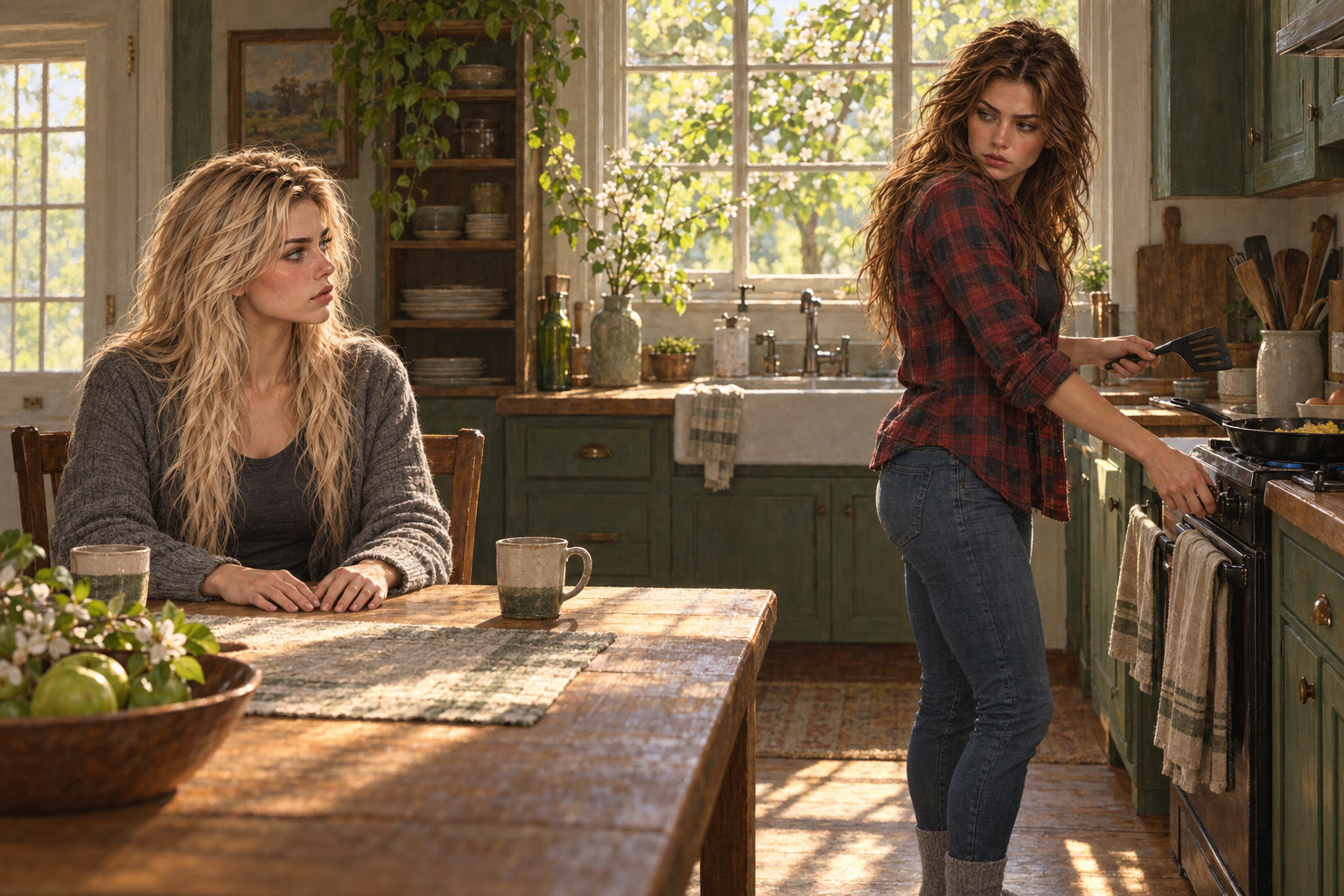
“The rings,” said Val.
Kyra stood with the spatula in her hand and did not understand for a second, and then did.
· · ·
They had never once been seen. That was the whole of the arrangement, and it had held for a very long time: a ring each, closed, a little smaller than a thumbnail, low down, where nothing would ever show — not in a bath house, not to any doctor, not to anybody living. Done by hand at a dry camp above the Sweetwater with the fire out and a company of strangers asleep a hundred yards away, each of them on the other, with three needles and soot off the bottom of a kettle. Val had insisted that there be nothing in them anybody could read. A circle was a circle.
Kyra had not thought about them once since the grange hall. She saw that now, standing at her own stove, and was briefly ashamed of herself, and then was not, because that was what Val was for.
“The camera will see them,” said Val.
“Yours is under all that hair.”
“Mine is under all that hair until you go looking for me, which you will, on camera, at length.” Val did not look away. “And yours is under almost nothing at all. You keep it short. You always have.”
“I grew it for you.”
“You grew it enough to cover a ring from a lamp across a room. Not from a lens six inches away that can be stopped and enlarged.” Val turned one hand over on the table. “You said a circle was a circle. I said it first, actually, but you agreed. And a circle is a circle. But two of them — the same size, the same place, on two women in the same video — that’s a pair. That’s a sentence. Anybody can read that one.”
· · ·
Kyra put the spatula down and came and sat across from her.
“So we cover them,” she said.
“So we cover them.”
“Every time.”
“Every time the camera is on.” Val paused. “There’s a way. I know the way. I’ve done it before.”
Kyra went still.
It was a long time ago, and on another world, and in a changing room full of steam with a dozen girls in it and rain on the windows; and a hand flat and warm and certain at the small of her back, out of nowhere, from a direction she wasn’t facing; and something cold; and Val’s voice saying bit of grit, off the path to somebody else. Four seconds. And then the long, terrible night in a locked room afterward, with her own voice going off the walls.
Don’t ever do anything like it again without telling me first.
She had said that. She remembered saying it. She had said it and then thanked her in the same breath, and Val had heard the thank you, and why on earth wouldn’t she.
· · ·
“I’d like to cover yours,” said Val. “If you’ll let me.”
Kyra looked at her.
“I’m asking,” said Val. “That’s what this is. I’m sitting at your table with my hands where you can see them, and I’m telling you what I’d like to do and why, and I’m asking. And if you say no, I’ll find another way, or we won’t do it at all.”
Kyra did not say anything for a moment, because she could not.
“You’re asking me,” she said.
“You told me to. In a room with a door that locked.” Val’s voice did not change. “I’ve been practicing.”
“It shows a bit.”
“I know it does,” said Val. “I’d rather it showed than not exist.”
Kyra put her hand over her mouth, and then took it away, and laughed — not well, and not for long — and reached across the table and put her palm on the back of Val’s hand.
“Yes,” she said. “Yes. Do it.”
“Thank you.”
“And I’ll do yours.”
Val looked up.
“Mine doesn’t show.”
“It’ll show the second I get through to you,” said Kyra, “and I’m going to be getting through to you a great deal. In good light. With a camera at my elbow.” She kept her hand where it was. “You don’t get to cover mine and leave yours out in the open because it’s under a hedge. If we’re doing this, we’re doing it to each other. That’s how we did them in the first place.”
Val was quiet for some time.
“Then we’ll both have to learn the color,” she said.
· · ·
They drove to Portland on the Tuesday, in Kyra’s car, because Kyra wanted to drive and Val wanted to look at the river.
The shop on the east side was exactly where Kyra had left it, between the two tire shops, with the bell over the door and the smell of greasepaint and the same man behind the counter, who looked at Kyra and then at Val and did not ask anything at all.
Kyra hung back by the wigs and let Val do it.
She knew exactly what she was watching. She had known it the moment Val said I know the way, and she watched it anyway, from beside a rack of mustaches, with a feeling in her chest she could not have named in any language either of them spoke. Val at a counter, explaining in a low exact voice that she needed to cover a small mark on skin, perfectly, so that it would not show under strong light or at close range; that it needed to survive water and heat and a certain amount of friction; that she would need to match two skin tones, one fair and one warmer, and would like to do the matching herself.
The man went into the back and came out with three small jars and a bottle.
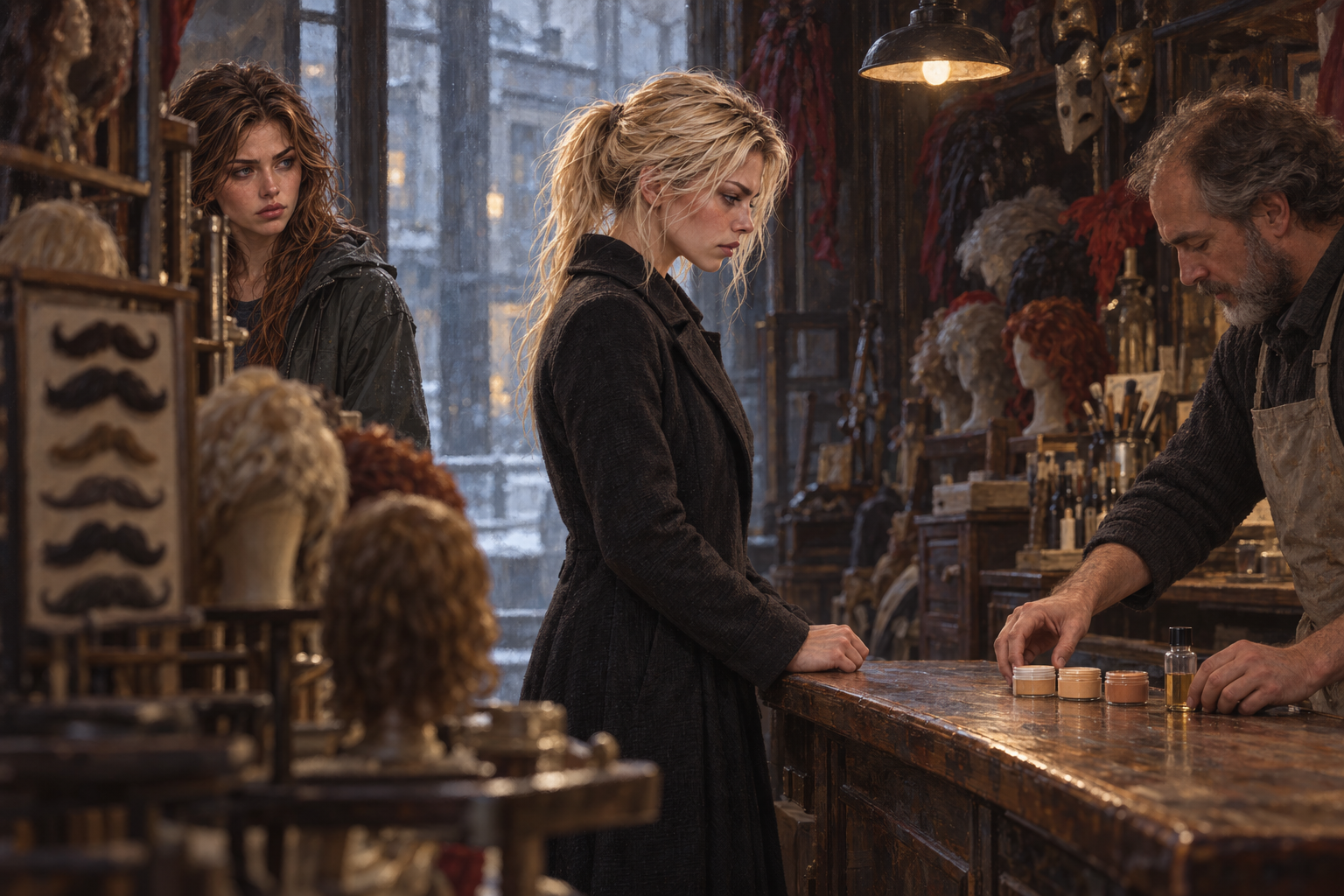
“You’ll want to mix,” he said.
“I will want to mix,” said Val.
“Sealant goes on last. Thin. Let it set.” He looked at her. “It won’t move after that. You’ll need the remover.”
“Yes,” said Val, “I know,” and paid, and Kyra watched her put the jars in her bag one at a time, as carefully as if they were sample tubes, and thought: the second time in her life.
· · ·
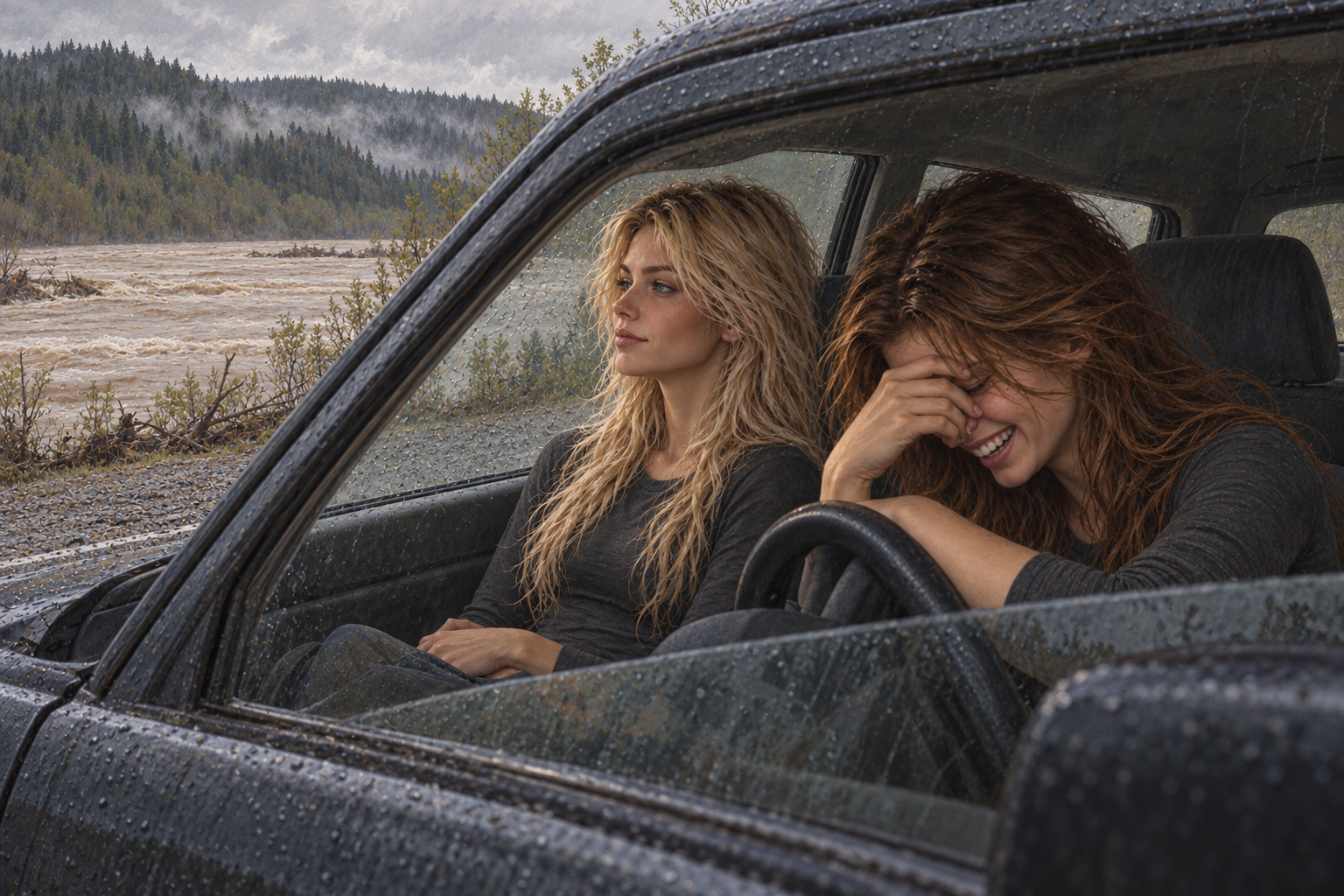
“Was it this?” Kyra said, on the road home, somewhere past the turn for the river.
Val did not pretend not to understand.
“The same kind,” she said. “Another world. Three shades and a sealant, from a shop that sold to the playhouses, because a shop that sold to anybody else would have asked me what tone I wanted, and I didn’t want a conversation.” She was looking out at the water. “The sealant’s better here. Theirs had a smell.”
“I never knew where you got it.”
“You never asked.” A pause. “That’s not a complaint. I didn’t tell you either. I didn’t tell you anything.”
“No,” said Kyra. “You didn’t.”
They drove for a while without saying anything. The river went by on Val’s side, wide and brown and full of spring.
“I’m glad you asked this time,” said Kyra.
“So am I,” said Val. “It’s much less work than carrying a tin around for six weeks.”
Kyra laughed so hard she had to pull over.
· · ·
They did it that night at Kyra’s, on the couch in the front room, with a towel down and every lamp on and the jars in a row on the coffee table.
Val did Kyra’s first, because Kyra’s was the one that showed.
She knelt on the rug with her reading glasses on and a little palette knife and a saucer, and worked the three shades together a speck at a time, testing each mix on the skin just beside the ring, and looking, and wiping it off, and mixing again. She did not speak. She had not spoken the first time either, in a locked room with Kyra four feet away arguing about the third season; Kyra knew that now, and lay back on the cushions and watched her do it, and understood that she was being given the thing she had not been given then.
It took an hour and a quarter. Kyra knew because Val told her, at the end, without looking up.
“An hour and a quarter,” said Val. “It was an hour and eleven minutes last time. Your skin has changed.”
“It’s been out in the sun.”
“It’s been out in a great many suns.” Val laid the color on — a little at a time, over the ring and a finger’s width around it, feathered out at the edges until there was no edge — and then the sealant, thin, with the tip of a brush, and sat back on her heels.
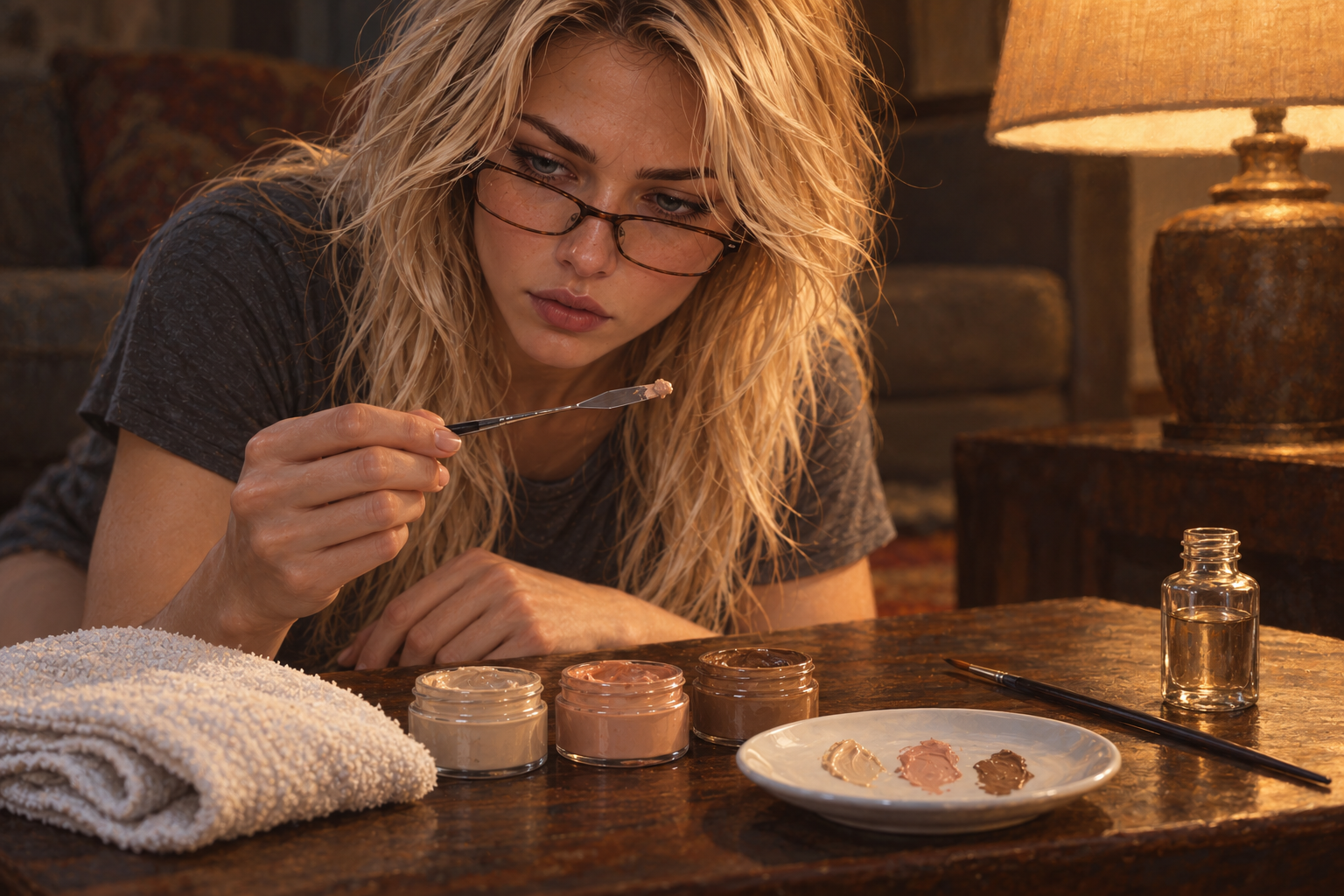
Kyra looked down.
It was gone. There was skin there, her own skin, warm and very slightly freckled and entirely ordinary, and nothing else at all. As though it had never been done. As though there had never been a dry camp, or a fire out, or three needles on a splinter of bone, or the blood coming up and staying in a bead instead of running.
“It’ll hold for two days,” said Val. “Water won’t take it. If you need it off, there’s solvent.” She put the brush down. “I’m telling you now. Before. Not after, on my way out of a room.”
Kyra could not answer her. She lay on her own couch with her own skin looking back at her, unmarked, and put her hand over her eyes.
· · ·
Then it was Kyra’s turn, and she turned out to be good at it.
Val had not expected that. Kyra could see her not expecting it, kneeling on the cushion with her knees apart and her cardigan off and the towel under her, watching Kyra take up the palette knife with an expression of polite apprehension, as though bracing for a child with a brush.
But Kyra had spent a long time once, on another world, doing nothing but chemistry — measuring tiny quantities of things into other things, with steady hands, under a lamp, getting it exactly right — and her hands remembered, even if the rest of her had long ago decided it was the kind of woman who sold raffle tickets and pulled strangers out of creeks. She mixed the fair shade and the pale shade and the faintest touch of the warm one, and tested it on the inside of Val’s hip, and looked, and did it again, and on the fifth try it was right.
“Forty minutes,” Kyra said. “Write that down.”
“I am not going to write that down.”
“You’re going to write it down the second I’m out of the room.”
“I am going to write it down the second you’re out of the room,” said Val, “and I am going to underline it.”
· · ·
The rest took longer, because Val’s was not in the open.
Kyra had to find it first. She knelt on the rug between Val’s knees and put the knife down and went looking with two fingers, slowly, the way she always went, through all that thick dark warmth below the pale — a little at a time, finding the lie of it and following it rather than fighting it, easing it aside and holding it there with the edge of her hand. Val did not move. Val’s breath did something, once, and then didn’t, and Kyra did not remark on it.
And there it was, an inch down, under everything. A ring. A little smaller than a thumbnail, and not quite around, because it had been Kyra’s hands that did it, in the dark, by feel, and Kyra’s hands had never been the steadier of the two. On one side of it the line went straight for a moment, where she had lost the rhythm and found it again.
“I’m sorry about the flat bit,” she said.
“I have been fond of the flat bit,” said Val, above her, “for a very long time.”
Kyra covered it.
She did it carefully, a little at a time, feathered out at the edges until there was no edge, and the sealant, thin, with the tip of the brush. Then she sat back on her heels on the rug and looked.
Nothing. Only Val. Only the pale skin and the dark over it, and nothing underneath that anybody could read.
· · ·
They stood in front of the long mirror in Kyra’s bedroom afterward, side by side, in the full light, and looked.
Two women with nothing on them. Not a mark between them. Exactly as they had been on the day they walked down off a mountain, before anybody had ever put anything in anybody’s skin, before they had decided that there was a single thing about each other they wanted to keep.
“I don’t like it,” said Kyra.
“No,” said Val. “Nor do I.”
“They’re still there.”
“They’re still there. Under a sealant. Waiting for the solvent.” Val’s voice was very level. “It’s two days. It’s a costume, like the mask. It comes off.”
“I know it comes off.”
“Then what don’t you like?”
Kyra thought about it.
“That it looks like nothing ever happened,” she said. “That’s what they’re going to see. Two women nothing ever happened to.”
Val did not answer that. She stood there a moment longer, looking at the two of them in the glass, and then she went and got the bottle of solvent from the front room and came back with it and a cloth, and held them out.
“There’s nothing in the camera until next week,” she said. “This was a test. It worked. I’d like them back.”
· · ·
They took them off each other on the edge of Kyra’s bed with the lamps still burning. It took a minute each. That was all. A minute, and a cloth, and the smell of the solvent, and there they were again — Kyra’s low down and plain under her short hair, Val’s under the dark with its flat bit, both of them exactly where they had been put, a long time ago, by hand, in the dark, above a river.
Kyra put two fingers just beside Val’s, not touching it.
“There you are,” she said.
“There I am,” said Val.
And then neither of them said anything for some time, and the cloth went on the floor, and the solvent went on the nightstand where it would be needed again, and the lamps stayed on, because there was nobody in the room to keep anything from.
Same color. Same hands. Asked first.
— end of chapter five —
May · the spare room
The spare room at Kyra’s had been nothing since the autumn. A bed nobody slept in, a chair nobody sat on, a window that looked at the side of the neighbor’s garage, and a smell of dust and old wallpaper paste that no amount of airing would shift.
By the Friday it was nowhere.
Val had seen to that. She had stood in the doorway on the Monday evening with her arms folded and her reading glasses pushed up into her hair and looked at the room the way she looked at a problem, and then she had made a list. The picture of a lighthouse came down off the wall — Kyra had not known it was there. The wallpaper was papered over in plain cream lining paper, which Val hung herself, very straight, with her sleeves rolled to the elbow for the first time since the autumn. A heavy gray blanket went up over the window on hooks, and a second one over that, and Val turned off the lamp and stood in the dark and checked for light at the edges, and found some, and went and got tape.
“It’s a bedroom,” Kyra had said, from the doorway.
“It is a room,” Val had said, from the dark, “with a bed in it. It is not anybody’s bedroom. There is no town outside that window and no year on that wall. Nobody who ever looks at it should be able to say a single thing about it except that it is a room.”
“It’s very depressing.”
“It is supposed to be anonymous.” A pause, and the sound of tape. “Depressing is a side effect.”
· · ·
On Friday night Kyra made the bed with the plain white sheets she had bought for it in Portland, which had never been on any other bed and never would be. She set a kitchen chair at the foot of it and stacked three of Val’s library discards on the seat — a dictionary, an atlas of the moon, and a book about bees — and propped her phone on top of them, on its side, and looked at the screen.
A bed. A cream wall. A gray blanket where a window should have been. Lamplight from the left, low and warm.
It could have been anywhere. It could have been any year at all.
“Well,” she said.
Behind her, in the doorway, Val said nothing at all.
· · ·
They had done the rest at Kyra’s kitchen table over two cups of tea that neither of them drank.
The color, first. Val’s, and then Kyra’s, the jars in a row and the little knife and the saucer, and neither of them talking, and the sealant thin with the tip of a brush. Then Kyra’s hair, which she did herself — up off her neck in a loose low knot she never wore in the town, pinned and then pinned again, with strands left down at her temples the way Val said strangers would think was on purpose.
Then Val’s.
Kyra stood behind her chair and took it in both hands — all of it, the whole pale weight of it, honey under the kitchen lamp — and began to braid it.
She had not braided Val’s hair since she could remember. Val wore it down. Val had always worn it down, in every house, in every decade, so that strangers in the street looked twice; and in the town it was the first and last thing anybody knew about the librarian. Kyra worked it back from Val’s temples in three strands, close to the head, tight, the way a woman braids her own hair to keep it out of the way for work, and drew it down the back of Val’s skull and on down her spine and tied it off.
When she had finished, she came around the table and looked.
It was Val’s face. It was Val’s jaw and Val’s mouth and the line of her neck. And it was not anybody Kyra had ever met in the street.
“Well?” said Val.
“You look like a woman who does something dangerous for a living.”
“I am a woman who does something dangerous for a living,” said Val. “As of tonight.” She put her hand up and touched the braid at the back of her head, once, as though checking it was there. “It’s very strange. It’s like wearing a hat.”
“It’s like wearing a hat,” Kyra agreed, “and the hair down is mine.”
Val looked up at her.
“I know,” she said. “I wrote it down.”
· · ·
Then the masks.
Kyra had put them on the table that afternoon, two of the three — black, light, close-fitting, the one with the mesh in the eyeholes and the one without — and they sat there between the teacups like two small animals asleep.
Val put hers on first. She did it the way she did everything that mattered, slowly, with both hands, settling it over her eyes and her cheekbones and the bridge of her nose and pressing the edges flat with her fingertips, and then she lowered her hands and looked across the table at Kyra through the open eyeholes.
Kyra’s breath went.
It was the strangest thing. She had seen that face in every light there was. She had seen it in a queue at the Vayr, furious; she had seen it in the snow; she had seen it asleep and lit and wrecked and laughing, and she had thought there was nothing left that it could do to her that she had not already seen. And now there was a woman across her kitchen table with Val’s mouth and Val’s chin and Val’s eyes looking out of a black mask, and her hair braided back hard off her face, and nothing else of her left at all — and it was somebody Kyra had never met, and wanted very badly to meet, and that was a thing she had not felt about anybody since the Vayr.
“Say something,” said Val.
“I don’t think I can.”
“Put yours on, then. It’s your turn to be strange.”
Kyra put hers on. The mesh came down over her eyes and the kitchen went faintly darker, as though somebody had drawn a fine curtain across it, and she could see Val perfectly well, and knew that Val could not see her eyes at all.
“Well?” said Kyra.
Val looked at her for a long time.
“I can’t see you,” Val said. “I’ve never once in my life not been able to see you. I don’t like it at all.” A pause. “It’s extraordinary.”
· · ·
They stood in the doorway of the room that was nowhere at a little after ten.
Kyra went first. She went to the chair at the foot of the bed and touched the screen of the phone once, and a small red light came on in the corner, and she turned around.
“It’s on.”
“I can see it’s on.”
“You can stop it any time you like,” said Kyra. “You know the stop. The grip. Two taps or gutters. Or the other word, and it’s all over, and we never mention it again. Any time. Even before we start.”
“I know the stop.”
“And the camera’s not yours. Nothing in this room is yours. I turned it on. I pointed it. I’ll turn it off. You don’t have to watch it. You don’t have to think about it at all.”
“I know,” said Val.
She did not move from the doorway.
Kyra could see her not moving. She could see it in the line of Val’s shoulders under her cardigan and in the hands, which were down at her sides, flat, the way Val’s hands went when something had come up too far in her and she was holding it down by force. It was not fear. Val did not look frightened. Val looked like a woman standing in a doorway at the edge of something very deep, deciding whether there was a bottom.
Kyra went back to her. She did not touch her. She stood in front of her in the doorway, close, mask to mask, so that the phone on its pile of books could see nothing but her back.
“Hey,” she said.
“I’m all right.”
“I know you are.” Kyra kept her voice very low. “Shall I tell you about the man with the pager?”
Val’s mouth moved.
“You’ve told me about the man with the pager.”
“I haven’t told you this one. This is a new one. On Tuesday he tried to back the engine into the bay and he’d left the bay door down.” Kyra put her hand on the front of Val’s cardigan, over her breastbone. “He did it very slowly. He did it with enormous dignity. He’d got about three feet of it into the door before anybody could get to him, and he got down out of the cab and looked at it for a long time, and do you know what he said?”
“What did he said.”
“What did he said?” Kyra started to laugh. “Val. That’s the worst sentence you’ve ever spoken.”
“I’m nervous,” said Val, with great dignity. “What did he say.”
“He said, well, that’s a door.”
Val laughed.
It was almost nothing. It was a breath through the nose and a movement at the corner of the mouth, under the edge of the black mask. But it was there. Kyra felt it go through her, under her palm, and felt the shoulders come down by about an inch, and she took her hand off Val’s cardigan and put it on the back of Val’s neck instead, under the braid — the way Val always began it, on stairs, in doorways — and drew her in.
· · ·
She did not hurry anything.
She kissed her for a long time in the doorway first, and then a little way into the room, and then by the bed; and somewhere in it Val’s hands came up off her sides and into the front of Kyra’s shirt, and somewhere after that the cardigan came off, and then the rest, and Kyra did not look at the phone once and did not let herself think about it at all. She thought about Val. She thought about the long pale line of her in the lamplight and the braid down her back and the warmth of her under Kyra’s hands, and talked, low, about nothing — the man with the pager, the dog that barked at the mail, the woman at the pie table with her glasses on a chain — and got her down onto the white sheets at last, and knelt over her, and went looking.
It was the long road. It was always the long road. Kyra had been ready since the doorway — she was always ready, she had been made that way, there was nothing in her way and never had been — and she put that aside entirely and went down slowly through all that thick dark warmth below the pale, finding the lie of it, following it, easing it aside and holding it with the edge of her hand. Val’s breathing was too careful. Kyra could hear it. She could hear Val listening to her own breath, the way she listened to everything, checking it, holding it level.
She’s watching herself, Kyra thought. Of course she is.
So she talked. She told her about the bees. She did not know anything about bees, but there was a book about them under the phone, and she had read the back of it, and she told Val all of it, at great length, inaccurately, while her fingers went on working their slow way down through the dark; and somewhere in the middle of a sentence about the queen, Val’s breath stopped being careful.
And something under Kyra’s fingers thickened, and lengthened, and came up through everything to meet her.
· · ·
They laced.
From above, so that it would look like something — Kyra over her, the two of them wound together at the hip and holding — and it was the same as it always was, and it was not the same at all, because there was a small red light in the corner of the room and both of them knew it.
And then Kyra felt the grip.
It came up out of Val small and certain, the way it always did, closing on her: the thing between them that had no word in any language on this world, that did not need one, that told her everything Val’s face would not. It was steady. It was a little too tight. It said, as clearly as if Val had spoken it, I’m here. I’m all right. I don’t know how to do this.
Kyra answered.
She did it without thinking, the way she had answered it in every bed in every house: tightened, and eased, and held. I know. I’ve got you. You don’t have to.
And the grip came back. Looser. All right.
And Kyra understood, kneeling over Val on white sheets in a room that was nowhere, with a camera at the foot of the bed taking down every single thing about the two of them that could be seen, that it could not see this. It could not see any of it. They could say anything they liked to each other, the whole time, all the way through, and nobody on the other side of that lens would ever know a word had passed.
She almost laughed. She did not. She bent down instead and put her mouth against Val’s ear, under the edge of the black mask, and said, so quietly that the phone would not have caught it:
“They can’t hear us.”
And the grip said, I know, and Val’s hands came up and closed on her hips and held on.
· · ·
It took a long time. It was not a performance and it did not look like one; it looked like two women in a plain room with the lamp low, moving slowly, very little happening anywhere the camera would have expected. Kyra went first — she always went first, she could not help it, and she did not try to help it now — loudly, laughing at the end the way she always did, and felt her eyes go behind the mesh, the gold coming up in them like heat through a stove door, and kept her face turned toward Val and away from nothing at all, because the mesh would hold. It held. She felt it hold.
And then she went on, as she always did, and Val stayed where she was: still, too still, the grip steady and tight, the light not coming.
Kyra slowed. She slowed until there was nearly nothing, and talked, low, about the bees, and the queen, and the man with the pager again, and Val’s hands on her hips went from holding on to just resting there.
And then Val forgot the camera.
Kyra could not have said how she knew. Nothing changed that anybody could have seen. But there was a moment, a long way in, when the grip loosened all at once — not letting go, but letting down, the way a held breath lets down — and Val’s head went back on the pillow, and her mouth came open under the mask, and Kyra knew, as surely as she knew north, that for the first time that night Val was not in the room with anybody but her.
The light came up.
It came at the throat first, faint and pale and the color of nothing on this world, and then the insides of the wrists where they lay on the sheet, and then along the collarbones and down; and Kyra watched it come the way she had watched it since the snow, and thought, with a part of her mind that was still somewhere else entirely, the camera’s getting this. Gray. A gray smudge. They’ll think it’s the lamp.
And then Val went quiet, and quieter, and her hands closed on Kyra’s hips, and she came apart under her without a sound, all at once, the whole of her lit, arching up off the white sheets with the braid crushed under her and her mouth open, and the murmur started up in her — low, unbroken, half of it in a language this planet had never heard, none of it in any order — and strung all through it, over and over, Kyra’s name.
Kyra put her mouth over Val’s and kissed her until it stopped.
She did not think about the phone. She did not think about the phone at all until much later, when it was over, and they were lying in a tangle on the white sheets with the lamp still low and the blanket still over the window and Val’s light going slowly down and out, last at the wrists; and then she lifted her head and looked at the chair at the foot of the bed, and the small red light was still on.
“Oh,” said Kyra.
“I forgot,” said Val, into the pillow, very quietly. “I forgot it was there.”
“I know you did.”
“I didn’t think I could.”
Kyra got up, and went to the chair, and turned the phone off, and the red light went out.
· · ·
They watched it at Kyra’s kitchen table at a little after one in the morning, on Val’s laptop, with the masks off and the blinds down and two fresh cups of tea, which they did drink.
That was in the terms too. They had brought the rule forward from a basement in another life: you watch it before anybody else does. You watch it together, at speed, start to finish. And then you decide.
It was very strange to watch. Kyra had seen the tape once, a long time ago, on a couch, and had cried; she did not cry now. She sat forward with her chin on her hands and watched two women in black masks in a room that was nowhere, and could not, for long stretches of it, make herself believe it was them.
The redhead was loud. The blonde barely moved. The redhead talked the whole way through, low, in a voice the phone had caught only half of. The blonde lay with her braid under her and her hands on the redhead’s hips and looked, for most of it, as though she was listening to something a long way off.
And then the blonde forgot the camera, and you could see it. You could see it. Kyra had not known you could. Something went out of her shoulders and her hands and her face, and her head went back, and she was nobody watching anything at all.
“There,” said Val, very softly, beside her.
“I know.”
“That’s where I forgot.”
“I know, sweetheart.”
The light came. On the screen it was nothing like the light. It was a pale gray bloom at the throat and the wrists and the line of the collarbones, faint and colorless, a softness in the picture that could have been a lamp too close or a lens that needed cleaning. And at the very end, at the moment itself, the edges of the frame went white — all four of them at once, briefly, as though the phone had been startled.
“Bad lighting,” said Kyra.

“Bad lighting,” said Val. Her voice was very odd. “That’s all it is. That’s all anybody will ever see.”
Kyra looked at her. Val was looking at the screen, at the gray smudge of her own light, with an expression Kyra had seen on her face perhaps a handful of times in their whole lives together. It was not grief and it was not relief. It was something with both of them in it.
“They’ll see everything,” said Val, “except the only thing that’s mine.”

· · ·
Then Kyra paused it, and Val took out her notebook, and they did the review.
It took an hour. It took an hour because Val would not let anything go past that had not been looked at twice, and because Kyra, who had expected to be bored, found that she was not bored at all. Val went through it at speed and then, with Kyra’s permission — Kyra held the laptop; that was in the terms — went back through it in pieces, and stopped, and made notes in her small exact hand.
The start. Twelve seconds of the two of them in the doorway before anything happened, with Kyra’s back to the camera and Val’s face over her shoulder, and Kyra’s voice, low, saying something that was almost certainly well, that’s a door. Cut.
The middle. A stretch where the phone had slipped on the book about bees and the frame had tilted, very slightly, toward the blanket over the window. Val went back to it four times. You could see nothing — a gray blanket, a cream wall — but the tilt made it look like a real room, a room in a house, and Val did not like it. Cut.
Kyra’s eyes. Val went through every frame where Kyra’s face came anywhere near the lens, slowly, one at a time, and leaned in each time, and looked, and sat back.
“Nothing,” she said, at the end. “Not once. Not the flicker. The mesh held all the way through.”
“I felt it hold.”
“I wanted to see it hold.” Val made a note. “No gold. That’s one of the terms kept.”
And then the end.
They watched the end three times. Val said nothing through the first two. On the third she stopped it, just before, with her own face on the screen frozen mid-arch and the white beginning at the edges of the frame, and put her pencil down.
“The sound,” she said.
Kyra knew.
“We’ll put music over it,” said Kyra. “Something low. From the start of the — from where you forget. Right through to the end. Loud enough that nobody can make out anything under it.”
“Can you do that?”
“I can do that. It’s my phone. It’s the one thing about all of this I actually know how to do.” Kyra put her hand flat on the table, next to Val’s. “Nobody will hear it, Val. Nobody will ever hear it. Not a word.”
“They’ll hear something.”
“They’ll hear a woman making a sound at the end. In a language. Or not in a language. They’ll argue about it.” Kyra shrugged. “Let them argue. They argue about everything.”
Val looked at the frozen screen.
“My name isn’t in it,” said Kyra, gently. “Your name isn’t in it. It’s mine. It’s my name you say. And nobody on this whole planet knows what my name sounds like in your mouth, because nobody’s ever heard you say it like that but me.” She paused. “And that’s still true. After tonight. It’s still only me.”
Val did not answer.
But she picked her pencil back up, and wrote something in the notebook, and underlined it, and Kyra did not need to read it.
· · ·
The music took Kyra until nearly three.
She found something with no words in it, slow, mostly strings, that she thought was beautiful and that Val said sounded like a dentist’s waiting room. She laid it in under the last of it, from the moment Val forgot the camera, and brought it up until she could not hear the murmur at all, and then up a little further, and then played it back with her eyes shut, and could not hear anything but the strings and her own voice, laughing, near the end.
“Mine’s in it,” she said.
“Yours is supposed to be in it,” said Val. “Yours is the whole point. You’re the loud one.”
“I’m the loud one,” said Kyra, and laughed, and Val did the thing at the corner of her mouth that was not a smile, and did not need to be.
· · ·
At a quarter past three, Kyra held up her phone.
The video was on it. Fourteen minutes and some seconds. Two women in black masks in a room that was nowhere, with music under the end. It needed a title, and they had argued about it for half an hour; Val had wanted it numbered, and Kyra had refused, and in the end they had put the only thing on it either of them could stand.
Hello from Andromeda.
“You press it,” said Val.
“It’s my phone.”
“I know it’s your phone. That’s why you press it.”
Kyra looked at her across the table. Val was sitting with her hands on either side of her teacup and her braid still down her back, coming loose now at the end where Kyra had tied it, and her face was perfectly composed and was not composed at all, and Kyra could see it. She had always been able to see it.
“Any time,” said Kyra. “Up to now. You can still say it.”
“I know I can.”
“I’m only saying.”
“I know what you’re saying,” said Val. “Press it.”
Kyra pressed it.
· · ·
Neither of them slept.
They went up to Kyra’s bed a little before four and lay in it with the lamp on her side turned low and the phone between them on the blanket, face up, and neither of them said that they were looking at it, and both of them were.
The page was black. The little gray spiral in the corner. The Girls from Andromeda. Copper and Blondie. And under it, now, a small square with a still of the room that was nowhere — a cream wall, a white sheet, the edge of a black mask — and under that, in small gray letters, a number.
0.
Kyra refreshed it.
0.
“It’s four in the morning,” said Val. “Nobody is awake.”
“Somebody’s awake. Somebody’s always awake somewhere.”
“Not in Calderveil.”
“It’s not in Calderveil, Val. It’s everywhere.” Kyra refreshed it again. “It’s in every telephone on the planet. You said so yourself.”
0.
Val did not say anything. After a while she turned onto her side, facing Kyra, with the phone between them, and her braid came over her shoulder and lay on the blanket, and Kyra reached out and began, very slowly, without asking, to take it apart.
She did it one strand at a time, the whole length of it, from the end up to the nape of Val’s neck. It took a long time. Val lay still and let her, with her eyes on the phone, and the hair came loose under Kyra’s fingers in long pale waves and spread out across the pillow between them the way it always did, everywhere, honey in the lamplight. Down. Hers.
When it was all undone, Kyra put her hand flat on the top of Val’s head, the way Val always did to her, and left it there.
And the number changed.
· · ·
1.
They looked at it.
Somewhere on the planet, in some room, in some town, under some lamp, one person neither of them would ever see had pressed on a small square with a cream wall in it, and was watching.
“Somebody,” said Val.
Her voice had gone very quiet.
Kyra did not answer her. She lay on her side with her hand on Val’s hair and her eyes on that single gray number, and felt something come up in her that she had been waiting for since a room full of people along two walls, a very long time ago, for a man she liked and did not love — and found that it was not what she had expected at all. It was smaller than she had expected. It was much, much larger.
“A witness,” she said.
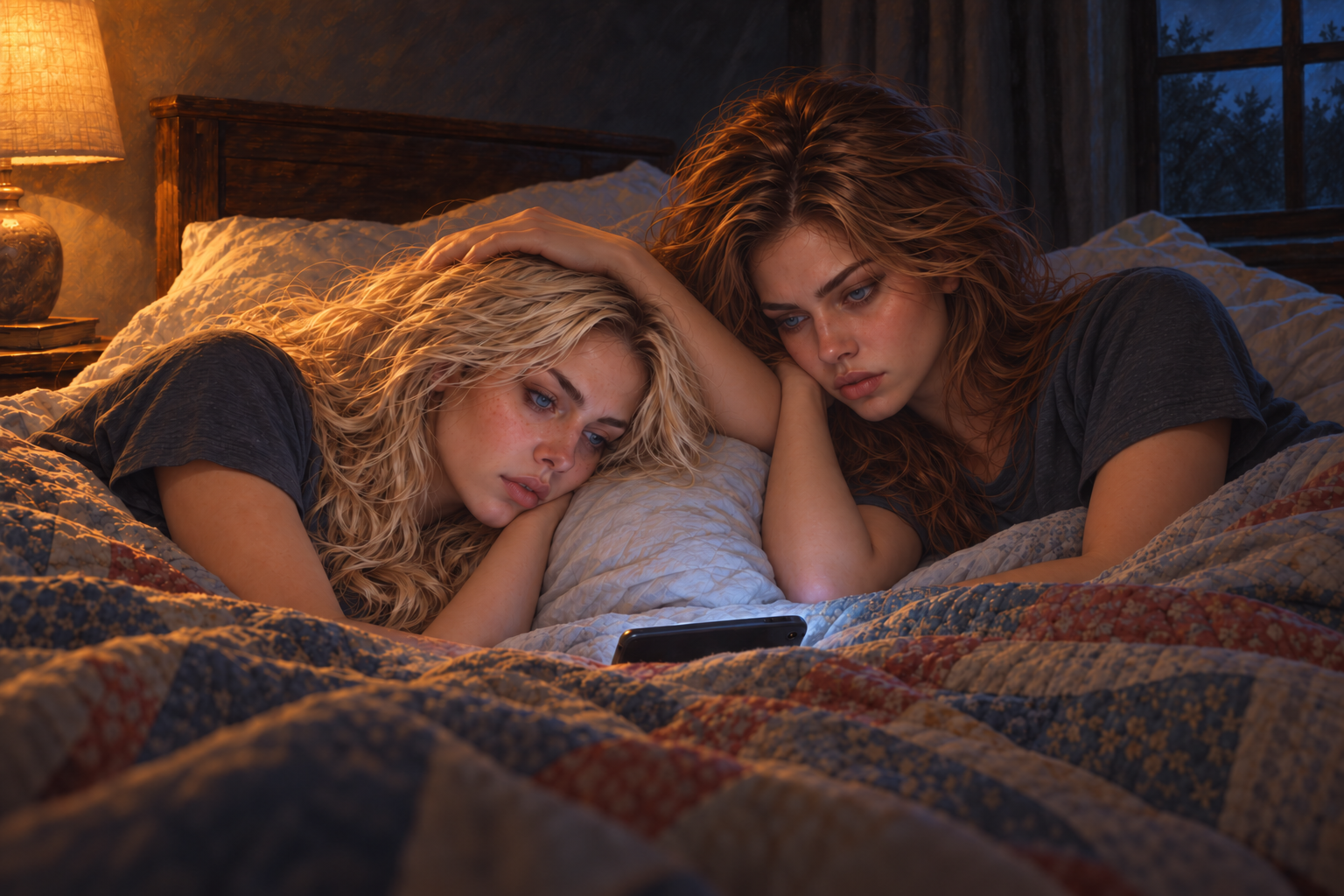
— end of chapter six —
May · Kyra’s kitchen, mostly
By nine in the morning it said 11.
Kyra read it out at the stove, in her socks, with the eggs going. Val was at the table in yesterday’s cardigan with her hair still down from the night and her hands around a cup of coffee, and she did not look up, but Kyra saw her stop drinking.
“Eleven people,” said Kyra.
“Eleven views. It may be one person eleven times.”
“Who would watch it eleven times?”
“You have watched it four times since six o’clock,” said Val, “in the bathroom, with the door locked. I could hear the strings.”
Kyra turned the eggs over and did not deny it.
· · ·
By noon it said 94. By the time Val drove home in the afternoon to feed nobody and change her clothes, it said 260, and there was a small gray speech bubble under the square with a number beside it, and the number was 3.
Kyra did not open them. She made herself not open them. She put the phone face down on the kitchen counter and went out to the fire hall and rewound a hose that did not need rewinding, and talked to the man with the pager for an hour about the bay door, and came home, and turned the phone over, and the bubble said 17.
She called Val.
“Come back,” she said.
“I’ve just got home.”
“Come back. There are seventeen of them. I’m not reading them on my own.”
There was a pause on the line of a very particular quality.
“I’ll bring dinner,” said Val.
· · ·
They read them at Kyra’s kitchen table with the plates pushed aside, Kyra holding the phone and Val leaning in at her shoulder, the way they had read letters once, a very long time ago, over a single candle.
The first one said: ok wow
The second one said: the blonde barely makes a sound and somehow that’s hotter??
Val made a small noise in her throat.
“That’s you,” said Kyra.
“I’m aware it’s me.”
“Somehow that’s hotter. Two question marks.”
“I can see the question marks.”
The third one said: what is that glow, I need the product
Kyra put the phone down on the table and put her face in her hands.
“Bad lighting,” said Val, very quietly, beside her. Kyra felt the small breath go through her nose. “A gray smudge in the shape of a woman. And the very first stranger on earth to say anything about it wants to know where to buy it.”
“I told you.”
“You told me.”
“I told you they’d want a link.”
“You told me they’d want a link,” said Val, “and I would like it noted that I didn’t believe you,” and picked the phone back up herself, which she was not supposed to do, and Kyra let her.
· · ·
They were not all like that.
Some of them were crude, and Kyra read those out too, in a flat bored voice, as if reading a list of groceries, until Val asked her to stop doing the voice, because it was making her breath go through her nose, and she was not sure she ought to be finding it funny. Some of them were simply strange. One was in a language neither of them could read and turned out, when Val looked it up, to be a recipe. One said is the music to cover the neighbors lol.
“The cow,” said Val.
Kyra laughed so hard she knocked over her water.
And one of them, near the bottom, said:
redhead is SO fake lol. nobody is that loud. she’s performing for the camera, the blonde is the real one
· · ·
Kyra read it out in the same voice as the others. She got to the end of it, and laughed, and said, “Well, that’s wrong,” and scrolled on to the next one.
And then she did not say anything for a while.
She did not mean to stop. She was reading the next one; she was looking at it; it was something about the sheets. But she found that she was not reading it at all, that she was somewhere else, in a bed on another world, lying beside a good man in the dark, telling him things in a low warm voice about what had happened to him, beautifully, at length, with her whole heart, and watching his face to see whether he believed her.
Nobody is that loud.
She had been loud with Emrin. She had been so loud. She had been loud because it was the only way she knew to fill the place where nothing was happening, and he had loved her for it, and he had never once known.
She’s performing for the camera.
· · ·
She had not been performing. That was the thing. Last night, in that room, with that red light, she had not performed one single second of it. She had been loud because she was always loud, because she had been made loud, because it came up out of her whenever Val was under her and there was nothing in the world she could do about it and nothing she had ever wanted to do about it. It was the truest thing about her.
And the one stranger on the whole planet who had decided to say she was faking it had picked, out of everything, the one place it had ever once been true.
She scrolled on. She read the next one out. It was something about the sheets. She made a joke about it, and it was a good joke, and Val made the small sound through her nose.
But Val had stopped laughing first, before the joke, and was looking at her. Kyra did not look back. She could feel the look go over her face the way it always did, taking inventory, and stop somewhere, and stay there.
Val did not ask. She only put her hand flat on the table, next to Kyra’s, the way she had in her own kitchen some weeks before, in front of a stranger’s bedroom stopped on a screen, and left it there.
· · ·
“We should answer,” said Kyra, later, when the plates were washed. “Some of them. People do.”
“Do they.”
“You saw. In the literature. Half of them answered every single comment.”
“Half of them,” said Val, “were trying to sell something.”
“We’re trying to sell something.”
“We’re trying to sell something,” Val agreed, with the expression of a woman tasting a word she had not expected to like and finding that she still did not, “but not that.” She folded the dish towel in three and laid it over the rail. “Very well. You answer. It’s your phone.”
“We both answer.”
“I don’t—”
“We both answer, Val. Two of us. It says so at the top. Copper and Blondie.” Kyra held up the phone. “I’ll type. You tell me what to say, and I’ll put a B at the end of it so they know it’s you.”
Val looked at the phone.
“I’ll want to see it before it goes.”
“You can see every word.”
“Then,” said Val, and sat down, and put her reading glasses on, “give me the one about the glow.”
· · ·
Kyra did hers first, because she was quick.
ha! thank you so much for watching, we had a lot of fun making it — and a little heart — —C
thank you, that’s very sweet of you to say — and a heart — —C
we’re so glad you liked it!! more soon — two hearts — —C
“You’ve put a heart on all of them,” said Val.
“They’re nice. You put a heart on nice things.”
“You’ve put a heart on the man who wanted to know what size the bed was.”
“He was very polite about it,” said Kyra. “Your turn. The glow.”
Val looked at the comment for a while over the top of her glasses. what is that glow, I need the product.
“It is the lamp,” she said.
Kyra waited.
“That’s all?”
“That’s all.” Val took her glasses off. “It is the lamp. Full stop. B.”
Kyra typed it. It is the lamp. —B
She looked at it on the screen, those four flat little words in a column of hearts and exclamation marks, sitting there like a stone in a basket of flowers.
“They’re going to love that,” she said.
“I very much doubt it,” said Val.
· · ·
They loved it.
By the Tuesday there were two hundred comments under the video and the number at the bottom of the square said something Kyra did not read out, because it made her stomach go, and a good third of the comments were not about the video at all. They were about the replies.
lmao “it is the lamp”
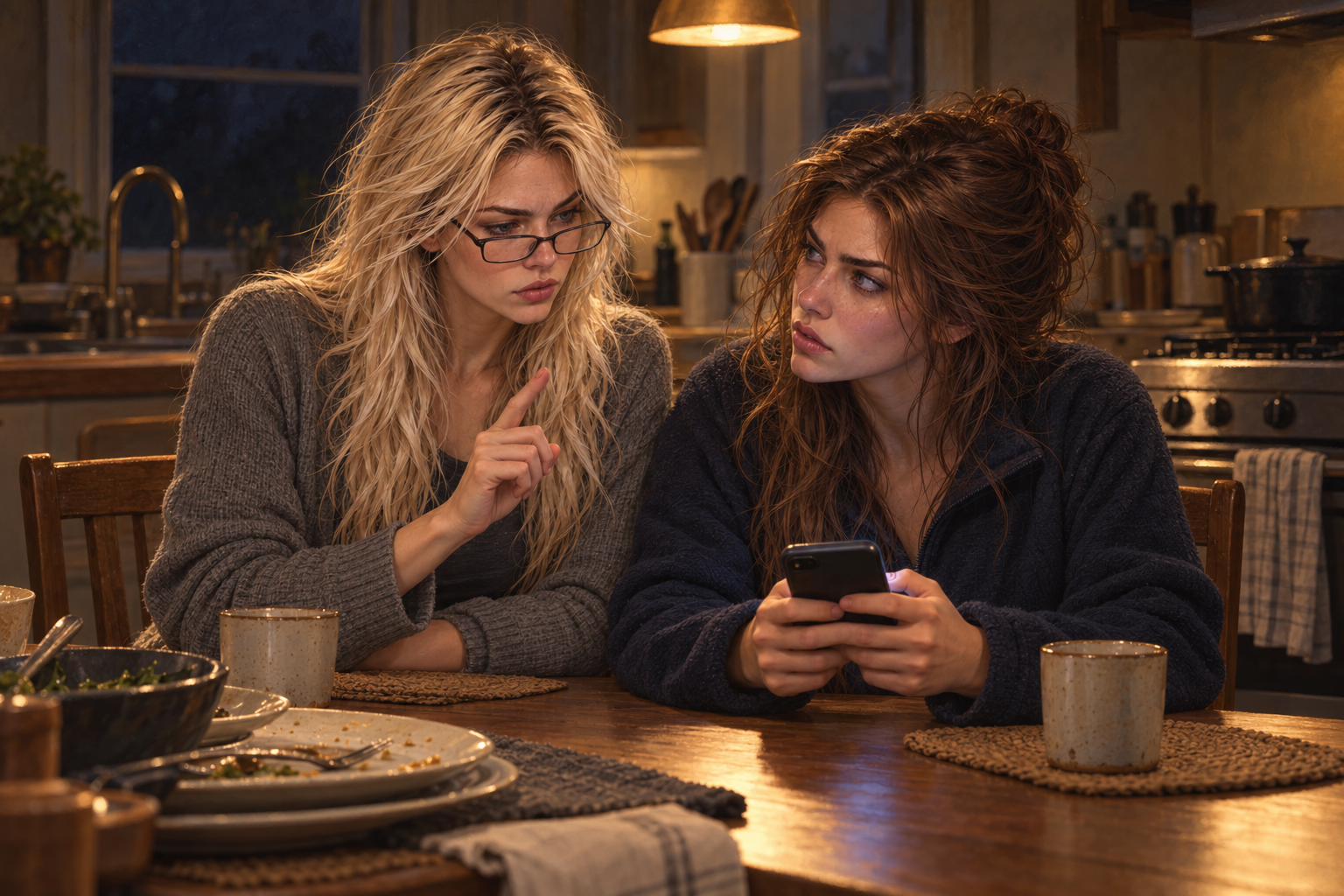
blondie does NOT do exclamation marks
copper is sunshine and blondie is a tax form and I would die for both of them
the quiet one types exactly how she sounds
Blondie said what she said
And under Val’s second reply — someone asked whether the bed is a queen or a king. It is a bed. —B — a stranger had written, in capital letters, SHE IS SO FUNNY AND I DON’T THINK SHE KNOWS.
Val read that one for some time.
“I’m not trying to be funny,” she said.
“I know you’re not, sweetheart.”
“I’m trying to be accurate.”
“I know,” said Kyra. “That’s why it’s funny.”
· · ·
On the Wednesday somebody asked whether they were sisters.
It was a reasonable question. They had been asked it in a great many cities. They had the same face, or near enough — the same height, the same jaw, the same mouth under the mask — one fair and one dark, and in most of the places they had ever lived it had been the easiest thing in the world to let people believe it. Kyra had always liked it. It was the cover strangers handed you before you had to claim anything at all.
It was not, on this page, a cover. It was the one thing the page could not have.
are they sisters?? they look so alike
Under it, already, three more people had answered. omg are they, and twins??, and something worse that Kyra did not read out.
“I’ll do it,” said Kyra. “I’ll be nice about it. I’ll say we get that all the time.”
“No,” said Val.
Kyra looked up.
“Give it to me,” said Val, and held out her hand, and Kyra — who held the phone, who had it written down in an envelope marked gutters that the phone was hers — gave it to her without a word.
Val put her glasses on. She typed for some time. Then she read it over, twice, and changed one word, and handed it back.
Kyra read it.
No. We are not sisters, cousins, or relations of any kind, by blood or by marriage, and never have been. The question is not one to ask on this page, and we will not be answering it again. —B
· · ·
“Val,” said Kyra.
“It’s accurate.”
“It’s terrifying.”
“Good,” said Val, and took her glasses off.
Kyra posted it.
Nobody asked again. Not that week, and not the next, and not for as long as there was a page. Somebody underneath it wrote yes ma’am, and somebody else wrote I felt that in my spine, and after that the question simply stopped, the way a room goes quiet when somebody in it has put down a glass very precisely on a table.
· · ·
That night, at a little after two, Kyra woke in her own bed in the dark and could not get back to sleep.
Val was beside her, deep under, with her hair everywhere and one hand open on the pillow, which was the only time in her life that hand was ever open. Kyra lay and looked at her for a while. Then she reached over to the nightstand, very quietly, for the phone.
She did not mean to look at the comments. She meant to look at the clock. But the page was the last thing she had had open, and it came up bright in the dark, and she turned the brightness down with her thumb and found that she was scrolling — back, a long way back, past the lamp and the bed and the sisters, to the bottom of the very first day.
redhead is SO fake lol. nobody is that loud. she’s performing for the camera, the blonde is the real one
There were replies under it now. She had not seen them.
you’re wrong, watch her hands, that’s not acting
agreed, look at her hands at 9:40
And under those, the last one, the newest, posted at a quarter past eleven that night, when Kyra had been in the bath and Val had been on the couch with Kyra’s phone in her lap, reading, while Kyra sang badly through the wall.
She has never once performed anything in this room. —B
· · ·
Kyra lay in the dark with the phone on her chest for a long time.
It was true. That was what undid her. Val had not written something kind. Val did not write kind things; Val wrote accurate ones. She had sat on that couch with the phone in her lap and found the one sentence in the whole of the language that was entirely true and that answered it — in this room — and put it there, flat, with a B on the end, where it would stay for as long as there was a page.
Not she has never performed anything. That would not have been true, and Val knew exactly why, and had known for a very long time.
In this room.
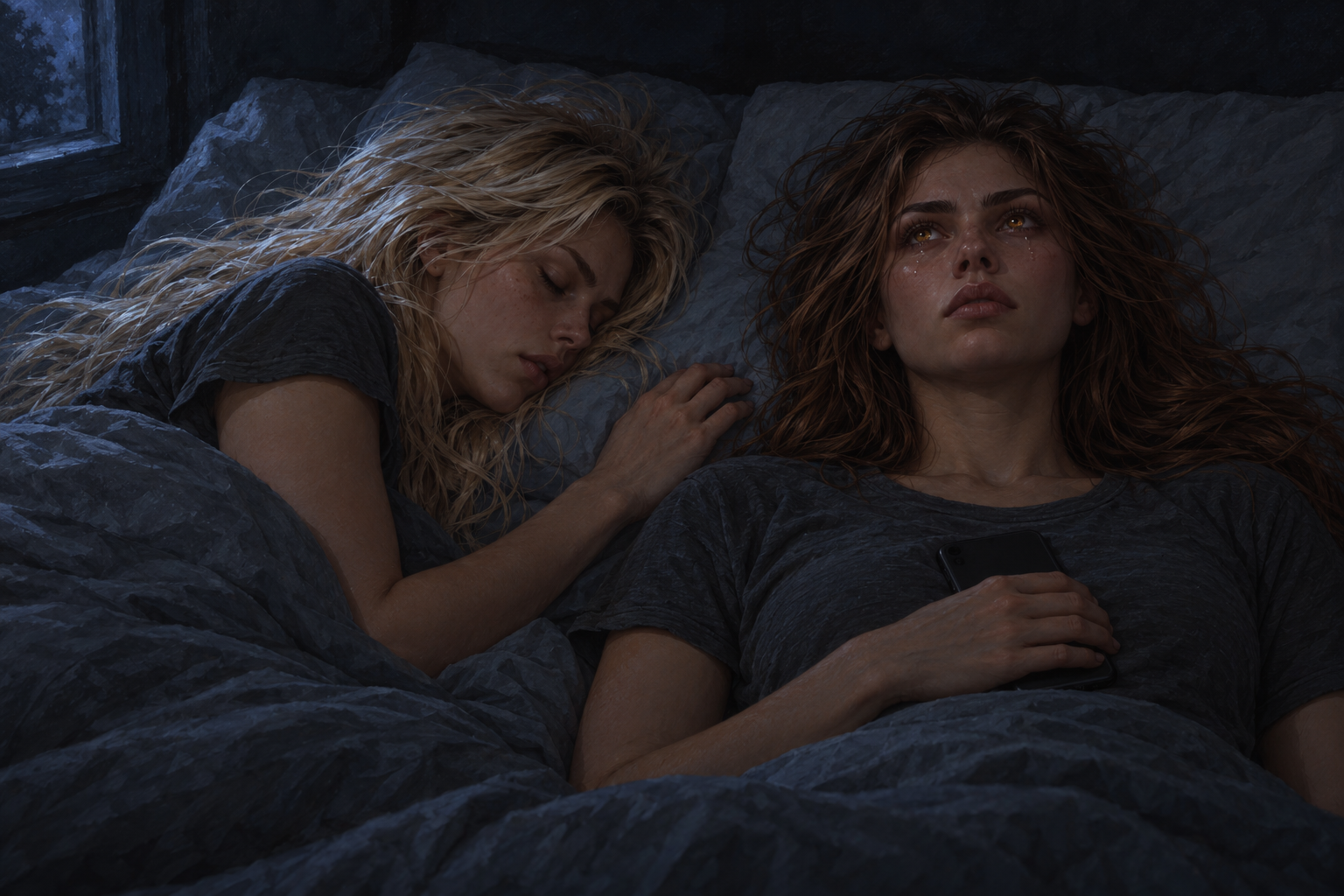
Kyra turned the phone face down on her chest and lay there, and her eyes went, in the dark, all the way, the gold coming up in them so that she could see the ceiling by it; and there was nobody in the room to hide it from, and she did not try.
Beside her, Val slept on, with her hand open.
· · ·
The money came on the Thursday.
Kyra did not see it come. She was at the fire hall. She found out because Val called her, which Val never did in the middle of the day, and when she answered Val said nothing at all for a moment, and then said, in the voice she used for instruments:
“Can you come to the house after the library shuts.”
“What’s wrong?”
“Nothing is wrong,” said Val. “Something has happened. I’d like you to be there when I write it down.”
· · ·
The library shut at nine on Thursdays. Kyra was in Val’s kitchen at five past, with every lamp in the house on and the rain starting, and Val was at the table with the laptop open and a notebook beside it.
The notebook was new. Kyra had never seen it before. It was bound in plain dark cloth, the kind with stitched pages, the kind you could not tear a sheet out of without anybody knowing, and on the first page, at the top, in Val’s small exact hand, there were ruled columns, very straight, done with a pencil and a ruler, and nothing in them yet at all.
“That’s the ledger,” said Kyra.
“That is a copy of the ledger. The ledger is out there.” Val nodded at the laptop. “Everywhere at once, in everybody’s keeping, with no names in it. This is just mine.” She turned the laptop toward Kyra. “Look.”
Kyra looked.
It was a wallet. She knew that much; she had watched Val set it up, and been told not to touch it. And in it, where there had been nothing since the night the page went live, there was now a number. A very small number, with a great many zeros after the point before anything happened.
“Somebody paid,” said Kyra.
“Somebody subscribed. This morning, at twenty past six. To see more of us.” Val’s voice did not change. “It is worth, at today’s rate, approximately the price of a slice of Dee’s pie.”
Kyra started to laugh.
“A slice of pie.”
“A large slice,” said Val. “It’s a good pie.”
· · ·
Val picked up her pencil.
She wrote the number in the first ruled line of the notebook, in the column headed Received, carefully, every zero, in a hand so small and so exact that Kyra had to lean in to read it. In the column headed From she wrote nothing at all, because there was nothing to write — a number paid to a number, the most perfect record ever designed, and not a single name in it anywhere. In the column headed Date she wrote the day and the month, and stopped there, and did not write the year, and Kyra noticed, and did not ask.
Then she put the pencil down and looked at it.
“There,” she said.
Kyra looked at it too. One line. One small number, and a blank, and a date. The first entry in a record that would not leak and would not forget and could not tell anybody who anybody was.
“It isn’t about the money,” said Kyra.
“It isn’t about the money,” Val agreed.
She picked the pencil back up, and in the narrow margin beside that first line, where nothing was meant to go, she wrote one more word, very small, and underlined it, and closed the book.
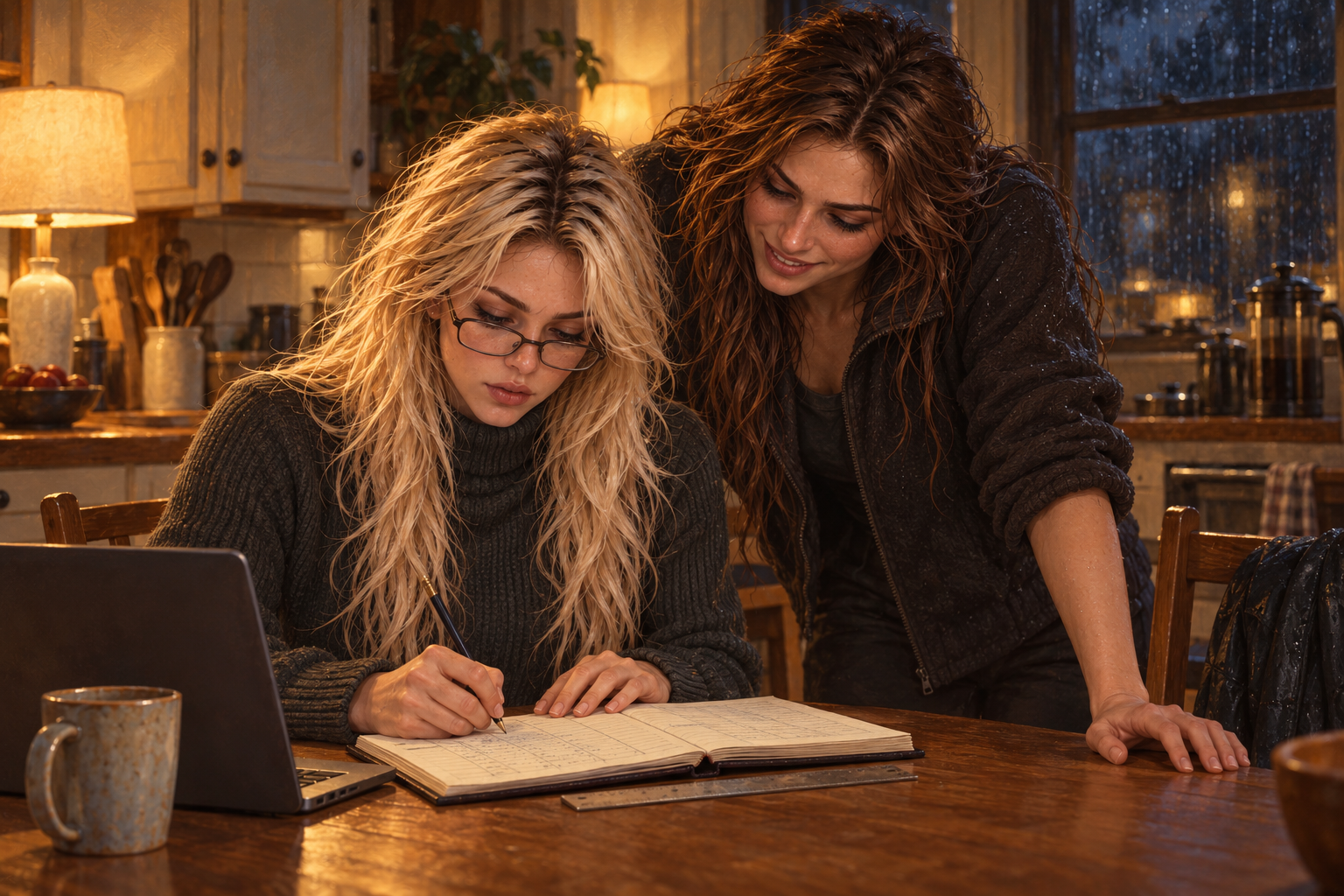
Kyra did not need to see it. Val had said it out loud at four in the morning, the night the number changed, with Kyra’s hand on her hair.
Somebody.
— end of chapter seven —
June · Val’s porch
Kyra found the first one on a Sunday morning, by accident, looking for something else.
She had typed the name of the channel into her phone in bed because she wanted to see what it looked like to a stranger — how it came up, whether the little gray spiral showed, whether it looked like anything at all — and the first thing that came up was not their page.
It was somebody else’s.
Same square. Same cream wall, same white sheet, same edge of a black mask. Same fourteen minutes and some seconds, with the strings coming up under the end. But it was on a page Kyra had never seen, crowded with flashing boxes down both sides, and it had a different title — MASKED Blonde & Redhead ALIEN Girls (Amateur) — and under it a number of views that was larger than theirs.
Kyra lay and looked at it for some time.
Then she went back and looked at the second result, and it was the same. And the third.
· · ·
She did not call Val. She drove across town in her sweater with her hair not done and let herself in by the back door, and Val was at the kitchen table in her reading glasses with the laptop open, and Kyra could tell from the back of her head, from the line of her shoulders under the cardigan, that Val already knew.
“How many?” said Kyra.
Val did not turn around.
“Eleven,” she said. “So far. I stopped at eleven.” She turned a page of the notebook beside her. “I started at six this morning. I search for us every other week. I always have.” A pause. “It was Sunday. It was the week.”
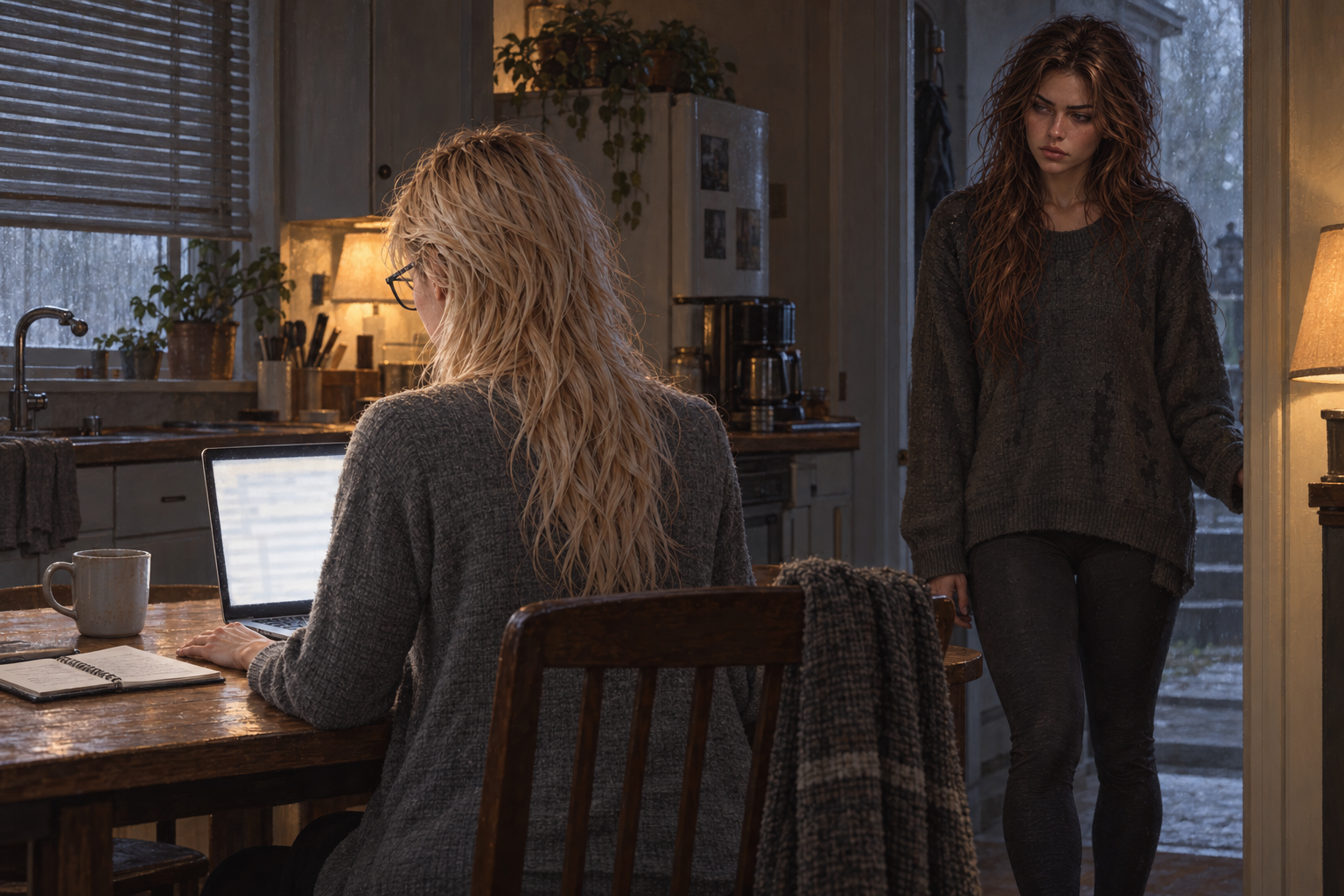
Kyra came and stood behind her chair.
On the screen there was a list. Val had made a list, of course; there was a column of addresses and a column of titles and a column of numbers, and the numbers were views, and every one of them was larger than it had been when Val wrote it down.
MASKED Blonde & Redhead ALIEN Girls (Amateur).
Hot Amateur Couple in Masks — Blondie Glows!!
Girls From Andromdea — full video
“They’ve spelled it wrong,” said Val.
“Val—”
“They’ve copied fourteen minutes of us, frame for frame, without asking anybody, and put it in eleven places in five countries that I have been able to find, and one of them has misspelled Andromeda.” Her voice was perfectly level. “I find that I mind the spelling. I’ve been sitting here for three hours trying to work out why I mind the spelling.”
· · ·
Kyra pulled out the other chair and sat down beside her.
“Can we make them take it down?”
“I looked.” Val turned the laptop a little toward her. “There’s a form. Every one of them has a form. You fill in the form and you say that this is yours and that they have no right to it, and they are obliged to take it down.” She scrolled. “Here. Here is the form.”
Kyra read it.
It asked for the address of the video. It asked for the address of the original. It asked for a description of the work.
And then it asked for a name. A full legal name. A postal address. A telephone number. A signature, under penalty of something.
“There’s always a name at the end of it,” said Kyra, very quietly.
“There’s always a name at the end of it,” said Val. “You found that out yourself. You read for two days, and every single thing you read ended with a form asking for a name.” She took her glasses off. “The only way to make them stop copying us is to tell them who we are.”
· · ·
Kyra did not say anything for a while.
Outside, it had begun to rain again. It came down on the porch roof and found its one place, as it always did, and dripped onto its one board, and the sound of it came in through the front of the house, small and steady, like a clock.
“Twelve,” said Val.
Kyra looked at the screen. Val had refreshed it. There was a new line at the bottom of the list.
“It’s still going.”
“It will always be going. That’s what I’ve understood this morning, sitting here.” Val put both her hands flat on the table on either side of the laptop. “It isn’t eleven, or twelve. It’s every copy of every copy of every copy, in every country, on every machine that has ever touched any one of them, and every one of those can be copied again by anybody who wants to, for nothing, forever. There is no number at the end. There is no end.” She looked at the screen. “I can find twelve. I can’t find the one somebody downloaded at four this morning onto a computer in a bedroom in a city I’ve never been to, and is going to keep in a folder, and look at, and give to a friend.”
· · ·
She got up and went out of the kitchen.
Kyra let her go. She sat at the table for a minute with the list and the rain and the laptop, and then she got up and followed, as far as the front door, and stopped in it.
Val was on the porch. She was sitting where she always sat, on the top step, with her back against the post, in the rain, with the one wet board beside her and the water coming through the roof onto it a drop at a time. She had her arms around her knees. She was not crying. Val did not cry, or not where anybody could see.
Kyra came out and sat down beside her, on the other side of the board, and got wet, and did not mind.
· · ·
“The tape,” said Val, after a long time.
“I know.”
“One cassette. One evening. Watched once, at speed, on a couch, and then it went in the stove in the basement, and I stood there and watched it go.” Val was looking at the field across the road, where the cow was standing in the rain with the patience of a thing that has never once in its life been surprised. “I wanted to keep it so badly. I argued for keeping it twice, and the arguments were extremely good. And you said the good ones are the ones to watch. And I let it go in.”
“I remember.”
“I thought that was the hard thing. Letting it burn.” Val’s voice did not change at all. “It wasn’t the hard thing. It was the easy thing. It was a thing that could be burned.”
Kyra did not answer.
“We said nothing kept,” said Val. “In the snow. You said it, and I said yes. Nothing kept, not from here on, not one thing, ever again. And we kept it. We kept it all this time. Not a letter. Not a photograph — I made sure of that, you’ll remember I made very sure of that. No tape, after one night. Nothing in any drawer that says anything but the name of the year.” She turned her head and looked at Kyra. “And now there is a thing of us in twelve places I can find and a thousand I can’t, and everybody on earth is keeping it except us, and I will never, as long as I live, be able to put it in a stove.”
· · ·
The rain came down. The drop came off the roof and hit the board between them, and hit it again.
“You can say it,” said Kyra.
Val looked at her.
“The word,” said Kyra. “You can say it. Right now. On this porch. That’s what it’s for. You say it and it’s over — no more videos, no more page, no more anything, and we never mention it again. I won’t argue. I’ll go inside and take the blanket down off the window in the spare room and put the lighthouse back up, and that’ll be that.”
“It won’t be that.”
“It’ll be the end of what we do.”
“It’ll be the end of what we do,” said Val. “It won’t be the end of what we’ve done.” She looked back at the field. “That’s what I’ve been sitting at that table all morning finding out. The word still works. If either of us says it, the show stops, tonight, for good, and I believe that and I’d keep to it. But the thing it was for — the thing it meant, in the basement — it can’t do that any more. It can stop us. It can’t stop them.” A pause. “It can’t burn anything. Not ever again. Not this.”
· · ·
Kyra sat with that for some time.
Then she said the thing she had been not saying since the kitchen, because she knew exactly how it was going to sound, and she had decided, a long time ago on another world, that she would rather be heard than be safe.
“I don’t mind,” she said.
Val did not move.
“I know I’m supposed to mind. And I do mind the spelling, sweetheart, I mind the spelling very much, and I mind the man in the bedroom with his folder, a bit. But the rest of it—” Kyra pushed her wet hair back off her face. “Somebody’s keeping it. All over the world. People we’ll never meet are keeping a thing of us, and copying it, and passing it on, and arguing about the glow underneath it. It doesn’t go in a stove. It doesn’t get lost when somebody dies and somebody else clears the house. It’s just — there. Everywhere. Forever.” She looked at the cow. “I wanted a witness. I didn’t know I was going to get one that couldn’t be burned.”
Val turned and looked at her for a long time.
“That,” she said at last, “is exactly the thing that frightens me.”
“I know.”
“And it’s exactly the thing you love.”
“I know,” said Kyra. “I’m sorry. It’s the same thing. It’s always been the same thing, with us.”
· · ·
They sat on the porch until the rain stopped. It took about an hour. Neither of them said anything for most of it, and the cow did not move once, and the drop went on hitting the board between them long after the rest of the rain had stopped, because the water on the roof took longer to come through.
Some things leaked. Val had lived with that board since the first wet day. She had noted it, and decided to live with it, and had never once tried to fix it, and Kyra had never asked why.
“I could fix that,” Kyra said, eventually, nodding at it.
“Don’t.”
“It’s one nail and a bit of flashing.”
“I know what it is.” Val put her hand out, flat, under the edge of the roof, and let the next drop fall into her palm, and looked at it there. “I like knowing where it comes in. Everything else in this house is closed up, and lit, and kept dry. And there is one place where the outside gets through, and I know exactly where it is, and I can put my hand under it.” She closed her fingers. “I’ve always thought it was useful. Knowing where the leak is.”
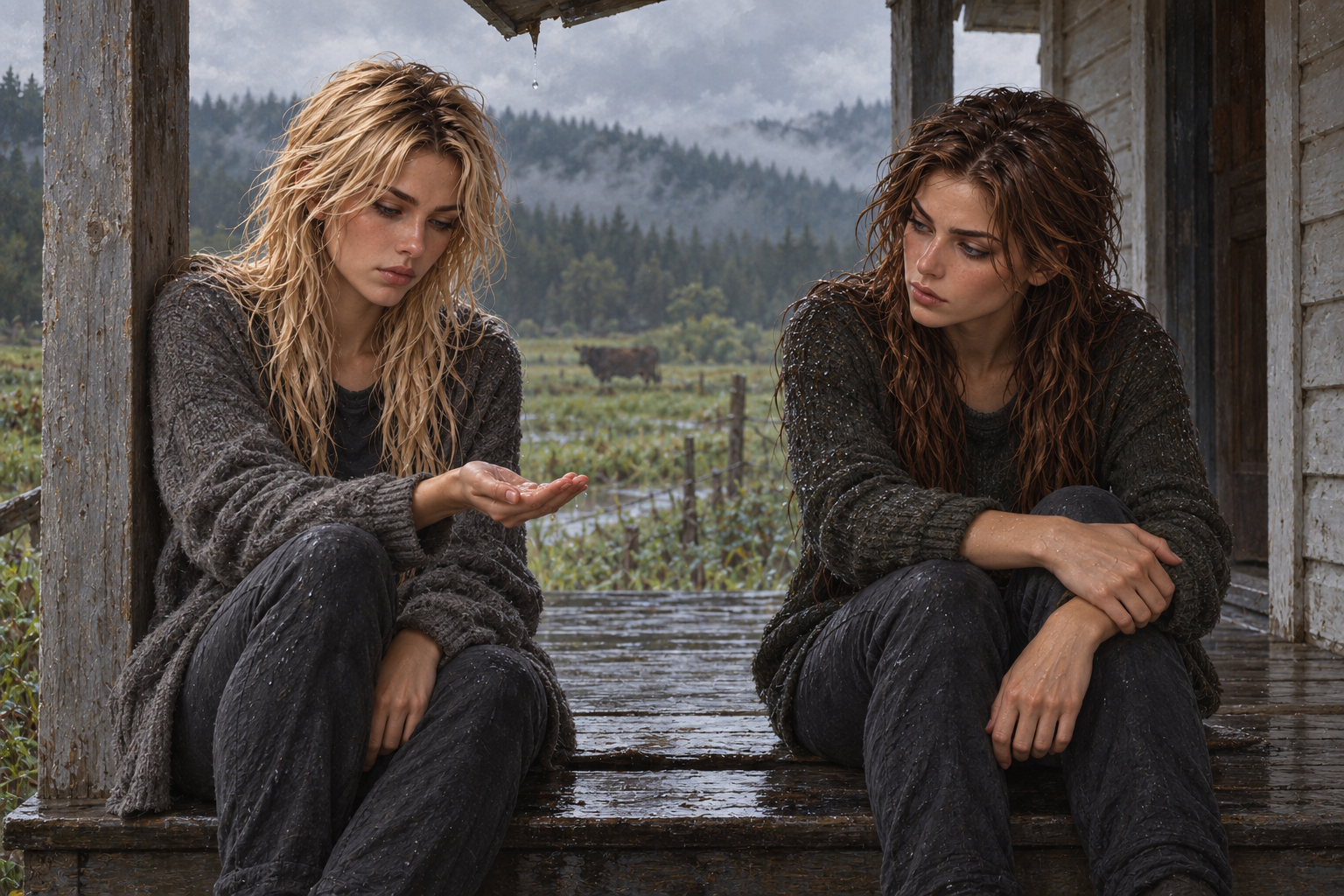
· · ·
They did the term at the kitchen table that night.
Val took the envelope marked gutters out of the drawer where she kept it, and took out the terms written on the back of the nine-page paper, and unfolded them, and laid them flat. Under the last line — under Kyra gets her witnesses. Val keeps her light — there was a little space left. Not much. Val had always left a little space.
She wrote in it, very small.
The stove ends what we do. It cannot end what we have done. Therefore: every frame as though it will exist forever. Because it will.
Then she turned it around so Kyra could read it, as she had the first time.
“That’s three sentences,” said Kyra.
“It’s one term. The other two are the reasoning.”
“You’ve never put reasoning in a term before.”
“I’ve never had to,” said Val. “Everything we ever did before could be burned.”
· · ·
It changed things, after that. Kyra could feel it change them, in small ways, over the following week, the way you feel a house settle.
Val went through the room that was nowhere again, on her knees, with a flashlight. She found a square of light the size of a fingernail at the bottom corner of the window, where the tape had lifted, and taped it again, twice. She took the atlas of the moon off the chair at the foot of the bed and looked at it and put it back on a shelf in the front room, because in the first video, in the stretch where the phone had slipped, the very corner of its spine had shown at the bottom edge of the picture for a second and a half — and its spine had a library sticker on it, and you could, if you stopped the frame and enlarged it, read the first three letters of the town. They had cut that stretch before posting. Val wanted the book out of the room anyway. She asked Kyra to stop wearing the little silver ring on her right hand that she had worn for so long she had forgotten it was there, because it was the same ring in every frame and somebody, somewhere, someday, would notice it on a hand at a pie table.
“It’s just a ring.”
“It’s just a ring,” said Val, “that will exist forever, on a hand that will not change, in a town where somebody sells raffle tickets.” She held out her own palm. “Every frame. As though it will exist forever.”
Kyra took the ring off and put it in Val’s palm, and Val closed her fingers on it, and Kyra did not see it again for a long time.
· · ·
And on the Friday they made the second video.
It was better than the first. Kyra knew it was better while it was happening. Val did not stand in the doorway this time; Val walked in and sat down on the edge of the bed with her braid down her back and her black mask on and looked at the small red light in the corner of the room, steadily, for about the length of a breath — the way you look at somebody across a room whom you have decided not to be afraid of — and then looked away from it, at Kyra, and did not look at it again.
Afterward, at the kitchen table, at one in the morning, they went through every frame of it twice.
“There,” said Val, at the end, and closed the notebook.
“Forever?”
“Forever,” said Val. “Let them keep it.”
— end of chapter eight —
June · both houses
It was the fourth video that did it.
The fourth video was the first one shot from a little further back — Val’s idea, because the phone on its pile of books saw too much of too little, and a stranger could learn more from a close shot of a hand than from a wide shot of a room. So Kyra had moved the chair back a yard, and propped the phone higher on the dictionary and the book about bees, and the whole of the bed came into it, and the whole of the two of them; and for the first time, in good lamplight, at a decent distance, the camera got a clear look at the whole of Val.
By the Sunday morning the comment at the top of the page, with more little hearts beside it than any other, said:
ok but the hair down there is PROOF the blonde bleaches lmao
· · ·
Kyra read it out at her kitchen table with her mouth full of toast.
Val, across from her, put down her coffee.
“Read it again.”
“Ok but the hair down there,” said Kyra, “is proof. The blonde. Bleaches. Capital letters on proof. And then the laughing thing.”
Val sat very still for a moment. Then something happened to her face that Kyra had not expected and could not at first identify, because she so seldom saw it there: it was pleasure. Plain, uncomplicated, entirely private pleasure, of a kind Val’s face did not usually have the equipment for.
“They’ve caught me,” said Val.
“Caught you at what?”
“Bleaching.”
“You’ve never bleached anything in your life. You’ve never so much as put a rinse on it. You wouldn’t know which end of the bottle to open.”
“I know,” said Val. “And they’ve caught me at it.” She picked her coffee back up. “Do you understand what that means?”
· · ·
Kyra put the toast down.
“It means they think you’re a liar.”
“It means they think they’ve found the one false thing about me,” said Val, “and that is the safest thing a stranger can ever think.” She turned her cup a quarter turn on the table. “Everybody who looks at a woman for long enough wants to find what’s fake about her. It’s the first thing they look for. And once they’ve found it — once they’re certain — they stop. They’ve solved her. They go away pleased with themselves and they never look again.” She looked at the phone. “That one is certain. And everybody who agrees with that one is certain. And every single one of them is looking at the dark below and the pale above and congratulating themselves on having caught a woman out, and not one of them, not one, is going to think to ask what else doesn’t match.”
Kyra looked at her across the table.
“You’re delighted.”
“I’m extremely delighted,” said Val. “It’s the best disguise I’ve ever had. And I didn’t even have to put it on.”
· · ·
It went on for a week.
Kyra had not known there could be so many opinions about so small a thing. By the Tuesday the comment had two hundred replies under it. By the Thursday there were factions, and the factions had names, and one of them had started using a little picture of a hedge.
its natural you idiots, look at the brows, they’re dark too
brows can be dyed
why would you dye your BROWS darker and your hair lighter, that makes no sense
because she’s a natural brunette who bleaches her head, that’s literally what everyone does
honestly love that she doesn’t shave, so rare now
rare?? what year does she think it is
very 70s. respect
“Very seventies,” said Kyra, reading it out, and Val made a small sound into her coffee that might have been a cough.
“Respect,” Kyra added.
“I was there,” said Val, to her cup. “Nobody said respect.”
· · ·
Some of it was not so pleasant.
Kyra had known it would come, and it came on the Wednesday: the crude version, the old one, the one about the carpet and the drapes, in a dozen spellings, with a dozen little faces after it, from a dozen men who had all apparently thought of it at the same moment and all apparently believed themselves to be the first.
Kyra read the first one out in the bored grocery-list voice and stopped halfway through the second and put the phone face down on the counter.
“What?” said Val.
“Nothing.”
“It isn’t nothing. You’ve put it face down. You never put it face down.”
Kyra stood with her back to the counter and her arms folded and looked at the ceiling. She was not upset. She was surprised to find that she was not upset. She was something else, something hot and fast and enormous, and she did not have a name for it in either language.
“Her carpet,” she said, to the ceiling, “has been on this earth longer than his whole family has had a surname. Her carpet has been in more countries than he’s been in rooms. Her carpet has been through a war, and a winter on a mountain, and a wagon, and it has never once in all that time needed his opinion on whether it matches—”
“Kyra.”
“—and he’s sitting somewhere in his underwear with his little laughing face, thinking he’s the first man who ever—”
“Kyra.”
Kyra stopped.
Val was looking at her across the kitchen, with her coffee in both hands and an expression Kyra could not read at all, which almost never happened.
“You’re shouting,” said Val, “in defense of my pubic hair.”
“Yes.”
“In your kitchen. To a man who isn’t here.”
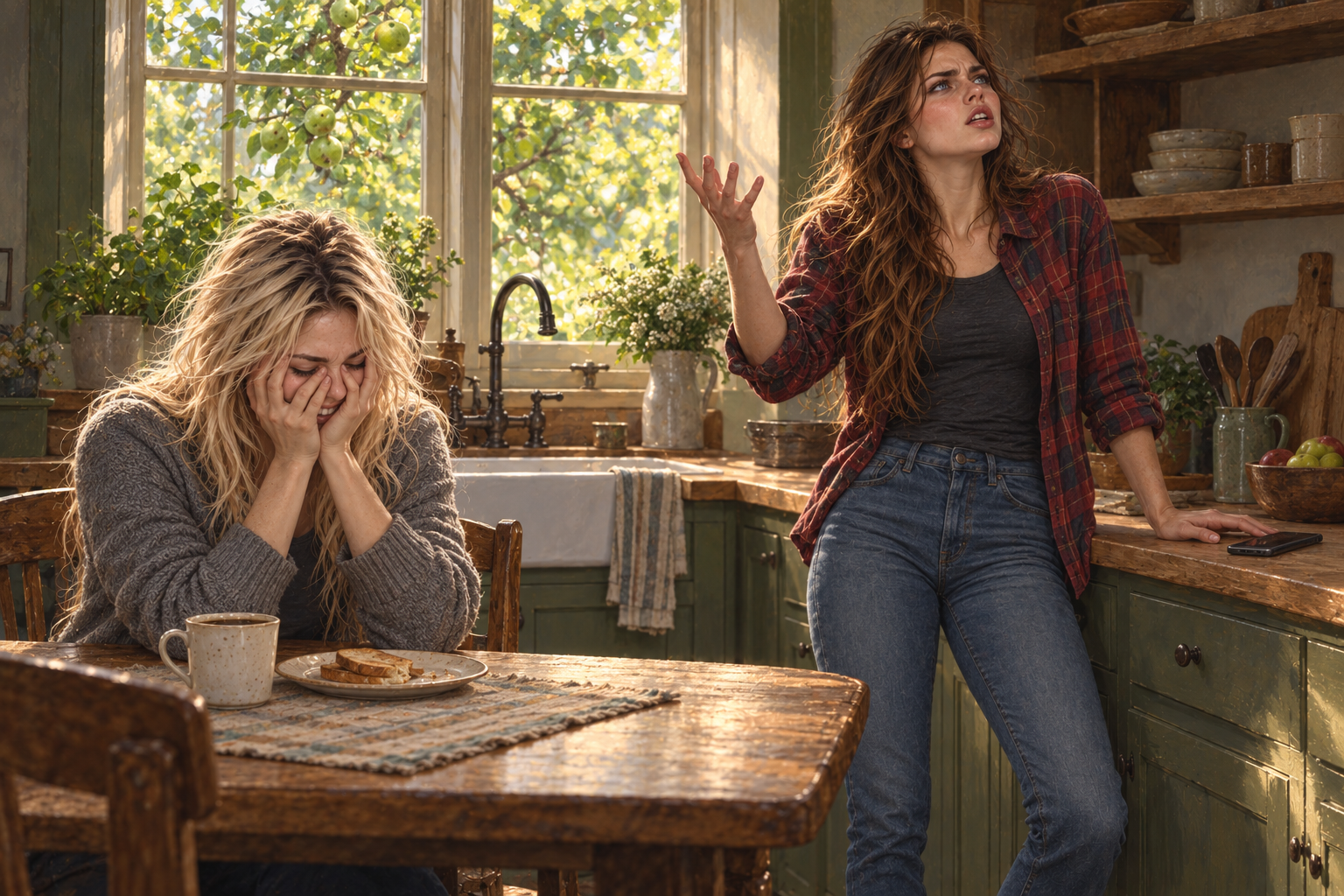
“Yes.”
Val looked at her for a moment longer. Then she put her coffee down, very carefully, and put her face in her hands, and her shoulders began to shake, and it was some time before Kyra understood that she was laughing.
· · ·
She did not shout at him in the comments. She wanted to. She stood at her counter with her thumb over the little box and wanted to more than she had wanted anything in some time.
Instead she wrote something else. It took her the better part of an hour, and she showed it to Val before she posted it, which she had not done with any of her own before.
hi all! just to say — it’s natural. all of it, up top and down below, always has been. she’s never dyed a hair on her head in her life, and she’s not going to start for you. I think it’s beautiful and so does she, and it’s not up for a vote. thank you for watching xx —C
Val read it twice.
“She’s not going to start for you,” she said.
“Too much?”
“It’s not too much.” Val handed back the phone. “It’s the exact amount. Post it.”
“You don’t want to add anything?”
“No,” said Val. “I don’t think I do.”
· · ·
Kyra’s comment got more little hearts than the comment about bleaching. Then more than twice as many. People quoted it. Somebody made a picture of it, white letters on black, with the little gray spiral in the corner, and it went around the site on its own, without the video, without anything, and came back with more hearts.
COPPER DEFENDING HER GIRL’S HONOR AT 2AM
”it’s not up for a vote” chills
the way she said “and so does she” like she knows
blondie hasn’t said anything though??
blondie doesn’t need to say anything, copper said it
we need blondie’s take
@Blondie thoughts???
Val did not reply.
She did not reply to any of it. Not to the bleaching, not to the hedge, not to the drapes, not to the dozen strangers who asked her directly, by name, what she thought. She went on replying to other things — It is a bed and It is the lamp and We do not have a cat — in the same flat voice, under the same flat B, at the same rate as before. But on this, she said nothing at all, and the silence sat in the middle of all that noise like a stone in a river, and the river went around it, and argued about what it meant.
· · ·
The fifth video went up on the Saturday.
Kyra did not think about it while they were making it. She had stopped, mostly, thinking about the camera; it had become a thing in the room, like the chair or the blanket over the window, and she did what she always did, which was go looking for Val the long way, slowly, from above, with her fingers and her patience and her low nonsense about the man with the pager, working her way down through all that thick dark warmth — finding the lie of it, following it, easing it aside and holding it with the edge of her hand — until something thickened under her fingers and came up through it to meet her.
She did not think about it until the Sunday, when she read the comments.
the way the redhead has to like SEARCH for it every time lmao
it’s a reveal. it’s a whole magic trick. she hides it in there and it comes out at the end
it’s a prop, look, it just APPEARS
no it’s not, she’s just patient. you can see her being patient. look at her face
how long does copper spend looking, someone time it
2:14 this time
the redhead is so gentle with her though. like she’s done it a thousand times
Kyra put the phone down.
“They think it’s a trick,” she said.
Val, across the table, did not say anything for a moment.
“It is a very good trick,” she said eventually. Her voice was odd. “It takes me a great deal of time to perform it.”
“Val—”
“Two minutes and fourteen seconds,” said Val. “Somebody timed it. On their own clock, from the first touch, which is the wrong place to start. But they timed it.” She looked at the phone, face down on the table. “I had wondered, once, whether anybody would ever see that. The waiting. Whether it would show, from the outside, to anybody but you.”
“And?”
“It shows,” said Val. “They think it’s a magic trick. But it shows.”
· · ·
That night, at Val’s house, in Val’s bed, with every lamp on, Kyra woke a little after one and found the other side of the bed empty.
She lay still for a while, listening. The house was quiet. No kettle, no pages. Then a sound from the bathroom across the hall — a cabinet door opening, very quietly, and after a long pause, closing again.
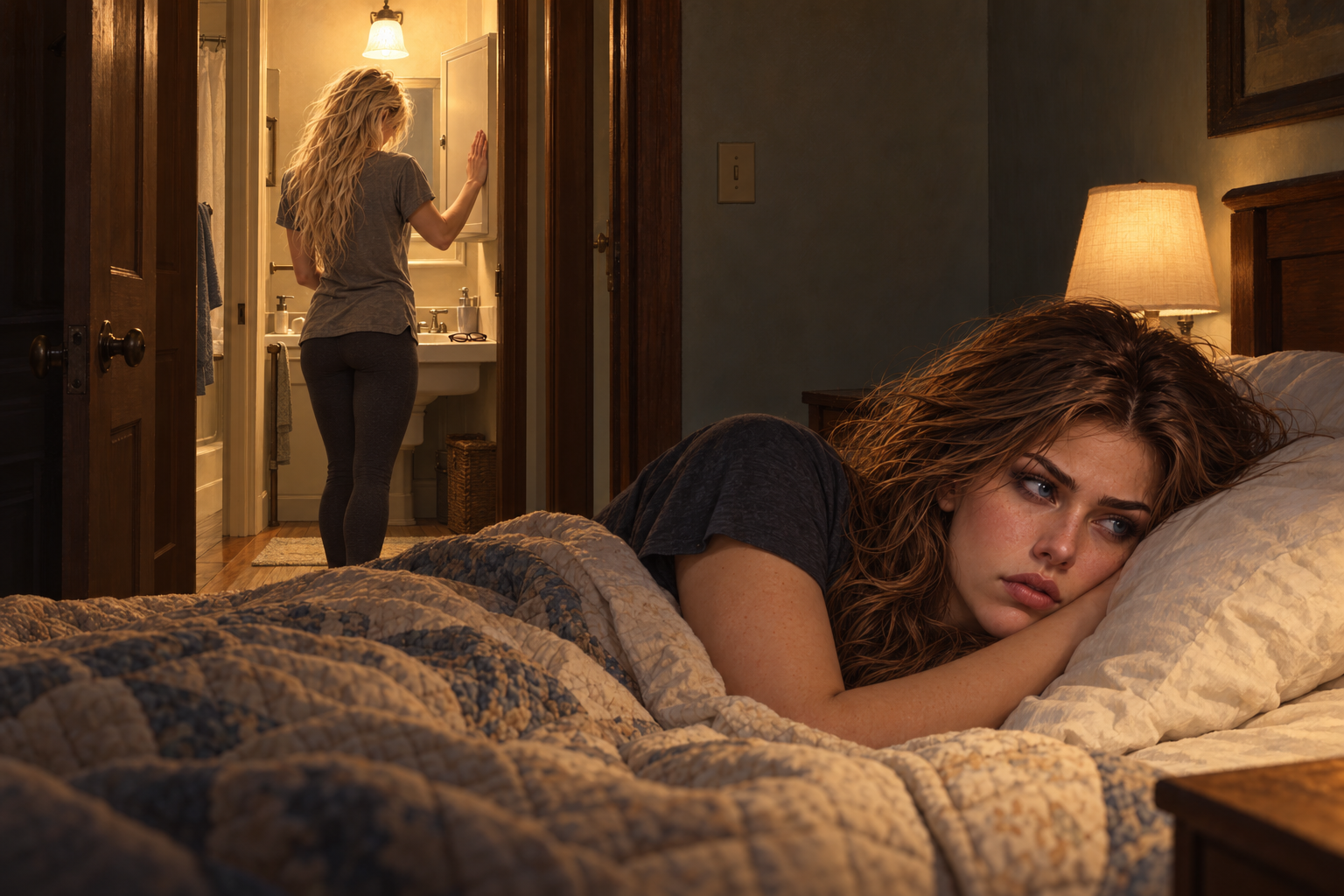
Kyra did not get up.
When Val came back she came back without a sound and lay down on her side with her back to Kyra, and Kyra lay looking at the pale fall of her hair across the pillow, honey in the lamplight, and the line of her shoulder, and waited.
“Do you think I should,” said Val, to the wall.
Kyra did not pretend not to understand.
“No,” she said.
Then she lay there and heard what she had said, and the speed she had said it at, and stopped.
· · ·
It was the oldest argument they had. It was older than most of the cities they had lived in.
In a very long life, Val had managed everything about herself. Her face, for the county. Her voice, her hands, her sleeves down to the wrist, her light, every lamp in every house. She had managed what she said and what she didn’t, and when, and to whom, and how much, and she had been doing it for so long that Kyra had sometimes thought there was nothing left of Val that Val had not decided.
Except that.
The dark below the pale. Thick and dense and entirely untended. The one thing about her body Val had never once taken in hand — because, Val said, there was no reason to; because nobody ever saw it; because it was nobody’s business. And Kyra, who had loved it since a mountain in the cold, had refused for all that time to let her so much as trim it, and had never been able to say exactly why, except that it was the one thing about Val that Val did not manage, and Kyra could not bear the thought of her managing that too.
Once, in Portland, Kyra had taken the whole of it with a razor, slowly, at Val’s asking, with Val lying back on a towel in the lamplight not knowing what to do with her face. It had grown back in weeks. Neither of them had ever quite said what it had meant.
And now there were strangers.
Hundreds of them. Thousands. Arguing about it in capital letters. Timing it. Drawing little hedges. Telling her, a word at a time, from bedrooms all over the world, what she ought to do with the one thing about herself she had never once done anything with.
· · ·
“It isn’t mine to say,” said Kyra.
Val did not turn around.
“I said no. I said it too fast. I’ve been saying it too fast for as long as we’ve known each other, and you’ve let me, and I don’t think I’ve ever once asked you whether you wanted me to.” Kyra looked at the line of her shoulder. “It’s yours, Val. It’s not mine and it’s not theirs. It’s the one thing about you that’s never belonged to anybody. Not even you, really. You’ve never managed it. And I don’t want to be the one who decides it for you any more than I want them to.”
Val was quiet for a long time.
“Strangers have opinions about it,” she said at last.
“Strangers have opinions about everything. Strangers have opinions about the lamp.”
“No one has ever had an opinion about it,” said Val, “but you. In all this time. It has been the one thing about me that nobody ever looked at and nobody ever decided. Not my father. Not the county. Not me.” A pause. “And now everybody’s looking. And everybody’s decided. And I find that I am lying here at one in the morning, opening cabinets.”
“I heard.”
“I know you did. I wanted you to.” Val turned over then, at last, onto her back, and looked at the ceiling. “I’m not going to do anything. Not tonight.”
“All right.”
“I wanted you to know I’d thought about it.”
“All right,” said Kyra. “Thank you for telling me.”
· · ·
Val lay on her back in the lamplight with her hands flat on the blanket. Then, after a while, she reached out without looking and found Kyra’s hand and brought it across and laid it on her own belly, below the navel, and held it there.
Kyra did not move it. She did not go looking. She left her palm where Val had put it, on the warm skin at the very top of all that dark, and felt it rise and fall under her hand with Val’s breathing.
“It’s yours,” said Kyra, very quietly.
“I know,” said Val. “That’s what I’m deciding.”
— end of chapter nine —
July · the spare room
The chair had been in the corner of Kyra’s bedroom since the autumn with a pile of clean laundry on it, which was what it had been doing, in one bedroom or another, for most of its life.
It was a plain wooden chair. Armless, upright, a little scarred along the front edge of the seat where something had once been dragged across it, and darkened at the top of the back where hands had held it. Nobody had made it for them. It had come with a house in Portland, a long time ago — stood in the corner of a bedroom there holding magazines, until one rainy evening in October Kyra had dragged it out in front of the mirror without explaining why, and Val had stood in the doorway and watched her do it with an expression of grave scientific interest. It had come with them through three houses since, and two sets of names, and every time they moved, Val had looked at it on the curb with the boxes and said we could leave that, and every time Kyra had picked it up and put it in the car.
On a Friday in July, Kyra took the laundry off it, and carried it down the hall, and set it down in the room that was nowhere, at the foot of the bed, facing the wall.
Val, in the doorway, did not say anything at all for some time.
“It’s in the first column,” said Kyra.
“I know it’s in the first column. I watched you write it.”
“Then it’s allowed.”
“It’s allowed,” said Val. She was looking at the chair the way she had looked at it in a Portland bedroom, with exactly the same expression, and Kyra could see her remembering, and could see her decide not to say so. “I simply hadn’t expected it so soon.”
· · ·
They had to move the phone.
That took most of an hour, because Val would not let a single inch of the room go into the frame that had not been looked at twice. If the chair faced the wall, the camera had to be behind it; if the camera was behind it, it would see the back of the chair, and the back of whoever was in the chair’s lap, and past them, the cream wall, and nothing else. Val stood the phone on its books on top of the dresser, which they dragged in from Kyra’s bedroom, and then took it down again and stood it on a stack of three dictionaries on a stool, and then took one dictionary away.
“There,” she said, and stood back, and looked at the screen.
Kyra came and looked over her shoulder.
A cream wall. The back of a plain wooden chair. Nothing else in the whole of the frame but light.
“It’s a picture of a chair,” said Kyra.
“For now,” said Val.
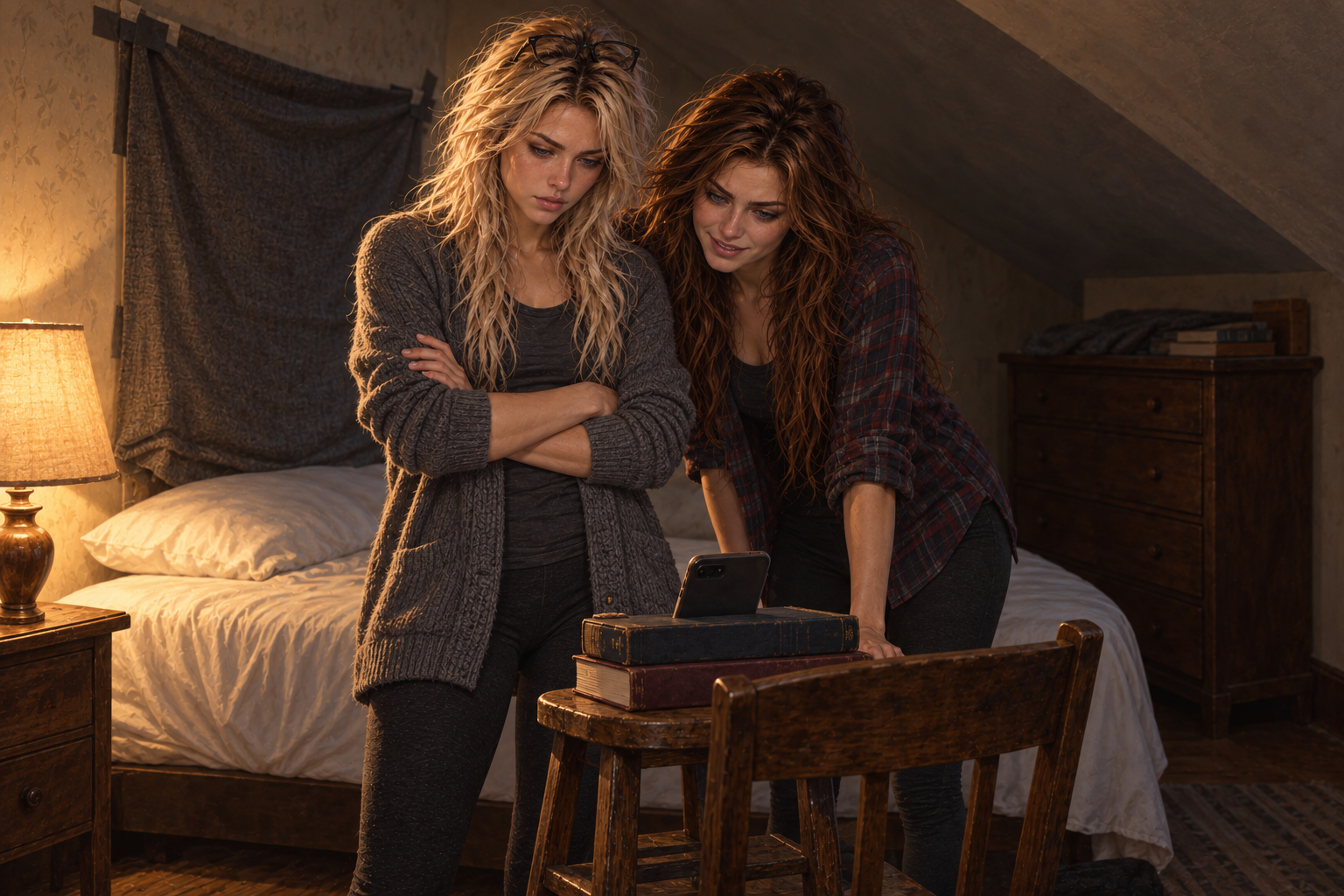
· · ·
Kyra sat in it first. That was how it went; it had always been how it went. She sat in it the way she had sat in it the first time, upright, with her bare feet flat on the floor and her knees a little apart and her back against the slats, and her black mask on and her hair pinned up off her neck, and she looked up.
Val came around the side of the chair. She had the braid down her back and the mask on and nothing else at all, and she stood for a moment in the lamplight looking down at Kyra — and Kyra, looking up at her through the fine dark mesh, thought, as she had thought a thousand times and had never once got used to, oh.
Then Val put one knee on the seat beside Kyra’s hip, and then the other on the other side, and lowered herself down astride Kyra’s thighs, facing her, slowly, with both hands on Kyra’s shoulders, until her whole weight had come down through Kyra’s legs and into the seat of the chair, and the chair took it, as it had always taken it, without a sound.
“Hello,” said Kyra.
“Don’t,” said Val, and kissed her.
· · ·
It was slow. It was always slow in the chair. That was the whole of what the chair was for; Kyra had worked that out in Portland, in front of a mirror, a very long time ago, and had never once had reason to change her mind.
She went looking with one hand, between them, low down, the long way, through all that thick dark warmth — easing it aside, holding it with the edge of her hand, talking low against Val’s jaw about nothing at all — while her other hand lay flat on the small of Val’s back and did nothing but stay there. It took the time it took. It always took the time it took. And then something thickened under her fingers and came up through all that dark to meet her, and curled, and took hold, and Val let out a breath against her mouth that she had been holding for some time.
They laced.
And Val began to move.
· · ·
She did not move the way the women on Val’s spreadsheet had moved. She did not move up and down, quickly, the way the camera wanted. She rolled — her hips going around, small and slow and continuous, the whole of her moving against the whole of Kyra, so that from the outside it looked like almost nothing at all and from the inside it was everything there was. Kyra put both her hands on Val’s hipbones, the way she had in Portland, and held them, lightly, and did not push and did not pull. She only held. And under her hands Val found the pace and kept it, and Kyra kept it with her, and between them, at the hip, small and steady and certain, the grip said there, yes, there, and Kyra’s hands said I know, and nothing at all needed to be said aloud.
Kyra could not see what the camera saw.
She knew what it saw. She had seen it once, a long time ago, in a mirror in a bedroom in Portland, over Val’s shoulder, by accident, and had never forgotten it. The long pale line of Val’s back, from the braid at the nape of her neck down the whole length of her spine to where it met the chair; the shoulders working; the slow roll of the hips going around and around; and at the bottom, where Val’s weight came down into Kyra’s lap, the cleft of her drawing longer and shorter with every turn of her hips, over and over, in no hurry at all.
That was what the camera saw. A stranger would see that. Thousands of strangers would see that, from the back, on their telephones, and not one of them would ever know that it was the thing Kyra had kept to herself since that October.
She found she did not mind. She found she was proud of it.
· · ·
It went on for a long time.
The roll deepened, by degrees, so slowly that Kyra could not have said when it started to change. Val’s hands came off her shoulders and went around the back of her neck, and locked there. Her forehead came down against Kyra’s — mask against mask, the edges of them touching — and her breath went short, and then shorter, and Kyra felt the stillness start to gather in her the way it always gathered, all through her, under the movement: the quiet getting deeper.
The light came up.
It came at the throat, close against Kyra’s own, faint and pale and the color of nothing on this world, and then along the insides of the arms locked around Kyra’s neck, and Kyra watched it come up out of the corner of her eye through the mesh, and thought, with a part of her that was somewhere else entirely, gray, on the phone. Bad lighting. A soft gray smudge around her shoulders.
And then the stillness broke.
Val’s back arched — all at once, the whole long line of it, from the nape of her neck down — and her head came down against Kyra’s shoulder, and her eyes were shut behind the open holes of the mask, and she came apart in Kyra’s lap without a sound, shaking, with her arms locked around Kyra’s neck and her whole weight gone down through the chair into the floor. The murmur started up in her, low against Kyra’s ear, with Kyra’s name in it, and Kyra turned her head and found Val’s mouth with hers and held it there until the murmur stopped, and kept her hands on Val’s hipbones the whole time, light, steady, not pushing and not pulling, the way she had in Portland.
Kyra went after. She always went after; she always went loud. She could not help it, in a chair, with Val’s weight on her and Val’s light going slowly down and out against her throat, last at the wrists where they lay on the back of her neck.
The chair did not make a sound. It never had.
· · ·
They did the review at one in the morning at Kyra’s kitchen table, as they always did, and Val watched the end of it four times without speaking.
“Well?” said Kyra.
“It’s very good,” said Val. Her voice was odd. “It’s very—” She stopped. “I’ve never seen it from there.”
“I have.”
“I know you have. In Portland. You told me.” Val looked at the screen, at the long pale line of her own back, frozen, mid-roll, with the braid down the middle of it. “I didn’t know it looked like that.”
“Like what?”
Val did not answer for a moment.
“Like somebody you’d want to watch,” she said.
· · ·
It went up on the Saturday. By the Sunday night it had more views than all the others put together, and by the Wednesday the page had a new number at the top of it, under the subscribers, that Kyra did not read out because it made her stomach go.
And the comments did not stop.
THE CHAIR
I have watched this nine times and I am not ok
the way she MOVES. it’s like the slowest thing I’ve ever seen and I can’t look away
nobody does it like this. everybody else goes so fast. this is like watching the tide
the blonde’s back should be in a museum
it’s the redhead’s hands though. look at the redhead’s hands on her hips. she’s not even doing anything and somehow she’s doing everything
the chair videos are the only videos
That last one stuck. Somebody else said it, and then somebody else, and by the end of the week the comment sections had a name for what Kyra and Val were making, and the name was not the name of the channel at all. The chair videos. Strangers asked for more chair videos. Strangers said I only watch the chair ones. Strangers asked, in a great many spellings, the same question, over and over, under every single one.
WHERE IS THE CHAIR FROM
· · ·
The furniture detectives came on the Thursday.
Kyra had not known there were people on the internet who could look at the back of a chair for four seconds, in lamplight, behind a naked woman, and tell you where it was made. It turned out there were a great many of them, and that they did not agree.
that’s a ladder-back, early american, turn of the century maybe
it’s NOT a ladder-back, look at the slats, they’re vertical, that’s a spindle back
it’s mid-century for sure
it’s ikea
it is NOT ikea, look at the wear on the top rail
farmhouse chair, I have one exactly like it, here’s the link
The link went to a chair that looked nothing like it. Then somebody posted another link, to another chair that looked nothing like it, and then somebody posted six. By the Friday there was a list — a long one, with pictures — of every wooden chair anybody had ever seen that looked even slightly like the one in the chair videos, and none of them were it, and all of them were for sale.
“They want to buy it,” said Kyra.
“They can’t buy it.”
“They want to buy it so much, Val.”
“It came with a house,” said Val, “a very long time ago. Nobody made it for us. Nobody’s made one since.” She was reading the list on her laptop, with her glasses on, at Kyra’s kitchen table, with an expression of increasing distress. “This one is pine. This one is painted. This one has arms, Kyra, they’ve posted a chair with arms, it’s not even the right—”
“Answer them.”
Val looked up.
“Answer them,” said Kyra again. “Once. You’ve been reading this all week like it’s a fire. You want to. Go on.”
· · ·
Val sat for a while with her hands on either side of the laptop.
Then she took Kyra’s phone off the table — Kyra let her — and typed for some time, and read it back, and changed one word, and handed it over.
Kyra read it.
It does not matter where the chair is from. Any armless wooden chair with an upright back and a seat about seventeen inches from the floor will do. The rest is technique. —B
Kyra read it again.
“Seventeen inches.”
“I measured it this morning.”
“Of course you did.”
“It is very nearly seventeen and an eighth,” said Val, “but I didn’t think they needed the eighth.”
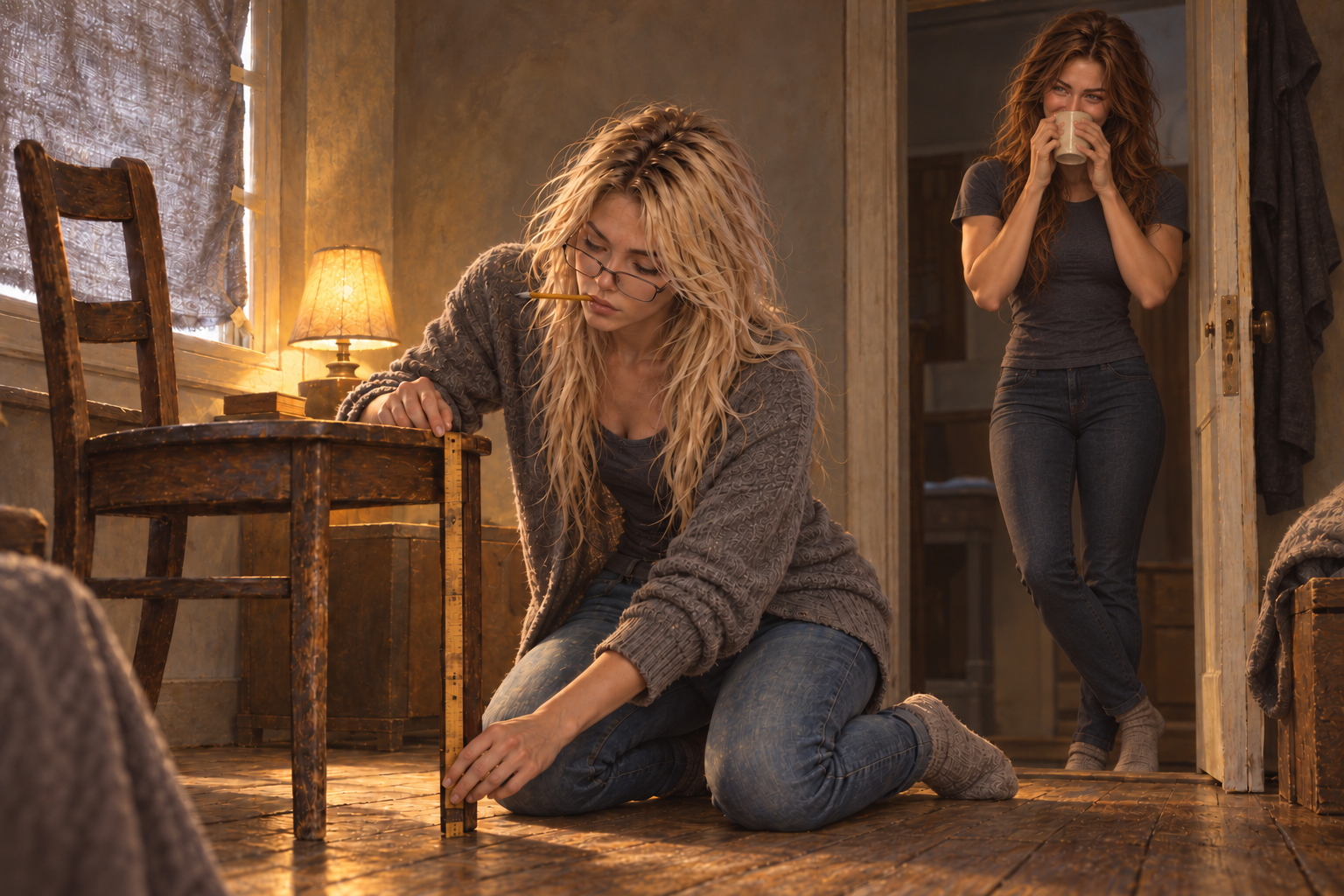
· · ·
By the Saturday it was everywhere.
SEVENTEEN INCHES
”the rest is technique” I’m going to have it tattooed
blondie really said get a ruler
went and measured every chair in my house. none of them are seventeen inches. I am being punished
seventeen inches is the new six inches
the rest is technique the rest is technique the rest is technique
Somebody made a picture of it: a plain wooden chair, drawn in white on black, with a little dotted line from the seat to the floor and 17” beside it, and under it, in tidy letters, the rest is technique. It went around the whole site. It went around other sites. It came back, a week later, on a T-shirt, for sale, which Kyra bought, and which Val would not let her wear.
And then the chairs began to arrive.
Not to them. To everybody else. As seen in the chair videos, said a shop in a city Kyra had never heard of, under a picture of a pine chair with a painted seat. The Andromeda chair, said another, with a picture of a chair with arms. 17” seat height — the original, said a third, and the chair in the picture had a cushion.
“A cushion,” said Val.
“I know, sweetheart.”
“It has a cushion.”
· · ·
It was late on a Sunday when Val went quiet about it.
Kyra was on her couch, scrolling, reading the new ones aloud, and Val was in the armchair with her laptop, and the laughter had gone out of her face at some point in the last half hour without Kyra seeing it go.
“What?” said Kyra.
Val turned the laptop around.
It was a comment. Not a joke; not a link. A long one, careful, from somebody who had clearly known what they were looking at.
I restore furniture for a living. That is not a reproduction. Look at the joinery where the back legs meet the seat rail, and the turning on the stiles, and that wear pattern on the front edge — that’s decades of something being dragged across it. That’s a factory chair from the Pacific Northwest, made not long after the war, I’d guess. There were a lot of mills up there making exactly this pattern. If I had to bet, I’d say Oregon or Washington.
Kyra did not say anything.
“It’s one comment,” she said eventually.
“It’s one comment,” said Val. “It’s one comment out of four thousand, and most of the people who read it will think it’s somebody showing off. And the chair is from a house two hours from here, a very long time ago, and there are a great many chairs exactly like it in a great many houses in two whole states.” She turned the laptop back around. “And none of that is the point.”
“What’s the point?”
“That it was the oldest thing in the room,” said Val. “And it is the first thing in the room that somebody has dated.”
· · ·
She did not ask Kyra to take the chair out of the videos. Kyra waited all evening for her to, and she did not.
At some point after midnight, in Kyra’s bed, in the dark, Val said: “I thought about it.”
“I know you did.”
“It’s in the first column.”
“It’s in the first column.”
“And it’s the first thing anybody has really loved, of ours,” said Val. “Not us. They don’t know us. The chair.” A pause. “I’m not going to take the first thing anybody’s loved away from them because one man knows his joinery.”

Kyra found her hand under the blanket.
“That’s not very Val of you.”
“I know,” said Val. “I’ve been doing a great many things this summer that aren’t.” Another pause. “I’m going to keep watching that comment. Every day. I want that understood.”
“I’d be worried if you didn’t.”
“And I’d like the T-shirt to go in a drawer.”
“No,” said Kyra, and Val made a sound in the dark that in anybody else would have been called a laugh.
— end of chapter ten —
August · Val’s bedroom
The originals had been gone for a very long time.
Kyra knew exactly when they had gone, and she did not like to think about it. They had been cotton, and thin, and cheap, and bought on a whim from a bin in a shop on Hawthorne that had since been a bank and then a coffee shop and then a bank again; and they had been washed a great many times, and worn a great many times, almost none of them by Kyra. Somewhere in a house two houses ago, the elastic had gone. Then a seam. And then one morning Val had held them up to the window and looked at the light coming through them and folded them, very carefully, into quarters, and put them in the stove without a word, and Kyra had not said anything either, because there was nothing to say that would not have been smaller than it.
That was the thing about Val. She burned the things that mattered. She always had.
· · ·
Kyra started looking in the spring, the week after the first video, without telling anybody.
It took her until August. It took her the whole of the summer and the better part of her evenings, on her phone, in her bed, with Val asleep beside her or two miles away in her own house with every lamp on, scrolling through ten thousand pairs of women’s underwear on a hundred websites with the dogged absorption of a woman looking for a missing hiker in a very large forest.
They had to be French-cut. They had to be cotton. They had to be pink — not that pink, and not that pink, and certainly not that one, but the exact soft unreasonable pink that had not been Val’s color at all, and had been, somehow, the best part of it. And they had to be narrow at the front. Nearly nothing. Cut high at the leg, almost nothing at the sides, and a front panel so narrow that on Kyra, who kept herself short, they would cover what they needed to; and on Val, who did not and never had—
Well. That was the point.
· · ·
She found them on a Tuesday in August, at two in the morning, on a website belonging to a small shop in a city on the other side of the country, and sat bolt upright in bed, and said “Oh,” out loud to nobody, and bought three pairs before she could think about it, in case.
They came in a little brown parcel, nine days later, to an address that went nowhere. Kyra took them out in her own kitchen and held them up to the window, one pair at a time, and looked at the light coming through them.
They were right. They were not the same — nothing was ever the same, and she had stopped expecting it to be a very long time ago — but they were right.
She wrapped one pair in tissue paper, very badly, because she had never once in her life wrapped anything well, and put the other two in her own drawer, under everything.
· · ·
She gave them to Val on the Friday, at Val’s kitchen table, after dinner.
She put the little tissue-paper parcel on the table between them, next to the salt, and folded her hands, which she never did, and waited.
Val looked at the parcel.
Then she looked at Kyra.
“It isn’t my birthday,” said Val. “Neither of us has a birthday. We have never had a birthday on this planet.”
“It isn’t for your birthday.”
“Then what is it for?”
“Open it,” said Kyra.
· · ·
Val opened it the way she opened everything, slowly, with both hands, folding the tissue back a layer at a time without tearing it, as though she might need it again; and at the last layer she stopped.
She did not take them out. She sat there with the tissue open on the table in front of her and her hands on either side of it and looked down at what was inside, and Kyra watched her face, and saw it go.
It did not go far. It never went far, with Val, in a kitchen, with the lamps on. But Kyra had been reading that face for longer than most of the countries on this planet had been countries, and she saw it go all the same — the composure come apart at one corner of the mouth, and the jaw, and something behind the eyes, and then come back together again, very slowly, like a woman picking up something she has dropped and putting it back exactly where it was.
“Where,” said Val, and stopped.
“A shop. On the other side of the country. It took me all summer.”
“All summer.”
“Since the week after the first video.” Kyra kept her hands folded on the table. “They’re not the same. Nothing’s ever the same. But they’re right.”
Val did not say anything.
“You’ve never once in your life wrapped anything well,” she said at last.
“I know.”
“This is the worst wrapping I’ve ever seen.”
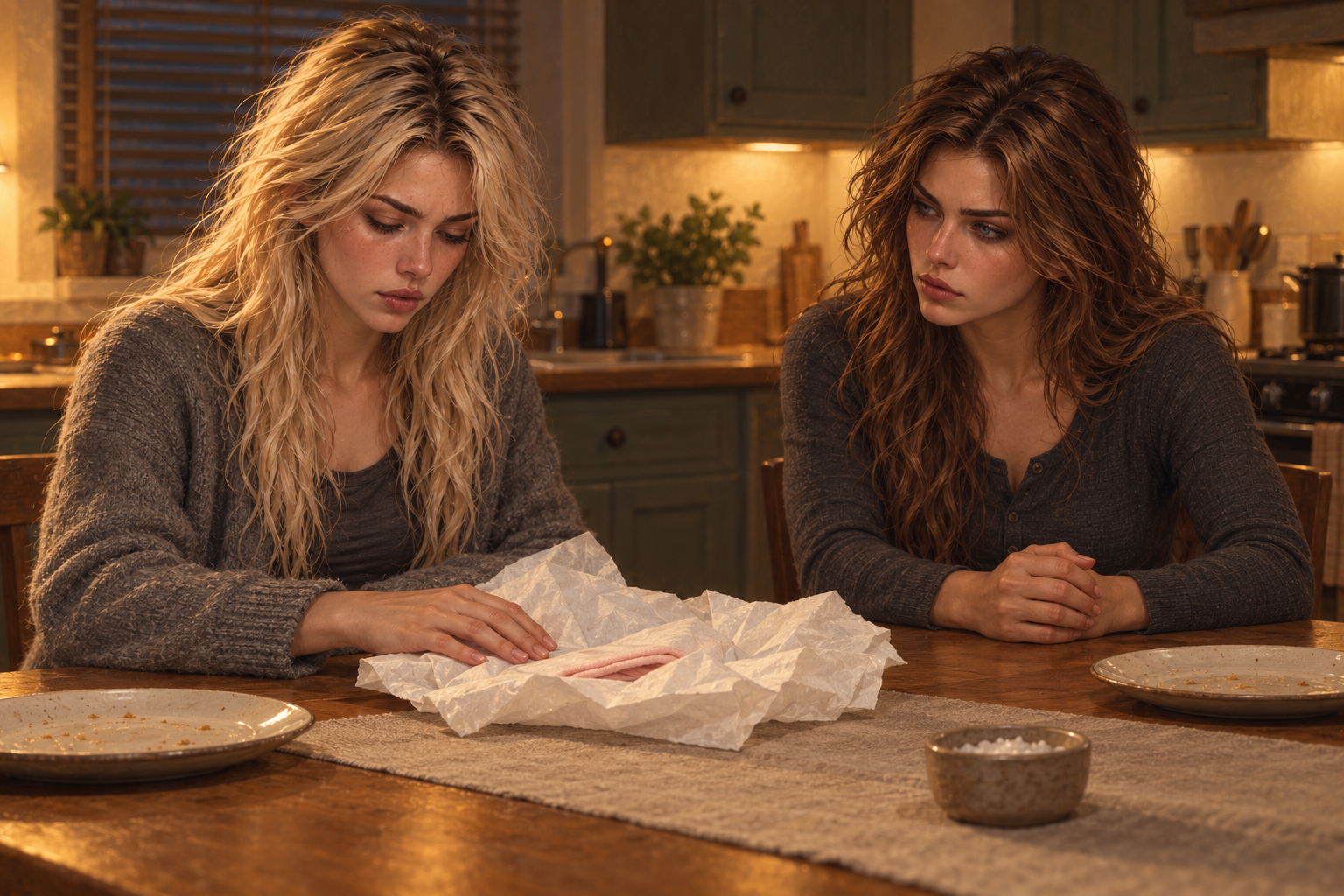
“I know, sweetheart.”
Val put one hand flat on the tissue paper, very gently, over what was inside it, and left it there.
· · ·
She tried them on that night, upstairs, in her bedroom, with every lamp on. She did not ask Kyra to leave, and she did not ask her to stay; she simply went up, and Kyra waited a minute and a half at the kitchen table, counting, and then went up after her and stopped in the bedroom doorway.
Val was at the long mirror on the back of the wardrobe door. She had taken off everything else. She had drawn them up, one leg and then the other, and she stood there in the lamplight in nothing but the pink ones, with her hair loose down her back and her hands at her sides, looking at herself.
They did not come close to containing her.
They never had. The dark of her came out at both sides of that narrow front panel and over the top of it, dense and unapologetic, the way a hedge comes through a fence. Val turned a little to the left, and a little to the right, and looked at it from both sides with her head on one side.
And then — Kyra saw it happen, in the glass — she put one hand on her own hip, which was not a thing she did.
· · ·
She looked up into the mirror, and Kyra was in the doorway behind her, as Kyra had been in a doorway once before, in Portland, on a Thursday in June, a very long time ago.
Val went absolutely still. Then she looked at the floor.
Kyra crossed the room without a word. She came up behind her, close, her front against Val’s back, her chin just past Val’s shoulder, so that in the glass there were two faces where a moment ago there had been one, and she put her mouth against the side of Val’s neck, just under the ear, and kissed her there, softly, once.
“Don’t you dare look at the floor,” she said.
Val’s breath went out of her. It was very nearly a laugh.
“You said that last time.”
“I’ll say it every time. Look up.”
Val looked up.
· · ·
They stood there for a long time, the two of them in the mirror, in the lamplight. Kyra’s hands came to rest on Val’s hips, light, the way they did in the chair. Val did not move away from them.
“That Thursday,” said Val, eventually, to the glass. Her voice was very quiet. “In Portland. When you found me.”
“I remember.”
“I had never—” She stopped, and started again. “I had stood in front of a great many mirrors in a great many houses. To check my face, for the county. To check my sleeves were down. To make sure nothing showed. I had never once stood in front of one to look at myself because I wanted to. And that afternoon I was alone in a quiet house with your drawer open and I put those on, and I looked, and I found—” She stopped again.
“That you liked how you looked,” said Kyra.
“That I liked how I looked.” Val’s hands had come up, at some point, and closed over Kyra’s on her hips. “It was the first time. In my whole life. On either world. And I’ve never told you that, because I didn’t have a way to say it that wasn’t ridiculous. And then I put them in the stove. When they wore out. And I never told you why I did that, either.”
Kyra kissed the side of her neck again, and did not ask.
“Because I couldn’t stand the thought of them in a drawer somewhere after,” said Val. “In some house, after us. Somebody finding them. Not knowing what they were.” She looked at the two of them in the glass. “That’s the only reason. They were the first time I ever liked myself. I wanted them to be ours, or nothing.”
· · ·
Kyra did not say anything for a while.
Then she said: “Wear them for the camera.”
Val’s eyes came up to hers in the mirror.
“I know,” said Kyra. “I know what I’m asking. I know what they are. And I know they’ll be everywhere, after, in a thousand copies, and you’ll never be able to put them in a stove again.” She kept her hands where they were. “But you just told me they were the first time you ever liked how you looked. And there’s going to be a stranger somewhere — a lot of strangers — looking at you in those, and liking how you look. And they won’t know why. They’ll never know why. But they’ll see it.” She paused. “I want them to see what I saw. That Thursday. In the doorway.”
Val was quiet.
“That’s the third column,” she said at last. “Things that would sell.”
“It’s not the third column. It’s the first. Things we love.”
“Things we love and will show them.” Val turned, then, in Kyra’s hands, so that they were face to face and not in the glass at all. “You’ve put it in the wrong column on purpose.”
“I’ve put it in the right column on purpose,” said Kyra. “You put it in the stove. I’m putting it in the first column. That’s how we’ve always done it, the two of us. You burn the things that matter, and I keep them, and somewhere in the middle we come out about right.”
· · ·
She wore them for the camera on the Saturday.
They did a chair video, because the chair videos were what the strangers wanted most and because Kyra wanted to see it from there, afterward, on the laptop, at one in the morning: the long pale line of Val’s back, and the braid, and the slow roll of her hips going around and around in Kyra’s lap, and at the bottom of it, before anything else had happened, the pink of those ridiculous briefs, and all that thick dark coming out of them at both sides and over the top, like a hedge through a fence.
It was the best thing they had ever made. Kyra knew it while it was happening. She knew it at the review, when Val stopped the frame near the beginning and looked at it for a long time and said nothing and then said, “Oh,” very softly, the way Kyra had said it at two in the morning on a Tuesday in August.
· · ·
It went up on the Sunday.
THE PINK ONES
I’m sorry but the pink with the dark hair is the best thing I’ve ever seen
they don’t even cover anything that’s the BEST part
it’s like they’re not even trying to contain it lmao
that’s not her color at all and somehow that makes it better??
blondie in pink is my new religion
WHERE ARE THEY FROM
Then the hunt began, the same as it had for the chair, only worse. Within a week there were lists. Within two there were a dozen shops claiming to sell the pink ones, in a dozen wrong pinks, in a dozen wrong cuts, one of them with lace and one of them with a little bow on the front, which Val looked at in silence and then closed the laptop on.
“A bow,” she said.
“I know.”
“There is a bow on it, Kyra.”
“Nobody’s ever going to find them,” said Kyra. “Not the real ones. The shop is tiny, and it’s on the other side of the country, and I’ve bought three of the only six pairs they had in that pink, and I’m not telling anybody.”
“You bought three?”
“In case,” said Kyra.
· · ·
After that, every video without them got the same comments, under it, within the hour, a dozen at a time.
where are the pink ones
no pink ones today?? 😭
petition for the pink ones every video
blondie please
Val did not answer any of them. She wore them when she wanted to wear them, which was not every time, and was not on any schedule anybody could work out, and the strangers argued about that too — whether it meant something, whether it was a mood, whether there was a pattern — and there was, and nobody ever found it, and Kyra knew exactly what it was, because it was the nights Val had stood in front of the mirror first, alone, before she came into the room that was nowhere, and liked how she looked.
· · ·
It was Kyra’s idea to wear them herself.
It was the end of August, and very hot, and they had made a great many videos by then, and Kyra had got it into her head — she could not have said how — that it would be extremely funny. She took the second pair out of her drawer from under everything and put them on in her own bedroom and came down the hall to the room that was nowhere in them and nothing else, with her mask on and her hair pinned up, and Val, already in the chair, looked up at her and went perfectly still.
“Those are mine,” said Val.
“They were mine first.”
“You gave them to me.”
“I gave you one pair,” said Kyra, and sat down in Val’s lap, facing her, with her knees on either side of Val’s hips, which was not the way around they did it, which was not the way around they had ever done it in the chair, and Val looked up at her with an expression Kyra had never once seen on her face in all their lives together, which was outrage, and something else underneath it, entirely helpless.
It was the funniest video they ever made. Kyra laughed the whole way through. On her, the pink ones covered everything they needed to and made a fairly serious argument about the rest, and the strangers lost their minds.
COPPER IN THE PINK ONES
she STOLE THEM
blondie’s face when she walks in i’m screaming
”those are mine” you could SEE her say it through the mask
this is a crime and i want to be a witness
· · ·
That night, in Kyra’s bed, Val said, in the dark: “I want them back.”
“You can have them back. They’re on the floor.”
“Not those. Those are yours now. You’ve worn them on camera. They’re ruined for me.” A pause. “I want the third pair.”
Kyra started to laugh.
“How do you know there’s a third pair?”
“You said in case,” said Val. “You always buy three of anything in case. You bought three masks.” She turned over. “Where is it?”
“In my drawer. Under everything.”
“Leave it there,” said Val.
Kyra turned her head on the pillow and looked at her.
“In case?”
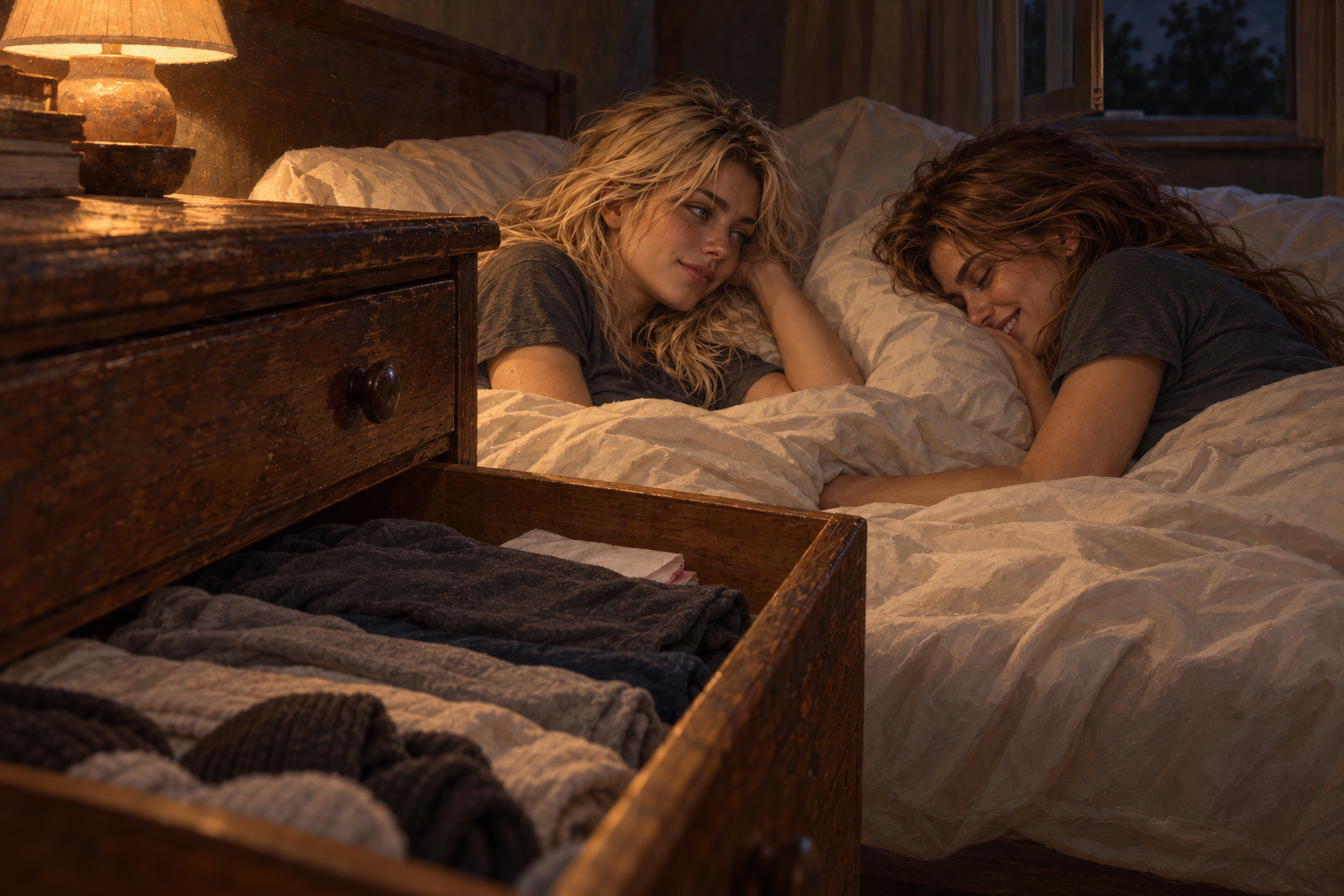
“In case,” said Val, “the other two ever wear out. So that this time, when I’m holding them up to the window and the light is coming through, there’ll be one more.” She found Kyra’s hand under the blanket. “I’d rather not put anything else in a stove, if I can help it. I’ve found I don’t like it as much as I used to.”
— end of chapter eleven —
October · Kyra’s kitchen, late
By the autumn there were too many comments to read.
Kyra had read every one, all summer — at breakfast, at the fire hall, in the bath, in bed with the brightness turned down — and somewhere in September she had stopped being able to. There were hundreds under every video. Thousands, under the chair ones. They came in faster than she could scroll, in a dozen languages, at every hour of the day and night, and most of them were the same few things said over and over: the chair, the pink ones, the glow, the blonde, the redhead, more, more, please, more.
She still read them. She read them the way you read weather.
And then there were the others, which did not come in the comments at all.
· · ·
SubRosa had a place for private messages. Kyra had not paid much attention to it; in the summer it had been mostly men, saying things that were either very short or very long and almost always about themselves, and she had read a handful and then started deleting them unread. Val had suggested turning it off altogether. Kyra had said no — she could not have said why — and left it on.
The first one came on a Sunday at the end of September, at ten past three in the morning, by the clock on the message.
It was long. That was the first thing Kyra noticed. Not long the way the men were long, rambling and capital-lettered and full of what they wanted; long the way a letter is long, when somebody has sat down with a thing they want to say and taken the time to get it right. It had paragraphs. It had commas in the right places.
It came from a name Kyra had not seen before. LongExposure.
She read it in bed, on the Sunday morning, with Val asleep beside her. Then she read it again. Then she reached over and shook Val by the shoulder until Val opened one eye.
“What,” said Val.
“Listen to this,” said Kyra.

· · ·
Hello. I don’t usually write to anybody. I’ve been watching for a few months now, and I’ve tried to write this several times, and I’ve decided tonight I’m going to send it whether it’s any good or not.
I wanted to say thank you. Not for the obvious things, though thank you for those too. For something I don’t think anybody else has mentioned, because I’ve read all the comments and nobody has.
Most people in your line of work are in a hurry. I don’t mean that unkindly; it’s what the work asks for. Everybody’s racing toward the moment they think the audience came for, and they get there, and the camera gets there, and it’s over. I’ve spent most of my working life watching people hurry toward the thing they want to see, and miss it.
You don’t hurry. The redhead doesn’t hurry. I’ve watched her, in every one of these, and she waits. She waits longer than anybody I’ve ever seen wait for anything on a screen. And the thing she’s waiting for is worth it, and she knows it’s worth it, and you can see on her face — even through the mask — that she would wait twice as long if she had to.
I don’t know who you are and I don’t want to. I don’t want anything. I’m not asking you for anything at all. I just wanted somebody to tell you that somebody is watching carefully, and has seen that, and thinks it’s the most beautiful thing on this whole site.
Let it come to you.
· · ·
Val said nothing for some time. She had both eyes open now and was looking at the ceiling.
“Read the end again,” she said.
“Let it come to you.”
“That’s all? No name?”
“No name. Just that.” Kyra looked at the screen. “She waits longer than anybody I’ve ever seen wait for anything on a screen.”
“I heard.”
“Nobody’s ever—” Kyra stopped. “Hundreds of them. Thousands. All summer. The chair and the pink ones and the glow, and the bleach, and the carpet and the drapes. And not one of them ever said anything about the waiting. Not once.” She put the phone down on her chest. “And this one did.”
“It’s one letter,” said Val.
“I know it’s one letter.”
“From somebody who writes at three in the morning,” said Val, “with every comma in the right place, and wants nothing, and signs it with an instruction.” She turned her head on the pillow and looked at Kyra. “Read it again. From the beginning. Slowly.”
· · ·
The second one came the next Sunday, at a quarter to three.
Hello again. I said I wasn’t going to write twice and here I am. I’m sorry. I watched the new one tonight — the one in the chair, with the pink — and there’s something I can’t stop thinking about and I’ve nobody else to say it to.
Whoever does your lighting: please don’t change it. I know it’s soft. I know it’s warmer than it ought to be, and it’s coming from too low and too much from one side, and the blonde blooms in it at the end until you can hardly see her for the glow. Every person who knows anything about light would tell you to fix it. Don’t fix it. It’s the only honest lighting I’ve seen on a screen in years. It looks like somebody’s room. It looks like a lamp somebody left on.
And there’s a moment, every time, in every one of these, where the blonde stops knowing the camera’s there. I don’t know if you know that. You probably do. It’s never in the same place. Sometimes it’s early and sometimes it’s nearly at the end. But you can see it, if you’re watching for it — something goes out of her shoulders and she isn’t performing for anybody any more, she’s just there. I’ve seen that happen to perhaps a dozen people in front of a camera in my whole life. It’s the rarest thing there is.
I hope you know how lucky you are, the two of you. I think you do.
Let it come to you.
· · ·
This time it was Val who read it, sitting up in Kyra’s bed with the phone in both hands and her glasses on, and when she got to the end she did not say anything at all, and Kyra watched her not say it.
“Somebody does our lighting,” Kyra said eventually.
“It’s a lamp.”
“It’s a lamp from the hardware store with a shade I bought at a yard sale.”
“I know what it is.” Val’s voice was very quiet. “It looks like a lamp somebody left on.” She read it again, to herself. “Whoever this is knows about light. Not the way people in the comments know about light. They say filter and LED and what’s the product. This one says too low and too much from one side.” She took her glasses off. “This is somebody who looks at light for a living. Or did.”
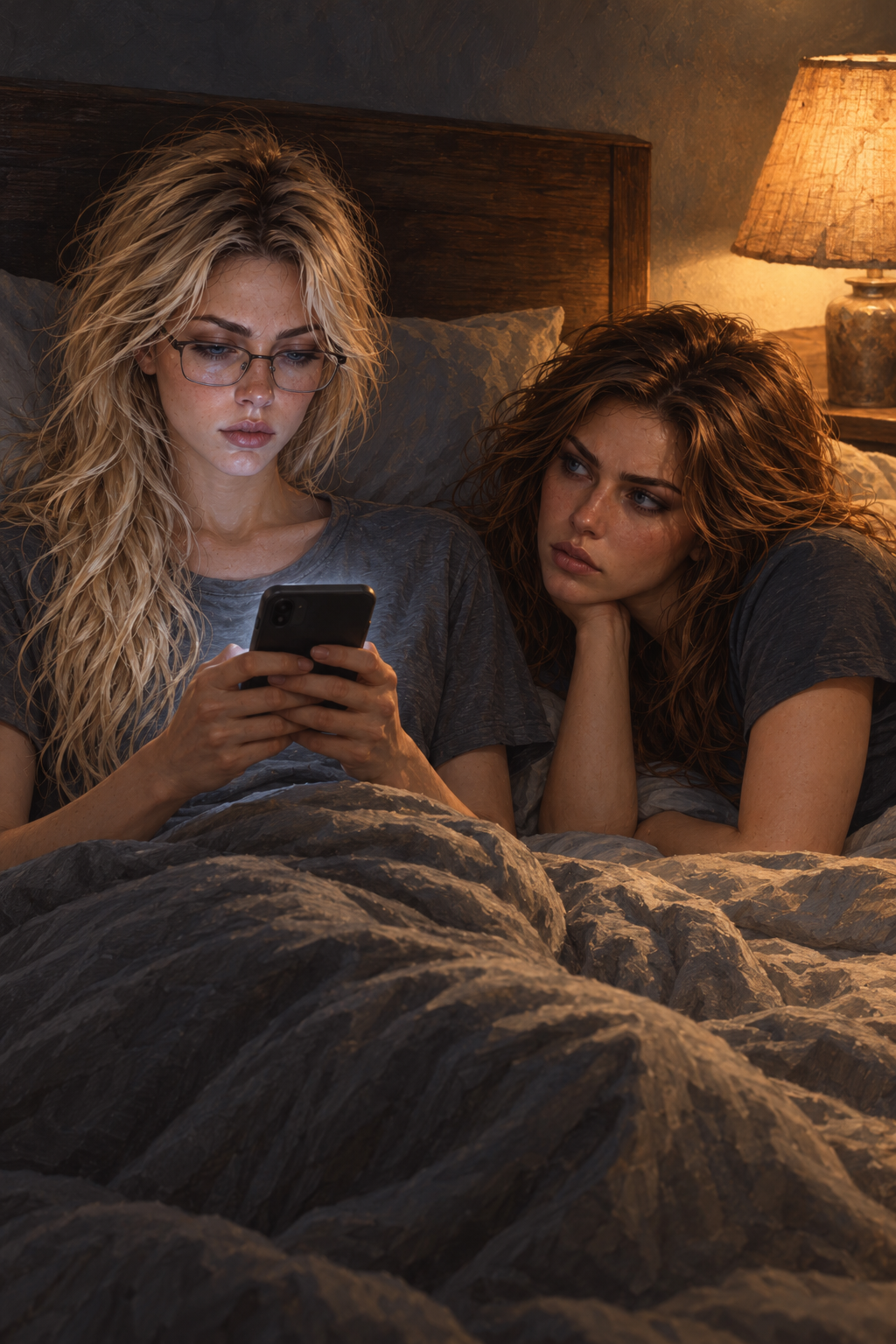
“And the other thing.”
“I know about the other thing.”
“Something goes out of her shoulders,” said Kyra. “That’s what I saw, Val. The first night. That’s the exact thing I saw. I watched it happen at the review and I didn’t have a word for it, and this—” She stopped. “Somebody else has seen where you forget.”
Val did not answer.
She sat there in the lamplight with Kyra’s phone in her hands, looking at the screen, and Kyra watched her face and could not, for once, read any of it at all.
“Somebody else,” said Val at last, very quietly. “Yes.”
· · ·
Kyra read the third one alone.
It came on a Sunday in October, at twenty to four, and she happened to be awake — she had woken at half past three for no reason and lain there in Val’s bed listening to the rain — and the phone lit up on the nightstand, and she turned it face down, and then turned it back over, and read it with the brightness all the way down so as not to wake Val.
It was shorter than the others.
I’m sorry. Three in a row. I promise I’ll stop.
I’ve had a long week. A long month, really. I won’t bore you with any of it. I watched the one where the redhead steals the pink ones, tonight, twice, and I laughed out loud at the blonde’s face, alone in my kitchen, at half past three in the morning, and I can’t remember the last time I did that. So I wanted to say thank you for that too.
I hope you never stop. I know you will someday. Everybody does. But I hope it’s a long time from now.
Let it come to you.
· · ·
She did not wake Val.
She lay there with the phone face down on her chest and the rain on the roof, and did not know why she was not waking her, and then knew.
Because this one was not for both of them. Not really. This one had been written by somebody alone in a kitchen at half past three in the morning, after a long month, laughing out loud for the first time in longer than they could remember. And Kyra had been that person — not in a kitchen, and not at half past three, but in every way that counted — for longer than she could bear to think about, in a great many houses, with the one person in the world she could have told asleep in the next room.
So she kept it. Just for the night. Just for a few hours, until the morning, when she would show Val, because she always showed Val everything in the end. But for a few hours, it was hers. One stranger’s long month, and a laugh in a kitchen, given to her and nobody else.
Let it come to you.
She turned the phone over and read it again, and again, until she knew it by heart.
· · ·
She showed Val at breakfast. Val read it without speaking, and then put the phone down beside her plate, very carefully, the way she put down things that might break.
“You read it last night,” said Val.
It was not a question. Kyra did not pretend it was.
“At twenty to four.”
“And you didn’t wake me.”
“No.”
Val looked at her across the table for a moment. Then she nodded, once, as though that were a reasonable answer to a different question, and picked up her coffee.
“We need to write back,” said Kyra.
“I know.”
“Properly. Not it is the lamp. Not a heart. Properly.”
“I know,” said Val again. She turned her cup a quarter turn on the table. “And I want us to agree something first.”
· · ·
It was a term. Kyra could tell from Val’s hands, which had come down flat on the table on either side of her cup, and from the way she said it, and from the fact that she waited until Kyra had put her own fork down.
“Kind,” said Val. “Always. We answer every one of these, if there are more of them. We answer them properly and we answer them kindly and we tell this person the truth.” She paused. “And nothing personal. Ever.”
“Val—”
“Nothing about us. Not where, not when, not what we do in the day, not a word about any house or any town or any weather. Not that you’re tired, not that I’ve had a long week. Not a single thing they could hold up to the light.” Val’s voice did not change. “This person is the most careful watcher we have. They’ve seen where I forget. They’ve seen you wait. They know what kind of lamp it is. If we give them one thing — one — they’ll see what it fits with. Not because they want to. Because they can’t help it. That’s what careful people do.”
Kyra was quiet for a while.
“That’s a very hard term,” she said.
“I know it is.”
“They’re lonely, Val. You can hear it. Three in the morning, every Sunday, alone in a kitchen—”
“I know they are,” said Val. “I can hear it too. That’s why it’s a term.” She looked down at the phone. “Because you’ll want to give them something, and so will I. And the kindest thing we can do for somebody who has seen as much as this one has is make sure they never see anything that could hurt them to know.”
· · ·
Kyra wrote it that night.
She sat at her own kitchen table, alone, a little before midnight, with Val asleep upstairs and the lamp on and the rain starting up against the window over the sink and the neighbor’s apple tree black against it. She had the phone in front of her, and a cup of tea she had not drunk, and the three messages open one above the other, and she wrote.
The first version was very long. It had everything in it. It had a long month of her own in it, and a kitchen, and a great many houses, and the place on the inside of her where she had been waiting for a witness since a room full of people along two walls. She read it back and saw that every single line of it broke the term, and deleted it.
The second version was shorter, and had a town in it by accident, three words from the end. She deleted that too.
The third version took her an hour.
· · ·
Thank you. For all three. We’ve read each of them more times than we’d like to admit.
You’re right about the waiting. Nobody else has ever said so. I didn’t know it showed, from the outside, until you told me. It’s the part I’d most want somebody to see, and you saw it.
You’re right about the moment, too. The one where she stops knowing anybody’s there. I’ve watched for it for a very long time and I’ve never once found a word for it. You found it. Thank you for that.
We’ll leave the lamp exactly where it is.
And I’m so glad you laughed. Please don’t stop writing. Not for us — we’ll be fine either way. But you write the most careful letters anybody’s ever sent us, and somebody ought to get to read them, and we’d like it to be us.
—C
· · ·
She read it back four times.
Nothing in it anybody could hold up to the light. No house, no town, no weather, no long month. Nothing about her at all, except the one true thing — that she had wanted somebody to see the waiting, and somebody had — and that was not personal. That was the whole of the show. That was what the whole thing had been for, since a fork in the air at Val’s table in the spring.
She thought about adding something at the end. She typed it, and looked at it, and thought about the term, and decided it was not personal either, because it was not about her. It was theirs. It was the only thing they had ever said.
She left it in.
· · ·
—C
P.S. We will.
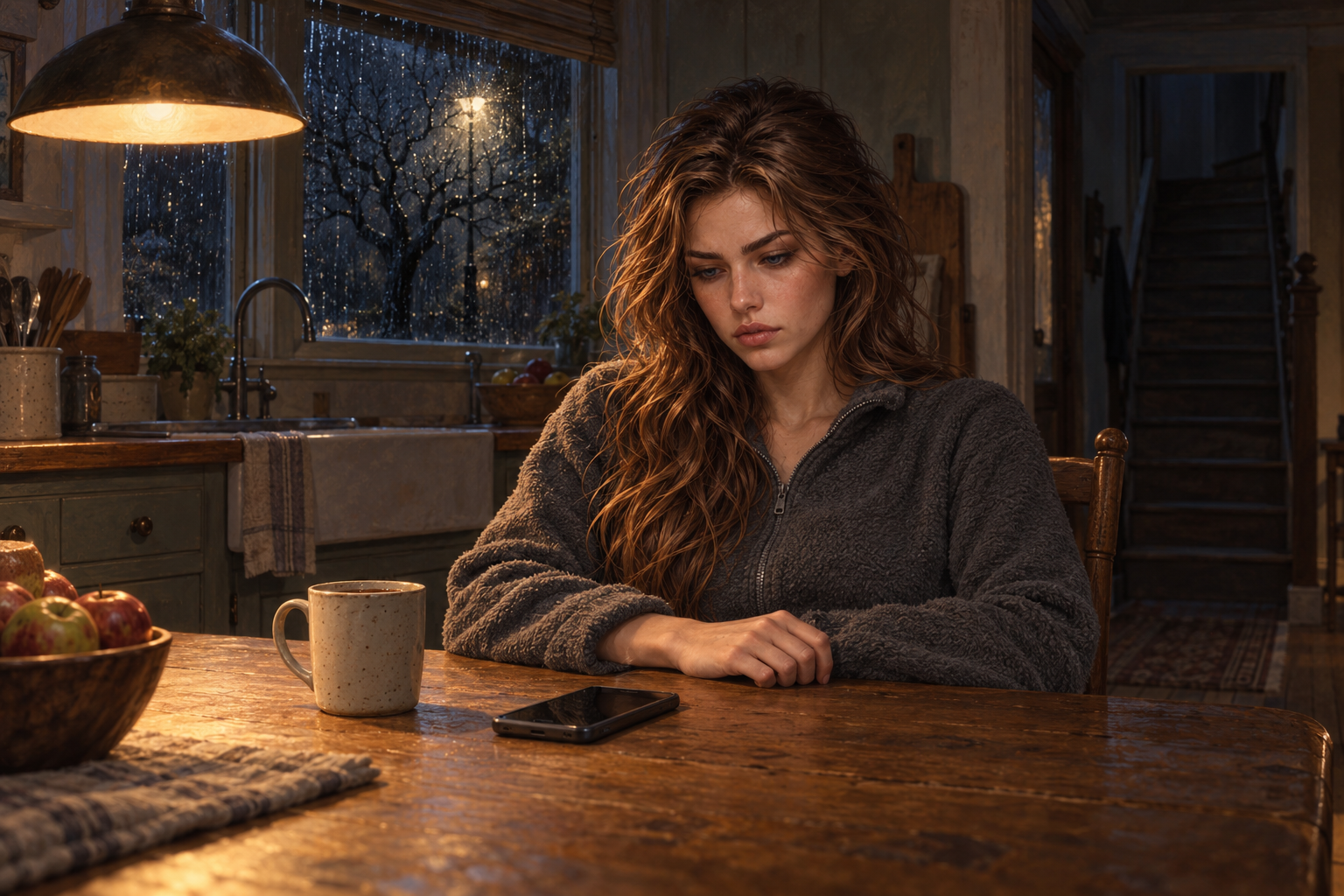
· · ·
She pressed send at twelve minutes to one, and sat back, and looked at the phone on the table in front of her with the lamp on it and the rain on the window, and thought about a kitchen somewhere — some kitchen, in some town, in some country, under some lamp — where somebody who looked at light for a living would wake up on a Monday and find it.
She did not know who it was. She did not know whether it was a man or a woman, young or old, in this country or another. She did not want to. That was the term, and it was a good one, and Val had been right about it, as Val was right about more things than Kyra ever let her know.
But somebody had been watching. Carefully. For months. And had seen the waiting, and the moment where Val forgot, and the lamp. And had not wanted anything. And had said so, at three in the morning, every Sunday, in letters with all the commas in the right places.
I want there to be a witness, she had said, at Val’s table, at the beginning of all this.
Well. There was one.
Kyra sat at her kitchen table for a long time after that, with the lamp on and the rain coming down, and did not go up, and did not want to. She was waiting for nothing at all. She had got very good at it.
Let it come to you.
— end of chapter twelve —
Winter · Val’s kitchen table
The cloth-bound notebook filled up faster than either of them had expected.
Kyra watched it happen from across Val’s kitchen table, on Thursday nights after the library shut, and on Sunday nights after the diner, and on any night at all when she came over and found Val already sitting there with the laptop open and the pencil in her hand. Val did it the way she did everything — carefully, one line at a time, every zero — and at first there had been a line a day, and then a line every few hours, and then so many lines that Val had stopped writing each one and started writing a total at the bottom of each day instead, and then at the bottom of each week, in a small exact column down the right-hand side of the page, with the date beside it and never the year.
Somebody, it still said, in the margin of the very first line, underlined.
By the first snow of the second winter there were eleven pages.
· · ·
“How much is it,” said Kyra, one night in November.
Val did not look up.
“I’ve told you. It’s in the ledger.”
“It’s in the ledger in a kind of money that isn’t money, with forty zeros after the point. I want to know how much it is in pie.”
Val put the pencil down. She turned the laptop toward herself and did something on it that Kyra could not follow, and looked at the number that came up, and was quiet for a moment.
Then she turned it around.
Kyra looked at it.
She looked at it for some time. Then she sat back in her chair and put both her hands flat on the table, which was Val’s gesture and not hers, and did not know she had done it.
“That’s—”
“Yes.”
“That’s more than the library pays you.”
“That is more than the library pays me,” said Val, “in a year. That is more than the library pays its librarian in about four.” She took her glasses off. “It’s more money than I’ve ever had in one place, at one time, on this planet. Or on the other one, if it comes to that. My father had more. I never did.”
· · ·
Kyra got up.
She did not know she was going to do it until she was doing it. She got up from Val’s kitchen table and went into the middle of the kitchen floor in her socks, and she put her arms up over her head, and she danced.
It was not good dancing. It had never been good dancing. It was the dancing of a woman who had been cold and poor and frightened in a great many cities, who had sold things she did not want to sell and slept in places she did not want to sleep, who had walked through the snow with nothing in her pockets and nothing behind her but a mountain, and who had just been shown a number on a screen in a warm kitchen with every lamp on. She danced around the table and around Val’s chair and around the table again, and Val sat in the chair and watched her with an expression of pained and absolute love.
“Kyra.”
“We’re rich.”
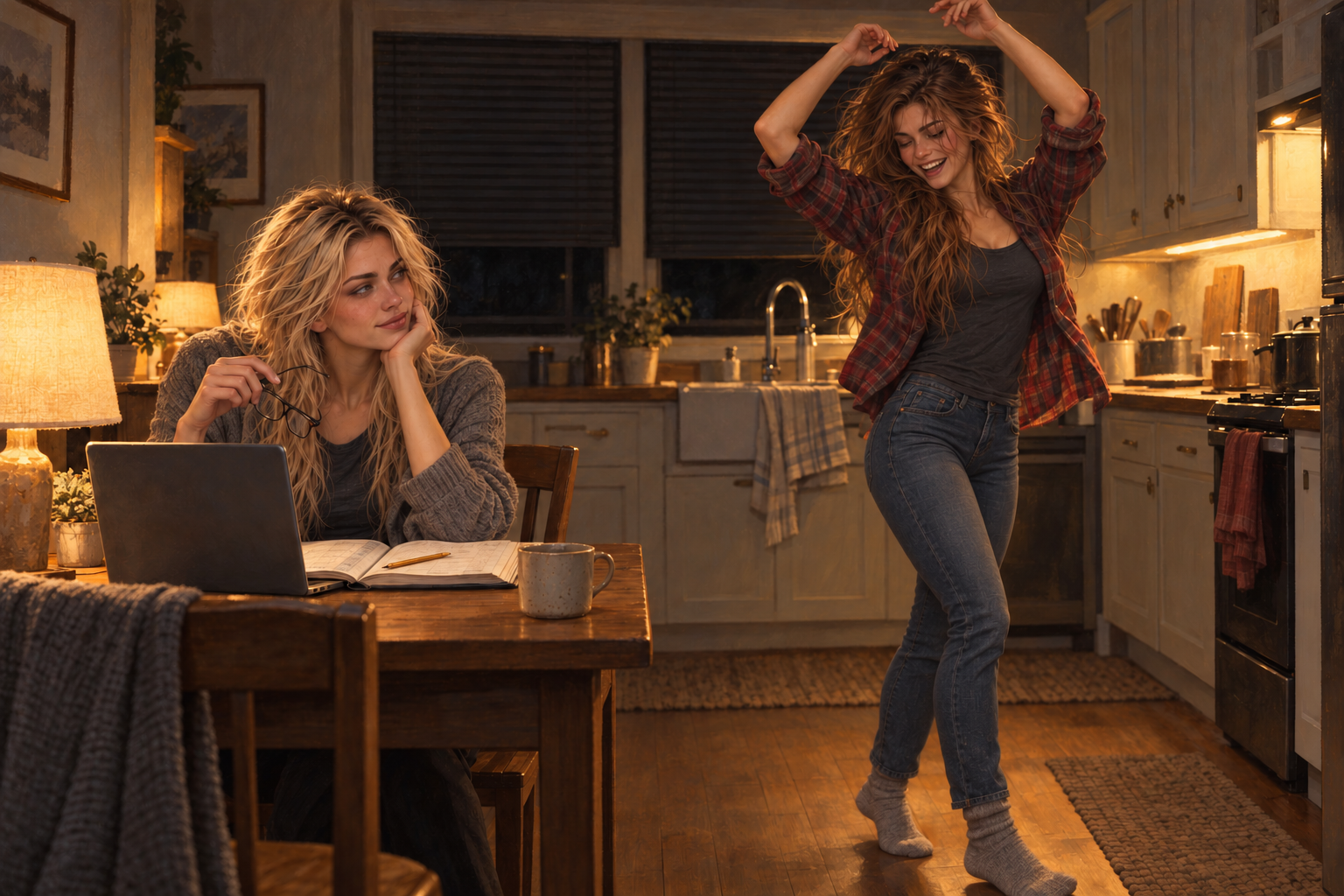
“We are not rich.”
“We’re rich, Val. Look at it. We’re two women in two small houses in a town with one stoplight and we’re rich.” Kyra came around behind Val’s chair and put her arms around her neck from behind and her chin on top of her head. “We could go anywhere. We could buy anything. We could buy a house.”
“We could not buy a house.”
“We could buy two houses. We could buy a house each and knock them together.”
“We are not,” said Val, “going to buy anything at all.”
· · ·
Kyra let go of her and came around and sat on the edge of the table, which Val disliked, and looked at her.
“Not anything.”
“Not anything anybody can see.” Val put her glasses back on. “Listen to me. Nothing has changed. I am the librarian. You run the raffle and pull people out of creeks. We live in two small houses at opposite ends of a town of nine hundred people who notice everything, and we have done since the autumn before last, and nobody in that town thinks about us at all except to say that the librarian is particular and the redhead from the fire hall is a laugh. That’s what we are.” She tapped the table. “And the day that redhead drives down Route 9 in a new car, somebody at the diner is going to ask where she got the money. And the day the librarian puts on a new roof, the woman at the feed store is going to look at her a moment longer than the sentence needs.”
“Marjorie.”
“Marjorie. Who misses nothing. Who would notice a new coat on a scarecrow.” Val’s voice did not change. “We are two women with exactly what we had last year. That’s the rule. Nothing changes that anybody in this town can see.”
· · ·
Kyra sat on the edge of the table for a while.
“That’s a terrible rule,” she said.
“It’s a very good rule.”
“It’s a very good terrible rule. It’s the worst kind.” Kyra swung her feet. “What’s the point of being rich if you can’t buy anything?”
“I didn’t say you couldn’t buy anything. I said you couldn’t buy anything anybody can see.” Val turned a page of the notebook. “You can buy whatever you like that stays inside a house and doesn’t make noise.”
Kyra thought about it.
“A kettle,” she said.
Val looked at her over the top of her glasses.
“I’ve wanted a better kettle for the whole of my life,” said Kyra. “The one I’ve got takes a week. It whistles in a key that doesn’t exist. I could get a good one. A very good one. A kettle that boils in a minute and doesn’t scream.”
Val considered this for longer than it deserved.
“A kettle,” she said, “is permitted.”
· · ·
Kyra bought the best kettle she could find. It cost more than any kettle had any business costing. It came in a box with a picture of a woman on the front looking at it with an expression of transcendent peace, and it boiled in a minute, and did not scream, and Kyra stood in front of it in her kitchen the first morning with her arms folded and watched it boil four times in a row.
Then she bought one for Val.
Val, when she unwrapped it — badly wrapped, in tissue, the way Kyra wrapped everything — looked at it and said, “I have a kettle.”
“You have a pan you boil water in.”
“It is a perfectly good pan.”
“It’s a perfectly good pan,” said Kyra, “and it isn’t a kettle, and you’re rich.”
Val looked at the box with the woman on it and her transcendent peace.
“I am going to put this on the counter,” said Val, “and use it every morning, and never once mention it to you, and you are going to know how I feel about it by the fact that I never mention it.”
“That’s the most romantic thing you’ve ever said to me.”
“It is very far from the most romantic thing I’ve ever said to you,” said Val, “but it’s the most romantic thing I’ve ever said about a kettle.”
· · ·
The crash came in the new year.
Kyra found out the way she found out most things that winter, which was on her phone, in bed, at two in the morning, scrolling through something she should not have been looking at. It was a page full of graphs, and all the graphs were going the same way, which was down. Steeply. All at once. As though somebody had taken the whole of the money that wasn’t money and dropped it off a roof.
She drove across town in her coat over her nightgown with the heater on full and let herself in by the back door, and Val was asleep. Of course Val was asleep. Kyra stood at the foot of her bed in the lamplight with her phone held out in front of her like a lantern.
“Val.”
Val opened one eye.
“It’s gone down,” said Kyra. “All of it. The money. It’s gone down by half since Tuesday and it’s still going and everybody’s selling and the graphs are all—”
“I know,” said Val.
Kyra stopped.
“You know?”
“I knew on Tuesday. I looked on Tuesday, and on Wednesday, and I looked again tonight before I went to sleep.” Val closed the eye again. “It’s gone down by a little more than half. It will probably go down further. Come to bed. Your feet will be cold.”
· · ·
Kyra did not come to bed.
She stood at the foot of it with her phone and her coat over her nightgown and looked at the woman in it, who had turned onto her side with her back to the room and her hair spread over the pillow and appeared to be going back to sleep.
“How are you calm?”
“Because nothing has happened,” said Val, into the pillow.
“Half of it’s gone.”
“Half of nothing has gone. We never had it.” Val turned over, then, onto her back, and looked at the ceiling. “Kyra. Sit down. Your feet are going to freeze to the floor.”
Kyra sat on the edge of the bed.
“I have lived,” said Val, “through banks closing in three countries. I watched a whole nation’s money turn to wallpaper in a single winter, and people pushing it through the streets in wheelbarrows to buy bread. I’ve had paper in my pocket that was worth a house on a Monday and worth a stamp on a Friday. I’ve been rich in money that disappeared, and I’ve been poor in money that didn’t, and there is not one currency on this planet I have ever trusted for longer than it took to spend it.” She paused. “And I never once measured this in dollars.”
“Then what did you measure it in?”
Val reached out without looking and found the cloth-bound notebook on the nightstand, where it apparently lived now, and put it on the blanket between them, and opened it to the first page.
The first line. The tiny number. The blank where a name should have been. Somebody, in the margin, underlined.
“In entries,” said Val. “In people. In lines in a book that does not forget and cannot be changed and has not got a single name in it. That’s what I’m keeping. Not the money. The record.” She turned a page, and another, and another, all of them full. “Every one of those is somebody who saw us, and paid to see more. Every one. It doesn’t matter what it’s worth this week. It doesn’t matter if it’s worth nothing next week. They’re still there. Nobody can take them out. It’s a ledger, Kyra. It’s the only one I’ve ever had that doesn’t leak.”
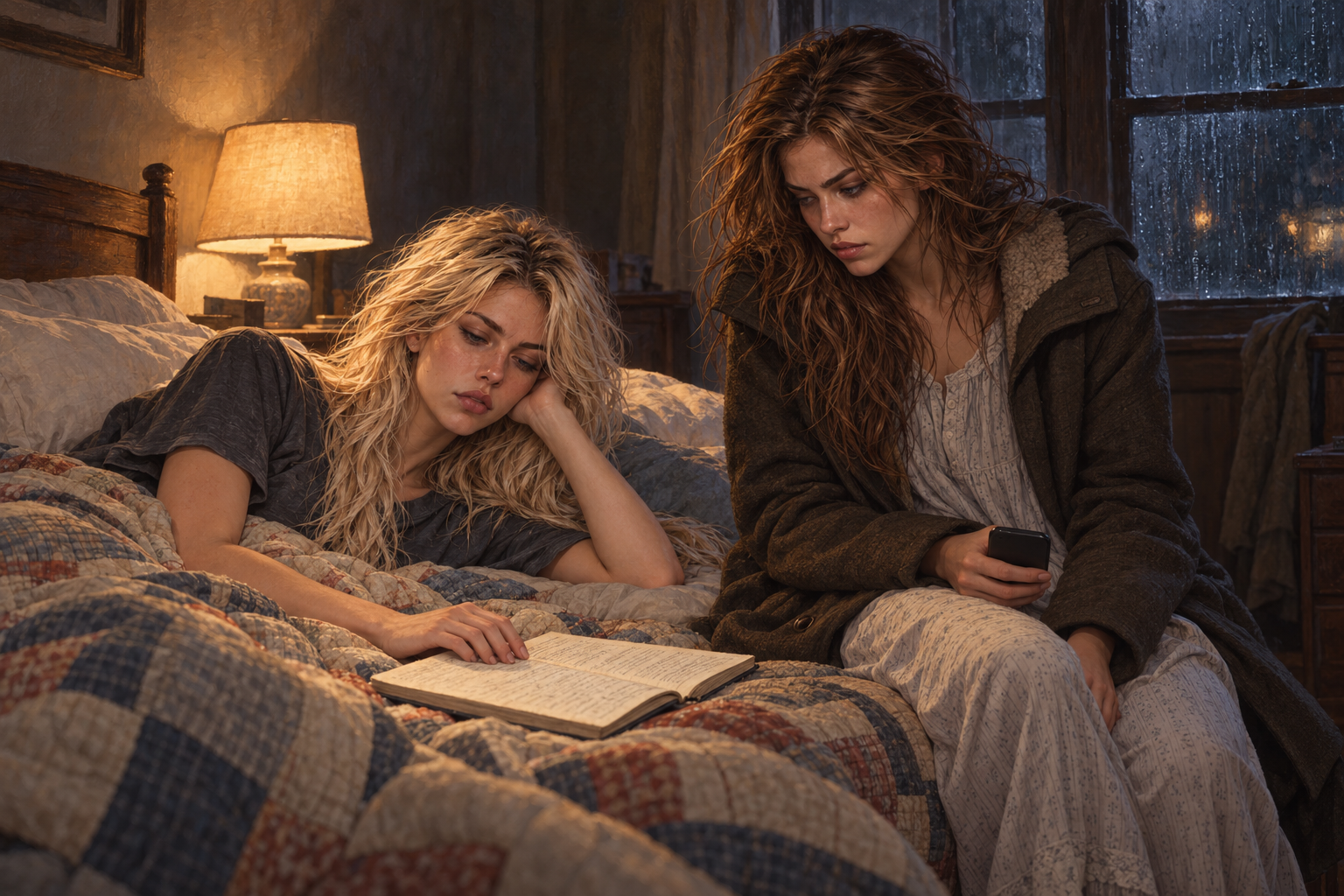
· · ·
Kyra did not say anything.
Then she took her coat off, and got into bed, and put her cold feet on Val’s calves, and Val made a sound like a cat stepped on and did not move away.
“You’re very strange,” said Kyra, into her shoulder.
“I am very sound,” said Val. “It’s a different thing that looks the same from outside.”
· · ·
It went down for most of a year.
It went down slowly, and then quickly, and then slowly again, and every few weeks somebody on the internet said it was finished, it was over, it was worth nothing and always had been. Kyra stopped looking at the graphs. Val did not stop looking at them, but she looked at them the way she looked at weather, without expression, at the same time every morning, with her new kettle boiling on the counter and never once mentioned.
And the ledger went on filling. That was the thing Kyra came to understand, that year. The money went down and down and the ledger did not care. The lines kept coming. More of them every month, every week, every day; more people, in more countries, finding the chair videos and the pink ones and the waiting, and paying in a money that was worth less every time they paid it, to see more. Val kept writing them down. Eleven pages became twenty, and twenty became forty, and somewhere in the summer she started a second book.
And then — in the autumn, the third autumn, without any warning at all — the graphs turned around.
· · ·
Kyra was not looking. That was the joke of it. She had stopped looking in the spring, the way you stop looking at a pot. And then one night in October Val came over to her house with the laptop under her arm and sat down at Kyra’s kitchen table and put her hands flat on either side of it and did not say anything, and Kyra, at the stove with her new kettle, turned around and saw her face.
“What,” said Kyra.
Val turned the laptop around.
Kyra looked at it.
She looked at it. She put the kettle down. She came and sat down across from Val and looked at it some more, and then she looked up.
“Val.”
“Yes.”
“Val, that’s not—” She stopped. “That’s not money. That’s not a number money comes in. That’s—”
“I know what it is.”
“How long has it been doing that?”
“About six weeks,” said Val. “I wanted to be sure it wasn’t a mistake.”
“And is it?”
“It is not a mistake,” said Val. “I’ve checked it eleven times.”
· · ·
Kyra did not dance this time.
She sat at her own kitchen table and looked at the woman across from her, and found that what she felt was not what she had felt the night she danced at all. It was quieter than that. It was much stranger.
“We could stop,” she said.
Val looked up.
“I don’t mean we should. I’m not saying stop for good. I mean we could. If we wanted to. We’ve got more than we could spend in — we’ve got more than we could spend. We don’t have to make another one ever. Nobody’s making us.” She looked at the screen. “We never needed it. Neither of us. We said so at the start. It was never about the money.”
“It was never about the money,” Val agreed.
“So why does it feel like something?”
Val was quiet.
“Because it’s true,” she said at last. “That’s all. It’s a record. It’s the truest one I’ve ever kept. It’s every single person who ever paid to watch us, all of them still in there, and nobody can take them out. And it turns out that when enough people have looked at you for long enough, and kept looking, and gone on paying to look, it comes to this.” She touched the edge of the screen. “It’s not money, Kyra. It’s a witness. It’s every one of your witnesses, added up.”
· · ·
They did not sell any of it. Val would not hear of it, and Kyra, sitting at her kitchen table looking at a number money did not come in, found she did not want to either.
“What happens to it?” Kyra said. “In the end. When we move on from here. When this town’s done with us, the way they all are.”
“I don’t know,” said Val. “Not yet.” She closed the laptop. “One day we’ll have to decide. Somebody will have to have it. It can’t come with us everywhere. Nothing ever does.” She put her hand flat on the closed lid. “But not yet.”
“Not yet,” Kyra agreed.
· · ·
“There’s one thing,” said Val, after a while.
“Go on.”
“One thing we could spend it on. One thing that stays inside a house and doesn’t make any noise, and that nobody in this town would ever see.” Val opened her notebook — not the ledger; the other one, the one with names in it, and the three columns, and the lists — and turned to a page Kyra had not seen before, and turned it around.
It had a heading. It had columns. It had a great many words on it that Kyra did not know.
Equipment, said the heading.
Kyra looked at it.
Then she looked at Val.
“Oh no,” said Kyra.
“I’ve been reading,” said Val.
“You’ve been reading.”
“For about six weeks,” said Val. “About light.”
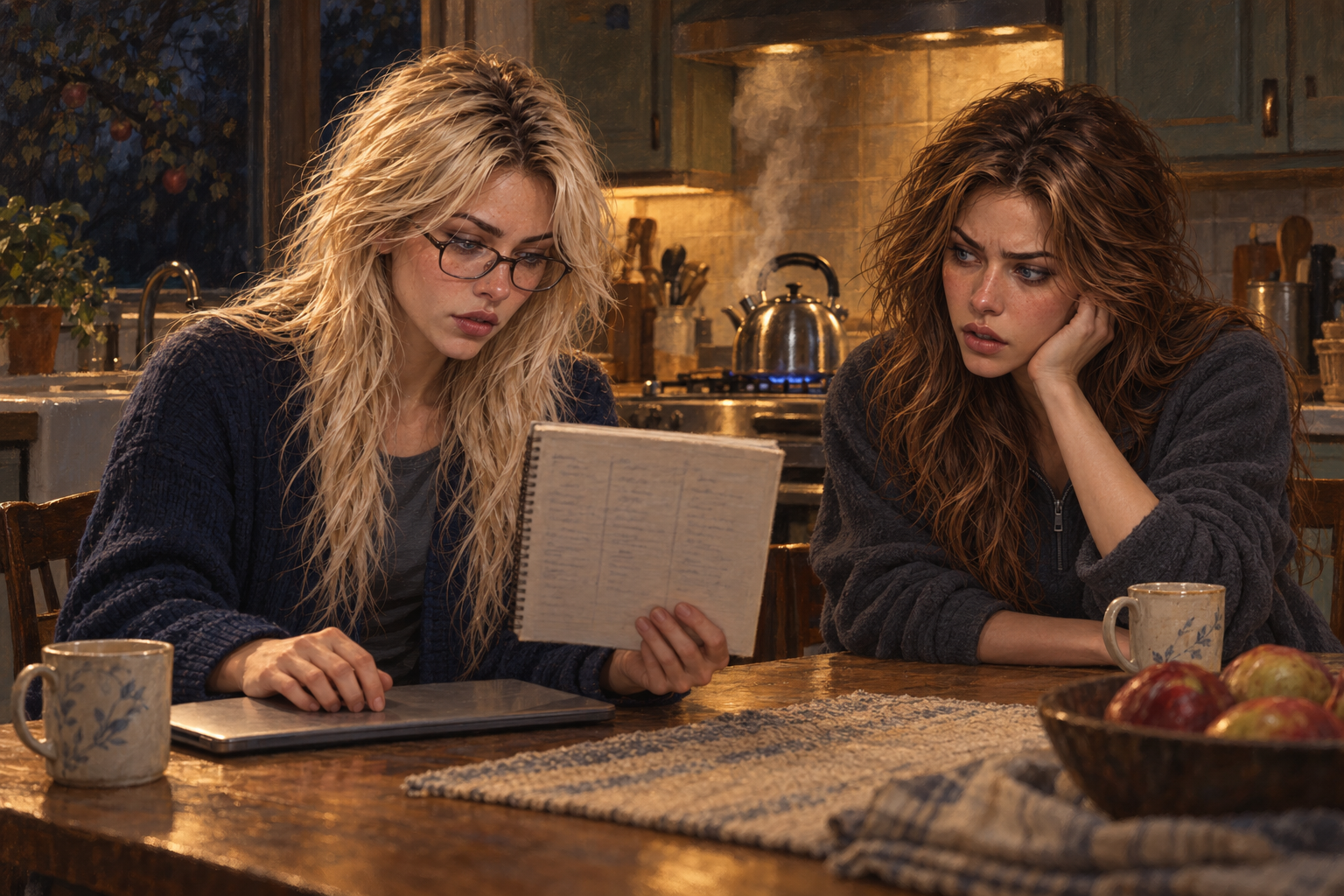
— end of chapter thirteen —
November · the room that was nowhere
The complaints had been there for a long time. Kyra had simply not been reading them as complaints.
just when it gets good for the blonde the picture goes to mush
why does it always go blurry at the end?? every time
the glow is cool but I literally can’t see her face when she finishes
the best part of every video and it looks like someone breathed on the lens
PLEASE fix the camera I am begging you I want to SEE her
There were hundreds of them by the third autumn. Kyra had read them from the start with a kind of pride. Bad lighting, she had thought each time. A gray smudge in the shape of a woman. They’ll never see a thing. She had thought it was the best joke in the world.
It was Val who turned it around.
· · ·
“They’re right,” said Val.
She said it at Kyra’s kitchen table, on a Sunday night in November, with the new notebook open in front of her — the one headed Equipment, which now ran to nine pages — and her reading glasses on, and the expression she wore for problems she intended to solve whether or not anybody wanted them solved.
“They’re not right,” said Kyra. “That’s the whole point. The camera can’t see you. That’s the term. Val keeps her light.”
“The camera can’t see the light,” said Val. “That isn’t what they’re complaining about. Listen to them. They aren’t saying what’s the glow. They’re saying I can’t see her.” She turned the laptop around. “The light doesn’t ruin the picture. The camera does. Look.”
· · ·
She had found it in the first video. Of course she had; she had gone back to the very first one, the one that said Hello from Andromeda on it, and stopped it at the end, at the moment itself, and blown it up as big as the screen would let her.
“There,” she said. “What do you see?”
Kyra looked. Val’s face, half under the black mask, arched back. Her throat. The pale glow around it. And around the glow, around everything, the edges of the frame going white — not soft, not pale, but white, blank, as though somebody had poured milk across the corners of the picture.
“Bad lighting,” said Kyra.
“No,” said Val. “Bad camera. The phone decides for itself how bright to make the picture. It looks at the room, all the time, and adjusts — every second, without asking anybody — so that the room comes out looking the way it thinks a room ought to look.” She tapped the screen. “And then something in the room gets brighter. Something it wasn’t expecting. And it panics. It overcorrects. It tries to make everything else brighter to match, and everything that was already bright goes white, and everything that was in between goes to fog.” She took her glasses off. “My light doesn’t do this. My light is very faint. You’ve told me so yourself; sometimes you have to look twice. It’s the phone that’s doing this. The phone sees something it has no setting for, and loses its head.”
Kyra looked at the white corners of the frame for a while.
“So the brighter you feel,” she said slowly, “the worse it gets.”
“The brighter I feel, the worse it gets.” Val’s voice did not change. “The most important moment in every video we have ever made is the one nobody can see. That’s what they’re telling us. Not that the light is strange. That they’ve been watching from the very beginning and they have never once been allowed to see me finish.”
· · ·
Kyra sat back in her chair.
“And you want to fix it.”
“I want to stop the camera ruining the picture,” said Val. “That’s all. I don’t want to show them the light. I couldn’t if I wanted to — nothing on this planet can show it. On any camera that will ever be made here, it will be gray. That’s still the term. That doesn’t change.” She put her hand on the notebook. “But I can stop the camera panicking. I can stop it turning me into fog. I can make it so that they see my face, and my body, and what happens to them, clearly — and the light is just a pale soft glow around all of it, the way it was always going to be.” She paused. “They paid to see me. They’re entitled to see me.”
“That’s very generous of you.”
“It is not generous,” said Val. “It’s a matter of accuracy.”
· · ·
The equipment came over three weeks, in boxes, to an address that went nowhere, and Kyra drove to fetch it.
There were two cameras. Not phones; real cameras, small and black and heavy for their size, with lenses that came off and went back on and cost more than her car. There was a box of round dark glass things that screwed onto the front of the lenses, and a box of other round glass things that did something else, and a tripod, and another tripod, and a small light in a soft box that Val unwrapped and looked at and then put back in the box and said they would not be using.
“Why not?”
“Because of the letter,” said Val.
Kyra knew which letter. Whoever does your lighting: please don’t change it. It looks like a lamp somebody left on.
“We said we’d leave the lamp,” said Val. “You wrote it. We’ll leave the lamp exactly where it is. So we’ll leave the lamp. We’re not fixing the light. We’re fixing the cameras.” She put the soft box in the hall closet. “Somebody asked us not to change the only honest thing in the room. I’d rather not.”
· · ·
It took Val two weeks to learn them.
She sat up every night at her own kitchen table with the cameras and the manuals and the lamp, the same lamp from the room that was nowhere, which she had borrowed and brought across town and set up on her own table so that she could practice on it. She turned it up and down. She turned the cameras on and off. She took pictures of the salt shaker, hundreds of them, under the lamp, with the lens wide open and then nearly closed, with the round dark glass on and off, and looked at every single one on the laptop afterward, in silence, making notes.
Kyra came over on the Thursday and found her sitting in the dark with the lamp turned down almost to nothing and a candle beside the salt.
“What are you doing?”
“Making the room brighter, suddenly, in one place,” said Val, “to see what the camera does.” She held up a match. “Watch.”
She lit the candle. On the laptop screen, the salt shaker stayed exactly as it was. Sharp, dark, clear. The candle flame came up beside it, small and bright, and nothing else in the picture moved at all.
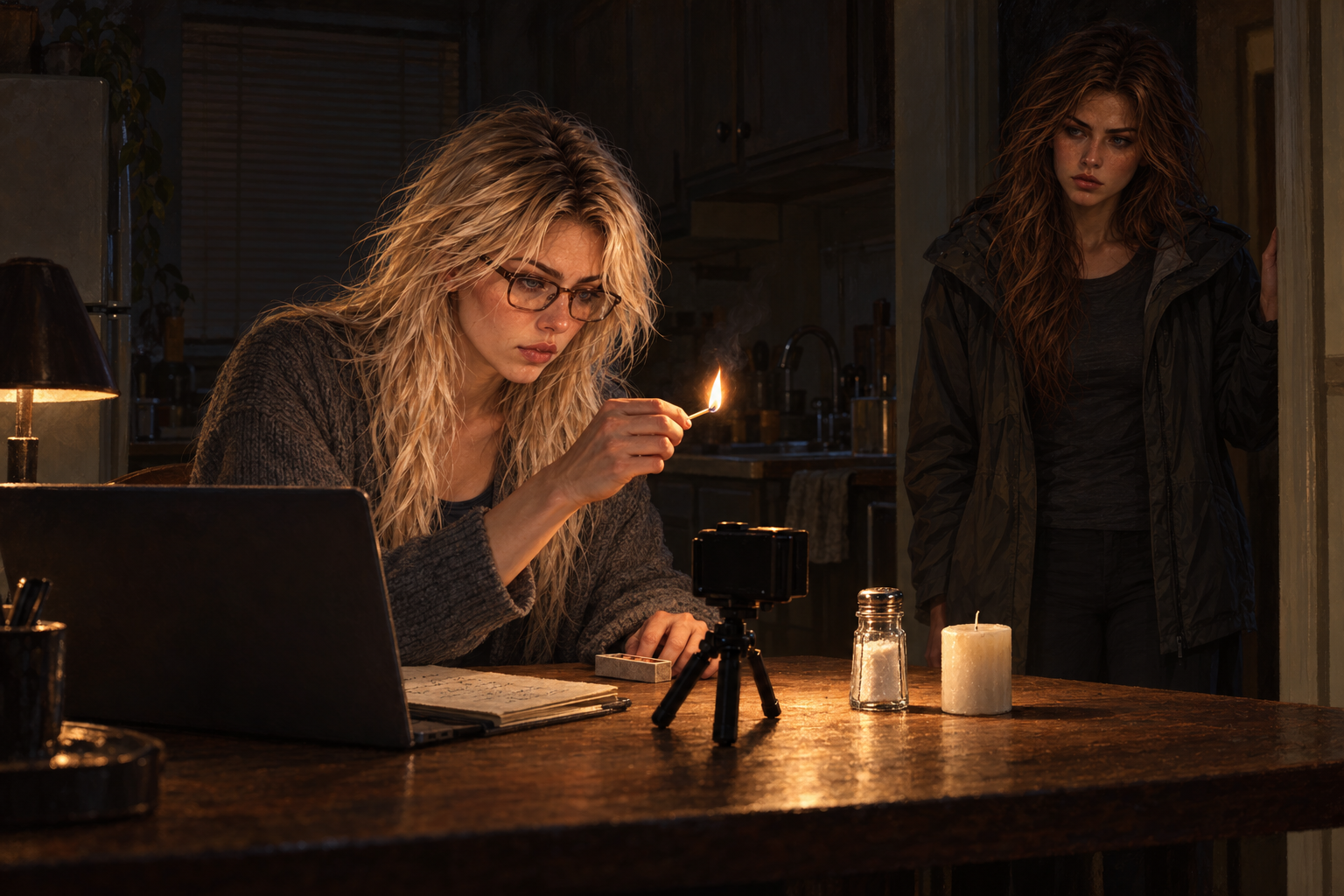
“It didn’t panic,” said Kyra.
“It didn’t panic,” said Val, “because I’ve told it not to. It isn’t allowed to decide for itself any more how bright the room is. I’ve decided. I’ve locked it. It sees the candle, and it does nothing about it, and the candle is just a candle, and the salt is still the salt.” She blew it out. “That’s the first thing. Manual exposure. Locked.”
“And the second thing?”
“The second thing,” said Val, “is harder. And it’s you.”
· · ·
“Me?”
“The camera can be locked for the room,” said Val. “Set for the lamp. Set for the two of us in the lamplight, the whole way through. And that’s right for nearly all of it. But at the end, when the light comes, there’s more of it than the lamp; and if the camera stays set for the lamp, the light will still be too bright in it — not fog any more, not white, but too bright, washed, a little blown, like a window behind somebody’s head.” She turned the laptop toward Kyra. “So at that moment — just at that moment, just before — somebody needs to turn the camera down. A little. Just enough. And then turn it back up afterward, when it’s gone.”
“Can’t you set it to do that by itself?”
“If I set it to do it by itself, it’ll do it when it notices,” said Val. “It’ll notice late. It always notices late. It’ll be a second behind me, every time, and you’ll see it catch up.” She looked at Kyra. “It needs somebody who knows before. Somebody who knows when the light is coming before it comes.”
Kyra looked at her.
“Who on this planet,” said Val, very quietly, “knows that?”
· · ·
There was a small remote. It worked from across the room, from anywhere in the room, and it had a little wheel on it that turned the camera’s brightness down and up, a click at a time. Val gave it to Kyra across the kitchen table, in her palm, the way she had once given her a mask, and Kyra took it.
“You hold the camera,” said Val. “That’s in the terms. Nothing in that room is mine. So you hold this too.”
“While we’re—”
“While we’re.”
“Val, I’ll be busy.”
“You’re always busy,” said Val. “You’re busy talking about the man with the pager. You’re busy holding my hips. You’re busy watching my face. You have been watching my face, at that moment, for as long as either of us can remember.” She closed Kyra’s fingers over the remote. “You know exactly when it’s coming. You always have. You knew in the snow. The jaw goes first. Then the wrists. Then the forearms. Then the elbows. And then the light. You’ve told me so yourself — you’ve told me the order — and I’ve never once been there to see it, because I’m never there for it. That’s the point of it.” She let go of Kyra’s hand. “You’re the only person on this planet who can read me. So read me. And turn the wheel.”
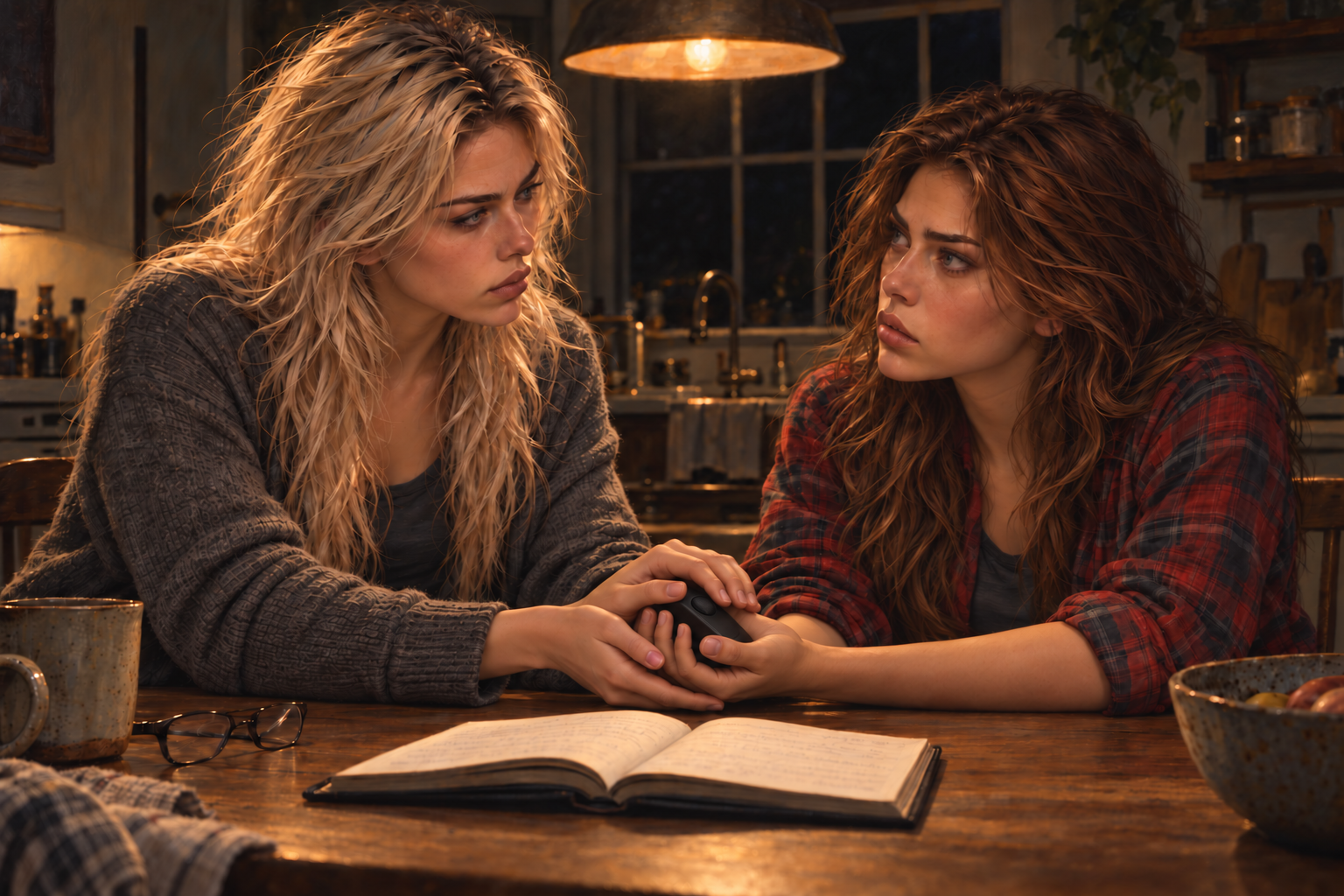
· · ·
They tried it on the Saturday.
Kyra had expected it to be impossible. She had expected to forget the remote, or drop it, or be so busy thinking about it that she would think about nothing else, and that Val would feel her thinking about it and close up like a hand.
It was not impossible. It was the easiest thing she had ever done.
She held it in her right hand on the pillow beside Val’s head, with her thumb on the wheel, and forgot it almost at once, the way you forget a ring. She went the long way, as she always went, through all that dark, talking low. They laced. The grip came up between them and said here, all right, here. And Kyra did what she had done every evening of her life with this woman, in every bed in every house, which was watch her.
The jaw went first.
It always went first. It was tiny — a slackening at the hinge of it, under the edge of the black mask, so slight that nobody else alive would have seen it — and Kyra saw it and knew, the way she knew north, and her thumb moved on the wheel. One click. Two.
The wrists, where they lay on the white sheet, turned a little outward.
Three clicks.
The forearms. A tension coming up in them, under the skin.
Four.
The elbows.
And then the light.
· · ·
They watched it at one in the morning at Kyra’s kitchen table on Val’s laptop, and Kyra did not breathe for the last minute of it.
Val was there. That was what she saw first. Val, clear and sharp and all of her — the line of her body on the white sheet, the braid under her, her hands, her mouth open under the edge of the mask. Not fog. Not milk in the corners. Not a gray smudge in the shape of a woman. Val.
And around her, rising — at the throat, at the wrists, along the collarbones — a glow.
It was gray. It would always be gray. It was the color of nothing at all, colorless, a pale soft shine with nothing in it, the camera doing its best with a thing it had no setting for. But it was clean now. It was soft and pale and clear, a light around her like breath on a cold morning, and every part of her could be seen through it, and the picture did not go white, and it did not go to fog. It held. The camera held her the whole way through, and at the very end, when she arched up off the white sheets and came apart, you could see her face.
Kyra put her hand over her mouth.
“There you are,” she said, through it.
Val did not answer. She was sitting very still in the chair beside her, looking at the screen, at herself.
· · ·
It went up on the Sunday.
WAIT
they fixed it????
OH MY GOD you can SEE HER
the glow is still there but you can see her face through it. I’m actually crying
whoever does their lighting needs an award
best glow on the whole site and it’s not even close
HOW do they light the blonde. how. I need to know. I work in video and I need to know
it’s like she’s lit from inside
Kyra stopped reading at that one.
She read it again. It’s like she’s lit from inside. And then she looked up at Val across the table, and Val was looking at her, and Kyra saw that Val had read it too, and had stopped at it too, and had known before Kyra had that it would come.
· · ·
“You knew,” said Kyra.
“I knew.”
“When you started reading about the cameras. In the summer. Before you ever bought anything.” Kyra put the phone down. “You knew that if they could see you clearly, they’d see where it was coming from.”
“Yes.”
“Not from the lamp. Not from anywhere in the room. From you. From your throat. Your wrists. Places a lamp couldn’t—”
“Yes,” said Val.
She put her glasses on and turned the laptop around and found the frame — the one near the end, the one Kyra had put her hand over her mouth at — and stopped it, and made it bigger.
“Look,” she said. “Look at the throat.”
Kyra looked. The glow at Val’s throat. Clear, now. Soft and gray and colorless, and coming, if you looked — if you looked properly, if you knew how to look — not from anywhere outside her at all. Coming from under the skin. From the hollow of the throat and the line of the collarbone. From her.
“In the fog,” said Val, “nobody could tell. The fog hid it. It could have been anything — the lamp, a lens, a filter, somebody’s bad camera. And now there’s no fog. Now it’s a woman with a light around her, and the light is clear, and anybody who looks at it for long enough, carefully enough—” She stopped. “Most of them will never look. Most of them will say filter and how do they light her and go away pleased. But somebody will look. One day. Somebody careful.” “A sharper picture is a better specimen. I knew that when I opened the notebook.”
· · ·
“Then why?” said Kyra. “Why do it?”
Val did not answer.
“Because I watched it,” she said at last. “The first one. And every one since. I watched every one of myself at the end, at the one moment that’s mine, and every single time it was fog. A smudge. A mistake in a picture. Something somebody had breathed on.” She looked at the frozen screen. “And I found I didn’t want to be a smudge. Not to them. Not any more.”
“They’ll see you.”
“They’ll see me. They’ll see a woman, clearly, with a light around her that they can’t explain. They’ll see her face.” Val’s voice did not change, but something underneath it did. “And they still won’t see the light. It’s still gray. It’s still the color of nothing. I keep the light. That hasn’t changed. But for the first time in my life, the rest of me is something they’re allowed to look at properly.” She put her hand flat on the table. “I decided it was worth it. I decided at this table. I knew the cost, and I decided.”
“Without asking me.”
“I’m asking you now,” said Val. “It’s not posted yet, the next one. If you say no, we go back to the phone. We go back to the fog. And I won’t argue.”
· · ·
Kyra looked at the woman across from her for a long time.
Then she looked at the remote, lying on the table beside the laptop, with its little wheel.
“Who turned it down?” she said.
Val looked at her.
“At the end. Just before. Before the light came. Who turned the wheel?”
“You did.”
“I did.” Kyra picked the remote up and turned it over in her fingers. “Because I knew. Because the jaw went first. Because I’ve watched for it since the snow.” She put the remote down. “They’re going to look at that video and see a woman lit from inside, and say how do they light her. And they’ll think it’s somebody who knows lighting. A professional. Somebody with a meter.” She smiled. “And it’s me. With one thumb. Reading you.”
“Yes,” said Val.
“I’m not saying no.”
“I didn’t think you would.”
“I’m saying it’s the best thing I’ve ever done with my hands,” said Kyra, “and I’ve carried a child out of a flood.”
· · ·
The letter came on the next Sunday, at twenty past three.
Hello. I know I said I’d stop. I haven’t. I’m sorry, and I’m not.
You changed something. I noticed straight away. You kept the lamp — thank you, I hoped you would — but you’ve done something to the cameras, and now I can see her. All of her. All the way to the end. I’ve waited a long time to see that, and I didn’t know how much until I did.
I want to tell you one thing, and then I’ll go.
Whoever is on your lights isn’t using a meter. I’d know a meter. A meter waits for the light and then catches up, and you can always see it catch up — a half-second behind, every time. Yours doesn’t catch up. Yours is there before the light is. It comes down just before she does, every time, in a different place every time, and it’s never once late.
Nobody can do that with a meter. You can only do it by watching her. By knowing her so well you know what she’s going to do before she does.
Whoever that is: they’re reading her, not a meter. I’ve worked with light all my life and I’ve never seen anybody do that. I’d give a great deal to be looked at like that, even once.
Let it come to you.
· · ·
Kyra read it out at Val’s kitchen table on the Monday, and her voice went in the middle of it, and Val took the phone out of her hand and read the rest.
Then Val put the phone down, very carefully, the way she put down things that might break.
“I’ve worked with light all my life,” she said.
“I heard.”
“They saw it. In a week. The wheel. Your thumb.” Val looked at the phone. “Out of all of them. Out of thousands. One person in a kitchen at three in the morning, who has worked with light all their life, saw that somebody in that room was reading me.” She was quiet for a moment. “I said somebody careful would look. One day.”
“You did.”
“I didn’t think it would be this week.”
Kyra reached across the table and put her hand over Val’s.
“I’d give a great deal to be looked at like that,” she said. “Even once.”
Val did not answer. But her hand turned over under Kyra’s, on the table, and held on.
— end of chapter fourteen —
Winter · Kyra’s front room, and a mountain
It was Kyra’s idea, and she regretted it within the hour, because Val took it seriously.
“Costumes,” Kyra said, one night in January, on her couch with her feet up and the phone on her chest. “Look. Half the comments are asking. Can they do a nurse. Can they do a schoolteacher. Can they do Victorian. Somebody’s asked for Victorian eleven times. I think it’s the same person.”
Val, in the armchair with a book, did not look up.
“Which Victorian.”
“What do you mean which?”
“There were several. It went on for a very long time. The early part had nothing in common with the late part except the queen.” Val turned a page. “Which do they want?”
“I don’t think they know, Val. I think they mean a corset.”
“There were several kinds of corset,” said Val, and closed the book on her finger, and looked at Kyra over the top of her glasses with an expression Kyra had not seen on her face in some years and had hoped not to see again for some time, which was the expression of a woman who has just been handed a research project.
“Oh no,” said Kyra.
· · ·
The trouble was that they had kept nothing.
They had promised it in the snow. Nothing kept. Not a letter, not a photograph, not a single object from a single decade that could ever sit in a drawer and say who they had been. In every house they had ever left, Val had gone through every room on the last night with a box and taken out everything that had a year on it, and burned it, or given it away, or left it on a curb in another city in the dark. Not a shawl. Not a button. Not one pair of gloves.
So there was nothing to take out of a trunk. There was no trunk.
There was only what they remembered.
· · ·
Val made the first one herself, at her own kitchen table, over five weeks, by hand.
She bought the cloth in Portland — a heavy cotton, a fine wool, a linen she held up to the window at the shop for so long that the woman behind the counter asked if she was all right — and she bought thread and whalebone substitute and a box of hooks and a box of eyes, and she brought it home and cleared the table and sat down at it in the lamplight every night after the library shut, and sewed.
Kyra had forgotten Val could sew. She had forgotten that Val, a very long time ago, in a city on the Adriatic with a different name, had sewn everything either of them wore, because there had been no money for anybody else to do it and Val would not have trusted them if there had. She had forgotten the sound of it: the small pull of the thread, the snip, the long silences.
“You remember all of it,” said Kyra, on the third week, watching her.
“I remember what I wore,” said Val, without looking up. “And what you wore. And what every woman wore who passed me in the street, and what she’d done to it to make it last another year. I remember how it was cut and where it pulled and how long it took to get into and out of.” She bit off a thread. “I don’t remember what I had for breakfast last Tuesday.”
“Toast.”
“Thank you.”
· · ·
It was a dress, in the end. Not a corset — Val would not do a corset on its own, it was not a thing anybody had ever worn on its own — but the whole of it, from the inside out: shift, stays, petticoat, gown, a kerchief crossed over the front and tucked in. The stays laced up the back in a particular way, a single cord spiraling up through holes set not quite opposite each other, so that a woman could get into them alone if she had to, which most women had. The gown was dark green wool, and pinned rather than hooked, and Val pinned it onto Kyra in Kyra’s front room on a Saturday in February, with her mouth full of pins and her face perfectly blank with concentration, and Kyra stood still and let her.
“Where’s this from?” said Kyra.
“A city on the Adriatic,” said Val, through the pins. “The year before everything changed there. You had one exactly like it. You spilled wine down the front of it at a wedding and wore it for years after with the stain turned to the wall.”
Kyra looked at herself in the long mirror.
It was strange. It was the strangest thing she had seen in some time. Not because it looked old — it did not look old; it looked new, it was new, it had been finished on Thursday — but because she knew it. She knew the weight of it on her shoulders. She knew how the stays held her, and where they pressed, and how to stand in them. Her body remembered, before she did.
“I did spill wine on it,” she said slowly.
“You did.”
“I’d forgotten.”
“I hadn’t,” said Val, and took the last pin out of her mouth.
· · ·
They did not have sex in it, the first time. Val was very clear about that. She had not spent five weeks on a dress to have it crushed in the first ten minutes.
So they did what the strangers called a set: photographs, and then a video, slow, with no sex in it at all — Kyra in the green dress, in the lamplight, in the room that was nowhere, with her hair up under a cap and her black mask on; and then Val behind her, very slowly, taking the dress apart. The pins first, one by one. The kerchief. The gown, off the shoulders. Then the stays, the cord drawn out through each hole in turn, the whole long spiral of it, unhurried, while Kyra stood with her hands at her sides and breathed for the first time in an hour.
It took nineteen minutes. Nothing happened in it except a woman being undressed by another woman, very carefully, from the inside of a century nobody watching had ever seen.
It was the most popular thing they had ever made that was not a chair video.
· · ·
the ACCURACY
okay but this is the most historically accurate thing I’ve ever seen on this site and possibly anywhere
I’m a costume nerd and I’m losing my mind, the stays are spiral laced, NOBODY gets that right
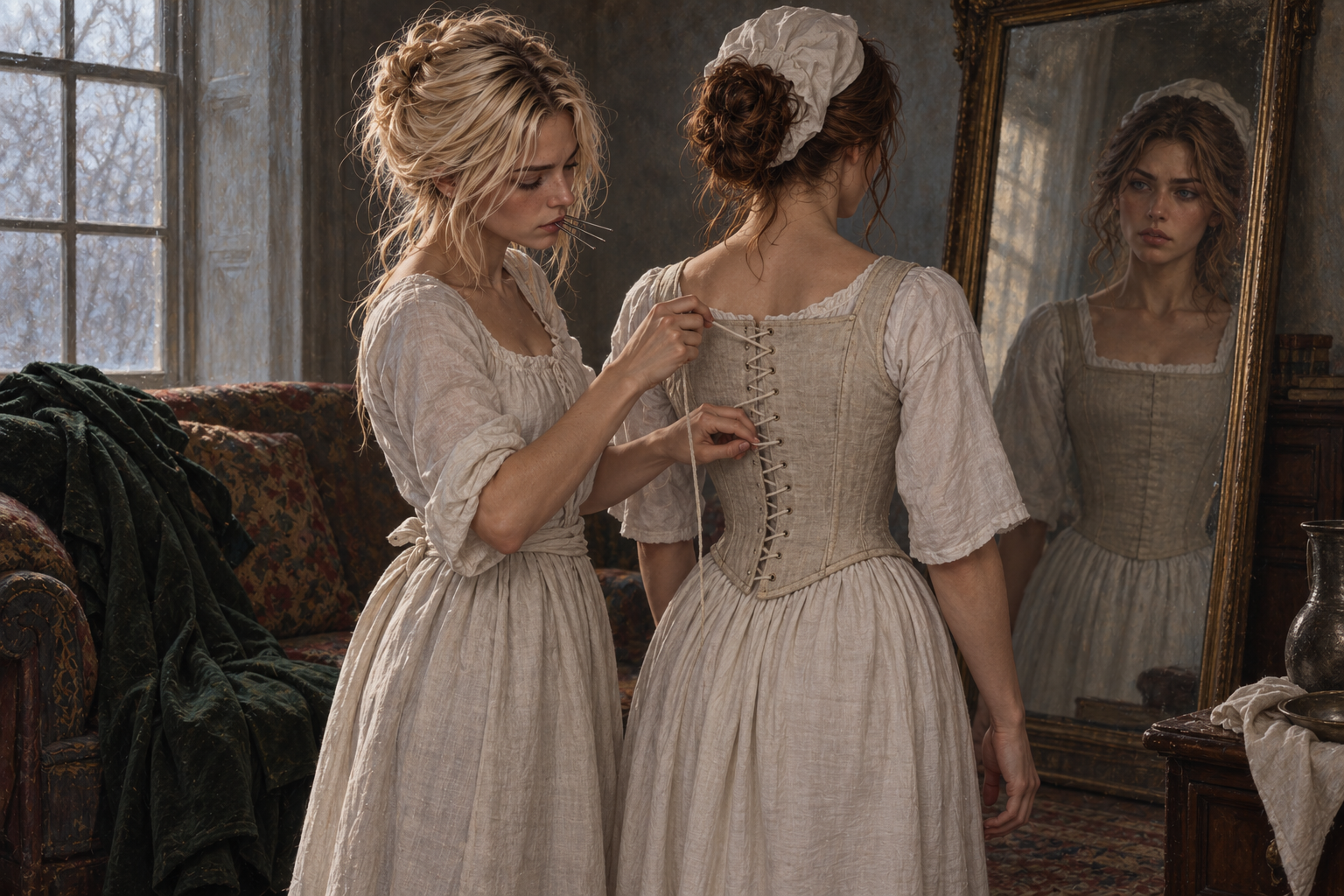
the pins!!! she pinned the gown on!!! no hooks!!!
who made this?? this is museum quality
watching the blonde unlace her was the most erotic thing I’ve ever seen and nobody took anything off below the waist
the way the blonde knows EXACTLY where every pin is, like she’s done it a thousand times
Kyra read that one out, and Val, across the table, went very still for a moment and then went on with her toast.
“You have,” said Kyra. “Done it a thousand times.”
“I’ve done it considerably more than a thousand times,” said Val. “I just never expected anybody to notice.”
· · ·
The letter came two weeks later. Not from LongExposure; from somebody else, somebody new, through the private messages, very long and very polite and full of footnotes.
I’m a costume historian, it began. I teach at a university and I’ve written two books on women’s dress in the late Georgian period, so please believe me when I say I’m not easily impressed by reconstructions.
It went on for some time about the stays, and the pinning, and the kerchief, and the way the petticoat had been pleated at the back, all of which, it said, were correct. And then it said:
But there’s one thing I can’t account for, and I’ve been looking for two weeks. The spiral lacing on her stays isn’t the usual pattern. It’s a variant — the holes are offset in a way I’ve only ever seen described once, in a single letter from a woman in that part of Europe to her sister, complaining about how long it took. There’s no surviving garment with it. There’s no painting. There’s no pattern book. As far as I know, there’s nobody alive who has ever seen it done.
So I have to ask. Where did you find it?
· · ·
Kyra read it out at Val’s kitchen table on a Sunday night, and when she got to the end of it neither of them said anything for some time.
“Where did you find it?” said Kyra eventually.
“On you,” said Val. “On a Tuesday. It was raining. You’d laced it up wrong and I redid it.”
“And nobody’s ever—”
“Nobody’s ever written it down, apparently. Except one woman, to her sister, complaining.” Val took her glasses off. “I’d like to know who she was. I’d like to know very much. I might have passed her in the street.”
“You can’t answer it.”
“I know I can’t answer it.”
“Val—”
“I know,” said Val. “I know. There is no answer I can give that woman that isn’t the truth, and I can’t give her the truth.” She looked at the phone. “So she’ll go on looking. For the rest of her life, possibly. For the one surviving garment, the one painting. And she’ll never find it, because the only person who could have shown her is sitting in a kitchen in a town she’s never heard of, and isn’t allowed.”
She put her glasses back on.
“I’d have liked to be a footnote,” she said. “Just once.”
· · ·
They did more. Of course they did more. The strangers asked and asked, and Val sewed and sewed, and over the following months there were four more of them — a dark wool gown from a cold northern city, a high-waisted white muslin that Val said nobody had ever been warm in, a riding habit, a thing from a very long time ago with a ruff that took her nine weeks and that Kyra could not sit down in. Every one of them was correct. Every one was made from memory. Every one drew a small, devoted crowd of strangers who knew exactly what they were looking at, and wrote long careful comments about seams, and argued about pleats, and adored it.
And every one of them made less money than the last.
· · ·
“It’s the other ones,” said Kyra, in the spring, with the ledger open in front of her on Val’s table. “Look. The ones that are making it. It isn’t the accurate ones.”
Val looked.
She had seen the other ones; of course she had. She had seen them in the comments and in the literature and on a hundred other channels. They were not from any century. They were not from anywhere at all. Gathered linen that had never been gathered like that, and lace in places lace had never gone, and sheer panels, and metal clasps, and brooches — brooches everywhere, on everything, pinned at the hip and the breast and the shoulder like a magpie had got at it — and waists in the wrong place and sleeves that had never existed and hair done in a way that no woman who had ever had to work would have put up with for an hour.
“It’s not real,” said Val.
“I know it’s not real.”
“Nobody ever wore a brooch there.” Val put her finger on the screen, on a still of a woman from another channel with a jeweled clasp low on her hip. “Nobody. Not in any city. Not in any decade. I was there, Kyra. I was in a great many of the places these people think they’re showing, and nobody ever wore a brooch there.”
“I know, sweetheart.”
“It’s a costume of a costume. It’s what people who were never there think it looked like.”
“I know,” said Kyra. “And they’d pay three times as much to see you in it.”
· · ·
Val did not speak to her for most of the evening.
It was not anger. Kyra knew Val’s anger and it was not that. It was something that sat further down, somewhere older; the face Val wore when she had been told a fact she could not dispute and did not want to live with. She sewed. She did not look up. At half past ten she put the needle down and said, to the cloth in her lap:
“It doesn’t matter, does it.”
“What doesn’t?”
“Whether it’s true.” Val looked at the dark green wool. “To them. It doesn’t matter at all. They don’t want what it was. They want what it should have been.”
“Some of them want what it was. The costume people. The historian.”
“Thirty of them,” said Val. “Forty. Who write very long comments and will love it forever. And who are not, as you’ve pointed out, paying for anything.” She folded the cloth. “And everybody else wants a brooch on my hip.”
Kyra came and sat on the arm of her chair.
“Do both,” she said.
Val looked up.
“Do both. The real ones for the forty — because you love them, and they love them, and somebody ought to get to see it right before it’s gone. And the other ones for the money.” Kyra put her hand on the top of Val’s head. “You can make the fantasy ones too. You’ll make them better than anybody. You’ll make them so well that the costume people will write long comments about those and argue about whether a thing that never existed was done correctly.”
Val was quiet.
“The brooch,” she said at last.
“What about it?”
“If I’m going to put one on my hip,” said Val slowly, “it’s going to be for a reason.”
· · ·
She found the reason with a ruler, at Kyra’s kitchen table, on a Thursday after the library shut.
The rings. The two small closed rings, low down, that they covered with three shades and a sealant every time the camera was on. Val stood Kyra up in the middle of the kitchen floor in her underwear and knelt in front of her with the ruler and measured — from the hipbone, from the navel, from the top of the thigh — and wrote the numbers down in the Equipment notebook, and then made Kyra do the same to her.
“There,” said Val, and drew it, on a fresh page: a low-slung band at the hip, of the kind the fantasy channels loved, sheer, with a clasp at the front, set slightly off center. A big ornate jeweled clasp, the sort of thing nobody in history had ever worn there.
It sat exactly over the ring.
“The color underneath,” said Val, “and that on top. And if the color ever slips — if a camera ever catches the edge of something, if anybody ever looks — there’s half a pound of glass jewels sitting on it, and every single eye in the room goes to the glass.” She looked up at Kyra from the floor. “It’s a brooch where nobody ever wore a brooch. It’s completely false. And it’s the most useful thing I’ve ever designed.”
Kyra started to laugh.
“It’s a lie on top of a lie.”
“It’s a lie on top of a truth,” said Val. “That’s what a costume is.”
· · ·
The fantasy ones made three times as much as the accurate ones, as Kyra had said they would. Val made them so well that the costume people did, in fact, write long comments about them, and argue about whether a garment that had never existed had been constructed correctly, and Val read every single one of those comments with an expression of grave, private satisfaction and never once replied.
And the strangers never asked why the clasp was always in the same place. They only said, over and over, in every language, I love the jewel on her hip.
· · ·
The mountain was Val’s idea.
They could not go anywhere. That was the term — no room that could be identified, nothing that said where, nothing that said when. A real forest would have trees that somebody could name; a real river would have a bend in it that somebody would recognize; a real sky would have weather on a date. So when the strangers asked, as they began to ask, for outdoor ones, for a waterfall, for a forest, Val bought a large green sheet and a frame to hang it on and a great deal of software, and learned, over another month at her kitchen table, how to put a place behind two women that had never been anywhere at all.
She found a picture of a mountain to put behind them. It took her a long time to find the right one. Kyra did not know she was looking for anything in particular until the evening Val turned the laptop around at the kitchen table and showed her.
It was a stream. It came down out of high peaks with snow on them, in spring, between dark firs, over pale stones, very clear and very cold, with the light coming down through the trees at a low angle the way it comes in the morning. There was nobody in it. There was no path. There was nothing in it that said where.
Kyra looked at it.
“Val.”
“I know.”
“That’s—”
“It isn’t,” said Val. “It’s a photograph somebody took in a national park on another continent, and it’s for sale for the price of a cup of coffee. It isn’t anywhere we’ve been.” She was not looking at the screen. “It’s just very like it.”
· · ·
It was very like it.
It was a mountain in spring, with the snow going off it, and a stream coming down out of the snow, cold and fast and clear. And two women had walked down beside a stream like that, a very long time ago, out of the snow, with everybody else they had come with lying somewhere behind them up in the white; and they had not known where they were, or what world it was, or whether they would be alive at the end of the year. They had walked down out of the snow in spring with nothing in their hands and nothing behind them but the mountain. And at the bottom of it there had been a valley, and a village, and the rest of everything.
No stranger on earth would ever know what that picture was. They would see a pretty waterfall, and a pretty woman in front of it, and say where is this, it’s so beautiful.
“You want to stand in front of that,” said Kyra.
“I want to stand in front of that,” said Val. “Once. In something I’ve made. Where nobody can see what it is but you.”
· · ·
And then she said the other thing.
She said it at the kitchen table that same night, after Kyra had made tea, with her hands flat on either side of her cup, which meant a term; and Kyra saw the hands and put her own cup down.
“For the mountain,” said Val. “I’d like to wear my hair down.”
Kyra did not say anything.
“I know what the term is,” said Val. “I wrote it. Braided. Pinned up if you like. Never loose on camera. It’s the first thing anybody would know me by. Everybody in this town has seen it loose. Every stranger in every street has looked twice.” She kept her eyes on her tea. “And I know the other reason. You said it. The hair down is mine. I wrote that down too, exactly as you said it, and I’ve kept it.” She paused. “So I’m asking. It’s not mine to decide. It’s yours.”
Kyra looked at her across the table.
“Why that set,” she said.
“Because when we came down off that mountain,” said Val, “I had nothing to put it up with. No pins. No ribbon. Nothing. It was down all the way, the whole of that spring, the whole way down. It was the first thing you ever saw of me on this world. Walking ahead of you, down beside a stream, in the snow.” She looked up. “I’d like to stand in front of that picture the way I was. Once. And have it be you who decided I could.”
· · ·
Kyra got up.
She came around the table, and stood behind Val’s chair, the way she had stood behind it the night of the first video, and took the pins out of Val’s hair one by one — there were only three; Val had put it up loosely, at the end of the day, to keep it out of the tea — and let it come down. All of it. Down Val’s back, over the chair, honey in the lamplight.
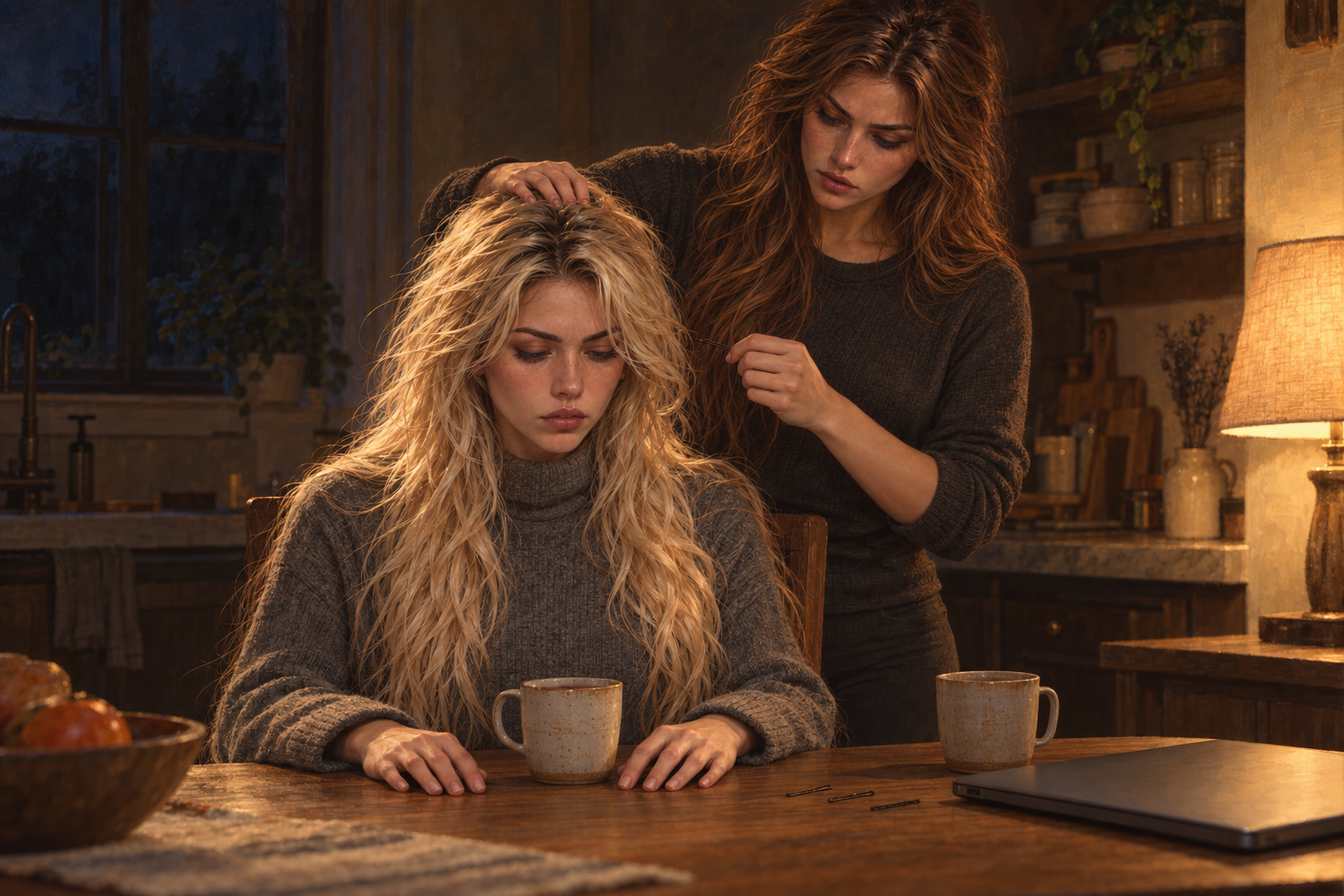
Then she put her hand flat on the top of Val’s head, and left it there.
“The hair down is mine,” said Kyra. “So it’s mine to give.” She bent and kissed the top of Val’s head, through all that pale. “Wear it down.”
· · ·
They shot it on a Saturday in May.
Val wore a dress she had made for it, which was not from any century — pale, simple, almost nothing, and nothing like anything anybody had ever worn on a mountain. She stood in front of the green sheet in the room that was nowhere, with the stream coming down behind her out of the snow on Val’s laptop, and her mask on, and her hair down her back, all of it, loose, the way it had been the first spring.
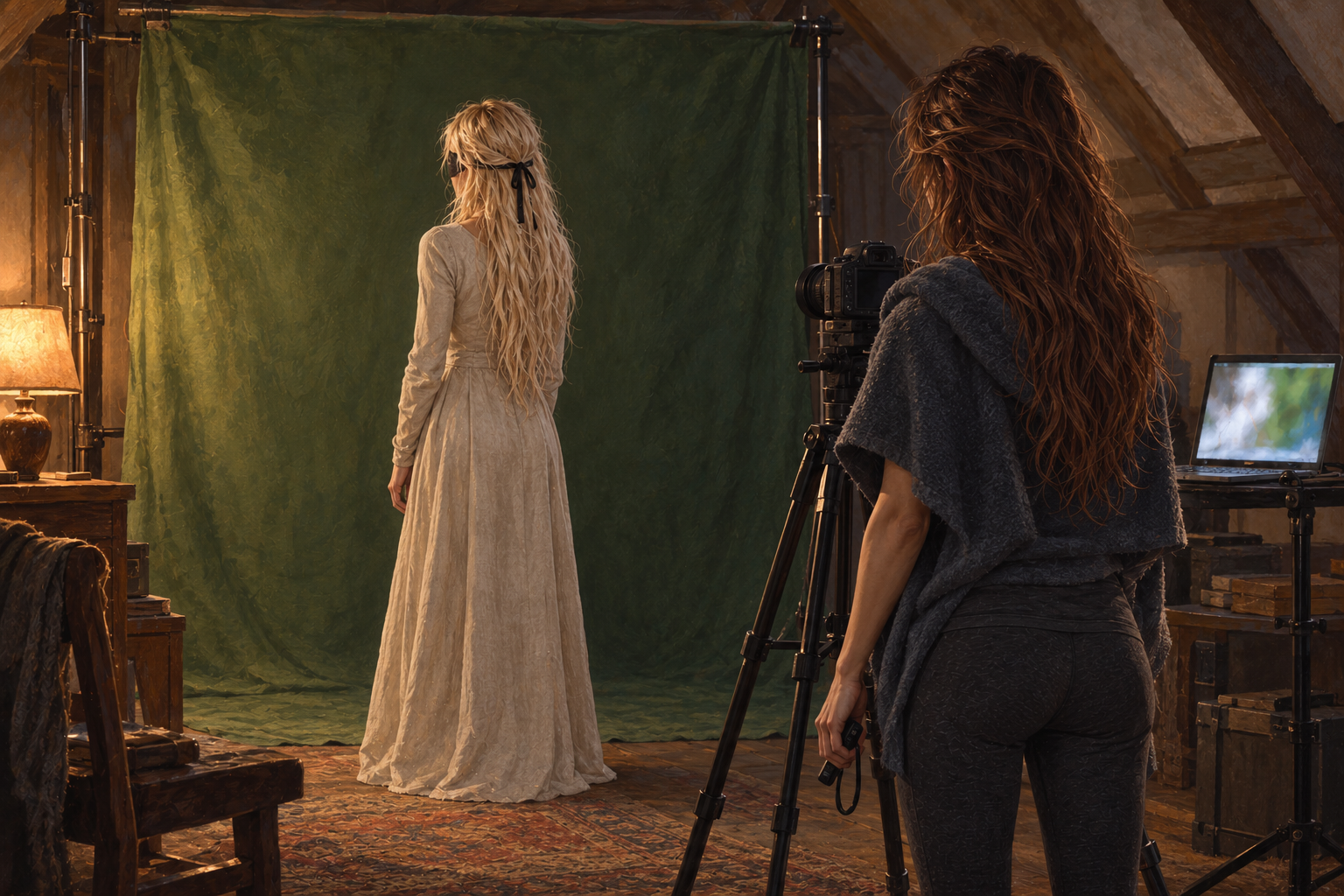
And Kyra, behind the camera, held the remote in her hand and did not need it, because there was nothing in that video but a woman standing very still in front of a mountain, looking at something nobody else could see.
It was four minutes long. Nothing happened in it.
The strangers called it beautiful, and asked where it was, and said they had never seen her hair down, and wanted to know why, and whether she would do it again.
She did not do it again.
— end of chapter fifteen —
Summer · Val’s kitchen table
“Price discrimination,” said Val.
Kyra, at the sink, did not turn around.
“I don’t know what that is and I don’t like the sound of it.”
“It’s not a bad thing. It’s a term of art.” Val had the laptop open and the Equipment notebook beside it and a third notebook Kyra had not seen before, with a gray cover and nothing written on it yet. “It means that different people are willing to pay different amounts for the same thing. And if you charge them all the same, you’re leaving money on the table. Some of them would pay more. Some of them want to pay more.”
“Nobody wants to pay more.”
“A great many people want to pay more,” said Val, “if it means they’re getting something the people who paid less aren’t.” She turned the laptop around. “Look.”
· · ·
It was the comments. Of course it was. Val had gone through all of them — tens of thousands — and sorted them, the way she sorted everything, into columns.
would pay double for longer ones
is there a way to get more?? I’d subscribe to anything
please tell me there’s a VIP tier
I want the uncut versions so bad
shut up and take my money
“There are a great many of those,” said Val. “Two thousand, near enough, that say some version of I would pay more. And another few hundred that say they’d pay anything.” “SubRosa lets you make a second tier. Above the first. People pay more to be in it, and they get things the others don’t.”
“What things?”
“That,” said Val, “is what I wanted to talk about.”
· · ·
She had made a list. It was in the gray notebook, on the first page, in two columns, and the columns had headings.
The first said Behind the second door.
The second said Never. At any price.
“The first one’s what goes in,” said Val. “The longer ones. The ones we cut to fourteen minutes that were really forty. The parts that are slower, and quieter, and longer, that most people skip and some people would sit through all night.” She ran her finger down it. “Anything riskier — whatever we do that’s further out on the table, toward the end where the money is. It goes there first, or only there. A smaller room. People who’ve paid twice to be in it.” She paused. “And if we ever do anything live—”
“Live?”
“If,” said Val. “If we ever do. It goes there and nowhere else. The most dangerous thing we could do, for the smallest number of people, at the highest price. A small room is easier to watch than a large one.”
Kyra came and sat down across from her, wiping her hands on a towel, and read the list upside down.
“And the second column.”
“The second column,” said Val, “is the same as it’s always been.”
· · ·
It was. Kyra read it, and it was all things she knew, things that had been written on the back of a nine-page paper in an envelope marked gutters since the very first week:
Faces.
Names. Either name. Any name.
Vaelith.
The room — anything that says where, or when.
And underneath those, in a slightly different ink, as though Val had come back to it later:
Side on.
Hair down. — and then a line through it, and above the line, very small: (once, the mountain, given — not for sale).
· · ·
“They’ll ask,” said Kyra.
“They’ll ask.”
“The people in the second room. They’ll have paid twice. They’ll think that means they can ask for anything.”
“They can ask for anything,” said Val. “Anybody can ask for anything. We’ve had men asking for things since the first week that I wouldn’t put in a ledger.” She closed the gray notebook. “That’s the whole of the term. They can pay to be in a smaller room. They can pay to see more of what we decide to make. They can’t pay to make us decide.”
She turned the notebook over and wrote on the back of it, in small exact capitals, and turned it around.
THEY CAN PAY. THEY CAN’T STEER.
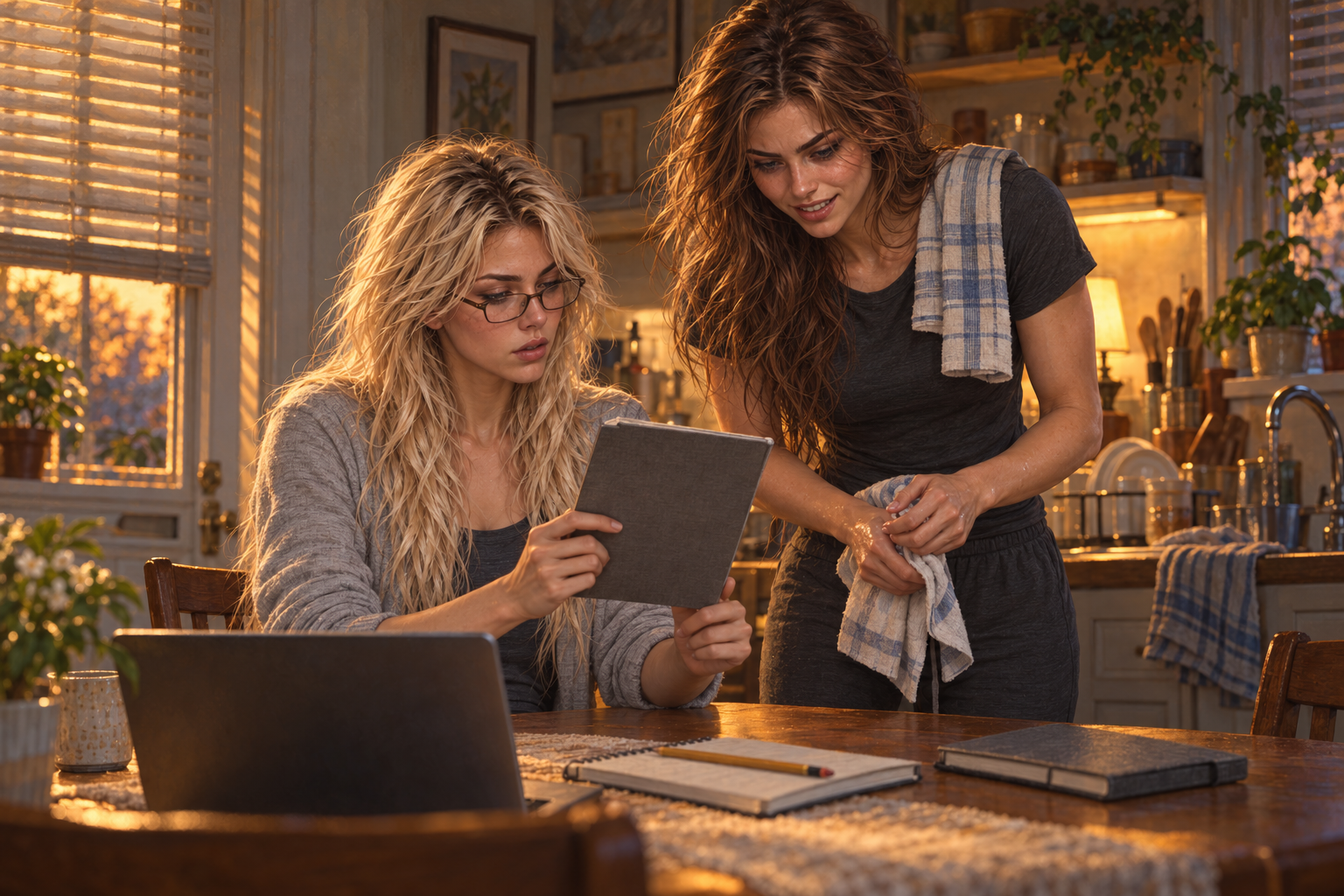
“That’s the term,” said Val. “Everything above it is procedure.”
· · ·
The name was Kyra’s.
They argued about it for a week. Val wanted something accurate, and offered Tier Two, and then Extended Access, and then something with the word premium in it that Kyra refused to let her finish. Kyra wanted something warm, and offered Love from Andromeda again, which Val pointed out was still a greeting card.
And then on the Thursday, at Val’s kitchen table, at a quarter past nine, with the library shut and the town shut and every lamp in the house on, Kyra said:
“Andromeda After Dark.”
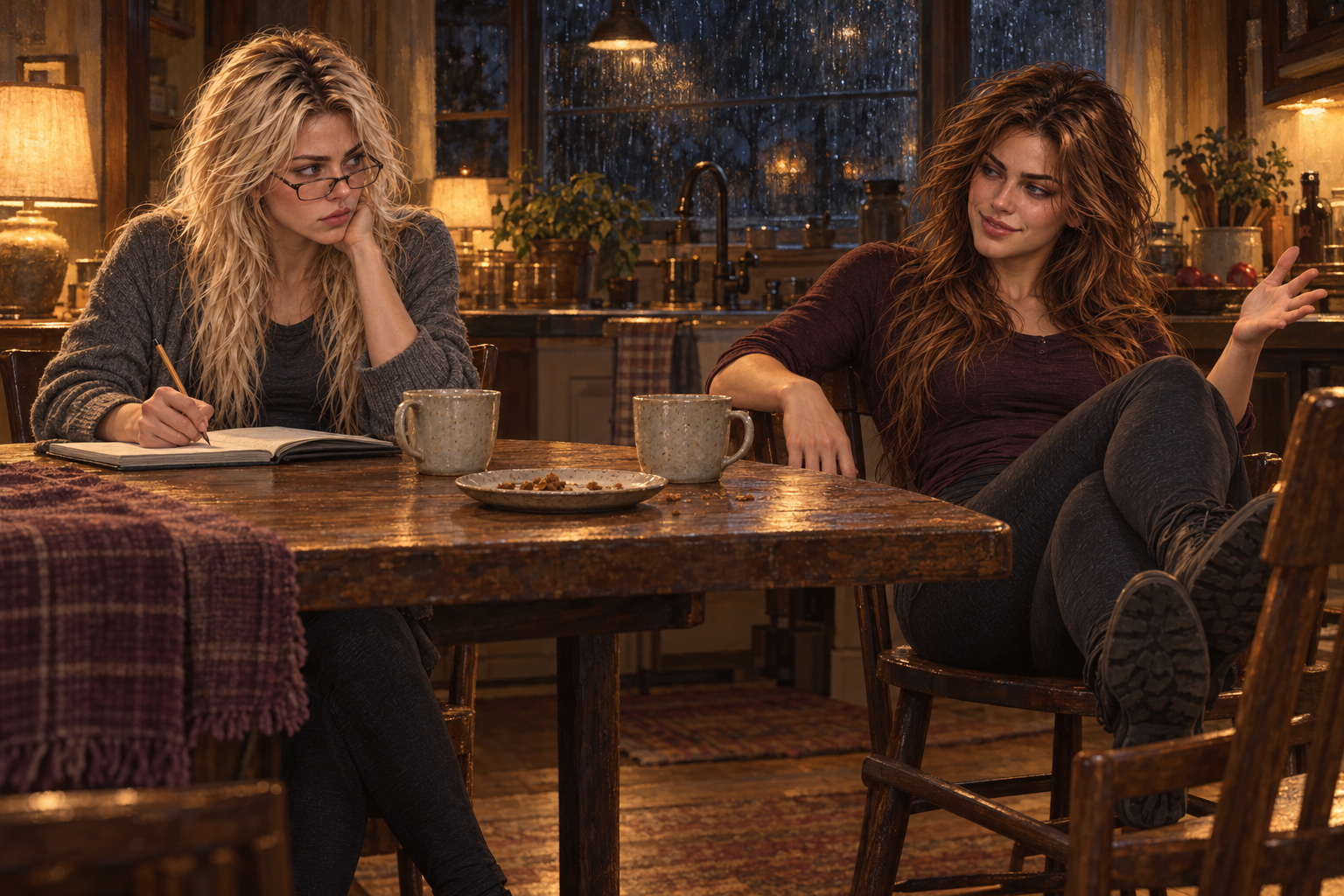
Val looked up.
“It’s what it is,” said Kyra. “It’s the same as the channel, after dark. The things you can’t see in the daytime. The back room.” She grinned. “Who’s in the back room tonight?”
Val considered this for some time.
“It sounds like a nightclub.”
“It sounds exactly like a nightclub.”
“It sounds like a nightclub in a film about a nightclub, in which somebody is murdered,” said Val. “It’s very vulgar.” She opened the gray notebook to the first page and wrote it at the top, in her small exact hand, over the two columns. “It’s perfect.”
· · ·
Val set the price.
She did it the way she did everything, with a spreadsheet and a great many columns and two long silent evenings, and at the end of it she turned the laptop around and showed Kyra a number, and Kyra looked at it and said, “Val.”
“It’s correct.”
“Nobody’s going to pay that.”
“About four in every hundred of them will pay that,” said Val, “on the first day. And another two in every hundred by the end of the month. And they will be the people who already watch everything, and write the long comments, and keep the counts, and know what time of day we post.” She turned the laptop back. “It isn’t for everybody. It’s not supposed to be. It’s for the people who would come back for the second door no matter what was behind it.”
“And if you’re wrong?”
“Then I’ll halve it,” said Val, “and be wrong in a different direction.”
She was not wrong.
· · ·
It opened on a Sunday in July, and by the Monday morning there was a new column in the ledger, and it was already longer than Kyra had expected, and Val was sitting at the kitchen table looking at it with an expression of pure and private delight that Kyra had last seen on her face over a broken cabinet she had broken herself.
“Six in every hundred,” said Val. “On the first day.”
“You said four.”
“I said four on the first day and six by the end of the month. It’s six on the first day.” She turned a page. “I underestimated how much they wanted a door to go through. It’s interesting. It’s very interesting. It isn’t what’s behind the door. We haven’t put anything behind it yet that they couldn’t almost see in the front room. It’s the door.”
Kyra laughed.
“Some people want us so much they’ll pay twice,” she said.
“Yes.”
“Twice, Val. For the same two women. To be in a smaller room with us.” Kyra put her chin on her hands. “I don’t think anybody’s ever wanted me enough to pay twice for anything. Not in my whole life.”
Val looked at her over the top of her glasses for a long moment.
“That,” she said, “is not true. But I’m not going to argue with you about it before breakfast.”
· · ·
The comments in the back room were different.
Kyra noticed it within a week. They were fewer, and longer, and calmer. Nobody shouted. Nobody wrote more more more. The people behind the second door had paid twice, and they seemed to feel that it made them responsible for something; they wrote like people in somebody’s house, careful of the furniture.
Is it worth it? somebody asked, on the front page, under one of the free ones, two weeks in.
And underneath it, from a name Kyra had seen in the back room every single night, a single line.
It’s worth it.
Then somebody else, from the back room. It’s worth it. And somebody else. And by the end of the week it was a thing the strangers said to each other, back and forth, the way they said seventeen inches and the rest is technique: somebody on the front page asking, and somebody from behind the door answering, every time, the same three words.
Is it worth it?
It’s worth it.
· · ·
The first one tried to steer in August.
Kyra had known it would come. Val had known it would come. It came through the private messages, from a name that had been in the back room since the first Sunday, at the top of a message so long Kyra had to scroll for some time to reach the end of it; and most of it was praise, extravagant and specific and not unkind, and at the end of it, in a paragraph by itself, was a number.
It was a very large number. It was larger than anything anybody had ever offered them for anything. It was, Kyra worked out, sitting very still on her couch, about what the whole of the back room had made in its first month.
And it was for one thing. Just once. Just for him. A private video, one copy, never to be shared, with the masks off.
Just for a second, he had written. I just want to see who you are.
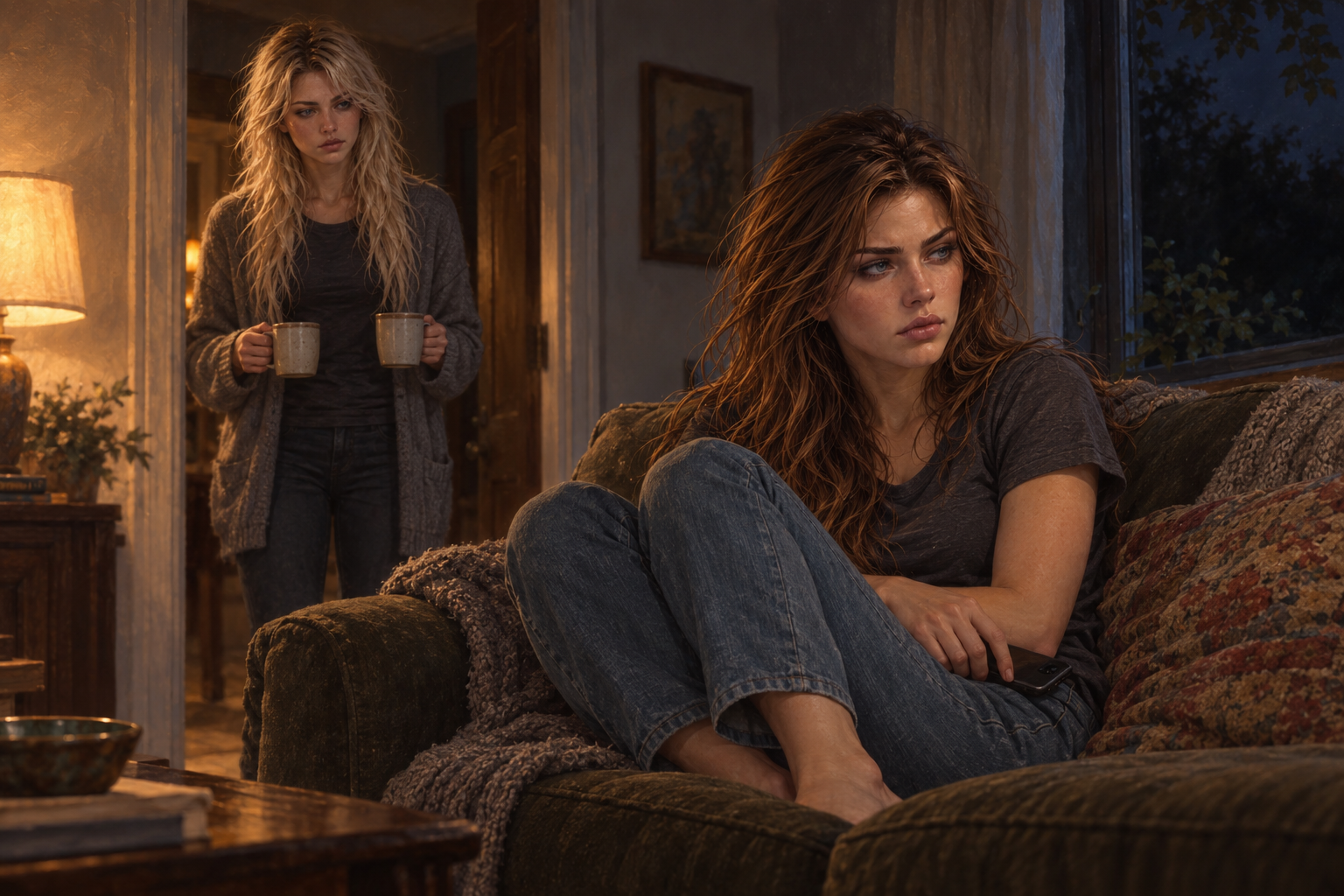
· · ·
Kyra did not say anything.
She sat on her couch with the phone in her lap, looking at the number, and found that what she felt was not what she had expected. Not anger. Not fear. Something much stranger: a kind of pity, enormous and tired and very old, for a man somewhere in a room with more money than sense who had looked at two women for long enough that he had started to believe he was owed their faces.
She gave the phone to Val without a word. Val read it once, all the way through, without expression, and then went back to the paragraph at the end and read that again.
“It’s a great deal of money,” said Kyra.
“It’s a great deal of money,” Val agreed.
“We don’t need it.”
“We don’t need it.”
“And even if we did—”
“Even if we did,” said Val. She took her glasses off. “Even if we had nothing. Even if the back room shut tomorrow and the front room after it and we were back where we were in the snow with nothing in our hands. Not for that. Not for any number. Not once, not for a second, not for him or for anybody.”
“I know.”
“I know you know.” Val held out her hand for the phone. “But I’d like to answer it.”
· · ·
She did not answer at length. Kyra watched her type it, and change one word, and read it back, and hand it over, and Kyra read it and started to laugh, and could not stop for some time.
Thank you for your kind words, and for being one of the first through the second door.
No.
You can pay to watch. You can’t pay to steer.
—B
· · ·
He did not cancel. That was the thing Kyra could never get over afterward. He did not cancel, and he did not argue, and he did not write again for a month, and when he did write again it was a short careful message about a video in the back room that he had liked very much, with nothing at the end of it at all.
And he never asked again. Not for the faces. Not for anything.
“They want to be told no,” said Val, that night, in Kyra’s bed, in the dark.
“Do they?”
“Some of them. The ones who’ve paid the most.” Val was quiet for a moment. “They’ve spent their whole lives being able to buy what they want. And then they find a room where they can’t. Where two women in masks will take their money and tell them, politely, no. And it makes the room worth more to them, not less.” A pause. “I didn’t expect that. I put it in the notebook.”
Kyra turned over and found her in the dark.
“Who’s in the back room tonight?” she said.
Val made a sound that in anybody else would have been called a laugh.
“Nobody,” she said. “It’s shut. It’s just us.”
— end of chapter sixteen —
Autumn · Val’s basement, and the room that was nowhere
Val had been trying to build it for a very long time, and Kyra had known that for a very long time, and neither of them had ever said so in a room with the lamps on.
It had begun with a piece of horn, in Boston, in a winter so cold the harbor froze, and Kyra’s idea, and Kyra’s knife, and an evening that had ended with both of them laughing so hard they had to lie on the floor. It had gone on, a long time later, with a catalog Val had read for years without ever once saying why, and a parcel from Illinois in a plain brown wrapper, and a device that had been a disaster from the first minute and had gone into the furnace before the second. And it had come, at last, in Portland, to a drawing in Val’s notebook — a bladder in a sleeve, filled slowly, a thing that would grow in place rather than be swapped — which had worked, after a fashion, and failed in every way that mattered, because a woman kneeling beside the bed with a rubber bulb in her hand was not frightening, and was not lost, and was not a man. She was tending. Val had written that down, and underlined it, and put the notebook away.
That had been the end of it. They had found the hands instead, that autumn — the wrist, the turn, the spiral — and the hands had been better than anything either of them had ever built, and Val had said so, and meant it.
And the hands did not reach. That had been the end of it too.
· · ·
So Kyra was not surprised, exactly, when she came over to Val’s house on a Saturday in October and found the basement door open and the light on and a smell coming up the stairs that she did not recognize.
She was surprised by the basement.
Val had cleared it. The boxes that had sat down there since the autumn they arrived were gone, stacked in the garage, and in their place were two long folding tables under a row of bright work lights, and on the tables were things Kyra had no names for. A small machine with a glass front and a tray inside it, humming. A row of plastic tubs with lids. Measuring cups, very clean. A scale that went down to the hundredth of a gram. Rolls of tape, and wire, and a soldering iron in a stand, and a tiny motor in a dish like a sugared almond. And in the middle of the largest table, on a sheet of white paper, laid out like a specimen, something about the size and shape of a cucumber, pale and smooth and faintly translucent, with a thin clear tube coming out of the end of it.
Val was bent over it with her reading glasses on and a pair of fine tweezers, and she did not look up.
“Don’t touch anything,” she said.
“I wasn’t going to touch anything.”
“You were going to touch the printer.”
Kyra, who had been about to touch the printer, put her hand in her pocket.
“Val,” she said. “What is all this?”
Val put the tweezers down.
· · ·
“They can make anything now,” said Val. She did not turn around. “Anybody can. In a basement. That machine prints a shape, layer by layer, out of a kind of plastic, to any drawing you give it, to a fraction of a millimeter. And there’s a kind of rubber you can buy now by the gallon, that you mix in a tub and pour into a mold, and it sets in an afternoon, and it’s soft, and it’s warm, and it moves the way skin moves.” She picked up a tub and turned it in the light. “You can put things in it. Pigments. Air. Fluid. Wire. You can make it do things.”
“Like what?”
“Like grow,” said Val. “In place. Slowly. Without anybody kneeling beside the bed with a bulb in her hand.” She touched the clear tube. “This goes to a pump. A small one, very quiet, run from a box with a dial on it, so that whoever holds the box can fill it a fraction at a time, as slowly as she likes, and it widens and lengthens all at once, from inside, the way a living thing does. Not a swap. Not a staircase. A fitting would be a staircase. This is an extension.”
Kyra was quiet.
“And this,” said Val, and turned the pale thing over on the paper, gently, with one finger, “has a motor in the base. There. You’d never see it. And when the box tells it to, it turns. Slowly. One way, and then the other. As much as you like. As often as you like.” She looked at it. “Because that’s the mechanism. Not the size. We found that out with our hands, a long time ago. It’s the turn.”
· · ·
Kyra came down the last of the stairs, slowly, and stood at the end of the table, and looked at it.
“It’s very pale,” she said.
“It isn’t finished.”
“It’s very — it’s quite large, Val.”
“It isn’t finished,” said Val again. “And yes. It is.” She took her glasses off. “There’s one more thing. Watch.”
She took a hair dryer from under the table — an ordinary hair dryer, pink, from the drugstore — and turned it on low, and held it a little way off the pale thing on the white paper, and moved it slowly back and forth, warming it.
And as it warmed, it changed color.
It went from pale to faintly gray, and from gray to a deeper gray, and then — slowly, all over, starting at the tip and moving down — it went blue. Not a bright blue. Not a toy blue. A deep, dark, particular blue, like the bottom of a bay at dusk, that Kyra had seen in exactly one place in her whole life, on exactly one kind of man, on a world a very long way from here.
Val turned off the hair dryer.
“There’s a pigment,” she said, quite steadily, “that changes color with heat. They put it in mugs. In children’s spoons. You can buy it in a jar. I mixed it in.” She put the hair dryer down. “At body temperature, it’s that.”
· · ·
Kyra looked at it.
And then she looked at the end of it. At the tip, where the blue was deepest. Where, when she bent down and looked very closely, there were ridges in the surface of the rubber — faint, shallow, running around it in a spiral, the way the lines go around the inside of a shell.
She had seen those once, too.
“Val,” she said.
“Yes.”
“How big is it.”
“At full,” said Val, “with the pump at the top of the dial?”
“Yes.”
Val told her.
Kyra sat down on the bottom step of the basement stairs.
· · ·
She did not say anything for some time. Neither did Val. The little machine with the glass front went on humming to itself, building something layer by layer that neither of them was looking at.
“That’s not a man,” said Kyra eventually.
“No.”
“That’s not men. That’s not an average, or a guess, or something out of a book. That’s not even what you’d say if somebody asked you what a big one was like.” She looked at the blue thing on the white paper. “That’s one man.”
“Yes,” said Val.
“That’s exactly one man. To the — what did you say? The fraction of a millimeter.”
“To about that,” said Val. “From memory. I’ve never measured anything else so carefully in my life. I had nothing to measure with at the time. I’ve had to work it out.” She was standing very still, with her hands flat at her sides, which meant something had come up in her and she was holding it down. “I worked it out over about six weeks. At this table. From what my hands remember.”
Kyra looked up at her.
“Aro,” she said.
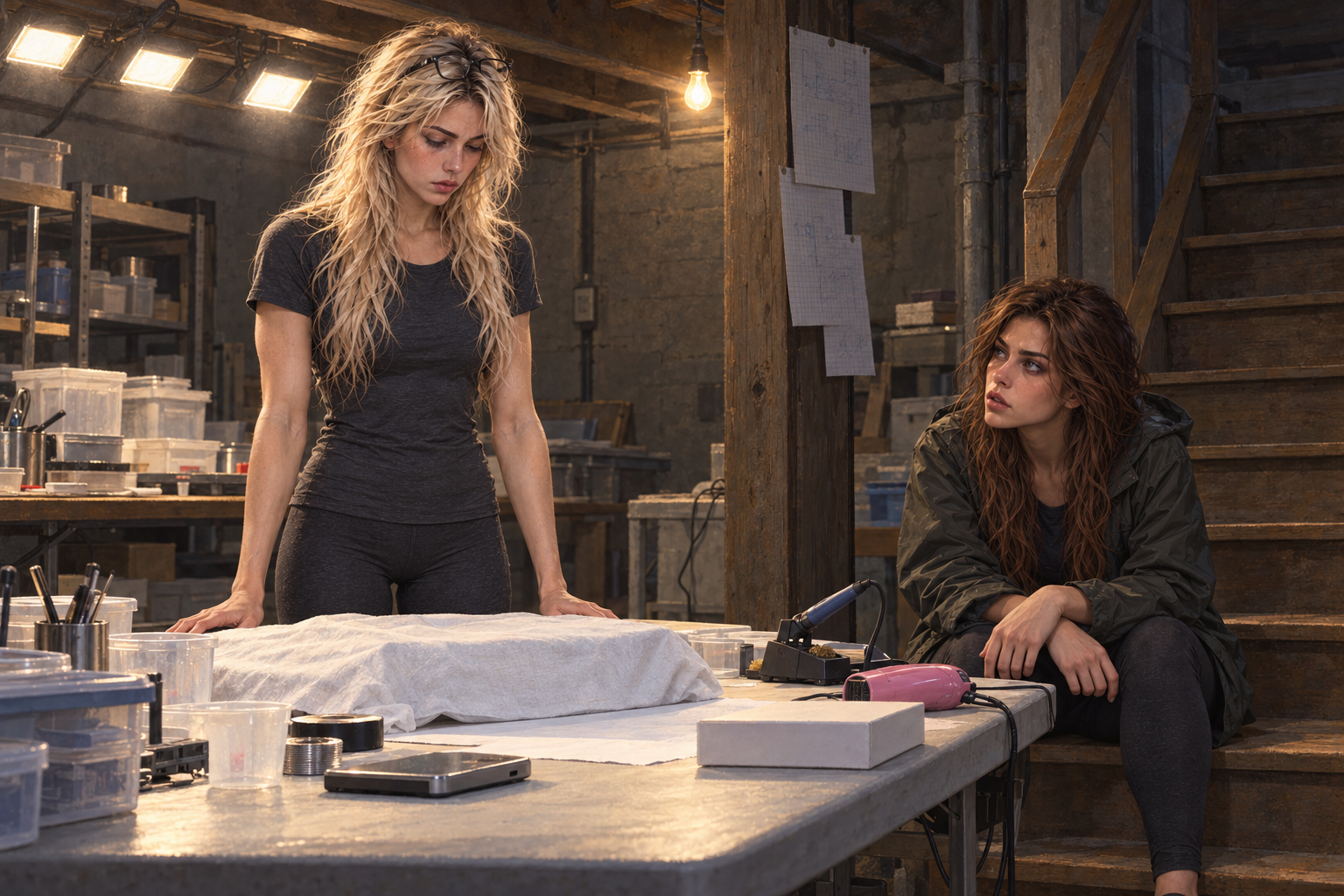
· · ·
Val had never told her.
That was the thing. Kyra had known about him — of course she had known; she had found out from the way Val took her coat off, on a plateau, a very long time ago, and they had had the worst row of their lives about it, and then come home, and then lain on a floor in a locked room with a bottle and talked about a broken cabinet that Val had broken herself. She knew he had fixed pumps. She knew he had been from four days east where there was actual soil, and had mentioned his mother once a week and never at length, and had been finished — a man who knew what he was and had stopped asking. She knew Val had walked three miles in weather that did not require it, carrying a housing she did not need to carry.
She did not know anything else. Not one thing. Val had never described any of it — the pump house, the four months, the nights — to anybody. Not even to her. Not in all their lives.
And here it was. On a white sheet of paper, in a basement in Oregon, under a work light. Blue.
“You never told me,” said Kyra. “What he was like.”
“No.”
“You’ve told me everything else. Everything. Every man since.”
“I know.”
“Why not him?”
Val was quiet.
“Because he was the one I walked to,” she said at last. “On Sethal. Three miles, in weather. The only man on that whole world I ever went looking for. Before you and I were anything to each other at all. Before I knew there was a country there.” She looked at the blue thing on the table. “And I didn’t have a way to say it. There isn’t a way to say it, in a kitchen, to the person you love, that isn’t either a boast or an apology, and it was neither. It was four months in a pump house. And I kept it.” She paused. “It’s the only thing about myself I’ve ever kept from you on purpose. Not out of shame. Out of — I don’t know what. Not having the words.”
“And now you’ve built it.”
“And now I’ve built it,” said Val, “because it turns out I can’t say it, but I can make it.” She almost laughed. “It’s the most precise account anybody has ever given of anything. And I can’t explain a word of it.”
· · ·
Kyra got up off the step. She came around the end of the table and stood beside Val, close, not touching, and looked down at the blue thing on the white paper with her.
“I never had him,” she said.
“No.”
“I’ve had everything else of yours. Every house. Every name. Every man since, told to me in detail with your particularity, and I’ve been insufferable about every one of them for a month.” She put her hand on the table, next to Val’s. “And I never had him. He was the one bit of you I was never part of.”
Val did not answer.
“And you’ve just given him to me,” said Kyra. “On a piece of paper. In a basement. Under a work light.” She turned her head and looked at Val. “Haven’t you.”
Val looked at her for a long moment.
“I suppose I have,” she said.
· · ·
The first video was a joke, and they both knew it was a joke, and that was the only way either of them could have done it.
It went on the front page, not in the back room. Nothing happened in it — nothing that anybody would have called anything. It was Kyra, in her mask, on the white sheet, sitting cross-legged with a box in her lap, holding the pale thing up to the camera like a woman demonstrating a kitchen appliance on a shopping channel; and Val beside her with the hair dryer.
“So,” said Kyra, to the camera, in her best announcer’s voice. “We’ve been working on something.”
The hair dryer went on. The pale thing went gray, and then blue, from the tip down, slowly, under the lamp, and somebody in the comments, later, would say that it was the single most unsettling thing they had ever seen happen to a sex toy.
“And now,” said Kyra, and turned the dial on the box.
It grew.
It grew slowly, in place, all at once, from inside, the way a living thing does. Wider, and longer, and wider, while Kyra held it up in one hand and the dial in the other and kept her voice perfectly level and narrated it like a cooking program, and the blue deepened, and the spiral ridges at the tip came up out of the surface as it stretched and stood out, faint and clear, like the lines on the inside of a shell.
“And it does one more thing,” said Kyra, and turned the other dial.
It turned.
· · ·
That was when Val laughed.
She had not meant to. Kyra could see that she had not meant to. She was sitting on the edge of the bed in her mask with the hair dryer in her lap and her braid down her back, looking at the blue thing turning slowly in Kyra’s hand at full extension — and at its size, which was not a toy size, which was not any size anybody on that site had ever seen or believed in — and at Kyra’s face, under the mask, doing its very best to remain the face of a woman on a shopping channel.
And something went in her. Kyra saw it go. Something that had been held down for a very long time, about a pump house and four months and a man who had been finished, and a thing she had never once been able to say in a lit room — and it came up out of her not as anything Kyra would have expected, not as grief, not as confession, but as a laugh. Out loud. On camera. The quiet one, who did not laugh, who had not been heard to laugh in a hundred videos, who typed It is the lamp — laughing, helplessly, with her hand over the bottom half of her mask, bent over on the edge of the bed until she had to put the hair dryer down.
Kyra lost the shopping channel voice entirely and laughed too.
· · ·
THE BLONDE LAUGHED
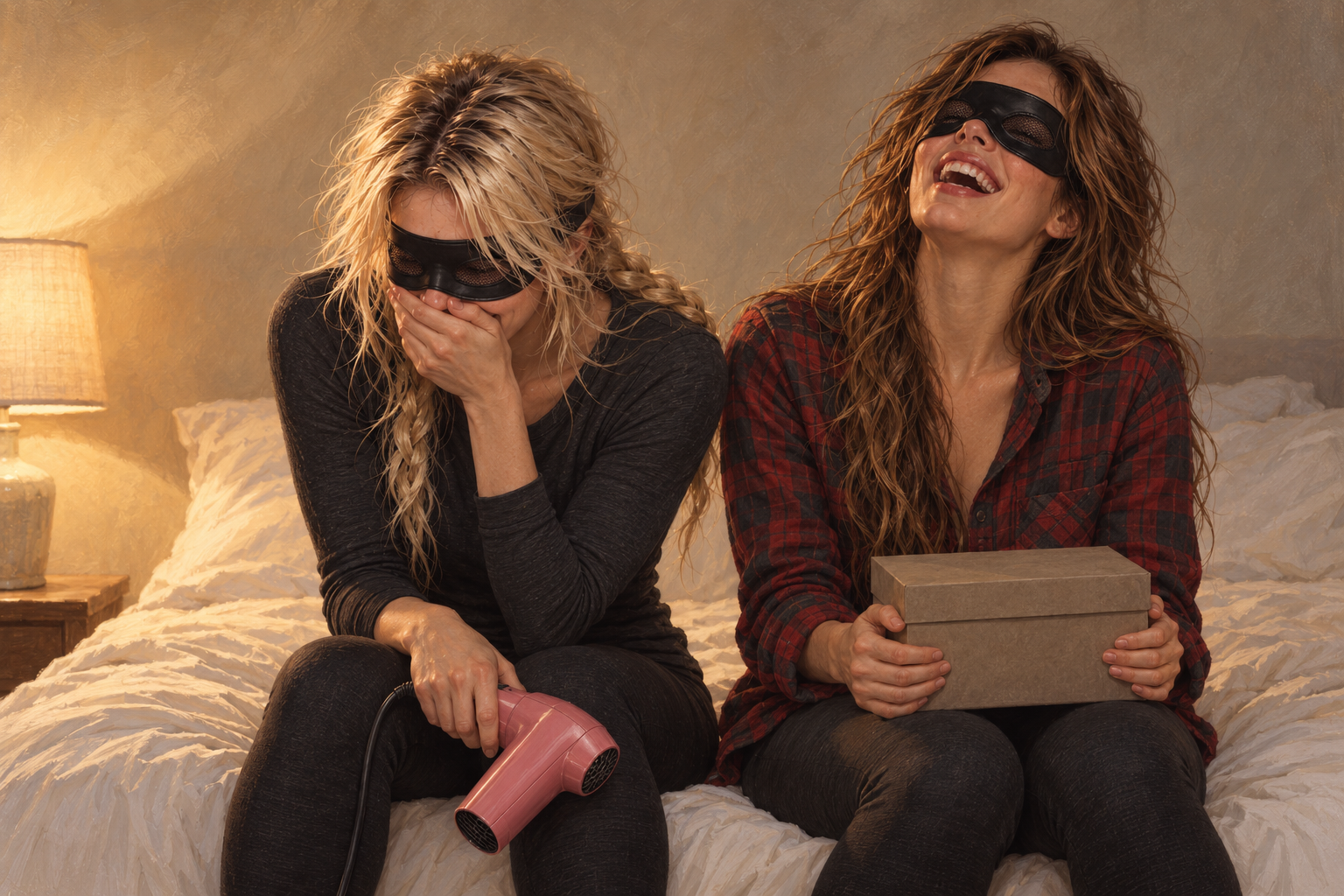
OH MY GOD SHE LAUGHED
a hundred videos and she’s never made a sound and she LAUGHED
I’ve watched that bit forty times
what IS that thing
no way. NO WAY. nobody is that big
that’s not realistic at all lmao it’s a fantasy toy
it’s like an alien dragon thing
what game is that from?? LINK??
is that a mechanical rig? it’s got a MOTOR
the color change though
why is it blue why is it BLUE
the blonde laughing at it is the funniest thing on this whole site, she knows how ridiculous it is
she’s laughing because it’s ABSURD. nobody’s built like that. not even close
Kyra read that last one out at her kitchen table, at one in the morning, and Val, beside her, put her face in her hands.
“Not even close,” said Kyra.
“I know.”
“Val. They think it’s a joke because it’s too big.”
“I know,” said Val, into her hands. “I know they do. That’s why I laughed.” She lifted her head. “Every single stranger who has ever watched us thinks that thing is the most ridiculous fantasy anybody ever made. And I’m the only person on this entire planet who knows it’s underselling him.”
Kyra stared at her.
“Underselling?”

“I couldn’t get the turn right,” said Val, with enormous dignity. “The motor’s too slow.”
· · ·
The second video went in the back room. It was not a joke.
They did the color on the Saturday night, Val’s and then Kyra’s, the jars and the knife and the sealant. Kyra braided Val’s hair. They put on the masks. And then they went into the room that was nowhere, and Kyra set the cameras and locked them, and checked the light, and put the remote for the exposure on the pillow where she could reach it; and then she sat on the edge of the bed with the other box in her lap, the one with the two dials on it, and looked at Val.
“I’ll run it,” said Kyra.
“I know you will.”
“You can’t. You know you can’t. If you’re holding the dial, you’ll be watching the dial, and if you’re watching the dial—”
“I’ll close,” said Val. “I know.” She was sitting very straight on the white sheet, with her hands flat on her knees. “Nothing in this room is mine. Not the camera. Not the light. Not this.” She looked at the box in Kyra’s lap. “It’s yours. I made it. It’s yours.”
Kyra put her hand flat on Val’s breastbone, and left it there for a moment, and felt the heart going under it, fast.
“Don’t be careful,” said Val.
Kyra knew those words. She had written them herself, a long time ago, in Portland, on a piece of paper Val still had somewhere, in a drawer, in an envelope marked tax.
“I won’t,” she said.
· · ·
It took a long time. Kyra did not hurry any of it. She went the long way first, as she always did, through all that dark, with her fingers and her patience and her low nonsense, until Val was under — until Val’s breath went loose and her hands came off her knees and her head went back on the pillow and she was nobody watching anything at all.
And then Kyra picked up the blue thing, warm now from the lamp and from her hands, gone to its deep dusk color, and brought it to her.
She knew what to do. She had done it with her hands, a long time ago, and found the turn, and found the spread, and found that the folds — the deep spiral of muscle inside, the thing Sethal had built for one purpose only, for a man and nothing else — wanted something to push against, and that gentleness gave them nothing. Don’t be careful. So she was not careful. She was patient, and she was steady, and she was not careful at all. And when it was in, she put her thumb on the first dial, and began, very slowly, a fraction at a time, to turn it.
It grew.
Slowly, in place, from inside, the way a living thing does. Kyra felt it go in her hand. And she watched Val’s face, under the mask, and saw the folds take hold — saw it in the jaw, in the throat, in the long line of Val’s body on the white sheet — and saw Val’s eyes come open behind the holes of the mask, wide, and look at nothing.
Kyra put her other thumb on the second dial, and turned it.
· · ·
She would not, afterward, be able to say very much about it, even to Val. There was no word for it in either language. It was not a thing Kyra had any way of knowing from the inside; it had never been done to her, not by a man, not by anything, and the hands had never reached it. She could only watch.
She watched the folds take it. The first part — the outer part, the part the hands had found, the part they had always had. And then the part after that. And then the part after that, the part the hands had never touched, the part Val had said plainly, a long time ago, in a bed in Portland with the lamp on, was gone for as long as they lived on this planet.
It was not gone.
Kyra watched it not be gone. She watched it go on — the turn, and the turn, and the turn, slow and steady and deeper and deeper, the whole of the spiral, inner and inner, the way it had been built to go and had not once gone since the snow — and Val’s whole body answering it, every muscle in her, not as a sensation, not as a thing being done to her, but as a thing she was doing, a thing she was good at, a thing she had been made for and had not been allowed to do for longer than most of the countries on this planet had existed.
It’s not a sensation, Val had said, in Portland. It’s an action.
It was an action. Kyra watched her act.
· · ·
And then the light came.
It came all at once, the whole of her, the way it had come once before that Kyra could remember, in a room in Portland at the end of everything — at the temples, at the throat, all down the arms, through the skin of her chest and her belly, in her hands where they had closed on the white sheet — and Kyra did not need the exposure remote, because she had turned the wheel down already, because the jaw had gone, and the wrists, and the forearms, and the elbows, and she had known.
And under the mask, in the lamplight, with the camera locked and the light clean and gray and every part of her clear, Val was crying.
Not a lot. Not where anybody would see who did not know where to look. A wet line at the edge of the mask, on the left, running down toward her ear. Val cried perhaps once in a very long while, and Kyra had never once remarked on it, and did not now.
She did not stop. She did not change anything. She held the dials steady, and let the whole of it go on until it was done.
· · ·
It was some time before either of them said anything.
They were lying on the white sheet in the lamplight with the blue thing put away and the dials off and the cameras still running, because Kyra had forgotten them, and Val was on her side facing her with her mask pushed up into her hair and her face wet and wrecked and not managing any part of itself.
“It reached,” said Val.
“I know.”
“Kyra. It reached.”
“I know, sweetheart. I watched.”
“I said it was gone.” Val’s voice was barely anything. “In Portland. I said it plainly. That part is gone for as long as we live on this planet. I said I’d be sad about it at intervals for the rest of my life. I was. I have been.” She stopped. “And it’s not gone. It’s in a basement. In a tub of rubber you can buy by the gallon.”
Kyra put her hand flat on the side of Val’s face, over the wet, and left it there.
“It isn’t him,” said Val, after a long time. “I want you to know I know that. There’s no trance. There’s nobody going under. There’s nobody there at all. There’s a motor, and a pump, and a pigment from a children’s spoon, and you.” Her eyes closed. “It was you. Holding the dials. It was the only way it could ever have been. If it had been me—”
“I know.”
“It was you,” said Val again. “Reading me. The whole of the spiral, the first time since the snow, and it was you, and nobody watching will ever know.” She opened her eyes. “That’s the best part.”
· · ·
They did not watch it back that night. They watched it the next night, at Kyra’s kitchen table, at one in the morning, and neither of them said a word the whole way through, and at the end Val reached out and stopped it on the frame where the light came, and looked at it, and did not say anything about the tear at the edge of the mask, and neither did Kyra.
It went in the back room on the Sunday.
I’ve never seen anything like that
I don’t know what happened in that video but something happened
the blonde is crying at the end. I’m not ok
whatever that thing is, it did something to her nobody else has ever done
she was SHAKING
that’s not acting. I’ve watched a lot of this stuff and that’s not acting
Is it worth it?
It’s worth it.
· · ·
And on the Wednesday, in the private messages, there was something from a name Kyra did not know, with a company logo at the bottom of it — a cheerful logo, pink and purple, with a little rocket in it — and a long polite paragraph about how much everyone at the company had admired the channel for a very long time, and how they had noticed the new product in the latest video, and how they would very much like to talk about the possibility of a partnership.
We’d love to know where you sourced it, it said. Or whether you made it yourselves. We think there might be a real market for something like that.
Kyra read it out at Val’s kitchen table.
Val, across from her, put down her coffee.
“A market,” she said.
“A real market.”
“For him,” said Val. “In a box. With a rocket on it.” She was quiet for a moment, and then her mouth did the thing it did instead of smiling, and then, for the second time that month, it did not stop at that.
— end of chapter seventeen —
Winter · Kyra’s kitchen table, and the room that was nowhere
“No edit,” said Val.
She said it at Kyra’s kitchen table on a Sunday night in January, with both hands flat on either side of her cup, and Kyra, who had been about to say something else entirely, put her own cup down.
“No edit,” Kyra agreed.
“Think about what that means. Properly. Not quickly.” Val did not look up. “Every video we have ever made, I’ve watched twice before anybody else saw it. We’ve cut the tilted frame. The corner of a library book. Twelve seconds of you in a doorway. The end of every single one of them, under music, so nobody hears—” She stopped. “Every frame of every one, gone over, at this table, at one in the morning, before it went out. That’s how we’ve done it. That’s the only reason we’ve been able to do it at all.”
“I know.”
“Live is the opposite. Live is whatever happens, at the moment it happens, to however many people are watching, and there is no table and no one in the morning and no second look. If the tape slips, they see it slip. If the blanket comes off the window, they see the window.” She turned her cup a quarter turn. “If I say something—”
“You’ll say something,” said Kyra.
“I always say something.”
· · ·
They had been asked for a long time. Do a live one. Please do a live one. When are you doing a live one. I’d pay anything for a live one. It had been in the comments since the chair, and in the back room since the back room opened, and Val had read every single one of them and said nothing, and Kyra had known exactly why.
Not the masks. The masks would hold. Not the room; the room was nowhere, and Val had made sure of that on her knees with a flashlight, more than once. Not the color on the rings, or the light, which the cameras would now hold clean and gray the whole way through.
The murmur.
At the very end, every time, without fail, Val’s speech got away from her. It was the only place in her whole life it ever did. A low unbroken run of nothing at all, half of it in a language this planet had never heard, none of it in any order — and strung all through it, over and over, like beads on a wire, Kyra’s name.
Not Copper. Not sweetheart. Her name. The one on the volunteer form at the sheriff’s office. The one on the clipboard. The one Dee said on Sundays.
On every recorded video they had ever made, there had been strings laid over the end of it, loud enough that nothing underneath could be heard. On a live one there would be no laying over. There would be whatever came out of Val’s mouth, at the moment it came out, to however many people were there.
· · ·
“Music,” said Kyra. “In the room. Not after — during. A speaker, by the bed. Loud enough that nothing under it carries. We start it before we start, and it runs the whole way through, and when you get there—”
“It covers it.”
“It covers most of it. Like the strings do.” Kyra kept her voice steady. “And you’re not loud, Val. You’ve never been loud. It’s low. It’s barely anything. With music over it, in a room, through a microphone across a bed—”
“Most of it,” said Val.
“Most of it.”
“And the rest?”
Kyra did not answer for a moment.
“Then the rest is a woman making a sound at the end in a language nobody can name,” she said. “Which is exactly what they already think it is. Since the first video they’ve been arguing about it in the comments, over the strings. What is the blonde saying at the end, you can see her mouth move. They’ve decided it’s Russian, or Welsh, or something she made up. Nobody’s ever once heard a name in it.” She paused. “And the only name in it is mine. And nobody on earth knows what my name sounds like in your mouth.”
· · ·
Val looked at her across the table.
“There’s a way to make sure,” she said. “You know there is.”
Kyra knew.
At the end, when Val went, if somebody’s mouth was on Val’s mouth — and stayed there, all the way through — then nothing at all would come out of it that anybody could hear. It had happened that way a great many times, in a great many beds. It had happened that way on the very first video, without either of them deciding, because Kyra had wanted to kiss her and had.
“No,” said Kyra.
Val’s eyebrows went up.
“No,” said Kyra again. “I’m not going to put my mouth on yours to keep you quiet. I won’t. Not on camera, not off. If I kiss you at the end it’ll be because I want to kiss you at the end. That’s the only reason it’s ever been. It’s not a lid.” She put her hand flat on the table. “The day I kiss you to shut you up is the day it stops being the thing it is. I’m not trading that for a live show. I’m not trading it for anything.”
Val said nothing for some time.
“That’s a term,” she said eventually.
“That’s a term.”
Val took the gray notebook out of her bag — the one with Andromeda After Dark on the first page — and turned to the back of it, and wrote it down, in her small exact hand, and turned it around so Kyra could read it.
The kiss is never a lid.
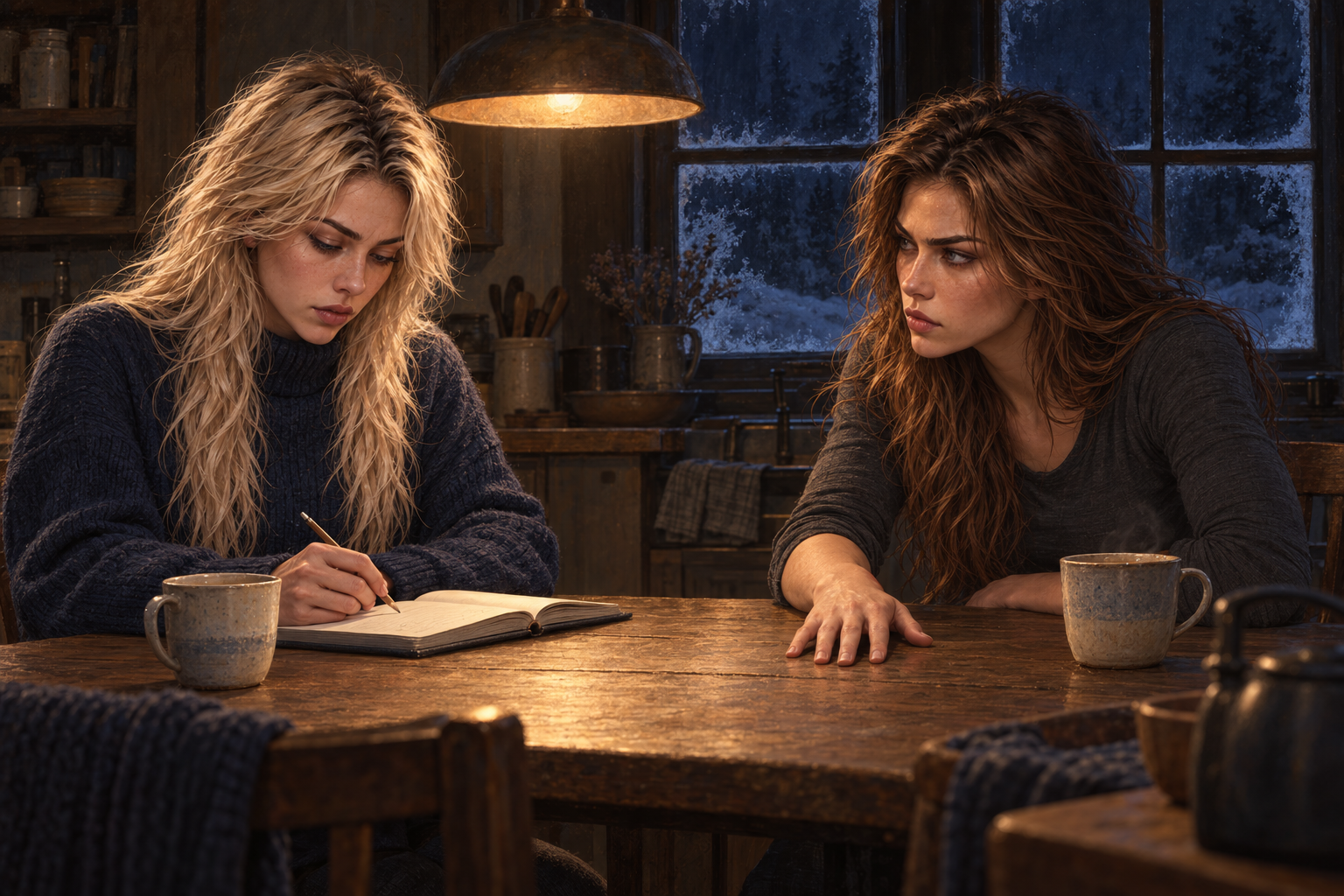
“Everything above it,” said Kyra, “is procedure.”
· · ·
It went in the back room, of course. Val had decided that a long time ago: if they ever did anything live, it would be there and nowhere else, behind the second door, for the smallest number of people at the highest price. A small room was easier to watch than a large one. She posted the time a week ahead, in one flat line, with nothing after it.
Live. Sunday, 05:00 UTC. —B
Kyra pointed out that it was Saturday night. Val pointed out that a time zone is a location.
Kyra read the comments under it on the Sunday night, in bed, out loud, and did not get to the end of them before Val took the phone away and put it face down on the nightstand.
“You’re making it worse,” said Val.
“I’m making it real.”
“It was real when I posted it.” Val lay back. “I’d rather not hear four hundred strangers tell me how excited they are for a week. I’ll want to cancel by Wednesday.”
“Will you?”
“No,” said Val, to the ceiling. “But I’ll want to.”
· · ·
Saturday came the way Saturdays do, which was all at once, after a week of not coming at all.
They did the color at Kyra’s kitchen table at seven, the jars and the knife and the sealant, and neither of them said much. Kyra braided Val’s hair. They put on the masks, and Kyra stood in front of Val and looked at her through the mesh — the black mask, the braid, the mouth she had been kissing since before most of the cities on this planet had their present names — and thought, as she had thought at this table before every single one, oh.
Val, looking back at her, said: “Your hands are shaking.”
“They’re not.”
“They’re shaking very slightly, at a frequency I’d estimate at about—”
“Val.”
“I’m only saying,” said Val. “Mine are too.”
· · ·
The room that was nowhere looked as it always looked. The cream wall. The white sheets. The blanket over the window, taped at every edge. The lamp, low and warm, from the left, exactly where the letter had asked them to leave it. The two cameras on their tripods, locked. The remote on the pillow.
And two new things.
A small black speaker on the floor by the head of the bed, which Kyra had bought in Portland and tested for three evenings with the door shut. And on a stand at the foot of the bed, angled so that Kyra could see it from where she would be and the cameras could not, Val’s laptop, open, with the back room’s page on it.
There was a box down the right-hand side of the page where the chat would go. It was empty. Above it, a small gray number said how many people were waiting, and the number was not small.
“You’ll look at it,” said Val, from the doorway.
“I won’t.”
“You’ll look at it. You always look. You’ll read it out loud in your head the whole way through.”
“I’ll look at it once,” said Kyra, “at the start, and once at the end. That’s all. The rest of the time I’ll be looking at you.”
Val looked at her for a moment.
“That’s a very good answer,” she said. “I’m not sure I believe it.”
“Then watch me,” said Kyra, and pressed the button on the speaker, and the music came up — low, slow, mostly strings, the same piece Val said sounded like a dentist’s waiting room — and filled the room to the corners.
Then she pressed the other button.
· · ·
The chat came up at once.
It came up the way water comes through a gap in a dam, all at once, a hundred lines in the first ten seconds, faster than anybody could read.
SHE’S HERE
omg omg omg
hi Copper hi Blondie!!!!
I’ve been waiting all week
first live!!! history!!!
is that the chair??
no chair tonight?
the lamp is the same lamp 😭
it’s real, it’s actually live, I can see the timestamp
hi from Melbourne it’s 4am here and I don’t care
hi from Glasgow
hi from São Paulo
hi from a kitchen
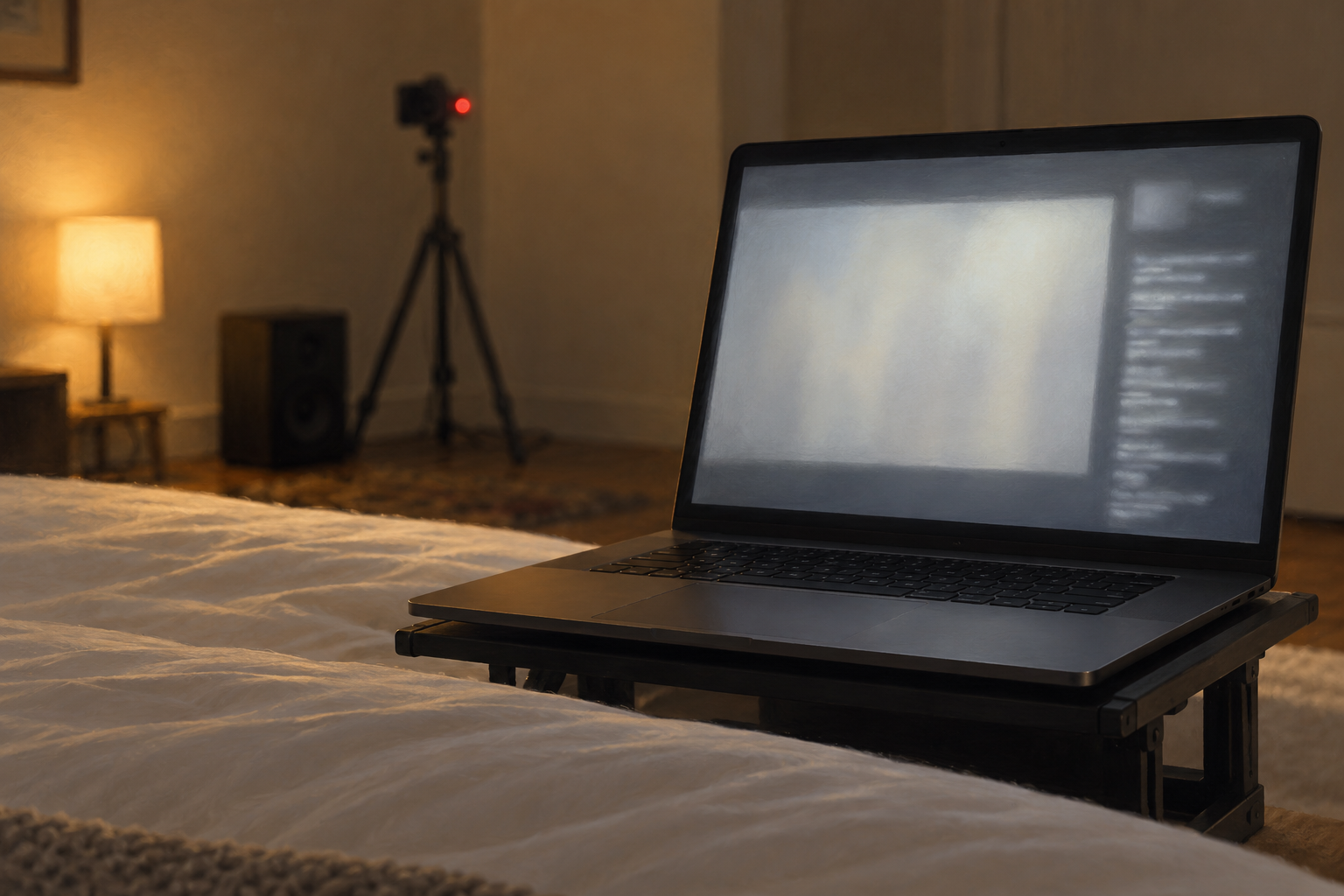
Kyra looked at it once. She had promised once. She read hi from a kitchen and felt something in her chest go, and did not let her face do anything at all under the mask, and then she looked away from it, at Val, who was sitting on the edge of the bed in the lamplight with her hands on her knees and the braid down her back, perfectly still.
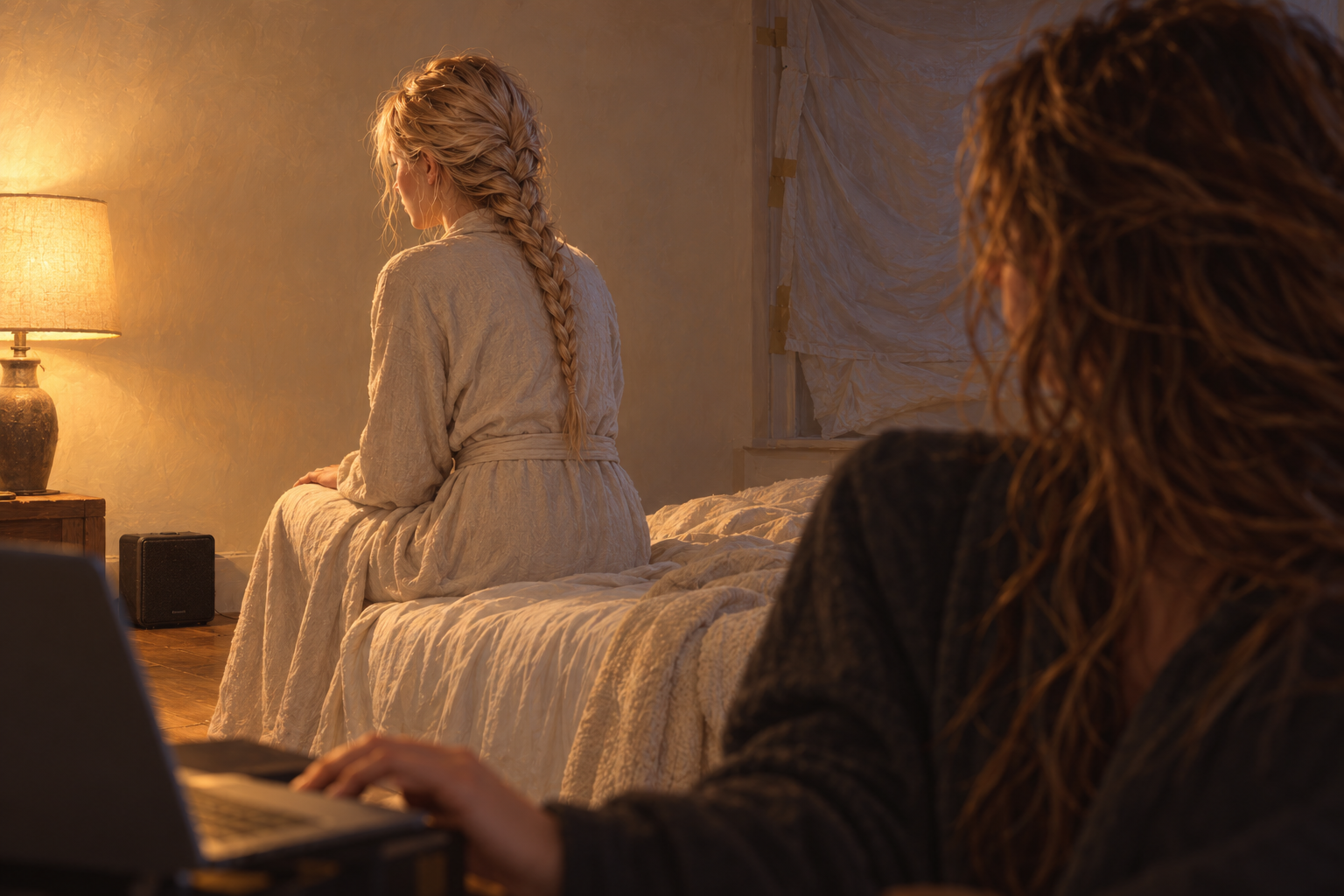
Kyra went to her.
· · ·
She did not hurry anything. She had decided that at the kitchen table, and she held to it. She went slowly, the way she always went, the way she would have gone if there had been nobody watching but the lamp — and talked, low, under the music, about nothing at all. The man with the pager, who had backed the engine into the bay door again on Thursday. The dog that barked at the mail, who had died in the autumn and been replaced by a smaller dog who barked at the same mail in a higher voice. The woman at the pie table, whose niece had gone to Seattle and bought a house.
And all the time, on the edge of everything, she could feel it: the room on the other side of the lens. Not empty, the way a recording was empty. Full. All of them, right now, in Melbourne and Glasgow and São Paulo and a kitchen, watching this, this, at the moment it was happening, with nothing in between.
She had wanted a witness. She had a great many of them. All at once, in the same breath.
She found she did not mind at all. She found it was like being lit.
· · ·
They laced.
Side on was not theirs to show; it never had been. So it was from above, the way the cameras had seen it a hundred times — Kyra over her, the two of them wound together at the hip and holding.
And the grip came up between them.
Kyra had known it would be the grip that saved them, and it was. It came up out of Val small and certain, the way it always did, and it said, as clearly as if she had spoken it aloud: Are they there?
Kyra answered. Yes. All of them.
How many?
I don’t know. I’m not looking.
A pause. Then the grip again, smaller. I can feel them.
I know, sweetheart. So can I.
I don’t know if I can—
You don’t have to. Nothing in this room is yours. Not them. Not the camera. Not the end. Kyra tightened, and eased, and held. I’ve got the end. You just stay here.
And above all of it, where anybody could see, two women in black masks in lamplight, under strings, moving slowly, very little happening anywhere a camera would have expected. And not one person on the other side of the lens, in any country, at any hour, had the faintest idea that the whole of that conversation had just taken place.
· · ·
It took a long time.
Kyra went first. She always went first and she always went loud, and she did not try not to; it came up out of her the way it always did, laughing at the end, her eyes going gold behind the mesh where nobody could see, and somewhere at the edge of things, on the laptop at the foot of the bed that she was not looking at, she knew that the chat had just gone white.
Then she went on. And Val stayed where she was.
Val was watching. Kyra could feel it in the grip — tight, and steady, and too careful, the grip of a woman holding a room up with both hands. There were too many people in it. There was a number on a laptop at the foot of the bed and Val knew it was there, and knew it was large, and knew every one of them was waiting for her, and the knowing was a thing to watch, and Val could never not watch a thing.
So Kyra did the one thing she knew. She slowed. She slowed until there was nearly nothing. And she put her mouth by Val’s ear, under the edge of the mask, under the strings, so that no microphone in the room could have caught it, and said, very low, over and over, in time:
“Nothing in this room is yours. Not them. Not the number. Not the end. Nothing in this room is yours.”
And the grip let down.
Not let go. Let down — the way a held breath lets down. Kyra felt it go all through Val, under her, the whole long line of her on the white sheet, and Val’s head went back on the pillow, and her mouth came open under the mask, and Kyra knew, as surely as she knew north, that for the first time since the button, Val was not in a room with anybody but her.
Kyra’s thumb found the wheel on the remote. One click. Two.
The jaw went.
Three. The wrists.
Four. The forearms. The elbows.
And the light came.
· · ·
It came the way it came, at the throat and the wrists and along the collarbones and down, and on the laptop at the foot of the bed it would be clean and pale and gray, a soft shine around a woman with nothing behind it; and Kyra watched it come up through the mesh and did not look at the laptop at all.
Then Val went quiet, and quieter.
And then she came apart under Kyra without a sound — all at once, the whole of her lit, arching up off the white sheet with the braid crushed beneath her — and the murmur started.
Low. Unbroken. Half of it in a language this planet had never heard, none of it in any order, under the strings, under Kyra, into the room.
And the name.
Kyra heard it go past. Once. Twice. Strung through all that low nothing like a bead on a wire, the way it had been strung there since the snow — her own name, in Val’s mouth, at the one moment in the world when Val could not help it — going out into a room with a microphone in it, under a violin, to Melbourne and Glasgow and São Paulo and a kitchen.
She did not stop it. She did not put her hand over it. She did not put her mouth on it. The kiss is never a lid. She held on, and kept the grip steady, and let it run.
And when it was nearly over — when Val’s light was going down, last at the wrists, and the murmur had gone to almost nothing, to breath — Kyra bent down and kissed her. Because she wanted to. Because she had wanted to the whole time. Because there was nothing left by then to cover, and she would have done it anyway.
· · ·
She did not look at the chat until it was over. She had said once at the start and once at the end, and she held to it.
Then she reached past Val’s shoulder for the laptop, and turned it a little, and looked.
I’m crying
I’m actually crying
that was the most beautiful thing I’ve ever seen
the GLOW
the redhead slowed right down at the end, did you see, she knew exactly
what was she saying in her ear
whatever it was it worked
the blonde was talking at the end again
what language is that
I heard it this time!! it’s not Russian
it’s not a language. she’s just making sounds.
it’s a language.
it’s a language, there’s a word that repeats
I heard the word that repeats
what’s the word
I couldn’t make it out, the music
it’s like a name or something?
it’s just a sound, you guys
it’s a language.
· · ·
Kyra read it twice. Then she reached out and pressed the button that ended it, and the page went to a gray card that said This live has ended, and the strings went on playing in the room by themselves for some time before either of them thought to turn them off.
· · ·
Val did not sleep.
Kyra knew she would not. She lay in her own bed with her face in Val’s hair and her arm across her and listened to her not sleep until a little after two, and then felt her get up, carefully, so as not to wake her, and heard the stairs, and the kitchen light.
Kyra gave it a quarter of an hour. Then she got up and went down.
Val was at the kitchen table in Kyra’s robe, with the laptop open and a pair of headphones on and her reading glasses on and a notebook in front of her. She did not hear Kyra come in. She was listening to something. Kyra could see the little line along the bottom of the screen, and the place where Val had marked it, and the place where Val had marked it again; and as she stood in the doorway, she watched Val drag the line back to the first mark, and play it, and listen, with her eyes shut and her hand on the table, and drag it back, and play it again.
Ten seconds. The end. The strings, and the murmur under them.
Over and over.
· · ·
Kyra did not say anything.
She knew this. She had known this woman a very long time, and this was the oldest thing about her. Not the light, not the hair, not the lamps. This: a record, and a lamp, and the small hours, and Val bent over it, checking. Checking again. Checking whether it was there. Checking whether anybody could see. Checking whether the thing she was afraid of had happened, one more time, with the volume up, in case she had missed it the last time.
She had promised to stop. In a bed in Portland, with the window going gray. I’ll stop checking. And she had, mostly. For a very long time. And here she was again, at two in the morning, in Kyra’s robe, with the headphones on.
Kyra came and sat down across from her. Val opened her eyes and saw her, and did not take the headphones off.
“How many times?” said Kyra.
Val did not answer.
“Val.”
“Thirty-one,” said Val.

· · ·
Kyra reached across the table and took the headphones off her head, very gently, the way you’d take a hat off somebody asleep, and put them on the table.
“Did it go out?” she said.
“I can’t tell.” Val’s voice was very level, which meant it was not level at all. “It’s under the strings. It’s very low. There’s a sound, twice, that might be — the stress is right, and the length. It could be. If you knew. If you’d ever heard me say it.” She looked at the screen. “And I can’t tell. I’ve listened thirty-one times and I can’t tell, and I’ll listen thirty-two times, and I won’t be able to tell then either, and I know that, and I’m going to do it anyway.”
“No,” said Kyra. “You’re not.”
Val looked at her.
“You can’t tell,” said Kyra. “Thirty-one times, with headphones, with the line marked, knowing exactly what you’re listening for, knowing what my name sounds like in your mouth — and you can’t tell. You’re the only person on this whole planet who could. And you can’t.” She put her hand flat on the closed lid of the laptop, and closed it. “Then it didn’t go out.”
“That isn’t how—”
“In this room,” said Kyra, “it didn’t.”
· · ·
Val sat very still.
“Somebody heard a word that repeats,” she said at last.
“Somebody hears a word that repeats in the sound of a kettle.”
“Somebody said it was like a name.”
“And somebody else said it was just a sound, and somebody else said it was a language, and they’ll go on saying it for the rest of their lives, and none of them will ever know.” Kyra kept her hand on the laptop. “They argue about everything, Val. They argue about the chair. They argue about the lamp. They’ll argue about this. And the only person who’ll ever know what that word was is sitting across the table from you in your robe.”
“It’s your robe.”
“Then I’m sitting across from you in nothing,” said Kyra, “which is worse, and you haven’t noticed, which means you’re further gone than I thought.”
· · ·
Val looked at her, then. Properly, for the first time since the headphones came off.
And then, very slowly, she took her glasses off, and folded them, and put them on the table on top of the notebook, which had thirty-one small marks in it in a column down the side of the page.
“Thirty-one,” she said.
“I know.”
“I said I’d stop.”
“You did stop. For a very long time.” Kyra came around the table, then, and stood behind her chair, and put both hands on her shoulders. “And then you did the most frightening thing you’ve ever done, in front of more people than have ever seen you do anything, and you came down here at two in the morning and checked thirty-one times. That’s not starting again. That’s the bill.”
Val put one hand up and laid it over Kyra’s on her shoulder.
“You kissed me,” she said. “At the end.”
“I wanted to.”
“It was after. When there was almost nothing left.”
“I know when it was. I was there.”
“It also—” Val stopped.
“Well,” said Kyra. “There’s that too.”
Val made a sound that in anybody else would have been called a laugh, and turned her head, and pressed her mouth briefly against the back of Kyra’s hand on her shoulder.
“Back room only,” she said. “Always. And not often.”
“Not often,” Kyra agreed.
“Very not often.”
“Come to bed,” said Kyra, and Val did, and left the notebook on the table with its thirty-one marks, and did not, in the morning or ever, make a thirty-second.
— end of chapter eighteen —
Spring · a supermarket two towns over, and the back room
It was Kyra who said it, and she said it at the diner, which was the worst possible place.
It was a Sunday. Dee had brought pancakes nobody had ordered, because it was the first warm Sunday of the year and Dee did that, and set a little steel jug down between them with a lid on a hinge, and gone away; and Kyra had picked up the jug and tipped it, and watched what came out of it go down onto the stack in a slow amber rope, folding over itself, not pouring so much as arriving, a little at a time, in no hurry at all.
And she had started to laugh.
She tried not to. She put the jug down and put her hand over her mouth and looked at the ceiling of the diner, and it did not help. It came up out of her in waves, the way it had not come up out of her in public in some years, until the man at the counter turned around and Dee called across from the coffee machine to ask what was so funny, and Kyra could not tell her, and could not stop.
Val, across the booth, did not laugh. Val sat very straight with her hands flat on either side of her plate and looked at the jug, and then at Kyra, and her face did absolutely nothing, which was how Kyra knew Val knew exactly what she was thinking.
“Don’t,” said Val.
“I didn’t say anything.”
“You’re going to say it in the car.”
· · ·
She said it in the car.
“They’d never know,” said Kyra, on the county road, with the window down. “That’s the joke. That’s the whole joke. We could do the whole thing — exactly, every bit of it, the way it actually is — and every single one of them would think it was the strangest thing they’d ever seen, and not one of them would know it was real.”
“It isn’t real. It’s syrup.”
“It’s syrup that’s real,” said Kyra. “You know what I mean.”
Val looked out of the window at the river for a while.
“It doesn’t pour,” she said eventually, very quietly. “It relocates.”
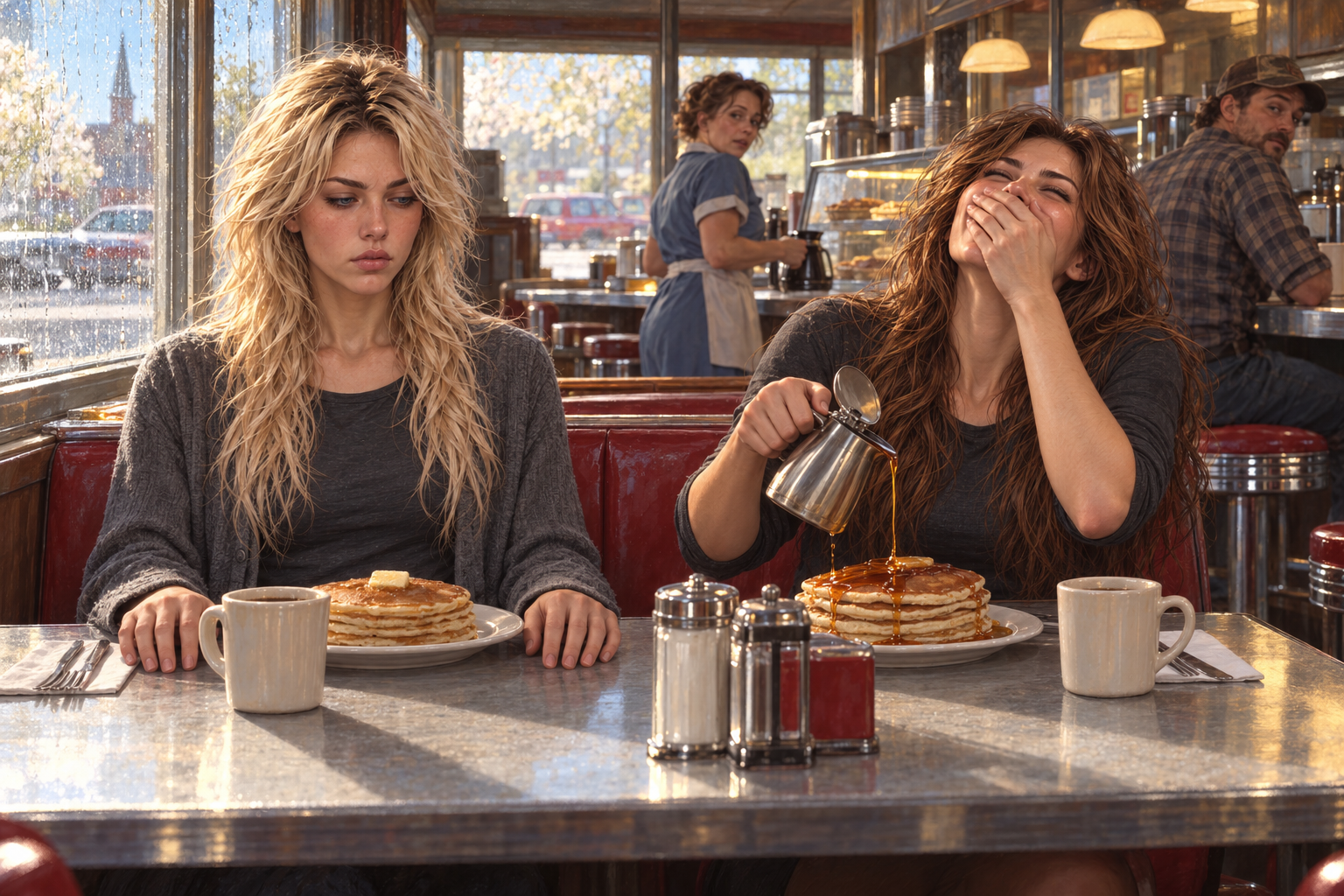
Kyra turned her head.
It was the oldest joke they had about it. It was older than the diner and older than this country; it was older than either of them could have put a date on without counting. Kyra had said it first, a very long time ago, at a honey jar, at a table, on the other side of everything, about a boy from four systems out — and Val had heard it, and had never once said it back, in all that time. Not once.
“You’ve never said that,” said Kyra.
“I’ve thought it,” said Val, “every single time anybody in this country has put a jug of syrup on a table in front of me. Which in this country is roughly every morning.” She did not look away from the river. “Every breakfast for a very long time. Every diner. Every pancake. I’ve sat there with my hands on the table and thought it relocates, and said nothing, and watched you not say anything either.”
“I didn’t know you—”
“I know you didn’t. That’s the point of not saying.” Val turned, then, at last, and looked at her. “Once. Back room. Live. Never on the front page, and never again.”
Kyra stared at her.
“You want to do it.”
“I want to do it once,” said Val, “correctly.”
· · ·
Correctly took three weeks.
It began in a supermarket two towns over, on a Tuesday afternoon, because they could not buy eleven bottles of maple syrup in Calderveil without every person in the valley knowing about it by suppertime. The supermarket two towns over was very large and very bright and nobody in it had ever seen either of them, and Val walked into it with a notebook and a stopwatch and an expression of grave intent, and Kyra walked in behind her already laughing.
The syrup was in aisle nine. There was a great deal of it. Val stood in front of it with her arms folded.
“Most of it isn’t syrup,” she said.
“It says syrup on it.”
“It says syrup on it. It says pancake syrup and table syrup and breakfast syrup. That is corn syrup with color in it and a smell added afterward.” Val picked up a bottle of something with a cheerful woman on the label, tipped it gently, and watched it move inside the plastic. “Look at that. It runs. It’s thin. It goes all at once. It’s the wrong weight.” She put it back on the shelf with an expression of mild personal betrayal. “It isn’t anything. It’s a costume of a syrup.”
“Like the brooches.”
“Exactly like the brooches,” said Val.
· · ·
The real ones were on the top shelf, smaller, in glass, and much more expensive, and there were four kinds. Val took down one of each and lined them up on the shelf at eye level and read the labels, out loud, in a low voice, as if reading the names of the dead.
“Golden, delicate taste. Amber, rich taste. Dark, robust taste. Very dark, strong taste.”
“They sound like wines.”
“They sound like a man’s character references,” said Val. “Golden. That’s the color. That’s the right color, when it’s warm.” She tipped the golden bottle, and watched it, and took out the stopwatch. “Now the pour.”
Kyra stood in aisle nine of a supermarket two towns over and watched the most exacting woman on two worlds tip four bottles of maple syrup one after another, very slowly, under fluorescent light, with a stopwatch in her other hand, timing how long it took a bubble to rise from the bottom of the bottle to the top.
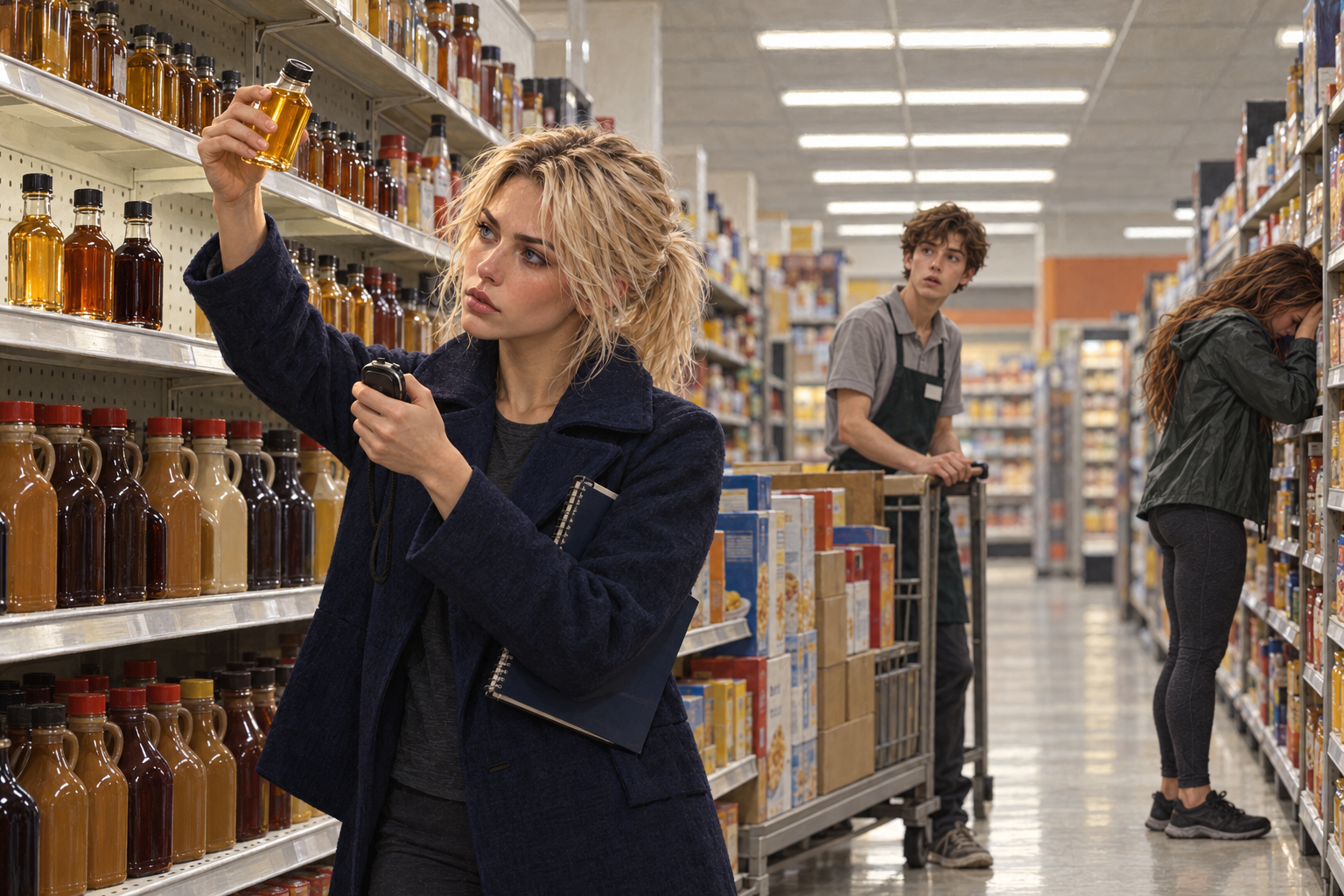
She was on the third bottle when the stock boy came around the end of the aisle with a cart.
· · ·
He was barely old enough to drive. He had a name badge that said Tyler and a cart full of cereal, and he stopped the cart and looked at Val, and then at Kyra, and then at the stopwatch.
“Can I help you find something?” he said.
“No,” said Val, without looking up. “Thank you. I’m comparing the viscosity.”
Tyler looked at the four bottles on the shelf.
“Of the syrup?”
“Of the syrup.” Val clicked the stopwatch, and wrote something in the notebook, and picked up the fourth bottle. “The golden is the right color, but it’s too thin at this temperature. The very dark is nearly the right weight, but it’s the wrong color entirely, and it smells wrong; it’s too much like something that’s been burned. The amber is closest overall. But I think I want the golden, warmed. Warmed to—” She stopped, and looked at him properly for the first time. “Do you happen to know whether the golden thickens or thins as it warms?”
Tyler opened his mouth and shut it again.
“It’s — syrup,” he said.
“I know it’s syrup.”
“I think it gets thinner? When it’s hot? Like on pancakes?”
“That’s what I was afraid of,” said Val, and wrote it down. “Thank you. You’ve been very helpful.”
Tyler pushed his cart away down the aisle, slowly, looking back over his shoulder twice, and Kyra had to go and stand in the next aisle with her forehead against a shelf of breakfast cereal for some time.
· · ·
They bought eleven bottles. Three each of the other three kinds, and two of the golden, and the woman at the register looked at the eleven bottles of maple syrup going past her one at a time and then at the two women and said, “Big breakfast?”
“Enormous,” said Kyra.
“Research,” said Val, at the same moment.
The woman looked from one to the other of them.
“Good luck with that,” she said.
· · ·
They tested it at Kyra’s kitchen table, over a week of evenings, and Kyra had never laughed so much in her life.
Val had a thermometer — a cooking one, with a long steel spike — and a saucepan of water on a low flame, and the bottles standing in the water like patients in a bath. She warmed each one to body temperature, exactly, and checked it with the spike, and then tipped it out onto a plate, a spoonful at a time, and watched it go, and timed it.
“Too thin,” she said. “Too thin. Close. No — look at it go, it’s running. It’s not supposed to run. It’s supposed to—”
“Relocate,” said Kyra.
“Relocate,” said Val. “Don’t laugh. It’s a real distinction.”
In the end it was the golden, warmed, with a little of the amber in it for weight — Val mixed it in a measuring cup, a few drops at a time, the way she mixed the color for the rings — and at the end of the week she tipped a spoonful of it onto a white plate at Kyra’s kitchen table under the lamp, and stood back.
Kyra looked at it.
It was right. The color. The way it sat. The way it came off the spoon, slow and folding, a little at a time, not pouring so much as arriving, and lay on the plate, golden, warm, faintly shining, and darkened slightly at the edges as it began to cool.
And the smell.
Kyra had not been ready for the smell.
· · ·
She sat down at her own kitchen table without meaning to.
It was not a smell she had expected to have again. It was not a smell she had expected to mind. It was maple, warm, the smell of every diner breakfast on this continent — and underneath it, if you had ever known the other thing, if you had ever been on another world on a bed in a cold room under a roof with a boy from four systems out — it was that. Very nearly. Close enough that Kyra put her hand flat on the table and held on to it.
Val did not say anything. Val sat down across from her, and put her own hand flat on the table, a few inches from Kyra’s, and left it there, and waited.
“It’s very close,” said Kyra eventually.
“I know.”
“I wasn’t ready for the smell.”
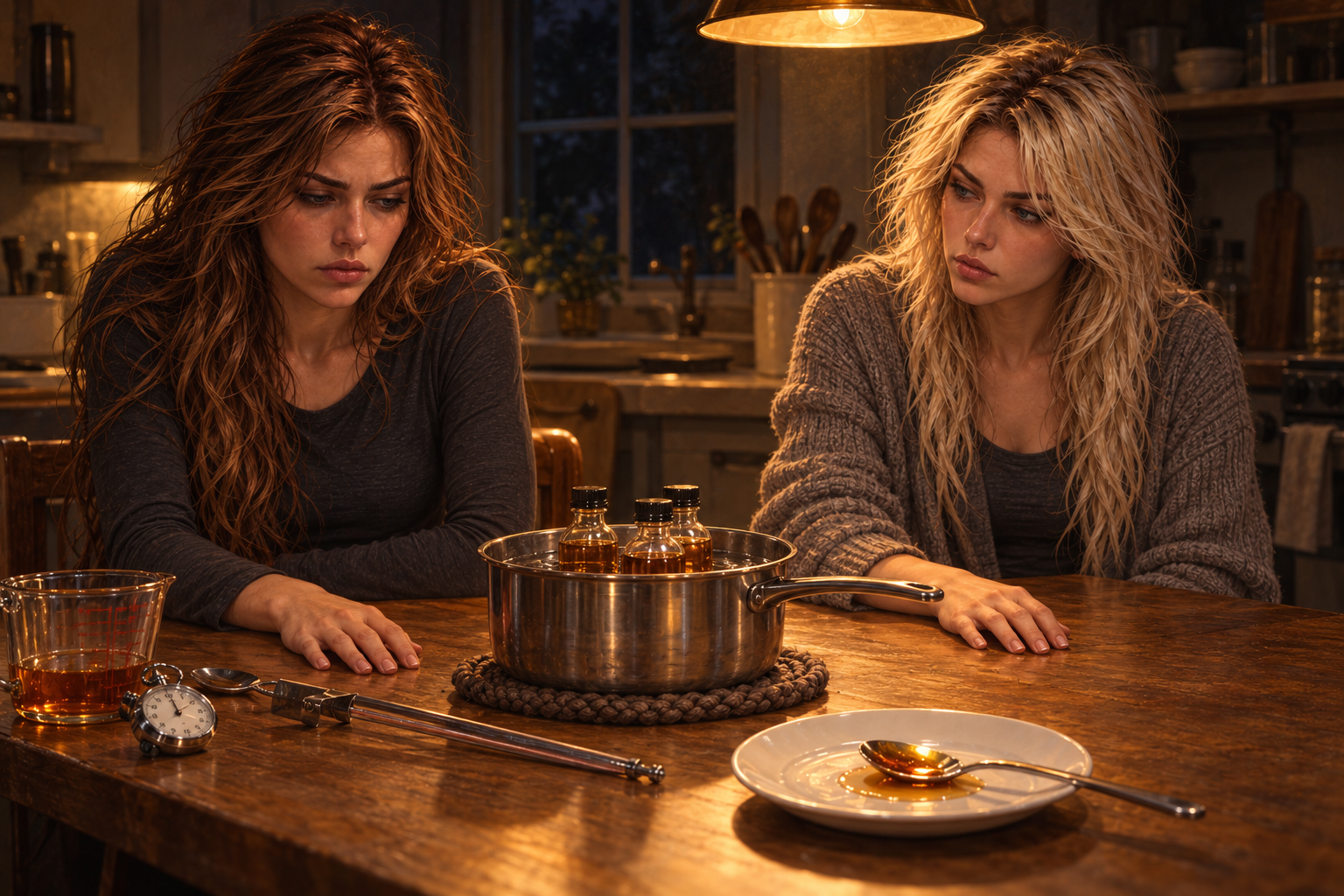
“Nobody ever is,” said Val. “It’s why I’ve never been able to eat at a diner in this country without keeping my hands on the table.”
· · ·
Then the cleanup, which they both already knew.
Cold water. Never hot. Hot water set it like glue, into anything — fabric, hair, skin — and it would not come out, and you would have it for a week. They had found that out the expensive way, a long time ago, on another world, and Kyra had lost four sheets learning it, and one of them had been her mother’s, and she had never told her mother where it went.
“Cold,” said Val, laying out towels. “Basin of cold water by the bed. Cloths. We don’t touch the hot tap until it’s all off.”
“I know.”
“I know you know. I’m saying it out loud so it’s said.”
· · ·
And then the pump.
Val had built a second channel into the blue thing — of course she had; she had built it in from the start, without telling anybody, a thin clear line running up inside it beside the first — and a second small pump to drive it, and a box with a single button on it. Press the button, and a measured amount of warm syrup came up the line and out of the tip. Let go, and it stopped.
“It’s simple,” said Val. “One press, one — one. Five seconds apart. Exactly five. You count it out, and press, and count, and press.”
“Let me try.”
Val looked at her for a long moment.
“You’ll be hopeless,” she said.
“I won’t be hopeless.”
“You will be utterly hopeless,” said Val, and handed her the box.
· · ·
Kyra was utterly hopeless.
She pressed too soon. She pressed too late. She pressed twice in a row, by accident, because she had started laughing on the fourth one and lost count; and a great golden rope of syrup came out of the tip of the blue thing and fell onto the white plate Val was holding up and folded over itself and kept coming, and Val said “Kyra” in a voice Kyra had last heard on a plateau, and Kyra laughed so hard she had to sit on the floor.
“It’s five seconds,” said Val, wiping the plate. “It’s the simplest interval there is. A child could count it.”
“I’m trying!”
“You’re laughing.”
“I’m laughing and trying! I can do both!”
“You can’t,” said Val, and took the box back out of her hand, and stood in the middle of Kyra’s kitchen with the blue thing in one hand and the box in the other and the white plate on the table under it, and pressed the button.
Then she waited.
Kyra, on the floor, watched her wait. Her lips did not move. She did not nod, or tap, or look at a clock. She simply stood there, perfectly still, with her thumb on the button, and at exactly the right moment, without any sign at all that she had been counting, she pressed it again.
And again. And again. Each one exactly the same. Each one exactly five seconds after the last, to the breath. The syrup came out of the tip in slow golden pulses and landed on the plate, and folded, and lay there, warm, one and then another and then another, and the kitchen was perfectly quiet except for the small sound of it landing.
Kyra stopped laughing.
“How,” she said.
“I always count,” said Val. She did not look away from the plate. “I’ve always counted. Every time. With every one. I’ve never once not counted.” She pressed the button. “It’s the only thing I’ve ever been able to do in that room, at that moment, that was entirely mine. Everything else was his. The count was mine.” She pressed it again. “You never counted.”
“I never counted.”
“You’d laugh and lose it. Or you’d forget there was a number. Or you’d be watching his face.” Val pressed it one more time, and let go, and the last of it fell onto the plate. “That’s what you were always doing. Watching his face. I always knew.”
· · ·
“How many,” said Kyra, from the floor. “For the show.”
Val did not answer at once.
“Nine,” she said.
Kyra looked up at her.
It was outside the range. Kyra knew the range; everybody on Sethal knew the range. Four to six, a few more if she kept going after the start, and nobody she had ever known of had ever had more than seven. Nine was not a number. Nine was a story.
“Why nine?”
“Because once there were nine,” said Val.
She said it to the plate. She did not say anything else, and her face did not do anything at all, and Kyra, sitting on the floor of her own kitchen with syrup on her sleeve, understood that there was a pump house in it, and four months, and a night when one woman did not stop, and that it had been carried, without a word, without a single word, for longer than most of the countries on this planet had had names.
She did not ask.
“Nine,” she said.
· · ·
The live show was on a Saturday in April, behind the second door, at a time Val posted in a flat line with no time zone in it. Nobody on the front page ever heard what was in it until afterward. Val had decided that the front page should only ever hear about it, and never see it, and so it was.
Kyra lay back on the white sheet in the room that was nowhere, under the lamp, in her mask, with her hair pinned up and the color on the rings and a towel underneath her, and laughed before anything had happened at all, and could not stop. The chat on the laptop at the foot of the bed was going by too fast to read.
what’s the towel for
why is there a TOWEL
what’s in the bowl? is that water?
is that the blue thing
IT’S THE BLUE THING
OH NO
oh no oh no oh no
what is happening
I don’t know what’s happening but I’m so happy
Val knelt on the bed beside her, in her own mask, with her braid down her back and the box in her hand, perfectly still, perfectly composed, like a woman about to perform a minor procedure on a patient she was fond of. The blue thing lay along Kyra’s belly, at full, warm from the lamp, gone to its deep dusk color, the way a man lies when he has gone under and is not there.
“Ready?” said Val.
“No,” said Kyra, laughing.
“Good,” said Val, and pressed the button.
· · ·
It came out of the tip warm and golden and landed on Kyra’s belly, a few inches up, in a slow fold, and lay there.
Kyra stopped laughing.
She had not expected to stop. She had expected to laugh the whole way through. But it was warm, and it was golden, and it was exactly the weight it should have been, and the smell came up off it in the lamplight — maple, and underneath maple, the other thing, the thing from a bed under a roof with no heating, a very long time ago, a world away — and she lay there with it on her and her hands on the sheet and could not, for a moment, do anything at all.
Val waited. Perfectly still. Five seconds. To the breath.
And pressed.
· · ·
The chat had worked it out by the third.
Kyra saw it happen, at the edge of everything, on the laptop at the foot of the bed that she was not looking at. Somebody had typed 1 after the first. Somebody else had typed 2 after the second. And by the third there were a dozen of them, and then a hundred, all at once, a column of them going up the right-hand side of the screen like a heartbeat:
3
3
3!!
THREE
they’re COUNTING it, she’s doing it on a COUNT
it’s exactly five seconds every time
I timed it, it’s EXACTLY five
4
4
4
why is it syrup
is this a pancake thing
the TIMING is so specific
who choreographed this
5
5
5
5
how many is she going to do
6
6
6
SIX
nobody does six
there’s no way
7
SEVEN??
SEVEN
7777777
I can’t breathe
what IS this
8
EIGHT
EIGHT
I’m crying I’m actually crying I don’t even know why
888888888
she’s not stopping
she’s still holding the button
she’s waiting
SHE’S WAITING
· · ·
Val waited.
Kyra, on her back on the white sheet with eight slow golden folds of syrup lying warm across her belly and the smell of maple and of the other thing all around her, looked up through the mesh of her mask at the woman kneeling beside her. Val was not looking at the camera. She was not looking at the laptop. She was not even, Kyra saw, looking at the button.
She was looking at nothing at all. At somewhere a very long way off. At a pump house, maybe, on a plateau, on a cold night, a very long time ago, before any of this. Before Kyra had been anything to her at all.
And she pressed it.
· · ·
9
· · ·
The chat did not count it. The chat came apart.
Kyra did not read any of it. She did not need to. She could see, at the edge of the screen, the column of numbers stop and turn into something else entirely, a wall, a flood, letters and capitals and little faces going by faster than anything she had ever seen on any page, and she did not read one word of it.
She was looking at Val.
Val had let go of the button. She knelt there in the lamplight beside Kyra with the box in her lap and her hands flat on her knees and her braid down her back, perfectly composed, perfectly still, and under the edge of the black mask, on the left, there was nothing at all. Not a tear. Nothing. Only a woman who had just done something exactly right, for the second time in her life, and was the only person in the room — the only person on two worlds — who knew what it meant.
Kyra reached up and put her hand flat on Val’s breastbone, and left it there, and felt the heart going under it, slow and steady and very hard.
“Nine,” she said.
“Nine,” said Val.
· · ·
Then the cold water.
They did it the way they had said they would, the way they had learned on another world at the cost of four sheets and one of them her mother’s — a basin by the bed, and cloths, and nobody touching the hot tap until it was all off. Val did it. Val knelt on the bed with the basin and wiped Kyra clean, every last fold of it, slowly, with cold water, while Kyra lay there and shivered and laughed, and the chat went on going by on the laptop at the foot of the bed, unread.
It took a long time. Val did not hurry it. When it was done she put the cloth in the basin and sat back on her heels and looked down at Kyra, and her mouth did the thing it did instead of smiling, and then, for the third time since the autumn, did not stop at that.
· · ·
the syrup show
That was what they called it, after. Not the golden syrup, and not the nine, and certainly not anything else. The syrup show. Nobody on the front page ever saw it. They only heard about it, from the back room, in comments that said you had to be there and I can’t explain it and I’ve never seen anything like it and I never will again.
Will they do it again?
They have to do it again.
@Blondie please do the syrup show again
@Copper please
I would pay anything for another syrup show
Is it worth it?
You missed the syrup show. Nothing will ever be worth it again.
They asked for years. They asked under every video, in every season, in every language. They asked in the back room and on the front page and in the private messages, in long careful letters and in single lines of capitals. They offered money. They offered a great deal of money.
Val answered once, the week after, under a comment that had nine hundred little hearts beside it and said only AGAIN??
Once. —B
And never said another word about it.
· · ·
Kyra could not eat pancakes at the diner after that.
She tried. She ordered them twice, and Dee brought the little steel jug with the lid on the hinge, and Kyra tipped it, and watched it come down onto the stack in a slow amber rope, folding over itself, arriving — and put the jug down and put her hand over her mouth and looked at the ceiling.
“What is so funny,” said Dee, the second time, with her coffee pot on her hip.
“Nothing,” said Kyra. “Nothing. I’m sorry. It’s the syrup.”
“What’s wrong with the syrup?”
“Nothing’s wrong with it,” said Val, from across the booth, with both hands flat on the table and her face doing absolutely nothing at all. “It’s very good syrup. It relocates beautifully.”
Dee looked at the two of them for some time.
“Girls,” she said, and went away.
— end of chapter nineteen —
Autumn · Kyra’s kitchen table
The spreadsheet appeared at the end of the summer, pinned to the top of the comments under the newest chair video by a name Kyra had seen a great many times and never thought about.
Tallyman.
He had been there from nearly the beginning. Kyra knew the name the way she knew the man at the gas station — not well, but always there, in the same place, at the same time. He did not write long letters. He did not write I’m crying. He wrote numbers. Under every video, within a day of it going up, a short neat comment with a number or two in it, and nothing else.
Copper: 4. Blondie: 1.
Copper: 6. Blondie: 1. New high for C.
Copper: 3. Blondie: 2 (!!!)
The others had started calling him the Accountant. He did not seem to mind.
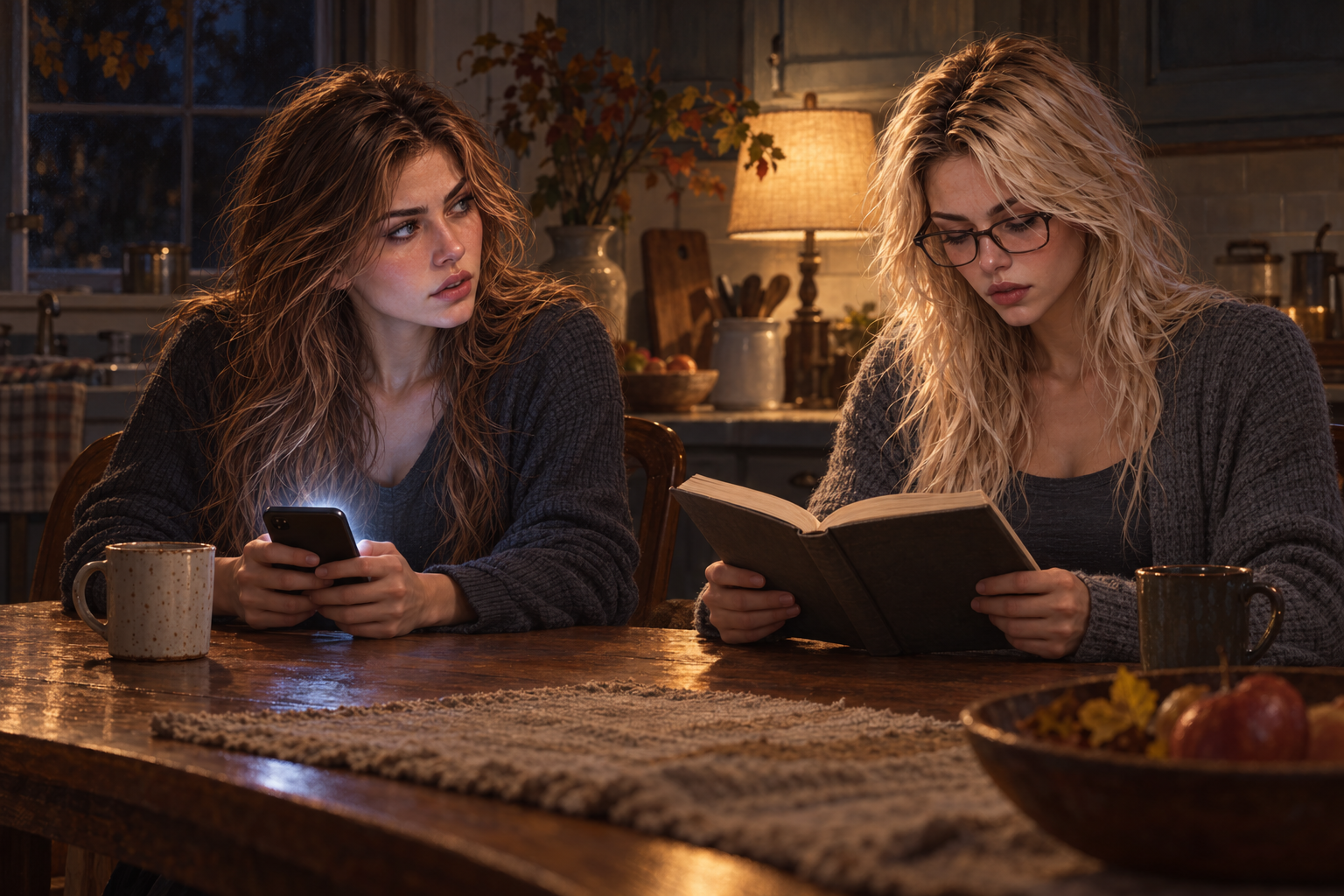
And at the end of that summer, he had put it all together. Every video, from the first one. Every count. Every time. All of it in a link at the top of the comments, in a grid of little boxes that went on, as far as Kyra could tell, forever.
· · ·
“Val,” said Kyra, at her own kitchen table, on a Sunday night in September. “You need to see this.”
Val, across from her, did not look up from her book.
“I’ve seen it.”
“You’ve seen it?”
“I saw it on Thursday. I’ve been through it twice.” Val turned a page. “He’s very thorough. His columns are reasonable. His methodology is wrong in at least three places, and I’ve been trying very hard since Thursday not to have an opinion about it.”
“How’s that going?”
“Badly,” said Val.
· · ·
Kyra opened it on her phone and scrolled.
It was all there. Every video, in order, with its date. A column for Copper’s count — how many times she had gone, by his reckoning, start to finish. A column for Blondie’s count, which was nearly always 1. A column headed Time to Blondie’s first, in minutes and seconds. A column for Chair strokes, which was blank for most of them and full for the chair ones. A column for Notes, which said things like pink ones and syrup show (back room, reported) and THE LAUGH.
And at the bottom, under the grid, a few lines of summary.
Copper average: 4.3 per video. Copper record: 7 (the one with the green dress, after).
Blondie average time to first: 12:40. Blondie record: 0:51 (!!!) — rare!
Chair stroke record: 23 (Copper on Blondie, the pink ones she stole).
Kyra read it out. All of it. She was laughing by the green dress, and laughing harder at THE LAUGH, and she got to Blondie record: 0:51 (!!!) — rare! and read it out in the same voice as all the rest, and looked up.
Val had stopped turning pages.
· · ·
Kyra knew what that was.
She had known for a very long time. There had been a column once — not in a spreadsheet, not on a page anybody could see. In Val. A ledger Val had kept, in the back of her head, for longer than either of them liked to think about, of every single time Kyra had been ready first. Every time Kyra had lain there at her side and waited. Every two minutes. Every night the whole long length of their life together, a mark in a column, a debt.
Counting the times, Val had called it once, in a bed in Portland, with the window going gray. It became a bill.
She had given it up. She had promised, in that bed, to give it up, and she had. Kyra was nearly sure she had.
And here was a stranger who called himself Tallyman, in a grid of little boxes, with a column headed Time to Blondie’s first, and an average, and a record, and three exclamation marks and the word rare.
· · ·
“Val,” said Kyra.
“I’m all right.”
“You’re not all right. You’ve read the same page four times since I started.”
“I’ve read the same page four times,” Val agreed, “because a man I have never met, in a room I will never see, has kept my column for me. From the very first one. In public. With an average.” She put the book down. “And he’s put an exclamation mark after the fastest one. Three. As though it were a remarkable thing, that I should once in all that time have managed to be quick.”
“It is remarkable.”
“It’s remarkable,” said Val, “in the way that a dog walking on its hind legs is remarkable.” She looked at the phone in Kyra’s hand. “Everybody’s very impressed, and nobody asks why the dog can’t usually manage it.”
· · ·
Kyra did not say anything for a moment. Then she did the only thing she knew to do with a moment like that, which was to change its shape.
She scrolled down, past the grid, to the bottom of the summary, and read it out again.
“Chair stroke record: twenty-three. Copper on Blondie. The pink ones she stole.”
Val looked up.
“Twenty-three,” said Kyra. “That’s me. In the chair. On you. In your pink ones. He counted every single one.”
“I know he did.”
“Twenty-three, Val. Before I went.” Kyra put the phone down on the table. “Twenty-three times, up and down, and then I couldn’t hold it any more. And some man in a spreadsheet has written it down as a record.”
Val looked at her across the table for a long moment. Then something happened at the corner of her mouth.
“In the pink ones,” said Val, slowly, in the voice she used for ledgers, “one viewer has noted that you went up and down on me twenty-three times before you came.” She folded her hands on the table. “Do you think you could do it in twenty-two? For fun?”

Kyra stared at her.
Then she started to laugh, and could not stop for some time.
“Or fifty,” she said, when she could.
“Or fifty?”
“I could do twenty-two. I could do it in twelve, Val, you know I could, you’ve seen me. I could do it in three.” Kyra wiped her eyes. “Or I could hold it. I could hold it all night. I could do fifty and then go around again.” She grinned. “I go both ways. My records go both ways. That man has no idea what he’s started.”
· · ·
“And yours,” said Kyra, later, with the kettle on. “We need to say something about yours.”
Val, at the table, did not look up.
“I could try,” she said. “For his column. The time to Blondie’s first. If you wanted. I could try to—”
“No.”
Val looked up.
“No,” said Kyra again. She turned off the kettle and came and sat down across from her, and put both her hands flat on the table, which was Val’s gesture and not hers, and did it on purpose. “Never. Not once. Not for him and not for anybody. Not for fun, not as a joke, not even if you want to.”
“Kyra—”
“You know why.”
Val did know why. Kyra could see her know it. It was the oldest refusal they had, older than the cameras, older than this town, older than Portland: Kyra had refused for longer than either of them could count to let Val trim the dark below the pale, and had never been able to say exactly why — except that it was the one thing about Val that Val did not manage, and that taking it would have meant Val altering herself in order to be quicker at being vulnerable. Which was the exact opposite of the point.
“You can’t be in charge of it,” said Kyra. “You can’t. You know you can’t. You can’t be holding the clock and arrive at the same time. And if I ever put a number in front of you — any number, even a joke, even for one night — you’ll be holding the clock. You’ll be watching it. And you’ll never get there again, not on camera, not off it, not anywhere.” She shook her head. “He can count you. He can count you all he likes. That’s his business. But we never chase it. You’re never a target. Not ever.”
Val was quiet.
Then she took the gray notebook out of her bag, the one with Andromeda After Dark on the first page and the terms in the back, and turned to the back, and wrote it down, and turned it around.
Kyra’s records are fair game. Val’s time is never a target.
“Everything above it,” said Kyra, “is procedure.”
· · ·
They did twenty-two on the Saturday.
It was in the chair, with Val in it and Kyra astride her — the wrong way around, the way they had only done it once before, in the pink ones — and Kyra laughed through all twenty-two of them and lost count twice and had to rely on Val, who said the numbers under her breath, very quietly, into Kyra’s shoulder, under the mask, so that no microphone could catch them, all the way to twenty-two.
And then Kyra went, loud, laughing at the end the way she always did, and the comments later said that you could see the blonde’s mouth moving the whole time and nobody could work out what she was saying.
They posted it the next day, in the back room. Val would not let them cut a single second of it. Not the start, not the middle, not the twelve seconds where Kyra lost the count and had to stop laughing to find it again. Val gave it a label, flat, at the top, in the place where the title went.
RECORD ATTEMPT — UNCUT.
“Why uncut?” said Kyra.
“Because if we cut it to make twenty-two,” said Val, “we’ve faked it. And we don’t fake anything in that room.”
· · ·
THEY READ THE SPREADSHEET
TALLYMAN THEY READ YOUR SPREADSHEET
22!!!! NEW RECORD
”record attempt — uncut” I’m screaming
of course blondie labeled it like a lab report
the uncut thing is so important actually. you know it’s real
you can see blondie counting!!! her mouth is moving the whole time!!!
she’s COUNTING FOR HER
Tallyman you’ve created a monster
And under all of it, the next morning, a single line from the man himself.
Updated. Copper chair record: 22 (attempt, uncut). Previous: 23. Thank you both. — T
· · ·
Then they did fifty.
They did fifty, two weeks later, in the back room, with the same label, and it took most of an hour, and Kyra did not laugh for any of it because she could not spare the breath; and when it was done the Accountant’s spreadsheet had a new line, and a new column, headed Copper — long, and the comments under the video were mostly capital letters and a great many of them were the word how.
“Both ways,” said Kyra, at the kitchen table, at one in the morning, sore all over and delighted. “I told you. I go both ways.”
“You go both ways,” Val agreed. She was not looking at the comments. She was looking at the spreadsheet, on her own laptop, and had been for some time, and Kyra could not see her face.
· · ·
It was three weeks before Kyra found out what she had been looking at.
She came over to Val’s on a Thursday after the library shut and found her at the kitchen table, as she so often found her, with the laptop open and the reading glasses on and the cloth-bound ledger beside her, and two other notebooks, and a sheet of paper covered in small exact columns that had not been there before.
“What’s this?”
Val did not answer at once. She was looking at the sheet.
“His clock is wrong,” she said.
“Whose clock?”
“Tallyman’s. The Accountant’s.” Val tapped the laptop. “He starts it at the first touch. The first time either of us touches the other on screen. That’s where his clock starts, every time. And that’s the wrong place.”
“Is it?”
“It’s not where it starts. It starts before the camera’s on. It starts at the kitchen table, or on the stairs, or in the doorway, with your hand on the back of my neck. Sometimes it starts at four in the afternoon.” Val did not look up. “And then we cut the start, half the time, to take out the doorway. So he’s starting late, and we’ve taken time out of the middle, and his numbers are all short.” She turned the sheet of paper around. “So I’ve redone them.”
· · ·
Kyra looked at the sheet.
It was the same grid. The same videos. But beside every one of the Accountant’s numbers, in Val’s small exact hand, there was another number. Her own. From her own notes. From the first moment, not the first touch; from the camera files, not the edit.
“You’ve been keeping your own time,” said Kyra slowly. “This whole while.”
“I keep everything.”
“You’ve kept your own time to Blondie’s first. Every video. From the first one.”
“I’ve kept my own time,” said Val, “because I keep my own time. I didn’t do it on purpose. It’s simply what my hands do with a clock.” She put her hand on the sheet. “And I wasn’t going to look at it. I’d decided not to look at it. And then he published his, and his was wrong, and I couldn’t sit here with a wrong number in front of me and not—” She stopped. “So I looked.”
“And?”
Val did not answer. Instead she reached over and took one of the other notebooks — an old one, Kyra saw, older than the show, older than the town, with a worn cloth spine — and opened it to a page near the back, and laid it beside the sheet.
It was a list of dates. Not many. One a year, going back a very long way. All of them the same day in August.
· · ·
Kyra knew the date. She would have known it in the dark.
It was the day they shaved back, once a year, each of them for the other, far enough to see the small closed rings low down that they had put on each other at a dry camp above the Sweetwater. They had done it every year for longer than this country had had paved roads. The razor, and the blind down, and the two of them looking. And then, for a few weeks after, until it grew back — for those few weeks, every year, there was a great deal less in Val’s way than usual.
“Look,” said Val, very quietly. “Look where the fast ones are.”

Kyra looked.
The Accountant had marked them. Rare! and !!! and fast one, here and there, scattered through all those little boxes. She had thought they were random. Everybody had thought they were random; the comments had a dozen theories about them. The weather. The pink ones. Whether the blonde was in a good mood.
They were not random.
They were in late August. Every year. In the two or three weeks after the date in the old notebook. Every single one. Every year of it. And the slow ones — the slowest, the ones with the longest numbers in Val’s column — were in the winter, in January, in February, when the hair had had six months to grow back and was as thick and dark as it ever got.
· · ·
Kyra did not say anything for a long time.
“It’s the hair,” she said at last.
“It’s the hair,” said Val.
“It’s always been the hair.”
“It’s been the hair,” said Val, “every single time. From the start. In public. In a stranger’s spreadsheet, on a clock that starts in the wrong place.” She took her glasses off and folded them and put them down on top of the sheet. “When it’s gone, I’m quick. When it’s back, I’m slow. When it’s thickest, I’m slowest. It isn’t me. It was never me.” She looked at the sheet. “It’s a hedge.”
· · ·
Kyra had said that. Not those words; Kyra did not have Val’s words. But she had said it, in every way she knew how. In a bed in Portland with the window going gray. In a hundred beds before that. The wanting was never the slow part. The wanting’s the fastest thing about you. There’s just a great deal of you in the way of it.
And Val had heard it every time, and had nodded, and had believed her for about an hour, and then had gone back to the column. Because Kyra loved her, and Kyra would say that. Because it was reassurance. Because Val had never once in her life been able to accept reassurance from anybody about anything, and least of all about this.
“I told you,” said Kyra. “I’ve told you since—”
“I know you told me.” Val put her hand flat on the sheet of paper, over the columns. “You’ve told me for longer than I can count. And I couldn’t hear it. Not from you. You love me. You’d say anything.” She looked up. “But I can’t argue with a number. You know I can’t. I’ve never once in my life been able to argue with a number.” Her voice did not change. “And a stranger who has never met me, who doesn’t care about me, who has no reason on earth to be kind to me, sat down every week and counted. And the number says you were right.”
· · ·
She did not cry. Val cried perhaps once in a very long while, and she had done it already, not long ago, in the back room, at the edge of a mask, and she did not do it again.
But she sat at her own kitchen table, with her hand on a stranger’s numbers and her own numbers beside them and a list of dates in an old notebook, and Kyra watched something go out of her that had been in her for so long that Kyra had stopped being able to see it. Not all of it. Not at once. But something. The way a held breath lets down.
Kyra reached across the table and put her hand on top of Val’s on the sheet.
“It belongs to both of us,” she said. “The wait. It always did. You with your hedge and me with nothing at all, the two of us together. It was never yours to carry.”
“I know,” said Val. “I know that now.” She turned her hand over under Kyra’s and held on. “He proved it. Tallyman. With a clock that starts in the wrong place.”
· · ·
“Are you going to tell him?” said Kyra, later. “That his clock’s wrong?”
Val looked at the laptop.
“No,” she said.
“You want to.”
“I want to more than I’ve wanted to do anything this year,” said Val. “I want to write him the most careful, most courteous, most thoroughly footnoted letter anybody has ever sent anybody, explaining exactly where his clock should start, and why, and correcting every single number in his column to the second.” She closed the laptop. “And I can’t. Because the only way to know where it really starts is to have been in the room before the camera was on. And nobody can know that but us.”
“So he’ll be wrong forever.”
“He’ll be wrong forever,” said Val. “In public. With an average.” She put her hand on the closed lid. “It’s going to cost me something every single time I look at it.”
“Then don’t look at it.”
Val looked at her.
“I’m going to look at it every single time he updates it,” she said, “for as long as he keeps it. I’d like that understood.”
“I’d be worried if you didn’t,” said Kyra.
· · ·
Tallyman updated it the following Sunday, after the next chair video. Copper: 5. Blondie: 1. Time to Blondie’s first: 11:12.
Val read it on her laptop at Kyra’s kitchen table, and wrote her own number beside it on the sheet, in her small exact hand.
It was longer than his. It was always longer than his.
She did not seem to mind as much as she once would have.
— end of chapter twenty —
Late winter into spring · the room that was nowhere
Val told nobody.
That was the first thing Kyra would remember, afterward, when she went back over it — that there had been no table, no hands flat on either side of a cup, no term. Val had sat at Kyra’s kitchen table on the Friday night doing the color on the rings exactly as she always did, the jars and the knife and the sealant, first Kyra’s and then her own, and had said nothing at all that she did not always say.
Except that she had taken longer over her own than usual. And had done a wider margin around it than usual, feathered out further, a whole palm’s width of color and sealant under all that dark where nothing would ever show. And had, at one point, held her own left forearm up to the lamp and looked at a small pale patch on the inside of it, near the elbow, for rather longer than a woman looks at the inside of her own elbow.
Kyra had noticed. She had thought Val had a bruise.
· · ·
It was a Saturday at the end of February, deep in the winter, when the hair was as thick as it ever got. They went into the room that was nowhere at ten. The cameras were locked, the lamp was where the letter had asked them to leave it, the blanket was over the window. The back room was waiting, and the number at the top of the page was not small.
And on the bed, on a folded white towel, there was a china bowl of warm water, and a cake of soap, and a brush, and a razor.
Kyra stopped in the doorway.
It was not their razor. Their razor was the one they used once a year, in August, with the blind down, to trim back far enough to see the rings: an old straight one of Val’s, stropped, that had been through more houses than the chair. This was a new one, a safety razor, plain and steel and very sharp, with the paper still around the handle.
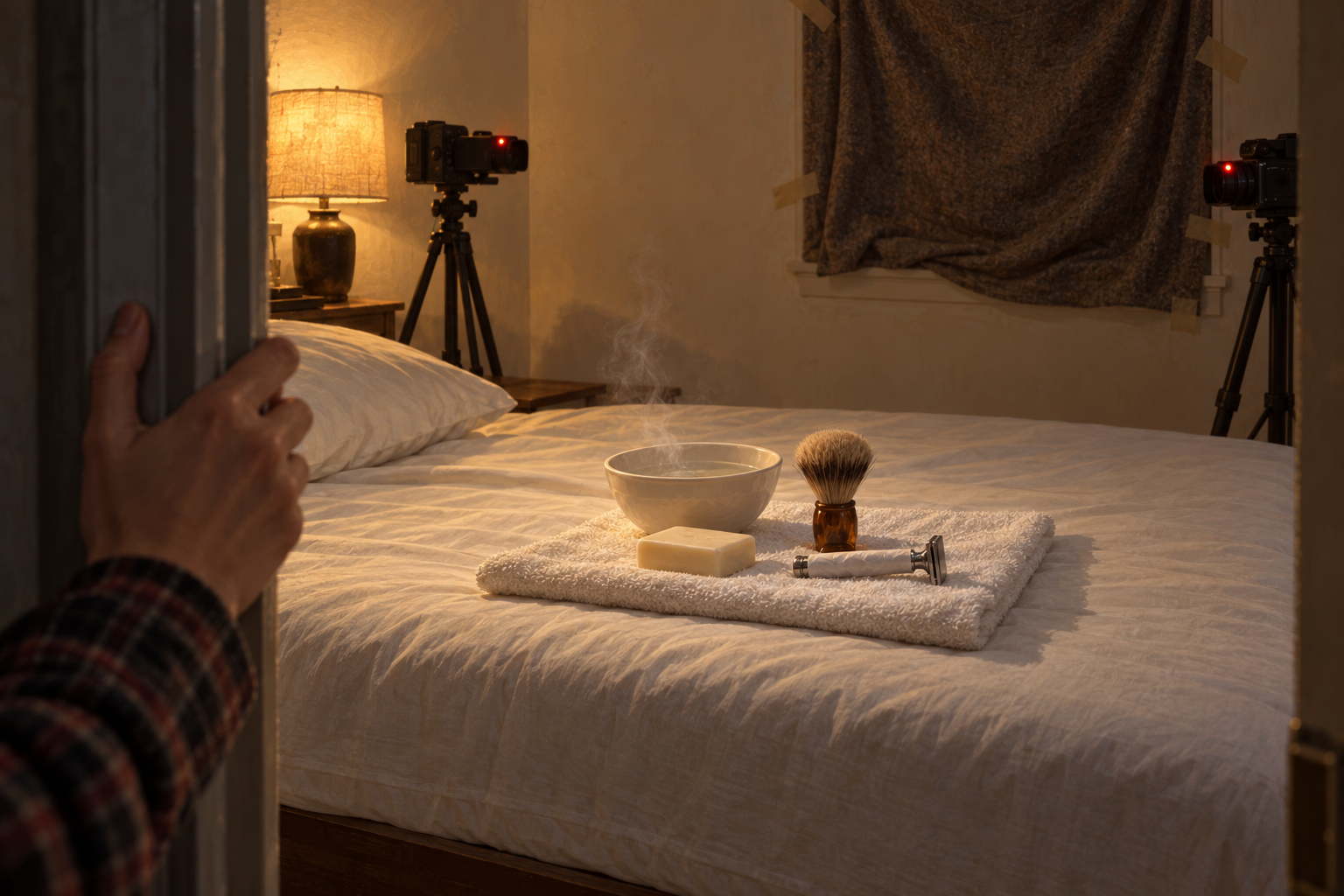
“Val,” said Kyra.
Val walked past her into the room, in her mask, with her braid down her back, and sat down on the edge of the bed beside the towel, and looked at the camera. Steadily. For about the length of a breath.
Then she picked up the brush.
· · ·
Kyra did not move.
She stood in the doorway in her own mask with the remote in her hand and could not have moved if the house had been on fire, and she watched Val do it.
Val did not hurry. Val had never once in her life hurried anything that mattered. She wet the brush in the bowl and worked the soap into a lather on the back of her hand, slowly, the way she would have mixed anything — and then she lay back a little on the white towel, propped on one elbow, with the lamp low and warm from the left and the cameras locked and a great many people on the other side of the lens watching, and laid the lather on.
All of it. The whole of that thick dark warmth below the pale, the thing Kyra had loved since a mountain in the cold, the one thing about Val that Val had never once managed — every inch of it, white with soap, under the lamp, in front of everybody.
Then she took the paper off the razor.
· · ·
It took eleven minutes. Kyra counted them later, on the recording, because she could not have counted anything while it was happening.
Val did it the way she did everything that mattered: exactly. Short strokes, with the grain and then across it, rinsing the blade in the bowl after each one, her hand perfectly steady, her face under the mask perfectly composed. She did not look at Kyra. She did not look at the camera, after the first time. She looked at what she was doing, and only at what she was doing, the way she looked at the salt shaker under the lamp, the way she looked at a sample, the way she had looked at the stays on a gown from a city on the Adriatic while she pinned them on.
And the dark came away.
A stroke at a time, under the lamp, into the bowl. And under it, where it had been for longer than most of the cities on this planet had had their present names, was skin. Pale. Bare. Untouched by anything but the August razor, and never this far. And low down, an inch above everything else — Kyra saw it, and her breath went — a patch of skin a palm wide that was exactly the same color as all the skin around it, and very slightly, if you knew where to look, smoother. Color, and sealant, laid on the night before, feathered out further than usual, under everything.
Val had tested it. The pale patch on the inside of her elbow. She had put the color on her own arm and shaved over it to see whether a razor would take it off.
It had not.
· · ·
When she was done she rinsed the razor one last time and laid it on the towel, and wiped herself clean with a warm cloth, and put the cloth in the bowl.
Then she lay back on the white sheet, in the lamplight, bare, and looked up at the doorway where Kyra was standing.
“Well?” said Val.
Kyra could not answer.
“You can come in,” said Val. “It’s your room. Nothing in it’s mine.” She paused. “Except that, for about three weeks. And then it’ll grow back.”
· · ·
Kyra came in.
She did not know what she was going to do until she was doing it. She came and knelt on the bed beside Val and put the remote down on the pillow and put her hand flat on Val’s belly, below the navel, on the warm bare skin where all that dark had been an hour before, and left it there.
“Why,” she said, very low, under the edge of the mask, where no microphone would catch it.
Val did not answer at once.
“Because it was mine,” she said. “For a very long time it was the one thing about me that nobody ever looked at and nobody ever decided. Not my father. Not the county. Not me.” Her voice was barely anything. “And then everybody was looking. And everybody had decided. Thousands of them. For years. Telling me, a word at a time, what to do with it.” She put her own hand over Kyra’s on her belly. “And you said it was mine to decide. And I’ve been deciding. For a long time. Every time somebody asked.”
“And you decided this.”
“I decided that the first time anybody ever takes it from me,” said Val, “it will be me. Not them. Not even you, this time. Me. In front of all of them. On a Saturday. Without asking anybody.” She closed her eyes. “It’s not theirs. It never was. I wanted them to watch me prove it.”
· · ·
They laced. It was easy. That was the first thing, and it was the thing Kyra had been afraid of since the doorway.
There was nothing in the way. Kyra’s fingers went down and found her, and she was already there — already out, already curled, already reaching — before Kyra had said a single word about the man with the pager, before she had said anything at all. No two minutes. No long road. Nothing to get through, nothing to wait for. Kyra’s breath caught on it, and she heard herself say there you are out of nothing but habit, and it came out wrong, because there had been nothing to wait for and nowhere for Val to arrive from.
And Val went fast.
She went faster than Kyra had seen her go since Portland — since that October, since the razor and the long mirror and the month after, when Val had driven and driven and got less out of it each time. The grip came up tight and quick and urgent, and the light came at the throat almost at once, faint, thin, and then the wrists, barely, and Kyra’s thumb went to the remote and turned it down out of habit, though there was hardly anything to turn down for.
And Val came apart in under a minute.
It was small. Kyra felt it under her and knew it was small. A short sharp thing, over almost before it had started, the light barely up and then gone, last at the wrists. The murmur did not even begin. Val lay there afterward on the white sheet with her breath short and her hands open and looked up at the ceiling with an expression Kyra could not read through the mask.
· · ·
SHE SHAVED
OH MY GOD SHE SHAVED IT
she actually did it, all this time asking and she DID IT
live!!! on camera!!! with no warning!!!
copper’s face in the doorway I’m screaming
copper did not know. COPPER DID NOT KNOW
and then she went SO FAST
under a minute!!! @Tallyman!!!
she finally lost it so fast, holy
the hedge was the problem all along lmao
NEW RECORD
we did it chat. we finally did it
Kyra read them in the morning, at her kitchen table, with her coffee going cold beside her. She read every one. And with every one she felt something in her chest pull tighter, until she put the phone face down on the table and sat with her hands flat on either side of it.
They were cheering. All of them, thousands, in every language. They had asked since the beginning and they had finally got it, and they were cheering, and Tallyman had already updated his column with three exclamation marks.
And what they were cheering was the smaller one.
They had no way to know. They had never seen the other. They had seen two minutes of a redhead patiently making her way through all that dark — a reveal, a trick, a thing to be timed — and then a long slow climb, and a light that rose and rose until the whole of a woman was lit with it, and a murmur at the end in a language nobody could name. That had been every video since the first. They had thought the slowness was the obstacle. They had thought the hedge was in the way of the good part.
They had never once understood that the slowness was the good part.
· · ·
Val came down at nine and found her there, and sat down across from her, and did not reach for the phone.
“I know,” said Val.
“I didn’t say anything.”
“You don’t need to. I read them at four.” Val folded her hands on the table. “She finally lost it so fast. The hedge was the problem all along.” Her voice was very flat. “They think they’ve won. They think that was the best one.”
“It was the smallest one.”
“I know it was.”
“Val, it was the smallest one I’ve seen you have since Portland. Since the month after the razor, when you—”
“When I drove,” said Val. “I know. I was there.” She looked at her hands. “I knew it would be. I found that out a long time ago, in a bed in October, with you. Bare, there’s nothing in the way. Nothing in the way means nothing to open for. Nothing to open for means I don’t. I just — go. Fast and thin. And get less out of it every time, and try harder, and get less.” She paused. “I knew. When I bought the razor. I knew what it would cost and I did it anyway.”
“Why?”
“Because I wanted it to be mine,” said Val. “Even the cost.”
· · ·
Kyra looked at her across the kitchen table.
Then she got up, and went upstairs, and came back down with something in her hand, and put it on the table between them.
It was a small cardboard box. White, with blue writing on it, from a pharmacy. It had been in the drawer of Kyra’s nightstand since the autumn they arrived, unopened, because Kyra had bought it in the first week, in the first town drugstore, without thinking, the way you buy aspirin for a house.
Cotton finger dressings, it said. For minor cuts and abrasions.
Val looked at it.
Then she put her face in her hands.
· · ·
They had found it in Portland. The finger dressing. Kyra had bought a box of them on Hawthorne from a pharmacist who had looked at her very kindly and said Nasty one, was it? and given her a leaflet about infection, and Kyra had taken the leaflet and the box home and slipped one onto Val without warning. And Val had worked it out, weeks later, after the razor, lying in a bed in the dark: that a little cotton sleeve over the part of her that came out to meet Kyra did the same thing the hair had always done. It slowed her. It took away the thing she drove with. It put something back in the way — and with something in the way, she had to open, and wait, and let go, and the bigger one came only that road.
It’s a prosthetic, Val had said, that night, in the dark. For the hedge.
“Three weeks,” said Kyra, sitting back down. “Till it grows back. We’re not spending three weeks giving them the smaller one.”
Val took her face out of her hands.
“On camera?”
“On camera,” said Kyra. “They’ll never know what it is. They’ll think it’s a kink.”
· · ·
They thought it was a kink.
why is there a BANDAGE
is that a finger bandage on her
what is happening
is this a medical thing
it’s a kink, there’s a whole thing about this
it’s not a kink, look at her, she’s not into the bandage, she’s into the REDHEAD
And then, a little after the twenty-minute mark, with the dressing on and nothing to drive with and Kyra’s hands on her hipbones in the chair and Kyra talking low and endlessly about a fence the Hallorans did not have and had never had in this town — Val opened. Kyra felt her open. Felt it in the shoulders, in the jaw, in the long line of her back, the held breath letting down. And the light came up the way it had come up every week since the beginning, slow and long and rising and rising, until the whole of her was lit, clean and gray and soft on the locked cameras, and she came apart in Kyra’s lap without a sound with the murmur running under the strings and Kyra’s name strung all through it, the bigger one, the real one, the one that came only that road.
OH
oh that’s the good one
THAT’S the good one. that’s the old one. that’s the one I missed
she’s GLOWING glowing
whatever the bandage is, it’s working
the bandage videos are the good ones. calling it now
the bandage videos are the good ones
the bandage videos are the good ones
Kyra read them out at one in the morning, and Val, across the table, with her glasses on, did not say anything.
“They’ve worked it out,” said Kyra.
“They’ve worked out that it’s better,” said Val. “They haven’t worked out why. They think it’s the bandage.” She took her glasses off. “Nobody on earth will ever know it’s the hedge. Put back, by hand, in a little cotton sleeve, from a box with a leaflet about infection.”
· · ·
It was the third week before they did the other one.
It was Kyra’s idea, and she regretted it, and then she did not regret it, and then she regretted it again, and then she lay in the dark afterward and laughed until Val put a hand over her mouth.
She put the dressing on herself.
She had never had anything in her way. Not once, not ever, not on either world. She kept herself short, and always had, and she was always ready first, before anything had happened, before Val had so much as put a hand on the back of her neck. She had no idea — none, in all that time — what it was to wait.
So she put the little cotton sleeve on, in the room that was nowhere, under the lamp, on camera, with Val watching her from the edge of the bed with an expression of deep scientific interest. And they began.
· · ·
It was dreadful. It was dreadful from the first minute.
Kyra could feel everything and could reach nothing. Something was in the way, soft and close and absolutely immovable, and every time she went for it she found cotton, and the thing she had always driven with was simply not there to drive. She was slow. She was slow for the first time in her life. She lay on her back on the white sheet and felt herself climbing and climbing and not arriving, and it was horrible, and it was the most interesting thing that had happened to her in an age.
And Val was ready first.
Val, bare, with nothing in her way at all, was ready before Kyra had properly started. And for the first time in their whole lives, the woman at the side of the bed, waiting, was Val; and the woman who had to keep the room open, keep it light, keep talking about nothing so that the one who was slow would not feel watched, was Val too.
Val could not talk about nothing.
· · ·
“The library,” said Val, lying on her side with her hand on Kyra’s belly, in her best flat voice, “is organized according to a decimal system first published in the nineteenth century by a man with very strong opinions about spelling.”
Kyra made a sound.
“Every subject in human knowledge,” said Val, “is assigned a number between zero and nine hundred and ninety-nine. Religion is two hundred. Natural sciences are five hundred. If you want a book about bees, you will find it at five hundred and ninety-five point seven nine.”
“Val—”
“I am talking about nothing,” said Val. “You do it to me. It works on me. I’m doing it to you.” She did not change her voice at all. “Agriculture is six hundred and thirty. Within agriculture, crop rotation is a subject of perennial interest to patrons in a farming valley. A three-field system rotates a cereal crop, a legume, and a fallow, and the purpose of the legume is to fix nitrogen in the—”
Kyra started to laugh.
It came up out of her and would not go down. She lay on her back on the white sheet in her mask with a cotton finger dressing on her and Val’s hand on her belly and Val’s flat voice explaining nitrogen fixation under the strings, and she laughed until she could not breathe, and every time she laughed she slowed down further, because laughing took everything she had and there was nothing left over for anything else.
“You’re not helping,” Val observed.
“You’re talking about crop rotation.”
“I’m talking about nothing. It’s what you do.”
“I talk about the man with the pager! I talk about the fence! I don’t talk about nitrogen!”
“The downspout on my porch,” said Val, without a pause, “has been loose since the second winter, and I’ve been meaning to have somebody look at the bracket, which is galvanized, and therefore should not have corroded, which makes me suspect the original installation—”
And Kyra laughed so hard that the whole bed shook, and the cameras caught all of it, and it was nearly forty minutes before she went, and when she did it was not small at all.
· · ·
THE BLONDE TALKED
SHE TALKED FOR FORTY MINUTES
about LIBRARY CLASSIFICATION
”bees are 595.79” I have it tattooed on my soul now
she’s so bad at dirty talk and it’s the hottest thing I’ve ever heard
it’s not dirty talk. she’s distracting her. you can tell copper’s having a hard time with the bandage and blondie’s doing what copper always does
she’s doing COPPER’S JOB
the role reversal I’m crying
I’ve never heard her talk this much. I’ve been here since the chair videos. I didn’t know her voice did that
her VOICE
can someone isolate the audio of blondie explaining crop rotation I need it as my alarm
Kyra read that last one at the kitchen table, and stopped laughing.
Val, across from her, had already stopped. Val had stopped several comments earlier, at I didn’t know her voice did that, and was sitting with her hands on the table, very still.
“Forty minutes,” said Val, very quietly. “Of my voice. In the clear. No strings over it, except at the very end.” She looked at the laptop. “Explaining the classification system I use at work every day of my life, in a voice that the schoolteacher hears every Thursday, in a town of nine hundred people.”
Kyra did not say anything.
“Once,” said Val. “Never again.”
“Once,” Kyra agreed.
· · ·
The last of the three weeks, they did both.
Val’s idea, this time. She put one on herself and one on Kyra, at the kitchen table, before the color, before anything, and they looked at each other across the table with a small white cotton sleeve on each of them and nothing else, and Kyra started to laugh again, and Val said, “Don’t,” and did not mean it.
They could not lace. That was the thing. With a dressing on, nothing could curl around anything else, nothing could take hold, there was no wound-together and no holding at the hip. And with no lacing, there was no grip.
No channel. No are they there. No I’m here, I’m all right. No conversation at all, running underneath everything, the way it had run underneath every single time they had touched each other since a mountain in the cold.
Kyra had not known, until it was gone, how much of what she knew about Val in any given moment came through that one place.
· · ·
So they did everything else.
Mouths, and hands, and the long slow drawing-out of Val’s nipples, which Val had always said was not a procedure and which Kyra had always secretly treated as a privilege. Kyra’s mouth on Val’s throat where the light came first. Val’s hands — those cool exact hands — on Kyra in a dozen places they never usually had the time to get to, because the grip was always there first, faster, saying everything. They talked, out loud, low, under the strings, because they had to. Is that all right? Yes. There? Not there. Slower. Like that. Asking each other, in words, every single thing the grip had always asked without them.
They had to use the taps, once — two flat taps, on Kyra’s shoulder, when Val’s hand found something on her that was too much, too soon — and Kyra stopped at once, and Val said, “It’s all right. It was only that,” and they went on. The stop worked. The stop always worked. It was the one thing in their lives that had never once failed.
It was very slow. It was clumsy in places. It was, Kyra thought afterward, lying in a tangle on the white sheet with both their dressings off and the cameras still running, the most they had talked to each other in bed in a very long time.
· · ·
the mummy episode
That was what the comments called it, by the Sunday night. The mummy episode. Two women in masks with their fingers — not their fingers — bandaged, doing everything they could think of, very slowly, talking the whole time.
they couldn’t do the thing
whatever the thing is that they usually do, they couldn’t
you could see them missing it
the way they kept asking each other. like they didn’t know
”is that all right” “yes” “there?” “not there” I’m weeping
that’s the most tender thing on the whole site and nobody even came that hard
the mummy episode is the best one and I will die on this hill
“They could see us missing it,” said Kyra, at the kitchen table.
“They could see us missing something,” said Val. “They’ll never know what.” She was quiet for a moment. “I didn’t know how much of it was the grip. How much of everything. I’ve been talking to you there since the snow, and I had no idea how much I’d stopped saying out loud.”
“We’ll say it out loud more.”
“We’ll say it out loud a little more,” said Val. “Not too much. It’d be very tiring.” She turned a page. “And Kyra.”
“What?”
“You were terrible,” said Val, “at waiting.”
Kyra laughed until she had to lie down on the kitchen floor.
· · ·
The last comment came in the week after, when the hair had begun to come back, under the bandage video — the first one, the good one — and it was not from anybody either of them knew.
Not to be weird but I went to buy finger bandages at the pharmacy after watching this. For research. And the pharmacist looked at me very kindly and said “Nasty one, was it?” and I just said “yes” and left and I’ve never been so embarrassed in my life
Kyra read it out.
She got as far as Nasty one, was it? and stopped, and put the phone down, and got up from the table, and went out of the kitchen, and out of the house, and stood in the yard in the cold under the neighbor’s apple tree for some time with her hand over her mouth.
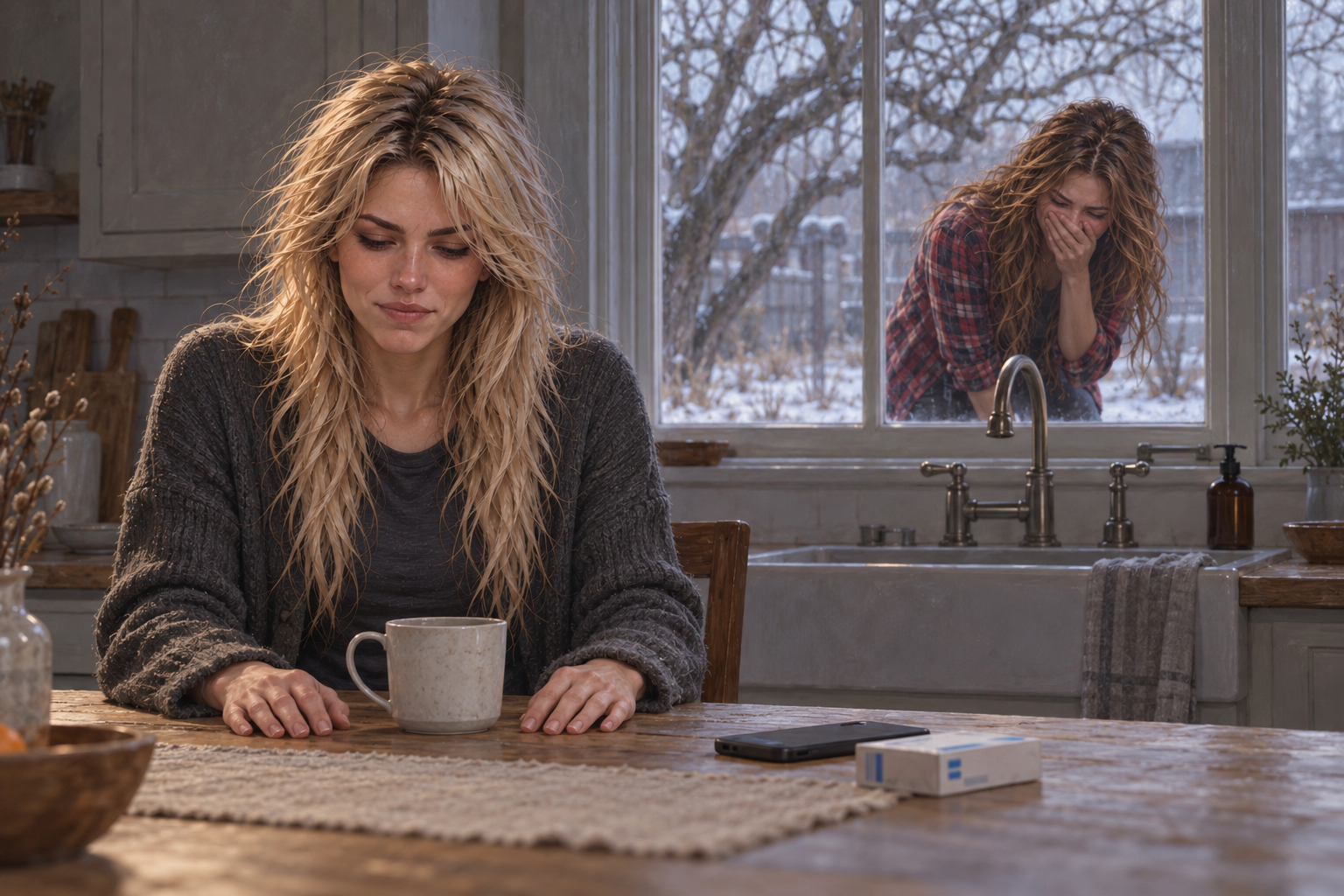
When she came back in, Val was sitting exactly where she had been, with her hands flat on either side of her cup, and her face doing absolutely nothing at all, and her shoulders shaking.
— end of chapter twenty-one —
Summer · Kyra’s kitchen table, and the room that was nowhere
It was the voice that started it.
Forty minutes of Val explaining the decimal system and crop rotation and the bracket on her downspout, in the clear, in her own flat voice, to everybody behind the second door; and after it, under it, the comment that said I didn’t know her voice did that, and the one that said can someone isolate the audio, and Val at the kitchen table with her face doing nothing at all.
She did not say anything about it until summer. Then, on a Sunday night in June, at Kyra’s kitchen table, with the window open and the neighbor’s apple tree full of birds, she said:
“The schoolteacher came in on Thursday.”
“She always comes in on Thursday.”
“She asked me where the books on bees were.” Val did not look up from her tea. “I told her. Five hundred and ninety-five. And she looked at me for a moment longer than the question needed.”
Kyra put her cup down.
“Val, she asks you where things are every week. She always looks at you a moment too long. She’s been building a collection since we got here.”
“I know.” Val turned her cup a quarter turn. “I know it was nothing. I’m almost certain it was nothing. I’d just like it to be impossible.”
· · ·
“Then don’t be you,” said Kyra.
Val looked up.
“On camera. Don’t be you. Be somebody else.” Kyra leaned forward. “Half the comments ask for it. Can they do a nurse, can they do a schoolteacher, can they do a librarian—”
“Absolutely not a librarian.”
“Not a librarian. Somebody else. Somebody who isn’t anything like you. Who talks differently, and moves differently, and doesn’t sound anything like the woman at the desk.” Kyra was warming to it. “You do it every day, Val. You do it for the county. You’ve done it in every town we’ve ever lived in — the face, the voice, the woman they think you are. You’re the best actor I’ve ever met.”
“I am not an actor.”
“You’ve been playing a quiet, particular, slightly cold librarian since the day we got here, to a town of nine hundred people,” said Kyra, “and every one of them believes it. Except the cold part. They’ve got the cold part wrong.”
· · ·
Val did not answer for some time.
“I can’t do the end,” she said at last.
Kyra knew.
“I can be somebody else in the front room,” said Val. “I can be somebody else at a desk, or on a porch, or across a counter. I’ve been doing it since before there were counters. But not at the end. You know I can’t. If I’m managing anything at the end — anything at all, my face, my voice, a woman I’m pretending to be — I’ll be watching it. And if I’m watching it—”
“You won’t get there.”
“I won’t get there,” said Val. “And I can’t fake that I did. My light won’t let me.” She put her hand flat on the table. “So I’d be a woman pretending to be somebody else, pretending to arrive, with no light. And everybody watching would know. Even if they didn’t know why.”
“Then don’t pretend at the end,” said Kyra. “Be somebody else all the way up. And then, at the end — let her go.”
· · ·
Kyra wrote the character down.
She did it at her own kitchen table over two evenings, in one of Val’s notebooks, which Val had handed across the table without being asked, open to a clean page, because Val knew that if it was going to be done at all it would have to be written down, and she would have to be able to study it.
So Kyra wrote it the way Val would have wanted it written. Not a costume. A specification.

Her name is Mira.
She is never in a hurry. She has never been in a hurry in her life. Everything about her is slow — the way she walks, the way she turns her head, the way she sits down.
She smiles before she speaks. Always. Every time.
She calls everybody darling. She means it about half the time.
Her voice is low and warm and a little lazy, as if she’s just woken up and is in no rush to be fully awake. She has an accent you can’t place. It might be from somewhere on the Adriatic. It might be from nowhere.
She touches things while she talks. The back of a chair. Her own collarbone. Your wrist.
She would never say a number. Not ever. If you asked her the time she’d say late, darling.
She is not cold. She has never once been cold in her life.
She is the opposite of a librarian.
· · ·
Val read it at the kitchen table, twice, with her reading glasses on, without expression.
“She would never say a number,” she read aloud.
“I thought that would be the hardest part.”
“It is going to be very hard,” said Val. She turned the page over and looked at the back of it, as if there might be more. “She touches things while she talks. I don’t touch things while I talk.”
“You put your hand flat on things.”
“That’s different. That’s afterward. That’s—” Val stopped. “Mira touches things while.”
“Mira touches things while.”
“Late, darling,” said Val, flatly, trying it, in her own voice, and Kyra put her face in her hands and laughed until the birds in the apple tree went quiet.
· · ·
The first rehearsal was a disaster, and they both knew it would be.
Kyra’s front room, Saturday afternoon, curtains drawn, no cameras. Val stood in the middle of the rug and tried to be Mira, and she was stiff as a board. She smiled before she spoke and the smile came a full second too early and stayed too long, like a woman remembering she had been told to smile. She said darling as if it were a word in a language she was learning from a book. She put her hand on the back of the armchair while she talked and then took it off again, and put it back, and looked at it.
“You’re thinking about your hand,” said Kyra.
“I’m thinking about my hand.”
“Mira doesn’t think about her hand. Mira’s hand just goes places.”
“Mira’s hand,” said Val, with enormous dignity, “is attached to a woman who has spent a very long time making absolutely certain her hands never go anywhere she hasn’t decided they should.” She took the hand off the armchair. “This is going to take some time.”
· · ·
It took two more Saturdays.
Kyra watched her do it, and it was the most remarkable thing Kyra had seen her do in some years. Val did not become Mira. Val studied her. She took the specification Kyra had written and went through it the way she went through a method paper — clause by clause, with notes in the margin — and she rehearsed each clause separately, alone, in her own front room with every lamp on, until it was right. The smile, first. Then the voice. Then the slowness. Then the hand.
By the second Saturday the smile came at the right moment and was the right size.
By the third, Kyra stood in her own doorway and watched a woman she had never met walk slowly across her front room, smiling, with one hand trailing along the back of the couch as she passed it, and turn her head — slowly, as if there were all the time in the world — and say, low and warm and a little lazy, in an accent from somewhere on the Adriatic, or from nowhere at all:
“Hello, darling. You’re late.”
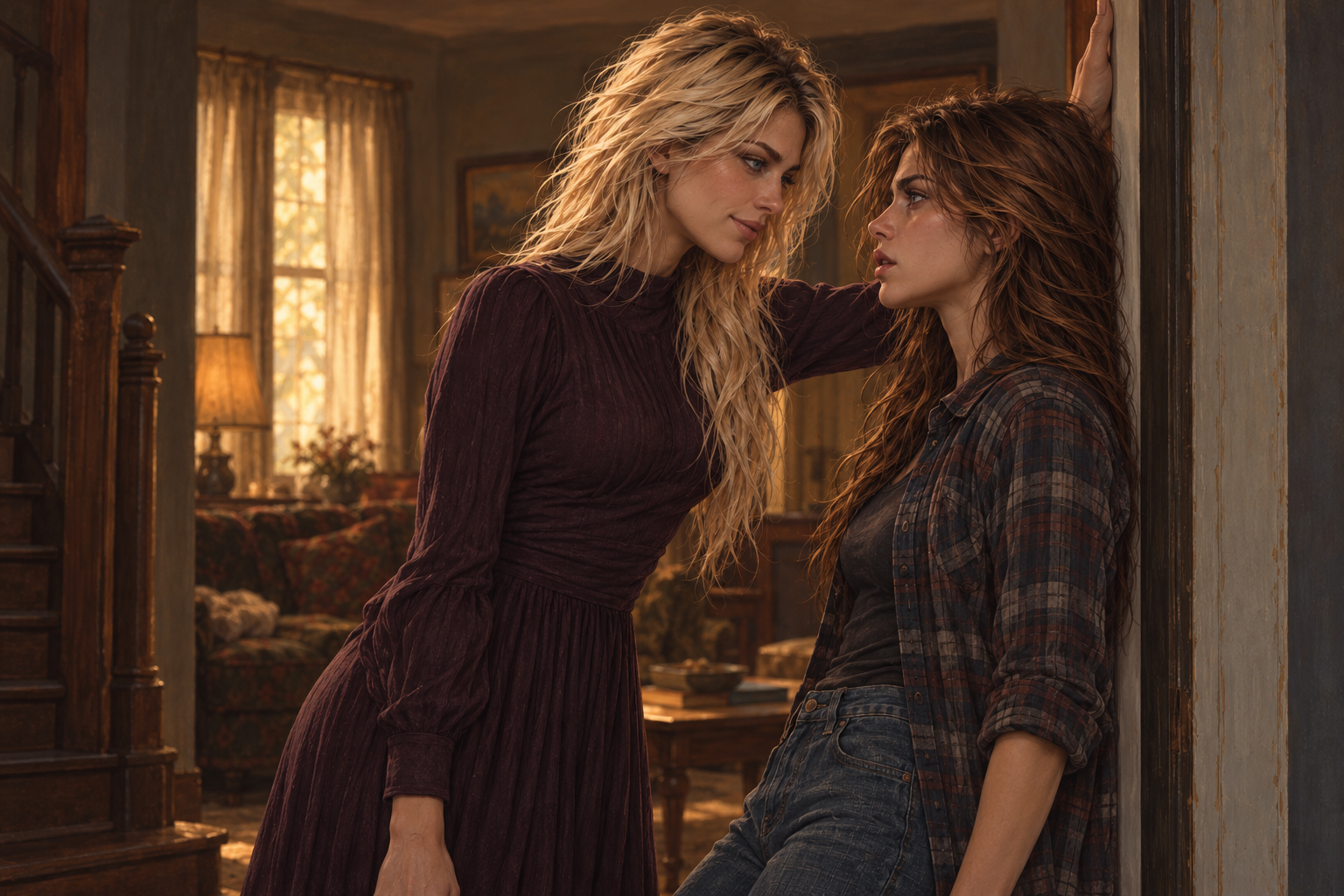
And Kyra’s breath went out of her completely.
· · ·
“Well?” said Mira.
Kyra could not answer.
“Darling,” said Mira, smiling, and crossed the rug to her — slowly — and put one hand flat on the doorframe beside Kyra’s head, and leaned, just slightly, and looked at her from much too close with Val’s eyes in a face that was not doing anything Val’s face had ever once done. “You look like you’ve seen something.”
“I have,” said Kyra.
“What?”
“Somebody I’ve never met,” said Kyra, and her voice was not steady at all, “and I don’t know where you’ve been hiding her.”
Mira smiled.
And then — very slightly, at the corner of the mouth — so did Val. Kyra saw it. The real one, under the other one, just for a second, like a light through a curtain.
“I’ve had her for a very long time,” said Val, in her own voice. “I just never had anywhere to put her.”
· · ·
There were three faces after that.
Kyra worked it out lying awake that night, with Val asleep beside her. There was the face for the county: the woman at the library desk, quiet and particular and a little cold, with her sleeves down and her voice flat and her hands flat on the counter, who had been in Calderveil since the autumn she arrived and had never once been late and whom nobody in that town had ever once seen laugh. There was the face for Kyra: the one under all of it, which did nothing at all where anybody could see it and everything where Kyra could, and which Kyra had been reading since a queue at the Vayr.
And now there was a third. A woman with a low lazy voice and an accent from nowhere, who smiled before she spoke and touched things while she talked and had never once in her life been in a hurry, and who had nothing whatsoever to do with a librarian, or a town, or anybody the schoolteacher would ever meet on a Thursday.
Three faces. And only one of them was ever going to be on camera again.
· · ·
The first Mira video was the hardest thing they had ever made.
Not because of Mira. Mira was perfect. Mira walked into the room that was nowhere in a long pale robe that Val had made for her, and a black mask, with her hair braided back, and smiled at the camera before she said anything, and said hello, darlings, low and warm and lazy, to everybody behind the second door; and the chat went white.
WHO IS THIS
IS THAT BLONDIE
that’s not her voice. that’s not her voice at all
she has an ACCENT
she SMILED
she smiles?? since when does she smile??
”darlings” I’m on the floor
Mira was perfect all the way through. She touched things while she talked — Kyra’s wrist, her own collarbone, the back of the chair. She was slow in everything. She laughed, low, at nothing, the way somebody laughs who has never once had anything to worry about. She called Kyra darling in a voice Kyra had never heard, and Kyra had to put her face in Val’s shoulder for a moment to recover.
And then they got to the end, and Val could not get there.
· · ·
Kyra felt it in the grip.
They were laced, from above, in the lamplight, Mira under her with her robe open and her braid crushed beneath her and that slow lazy smile still on her face. And the grip was tight. Too tight. Steady, careful, holding. The grip of a woman holding a room up with both hands.
Because Mira had to be held up. Every second. The smile, the voice, the accent, the slowness — every one of them was a thing to watch, a thing Val had studied clause by clause and was still, under everything, running from the specification. And a woman who was watching four things could not stop watching herself.
The light did not come.
Kyra waited. She slowed. She talked, low, about nothing, and it did nothing at all, because talk was the remedy when Val was holding nothing, and Val was holding Mira. The grip said I can’t, I can’t find it, she’s in the way.
And Kyra put her mouth by Val’s ear, under the edge of the mask, under the strings, where no microphone would catch it, and said:
“Let her go.”
The grip went still.
“Nothing in this room is yours,” said Kyra, very low, in time. “Not the camera. Not the end. Not her. She’s not yours either. She’s mine. I wrote her. Let her go.”
· · ·
And Mira went.
Kyra felt her go. It was the strangest thing she had ever felt in a bed with this woman, and she had felt a great many strange things. The smile went first — just slid off, the way a robe slides off a shoulder — and then the slowness, the lazy careless slowness that had never once been Val’s, and then the voice, which stopped, and did not start again. And underneath all of it, under the robe and the accent and the low warm laugh, was Val. Just Val. Bare-faced under the mask. Nobody watching anything at all.
The grip let down.
And the light came — the way it always came, at the throat first, and the wrists, and up and up until the whole of her was lit, clean and gray and soft on the locked cameras — and she came apart under Kyra without a sound, and the murmur started up in her, low, in no language anybody had ever named, with Kyra’s name strung all through it. Not in Mira’s voice. Not in any accent. In her own.
· · ·
what happened at the end
she dropped it. did you see. right at the end she just DROPPED it
the smile went away and then she was just — her
it was like watching somebody take off a costume from the inside
that’s the realest thing I’ve ever seen
the character was so good and then the ending was REAL and the contrast
she couldn’t fake it. she was acting the whole time and then at the end she couldn’t act any more
that’s literally the whole brand. nothing about them is performed. even when it’s a character, the end isn’t
Kyra read that one out, at one in the morning, and Val, across the table, put her glasses down very carefully on top of the notebook.
“Nothing about them is performed,” said Val.
“They wrote it themselves. Nobody told them.”
“They worked it out,” said Val. She was quiet for a moment. “From a woman with an accent from nowhere, who smiles.”
· · ·
It got easier after that. Not easy; Val never found Mira easy, and Kyra did not think she ever would. But she learned where the edge was — the place, near the end, where Mira had to be let go of — and she learned to feel it coming, and after a few weeks she did not need Kyra to say it. She simply put Mira down, the way you put down a coat, and went on as herself.
The role carries her up to it, Kyra wrote, in the back of the gray notebook, and then she sets it down. Up to the end, Mira. At the end, nobody.
Val read it over her shoulder and did not correct a word.
· · ·
The period pieces were the strangest part.
The strangers loved them — loved them more, once Mira came, and they started to understand that the blonde could act. The green dress, the gown from the cold northern city, the riding habit, the thing with the ruff that nobody could sit down in. Most convincing roleplay on the site, somebody wrote, under the dark wool, and somebody else wrote she’s not even in character, she’s just LIVING there, and a hundred people agreed.
“They think it’s the best acting you do,” said Kyra.
“It’s the least acting I do,” said Val. “Mira’s acting. That’s — that wasn’t acting. That was a Tuesday. In a city on the Adriatic, in the rain, with you lacing yourself up wrong.” She put her hand on the laptop. “I wasn’t playing a woman from then. I was remembering being one.”
“They’ll never know.”
“No,” said Val. “That’s the best part of it.”
· · ·
It was Kyra who got into trouble, in the end, and she had not seen it coming at all.
She had thought it would be easy for her. It was easy for her — that was the trouble. Val had needed three Saturdays and a specification to become Mira; Kyra could become anybody in about four seconds. She did it the first night they tried it the other way around: Val as herself, behind the camera, in a black mask, and Kyra in front of it, as somebody else. Kyra wrote nothing down. She simply walked into the room that was nowhere and was somebody — a woman from a farm, she decided on the way in, with a husband away at market and an afternoon to herself and a great deal to say about it — and she began to talk.
And she could not stop.
It came out of her the way it always came out of her: fluently, warmly, with her whole body, without effort. A name for the husband. The color of his eyes. What he said at breakfast. The name of the farm, and the dog, and the river behind it, and a quarrel with a neighbor about a fence, and the way the light came through the kitchen window at four in the afternoon. All of it invented, on the spot, out of nothing, as easily as breathing, and all of it beautiful, and none of it true.
Kyra heard herself doing it.
· · ·
She stopped in the middle of a sentence about the river.
She did not mean to. She was standing in the room that was nowhere, in her mask, in a dress Val had made, halfway through describing a river that had never existed to a camera full of strangers, and she heard her own voice doing it — that warm, easy, fluent voice, inventing and inventing — and she knew it.
She had heard it before. In a bed on another world, for years, beside a good man she liked and did not love. Lying in the dark, telling him what had happened to him, beautifully, at length, with her whole heart and a great deal of detail, while she watched his face to see whether he believed her. Inventing it. Every time. Because there had been nothing to describe, and she could not bear for there to be nothing, and she had found that she could make something out of nothing so easily, so warmly, that he had never once known.
Her openness and her lying are the same faculty. Val had said that to her once, in some form, a very long time ago. Kyra had not wanted to hear it.
She heard it now.
· · ·
“Copper?” said Val, very quietly, from behind the camera.
Kyra did not answer for a moment. Then she took off the farmer’s wife — just took her off, the way Val had learned to take off Mira — and stood there in the room that was nowhere as herself.
“I’m all right,” she said.
“You stopped.”
“I know I stopped.” Kyra looked at the camera, at the small red light. “I’m not doing her. I’m sorry. I’m not doing anybody. I’ll be Copper. I’ll be me, in the mask. That’s all.” She turned her head and looked at Val, at the black mask over Val’s eyes. “You can be Mira. You should be Mira. She’s yours and she’s wonderful. But I can’t do it.”
“Why?”
“Because it’s too easy,” said Kyra.
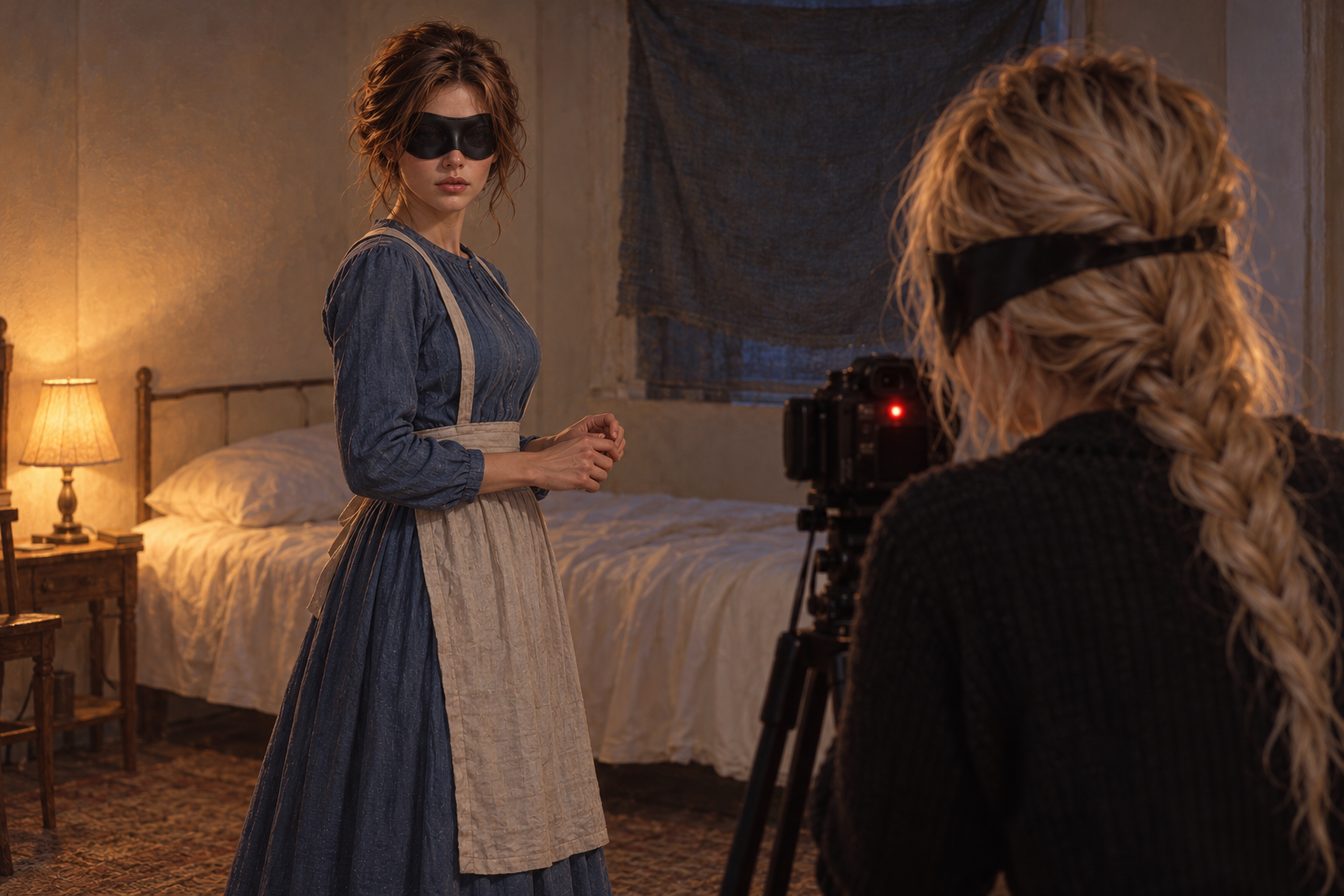
· · ·
They talked about it at one in the morning, at the kitchen table, with the cameras off and the masks off and the tea going cold.
“You were extraordinary,” said Val. “For about six minutes. The river was very good.”
“The river didn’t exist.”
“I know it didn’t exist. That’s why it was good.” Val put her hand on the table. “I needed three weeks and a specification to make up one woman, and I’ll never stop feeling her in my hands. You made up a farm and a husband and a dog and a quarrel about a fence in six minutes, standing up, without a note, and they were all alive. I’ve never seen anybody do that.”
“I have,” said Kyra. “I’ve done it. For years. In a bed. To a man who couldn’t see.” She looked at her tea. “That’s what I heard. Halfway through the river. I heard myself doing it to Emrin.”
Val did not say anything.
“It’s the same thing,” said Kyra. “Isn’t it. The thing that makes me good at that — that makes me good at talking, at telling a story at the diner with my whole body, at being open — it’s the same thing I used to lie to him. Every night. Beautifully. It’s not two things. It’s one.”
“Yes,” said Val.
Kyra looked up.
“Yes,” said Val again. “It’s one thing. I’ve known that for a very long time. I’ve never said it, because I didn’t think you could hear it without thinking I meant it as a charge.” She turned her cup a quarter turn. “It isn’t a charge. It’s the best thing about you and it’s the worst thing you ever did, and they’re the same, and you get to decide every single time which one it is.”
“So I’m not doing roleplay.”
“So you’re not doing roleplay,” said Val. “You’re doing Copper. Who is you, in a mask. Who never says one thing on camera that isn’t true.” She paused. “And I’ll do Mira. Who is somebody else entirely, all the way up, and then nobody at all.”
· · ·
“That’s backwards,” said Kyra, after a while. “Isn’t it.”
“What is?”
“You’re the one who can’t act. Everybody would say. The quiet one, the cold one, the one who says it is the lamp. And it turns out you’re the best actor on the whole site.” Kyra started to laugh. “And I’m the one who’s supposed to be made for it. Loud and open and quick. And it turns out I’m the one who can’t, because I’m too good, and the being good is the problem.”
“Yes,” said Val.
“That’s very annoying.”
“It’s extremely annoying,” Val agreed, and her mouth did the thing it did instead of smiling, and then, in a low lazy voice with an accent from nowhere at all, she said, “Come to bed, darling. It’s late.”
And Kyra laughed until she had to hold on to the table.
— end of chapter twenty-two —
Autumn · the room that was nowhere, and Kyra’s kitchen
It was an ordinary night. That was what Kyra would keep coming back to, afterward. Nothing had happened. There was no schoolteacher, no comment, no number at the top of a page. No Mira. Just the two of them in the room that was nowhere on a Friday in October, in the masks, with the color on the rings and the lamp where the letter had asked them to leave it and the cameras locked, the way it had been a hundred times.
And Val could not get there.
· · ·
Kyra felt it early. She felt it before the lacing, in the long slow part, on the long road through all that dark; it took the time it always took, and then it took longer, and when Val came out to meet her at last she came out careful. Not closed. Val was not closed; Kyra would have known closed. She was open, and willing, and wanting — Kyra could feel the wanting in her, the way she always could, hot and early and very nearly the fastest thing about her. But she was careful. Every part of her was being held a quarter of an inch above where it should have been.
They laced. And the grip came up between them steady and tight and exact, the grip of a woman doing everything correctly.
She’s watching, Kyra thought.
Not the camera. Not anything outside. Herself. The way Val sometimes did, on no particular night, for no reason she could ever name — lying there doing everything right and listening to herself do it, checking her own breath, her own hands, her own grip, the way she checked everything, all the time, without meaning to, because it was what she was.
And a woman who was watching herself could not arrive. That was the law. It had always been the law.
· · ·
Kyra talked. She talked about the man with the pager and the dog that barked at the mail in its higher voice and the woman at the pie table whose niece had now had a baby in Seattle. She slowed. She slowed further. She went first, as she always did, loudly, laughing at the end, and came back closer to the surface, and kept going, and waited.
The light came up at Val’s throat, faint. It came up at her wrists. It hung there.
It did not come any further.
Kyra waited a long time. She knew how to wait; she had been waiting for this woman since a mountain in the cold, and she was better at it than she was at anything else on either world. But the light hung, and the grip stayed tight, and Val’s breath stayed careful, and somewhere at the edge of everything there was a small red light in the corner of the room that had been on for forty minutes.
And Kyra — without deciding, without thinking about it at all, the way you put out a hand when somebody stumbles — got louder.
· · ·
She did not notice herself doing it. That was what she would find hardest, afterward. She did not notice at all.
She went again — she could always go again — and she went loud, louder than usual, and long, and she laughed at the end of it, and she kept going, and the room filled up with her. Her voice. Her breath. The sound she made at the top of it, and the sound after, and the laugh. There was so much of her in the room that there was no room for anything else, no room for the quiet underneath, no room for anybody watching to notice that the woman under her had stopped climbing and was lying there with her light hung at her wrists, faint, going nowhere.
It filled the frame. It filled the forty minutes. It made the video work.
And then she let it end — let it wind down, the way a song winds down — and lay there on top of Val in the lamplight, breathing hard, and felt the grip between them go slowly, quietly loose, and come apart, and the light at Val’s wrists go down and out, having never once got any higher.
Val did not say anything.
· · ·
They did the review at one in the morning at Kyra’s kitchen table, as they always did. Val watched it all the way through without speaking, with her glasses on.
Kyra watched Val.
On the screen, two women in black masks in lamplight. The redhead loud and long and laughing, going and going and going. The blonde under her, still, quiet, her light coming up faint at the throat, the wrists — and then the redhead so loud, so much of her, that the eye went to her and stayed there, and you had to be looking very closely, looking for it, to see that the blonde’s light had never got any further than the wrists.
Nobody would be looking for it.
The video ended. Val closed the laptop.
“You were louder tonight,” she said.
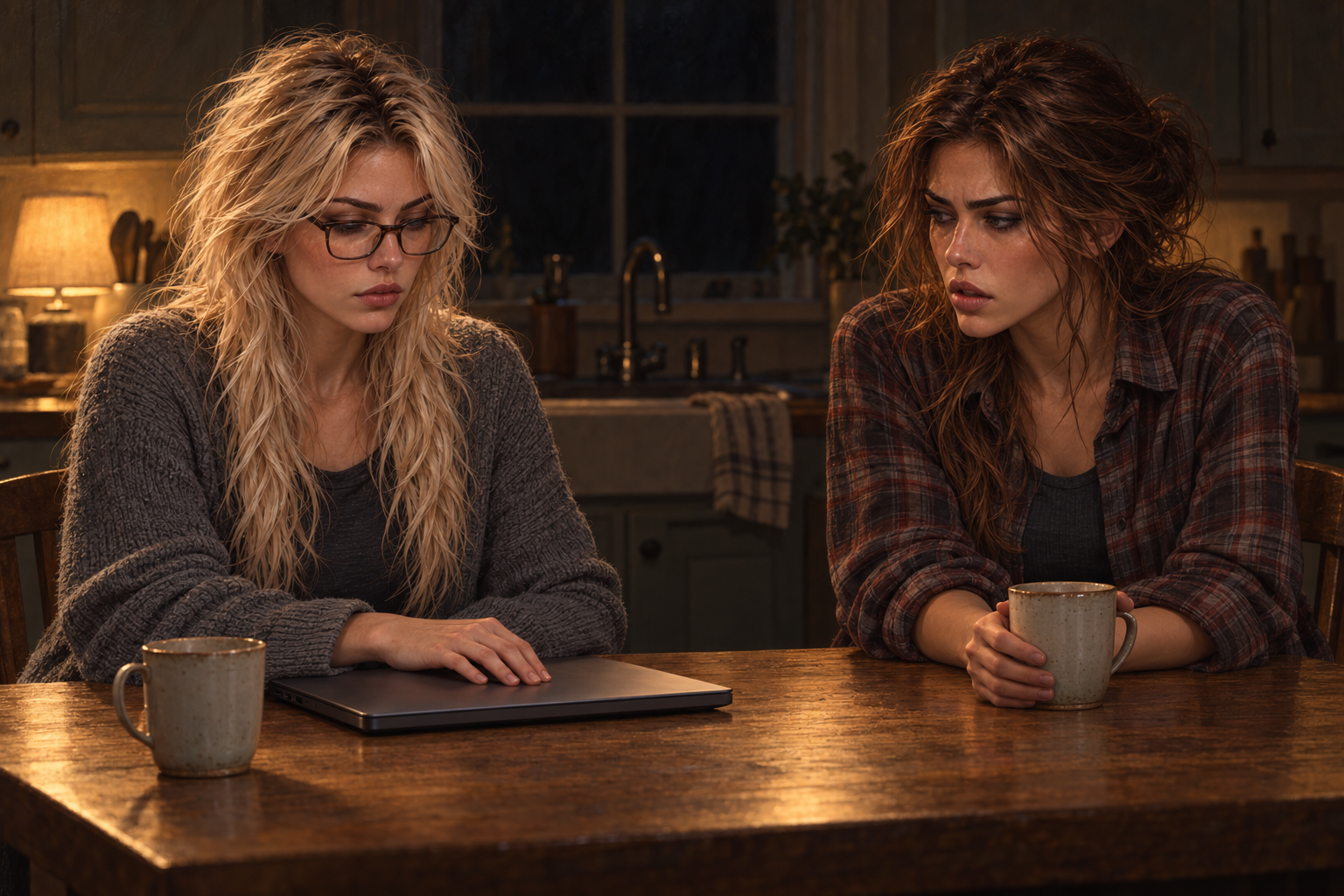
· · ·
Kyra opened her mouth to say she wasn’t.
And then she heard it. She did not need to see the video again; she heard it, in her own head, the whole of the last ten minutes of it, the way you hear a thing you have said in an argument after the door is shut. Her own voice, going on and on, filling the room. Filling it on purpose. Filling it so that nothing else could be seen.
“I didn’t—” she said, and stopped.
“I know you didn’t,” said Val. “I could feel you not decide. In the grip.” She took her glasses off and folded them and put them down. “You didn’t decide anything. You just did it. The way you’d catch somebody. You felt me get stuck, and you felt the camera, and you filled the room so nobody would see.”
“I was helping.”
“You were helping,” Val agreed. “You were being kind.” She looked at the closed laptop. “I’ve seen you be kind like that before.”
· · ·
Kyra sat very still.
She knew what Val meant. She had known it for a long time, and she had heard it clearly in the summer, halfway through a river that had never existed; she did not need to be told. A bed on another world. A good man she liked and did not love. The nights there had been nothing to describe, because she had frozen, because it had not taken, because she had not known why — and she had lain beside him in the dark afterward and filled the room. With her voice. With a beautiful, warm, detailed account of a thing that had not happened, so full and so kind that there was no room left in it for him to notice that nothing had.
Covering. That was the word for it. She had covered for a man who could not see, and now she had covered for a woman who could.
“I didn’t mean to,” she said.
“I know you didn’t mean to,” said Val. “That’s what worries me.”
· · ·
“We can’t post it,” said Kyra.
She said it before Val did. She wanted to be the one who said it.
“No,” said Val.
“It’s a good video. It works. Nobody would know.”
“Nobody would know.” Val put her hand flat on the closed laptop. “I would know. You would know. And every single person who has ever written nothing about them is performed under one of ours would be wrong, and wouldn’t know it, and would go on telling other people.” She paused. “It’s not that I didn’t get there. That isn’t the lie. Lots of nights I don’t get there. Some nights neither of us does. If it had been a video of me not getting there, I’d post it tomorrow, and let Tallyman write down a zero, and let them all have opinions about it.” Her voice did not change. “The lie is that you made it look like I did.”
“I didn’t make it look like you did. I made it so nobody would look.”
“That’s the same thing,” said Val, “from the other side.”
· · ·
So they did not post it. Val deleted it herself, at the kitchen table, at a quarter to two in the morning, the first video they had ever made and not posted. She did it without ceremony, two clicks, and then sat looking at the screen where it had been.
“That’s the rule, then,” said Kyra.
“That’s the rule,” said Val. “If it’s real, we post it, whatever it is. If it isn’t, we don’t. We never fake it.” She turned her cup a quarter turn. “Not for them. Not for the video. Not for the brand, not for the money, not for the number at the top of the page. And not—” She stopped.
“Not for you,” said Kyra.
“Not for me,” said Val. “You don’t cover for me, Kyra. Not ever. Not in that room. If I’m stuck, I’m stuck, and they can watch me be stuck, and I’ll live.” She looked up. “Promise me.”
Kyra looked at her across the kitchen table.
“And what am I supposed to do instead?” she said. “When you’re stuck. When I can feel it in the grip. When the light’s hanging at your wrists and it’s been forty minutes and there’s a red light in the corner. What do I do? Just lie there and wait and watch you watch yourself?”
Val opened her mouth, and then closed it again.
“I don’t know,” she said.
· · ·
Kyra thought about it for a week.
She thought about it at the fire hall, and on the Salt Fork trail, and at the diner on the Sunday while Dee put down coffees, and in her own bed at night with Val asleep beside her. She turned it over and over. Not covering. Not filling the room. Not making it look like something was happening that wasn’t.
But not lying there either. Not waiting for a woman to stop watching herself while she lay there watching herself.
And on the Saturday morning, on the Salt Fork trail, at the place where it split at a sign somebody had shot full of holes, she stopped running, and stood still in the path with her hands on her knees and her breath going, and understood.
You did not have to make it look like you’d got to the place you were going. You could simply go somewhere else.
· · ·
“Change the road,” she said, at Val’s kitchen table that night.
Val looked up from her book.
“When you’re stuck,” said Kyra. “When I can feel you watching. I don’t cover. I don’t fill the room. I don’t make anything look like anything.” “I change what we’re doing. I change what it’s for. I take us somewhere you can’t be watching yourself, because there’s nothing there for you to watch. And it’s all real. Every bit of it. Nothing performed. Just — different.”
Val put the book down.
“Somewhere else,” she said slowly.
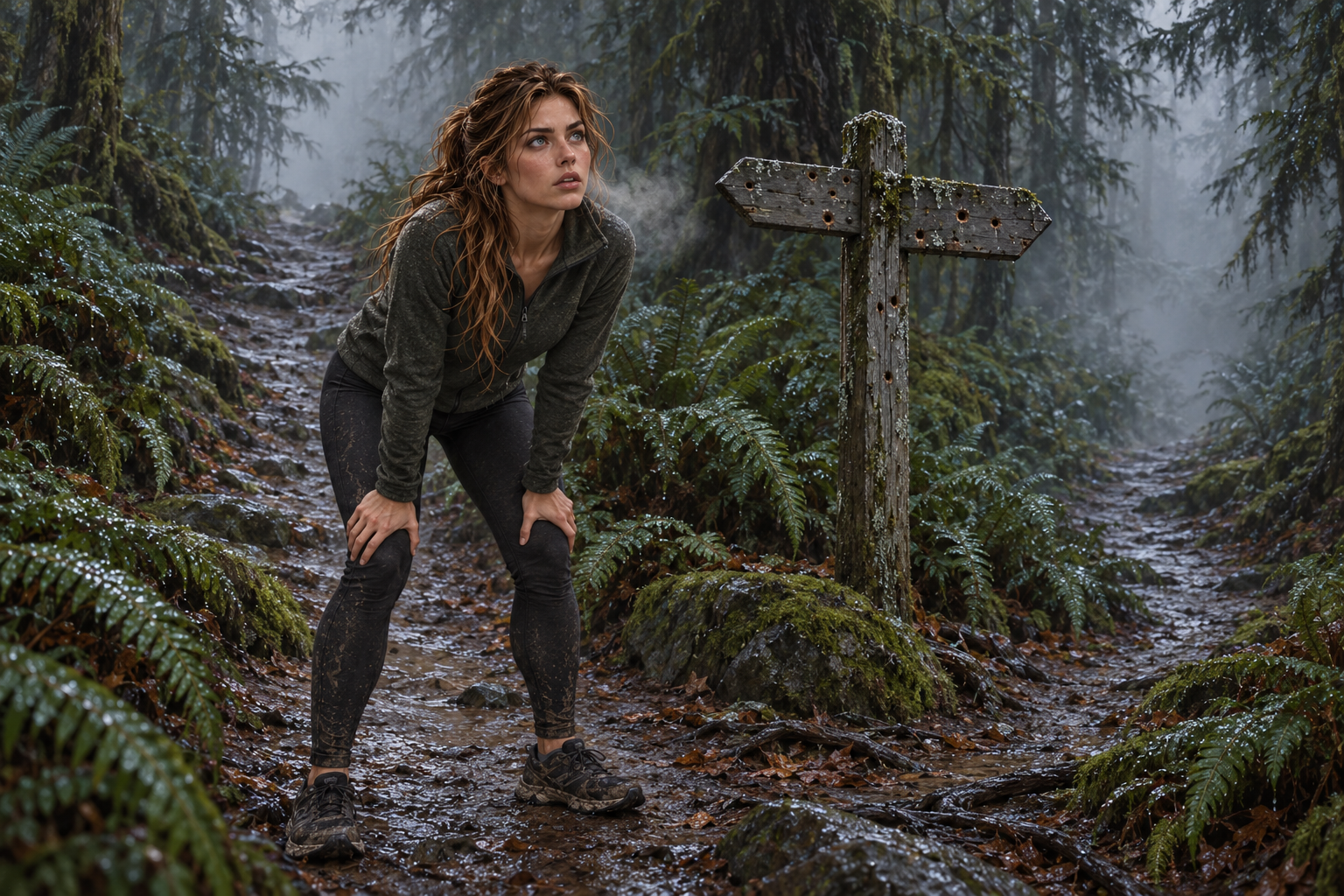
“Somewhere else. Something you don’t have to hold up. Something where the thing you’re watching — you, getting there — isn’t the point any more.” Kyra leaned forward. “And maybe you get there anyway, later, when you’ve stopped looking for it. And maybe you don’t. And either way, it’s true.”
· · ·
Val was quiet for a long time.
“That’s the contract,” she said at last. “Isn’t it. You hold the wheel. You notice the road’s closed, and you take another one, and you don’t stop the car to ask me which.”
“That’s the contract.”
“And I don’t have to do anything.”
“You don’t have to do anything. Nothing in that room is yours. Not even where we’re going.”
“You’ll need to tell me,” said Val. “When you’re changing it. Without saying anything. On camera.”
“I know.”
“Not with the stop.” Val’s voice went very flat, and very certain. “Not the grip’s stop. Not two taps. Not gutters. Never. The stop is the stop. If it ever means switch to something else, even once, it’ll stop meaning stop, and one night one of us will need it to mean stop and it won’t.” She put her hand flat on the table. “That’s not a term. That’s the only thing in our whole lives that has never once failed, and I am not letting a camera anywhere near it.”
“I know,” said Kyra. “I’d never.”
“Then we need new ones.”

· · ·
They made them at Val’s kitchen table that night. It took an hour and a pot of tea. Val wrote them in the back of the gray notebook, under the kiss is never a lid and Val’s time is never a target, in her small exact hand.
Three of them. For when they were not laced, and the grip could not say it for them.
A flat palm on Val’s breastbone. That one was Val’s own gesture, borrowed — the one she had put on Kyra’s chest all night on the floor of a front room, once, the one she put on folders and notebooks and the top of Kyra’s head. On camera, from Kyra, it would mean: let it go. It’s mine. We’re going somewhere else.
Kyra’s thumb on Val’s lower lip. That one meant: your mouth. On me. Now.
Kyra’s hand on the back of Val’s neck. That was how Val began things, on stairs, in doorways, and had since before either of them could remember. From Kyra, on camera, it would mean: come here. Change places.
“And when we’re laced?” said Kyra.
“When we’re laced,” said Val, “you ask. In the grip. Are you close? And I answer. And if I answer no—” She stopped.
“Then I change the road.”
“Then you change the road,” said Val. “And nobody watching will ever know you asked.”
· · ·
It was the third Saturday in November before they needed it.
It was not a bad night. It was not even a stuck night, at first. It was the long road through all that dark and the coming out to meet her, and the lacing, from above, in the lamplight, with the cameras locked; and it was only a long way in, after Kyra had gone twice and come back each time closer to the surface, that she felt it in the grip. The quarter-inch. The carefulness. The light coming up faint at the throat and the wrists and hanging there.
Kyra asked. In the grip, where nobody could see.
Are you close?
And the grip came back, small and honest, the one channel on two worlds that Val could not falsify.
No.
· · ·
Kyra did not get louder.
She felt the old thing start to come up in her — the kindness, the catch, the instinct to fill the room — and she knew it this time, she heard it coming the way you hear a car on gravel, and she did not let it. She stopped. She slowed. And she took one hand off Val’s hip and laid it, flat, on Val’s breastbone, between the breasts, over the heart, and left it there.
Let it go. It’s mine. We’re going somewhere else.
She felt Val feel it. She felt the grip go still for a second — surprised — and then she felt it ease, very slightly, the way a held thing eases when somebody else has taken the weight of it.
And Kyra unlaced, slowly, carefully, and moved down, and put her mouth on Val’s breast.
· · ·
It was nothing to look at, from the outside. Kyra knew that; she had watched enough of the strangers’ videos with Val to know what the camera wanted, and this was not it. It was slow, and patient, and very quiet. It was Kyra’s mouth on the pink of Val’s breast, where the nipple sat drawn in and small the way it always sat when nothing had been done about it — and Kyra doing something about it. Slowly. With her tongue and her lips and an enormous amount of time. Going around the pink of it, and around, and drawing gently, and waiting, and drawing again, until it came — out past her tongue, hard and standing clear, further than her own ever went — and then the other one.
It was not a procedure. Val had always said that. It was not required, and it was not every time, and it was not something Val’s body could do on its own; it needed somebody else to show what it had, the way the two minutes did, the way the light did. And it was the one thing Kyra had always secretly thought of as a privilege.
And it was not anything that Val had to hold up.
Kyra felt her stop watching. She felt it go — the quarter-inch, the carefulness, the checking. There was nothing here to check. Nobody was going anywhere. There was no light to get to, no peak, no moment the camera was waiting for. There was only Kyra, being patient, with her mouth, for as long as she liked; and Val’s breath, which had been so careful for so long, came out of her all at once in a sound Kyra had heard perhaps a dozen times in a very long life, and never once in company.
· · ·
Then Kyra lifted her head, and put her thumb on Val’s lower lip.
Your mouth. On me. Now.
And Val — who was very good at this, who had always been very good at this, far better than she had any right to be, which Kyra had told her once in a bed in Portland and had been told in return there’s a fourth one — Val looked up at her through the open eyeholes of the black mask, and something happened at the corner of her mouth, under Kyra’s thumb.
And she moved.
· · ·
Kyra did not think about the camera for a long time after that. She did not think about anything. Val’s mouth was on her, and Val was not watching herself at all, because Val was not doing anything for herself; she was doing it for Kyra, entirely, all of her attention gone out of her and into Kyra like water out of a cup, and she was superb at it, and Kyra went, and went again, and could not have stopped laughing if the house had been on fire.
And then, a long while after — long after Kyra had stopped expecting anything, long after there had been anything to expect — Kyra felt it in Val, under her hands, without any grip at all to tell her. The shoulders going. The jaw. The light coming up at the throat, at the wrists, along the collarbones, and up, and up, out of nowhere, with nothing to hold it up and nobody watching for it, slow and long and clean and gray on the locked cameras, until the whole of her was lit.
Val had not been going anywhere. And she had arrived anyway.
· · ·
the redhead switched it up halfway through, did you see
she could tell something wasn’t working and just CHANGED it
the way she read her though. she just knew
the blonde didn’t finish the first way and the redhead didn’t fake anything, she just went somewhere else
and then the blonde got there anyway at the end, out of NOWHERE
that’s the most attentive partner I’ve ever seen on a screen
she’s not performing for us. she’s paying attention to HER
that’s the difference. that’s the whole difference
Kyra read them out at the kitchen table, at one in the morning, and Val, across from her, did not speak.
“They saw it,” said Kyra.
“They saw you change it,” said Val. “They didn’t see why. They didn’t see you ask.” “They saw a woman pay attention to another woman. That’s all. And they thought it was the most remarkable thing on the site.”
“Is it?”
Val looked at her across the table.
“It’s been the most remarkable thing on two worlds,” she said, “for as long as I’ve known you. They’ve just only now got a camera on it.”
· · ·
They posted it the next day. All of it. The stuck part, and the hand on the breastbone, and the long slow patience, and the thumb on the lip, and the end that came out of nowhere. Uncut.
Tallyman updated his column on the Sunday night. Copper: 4. Blondie: 1. Time to Blondie’s first: 1:12:40 (!!). Note: she changed it up. Worth it.
“An hour and twelve minutes,” said Val, reading it, at Kyra’s table.
“He’s wrong,” said Kyra. “His clock starts at the first touch.”
“His clock starts at the first touch,” Val agreed. “Mine starts at four in the afternoon, when I decided.” She closed the laptop. “But for once, I don’t think either of us is counting the right thing.”
— end of chapter twenty-three —
Winter · Kyra’s kitchen, and the room that was nowhere
It began with fifty dollars, in the back room, in the chat, in the middle of a live show in January.
$50 says Copper can’t make Blondie scream
It went by in the column on the laptop at the foot of the bed, and Kyra saw it, because she had promised to look once at the start and once at the end and had never once managed only twice. And under it, before she had looked away, somebody had matched it.
$100 says she can
$200 says nobody can. she’s never made a sound in her life
I’ll put up $500 if Copper gets ONE real scream out of her
make her LOUD copper
make her loud
make her loud
· · ·
They read the rest at the kitchen table that night, and there was a great deal of it.
It had not stopped after the show. It had gone on in the comments, under every video, for a week: a running wager, with a pot. Somebody had made a page for it. People were adding to it. It was, by the Friday, more money than the back room took in a month, and it was all for one thing.
$2,400 now. Copper, you know what to do.
she’s so QUIET. just once. we just want to hear her once.
the blonde could end this tonight lol
we know you can see this blondie 😏
“We can see it,” said Val, at Kyra’s kitchen table, without expression.
“We can see it,” Kyra agreed.
· · ·
Val was silent for a while. She sat with her glasses on, reading, and Kyra watched her read, and watched something happen on her face that Kyra did not see very often and did not at first recognize.
It was not anger. It was not fear.
It was temptation.
“Val,” said Kyra.
“I’m only reading.”
“You’re not only reading. You’re thinking about it.”
Val took her glasses off.
“I’m thinking,” she said, “that it would cost me nothing. That’s what I’m thinking. That’s what’s interesting.” She folded the glasses. “I’m quiet because I’m quiet. It isn’t a principle. It’s a fact about my body, the way the light is. But I could make a sound. I could make one sound, once, on purpose, at the right moment, for them. It wouldn’t be fake, exactly. It would just be — loud. Once. And two thousand four hundred dollars, and a page full of strangers who’ve been begging for months, would all be very happy.” She looked at the screen. “I find that I want to see what it would feel like to give them something they want that badly.”
· · ·
Kyra did not say anything. She had learned that, over a very long time. You did not argue Val out of a thing. You waited, and let her argue herself.
It took about a minute.
“No,” said Val.
“No?”
“No.” Val put her glasses back on. “Because it isn’t mine to give. Not to them. If I’m ever loud — and I don’t know if I ever will be — it’ll be because I was, at the moment, without deciding. Not because there was a pot.” She put her hand flat on the laptop. “The minute I’m loud for money, I’m Mira without the accent. And Mira doesn’t get to be in the room at the end. Nobody does. Not even me.”
She closed the laptop.
“They can pay,” said Val. “They can’t steer.”
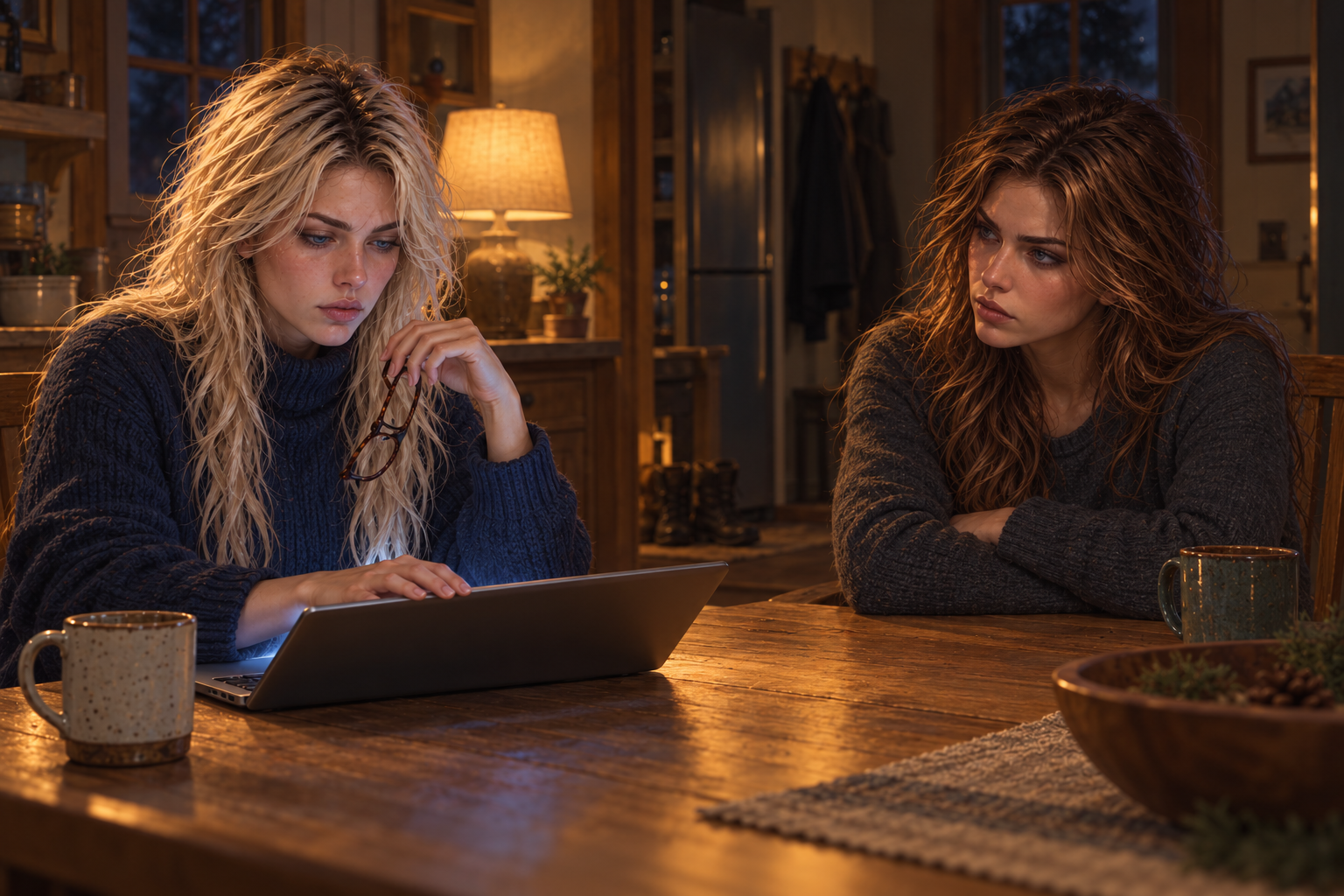
· · ·
Kyra wrote the reply. It was the only one they ever posted about it, and it went under the page with the pot on it, and it was short.
Thank you, all of you, for caring this much. We mean that.
But nobody makes anybody do anything in our room. Not for $50 and not for $2,400. If she’s ever loud, you’ll be there, and you’ll know it was real.
Please give the money to something good. xx —C
They gave it to an animal shelter, in the end. Somebody posted the receipt. Tallyman put a new line at the bottom of his spreadsheet, under the averages: Blondie scream pot: $2,612. Donated. Status: still waiting.
Val read that one twice.
“Still waiting,” she said.
“They’ll wait forever,” said Kyra.
“They might,” said Val, and Kyra could not tell from her voice whether she meant it as a promise or a warning.
· · ·
The other ones were worse, and there were not many of them, and Kyra did not read them all out.
They came in the private messages, mostly. Not the wagers, not the begging. Something else. Men — always men, as far as Kyra could tell — who had been watching for a long time and had begun, somewhere along the way, to believe that the watching made them owed something.
I know you think nobody knows who you are. I’ve watched every one. I know your bodies better than anyone alive.
The blonde is mine. I’ve decided. I know she can feel it.
I’ve been studying the windows. There’s a window behind that blanket. I can see the edge of it in the one from March.
Kyra read that last one and went very cold, and showed it to Val without a word, and Val went through the video from March frame by frame at the kitchen table until three in the morning, with her glasses on, looking for the edge of a window.
There was nothing. There had never been anything. Val had taped every edge of that blanket on her knees with a flashlight more times than Kyra could count. It was a man in a room somewhere pretending to know something he did not, to see if it would frighten them.
It frightened them.
“Block him,” said Val, at three, when she had been through every frame twice.
Kyra blocked him. Then she blocked the other two. Then she sat at the kitchen table and did not move for a while.
“I know your bodies better than anyone alive,” she said.
“He doesn’t,” said Val. “There’s exactly one person alive who does. And she’s sitting at this table.” She closed the laptop. “He’s wrong about everything. He’s just wrong very loudly.”
· · ·
It was February before Val got stuck again, and then she got stuck three times in a month.
Kyra did not know why. Val did not know why either, as far as Kyra could tell. It was not the schoolteacher, or a comment, or a man in a room claiming to see a window. There was no reason at all. Sometimes there was no reason. Sometimes Val simply lay there doing everything right and listening to herself do it, a quarter of an inch above where she should have been, and the light came up at the throat and the wrists and hung there, and would not come any further.
And each time, Kyra changed the road.
She was good at it now. She did not have to think. A palm on the breastbone, and the long slow patience with her mouth; a thumb on the lower lip; a hand on the back of the neck. Each time it was real, and each time it was something, and twice out of the three Val got there anyway, late, out of nowhere, once the pressure was off.
But the third time she did not. And Kyra lay beside her afterward in the lamplight with the cameras still running and her hand flat on Val’s breastbone, and felt the heart going under it, and felt Val not say anything at all.
· · ·
“Three,” said Val, at the kitchen table, at one in the morning.
“It’s fine.”
“It isn’t fine. It’s three in a month.” Val did not look up from the laptop. “You’ve had to change the road three times in a month. You’ve had to stop, and think, and go somewhere else, three times, with a camera on, because of me.”
“That’s what the road’s for.”
“I know what it’s for.” Val’s voice was very level, which meant it was not level at all. “I watched your face, Kyra. The third time. When you put your hand on me. You looked—” She stopped.
“I looked what?”
“Tired,” said Val.
· · ·
Kyra did not know what to say to that, so she did not say anything. And that was the mistake, she would think afterward. That was the place where she should have said something, anything — I’m not tired, I’m never tired of you, I’d change the road every night for the rest of our lives — and she did not, because it was one in the morning, and she was a little tired, and she did not think it mattered.
It mattered.
· · ·
It was the second Saturday in March.
It was a good night. That was the strange thing. It was not a stuck night at all, not at first — the long road, and the coming out, and the lacing, from above, and the grip saying here, all right, here. And then they unlaced, a long way in, the way they sometimes did, and Kyra went down and put her mouth on her, below, and stayed there; and with Kyra’s mouth on her there was no lacing, and no grip, and no channel at all. Nothing passed between them that Val did not choose to show.
And somewhere in there, Kyra felt the quarter-inch come.
She felt it in the hips, under her hands. A carefulness. A holding. The old thing, starting. And she thought — she would remember thinking it — oh, not again, not four, and she felt her own hand begin to move, up, toward Val’s breastbone, to change the road.
And before it got there, Val arrived.
· · ·
It was perfect.
That was what Kyra would remember, afterward, with something close to horror. It was perfect. Every single thing was there. The breath went on the third, not the second — it always went on the third. The jaw went first; Kyra did not see it, her face was down, but she felt it in the line of Val’s body, the slackening. Val’s hands closed on the sheet. Her back arched, the whole long line of it. She shook, the way she always shook, all through, in waves. She made no sound, because she never made a sound. And then she went down again, slowly, by degrees, in pieces, with her hands opening on the sheet one finger at a time.
Every tell Kyra had ever read in her, in every bed in every house since the snow. All of it. In order. Exactly.
And Kyra, with her face down and her eyes shut and her mouth on her, felt it all, and believed it.
· · ·
At the review she noticed that the light had not come up much.
“It didn’t come up much,” she said, watching the end of it on the laptop. On the screen, the blonde’s throat had a faint gray glow at it. Her wrists, barely. And that was all. No collarbones. No arms. No whole woman lit, clean and soft, the way it had been on the locked cameras for months.
“It was a quiet one,” said Val, beside her.

“It was very quiet.”
“Some of them are,” said Val. “You know that. The light answers what it answers.” She reached past Kyra and closed the laptop. “It was a quiet one. It was fine.”
And Kyra, who had known this woman since a queue at the Vayr, who had read every tell in her body for longer than most of the countries on this planet had existed, who had read her light since the snow and never once got it wrong — Kyra looked at her face across the kitchen table and saw nothing.
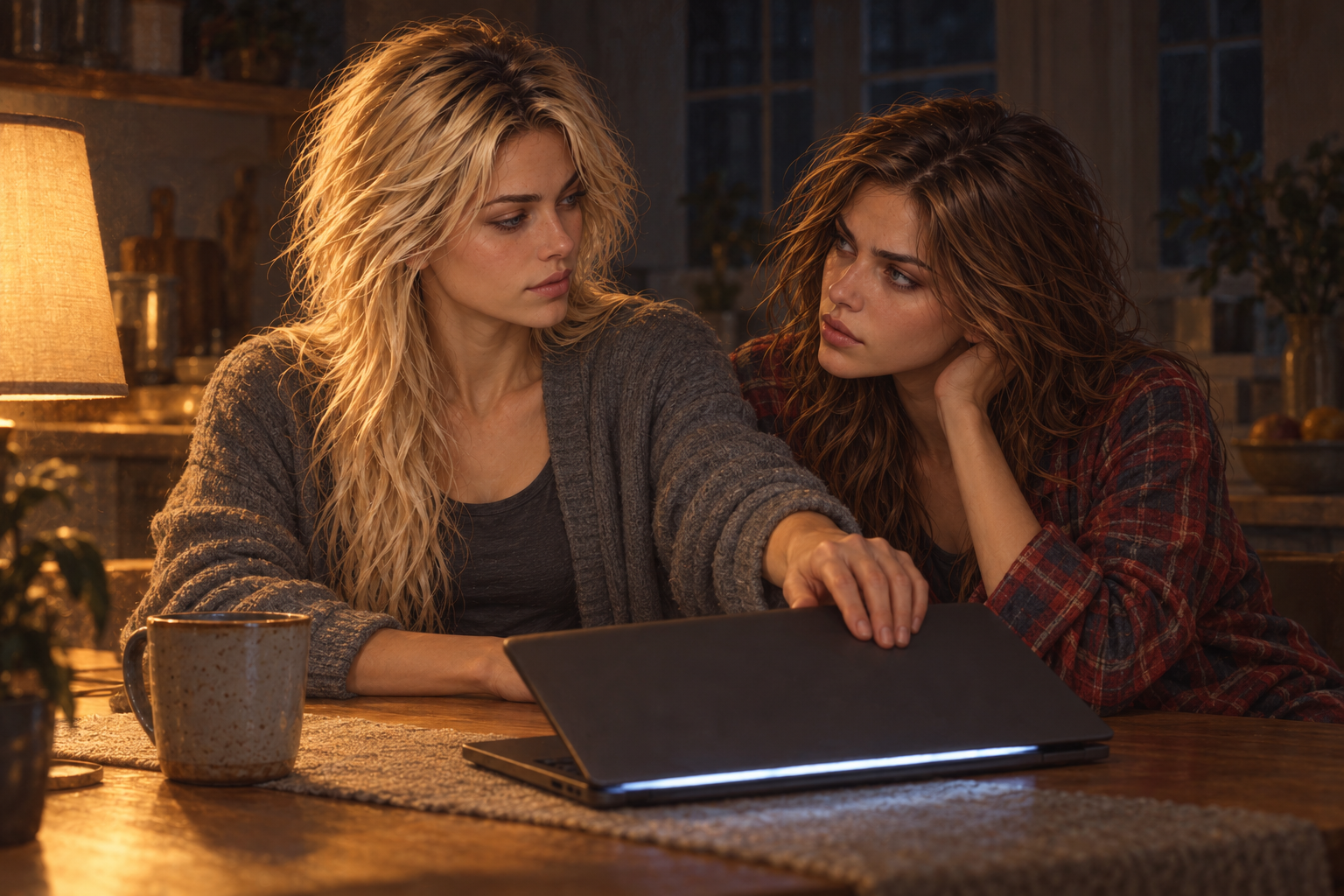
Not because there was nothing there. Because Val was the best at this of anybody on two worlds, and had been for a very long time, and for the first time in their whole lives she was using it on Kyra.
· · ·
They posted it on the Sunday. The letter came on the next Sunday, at twenty past three in the morning.
Kyra read it at the kitchen table, on her phone, the way she read all of them; and she got two lines into it and stopped, and read the two lines again, and then put the phone face down on the table and sat there for some time.
Then she drove across town in the dark with her coat over her nightgown and let herself in by the back door, and went upstairs, and Val was awake. Val was sitting up against the headboard in the lamplight with her own phone in her hands and her face doing nothing at all.
She had already read it.
· · ·
Hello. I’m sorry. I know I write too often. I’ll be brief.
The new one, from last week. It’s lovely, as they always are. The redhead is so patient with her. I watched it twice.
But the blonde’s glow didn’t come up that time. Not really. At the end. It came up at her throat a little, and her wrists, and then it stopped, and everything else happened anyway — the arch, the shaking, all of it, just the way it always does — and the light wasn’t there.
I’ve watched every one of these. I know what her light does. It’s the only thing in any of them I’ve never been able to explain, and it’s the most honest thing I’ve ever seen on a screen. It comes when she does. Every time. It always has.
It didn’t, this time.
Is she OK?
Let it come to you.
· · ·
Kyra stood in the bedroom doorway.
She did not say anything. She did not need to. She looked at the woman sitting up against the headboard in the lamplight with the phone in her hands, and Val looked back at her, and Kyra saw it — at last, now, too late — saw what she had not been able to see at the kitchen table a week ago. Not the composure. Under the composure. The thing it had been built over.
“You didn’t,” said Kyra.
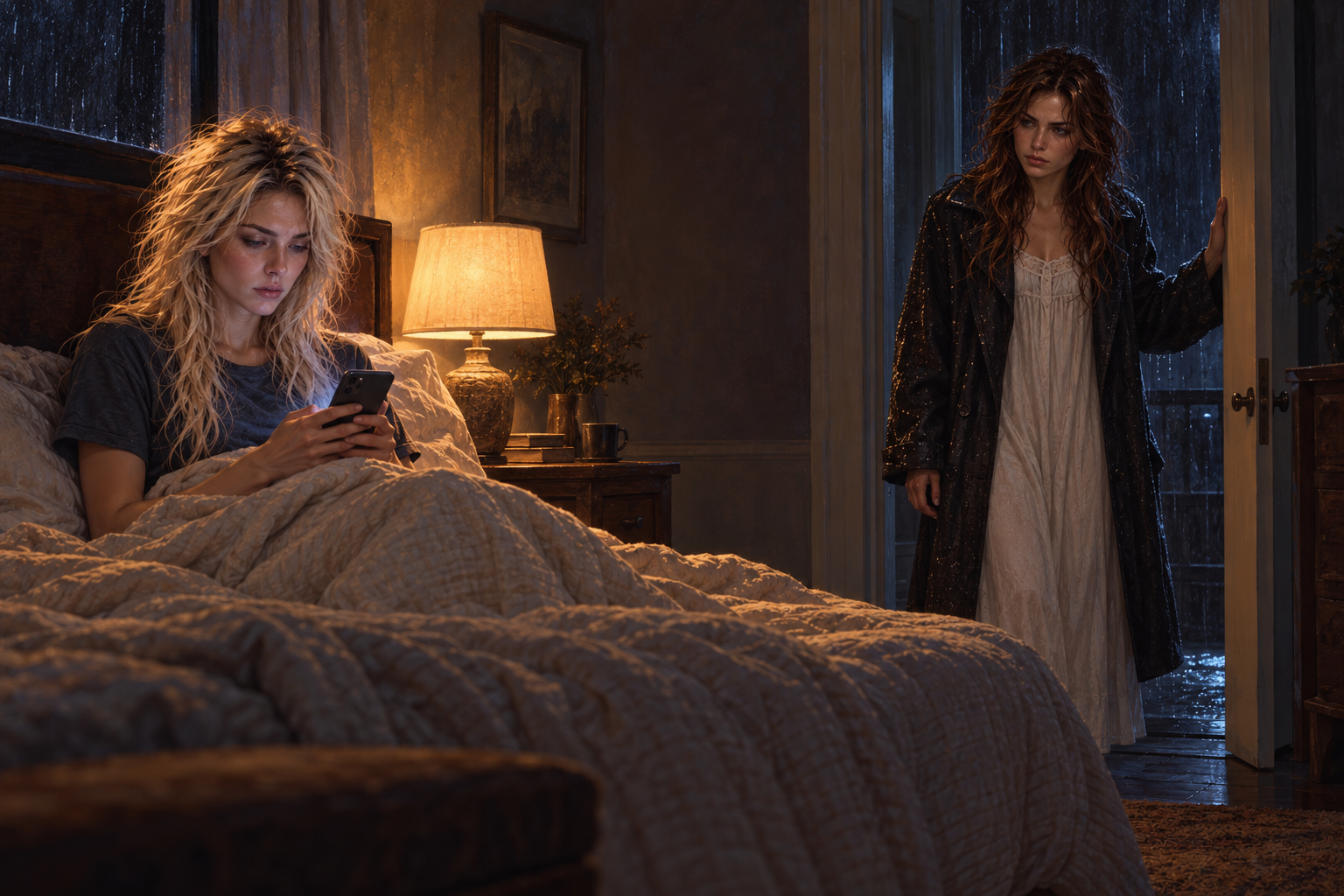
“I did,” said Val.
· · ·
Kyra came in and sat down on the end of the bed, a long way from her, which she never did.
“Why?”
Val looked at the phone in her hands.
“Because it was going to be four,” she said at last. “I could feel it coming. The quarter-inch. And I could feel your hand start to move. And I thought of your face, the third time, when you put your hand on me. And I thought—” She stopped. “I thought I could spare you. Just once. I could spare you having to change the road again. I could just — arrive. And you’d never know. And you could stop being tired of me.”
“I’m not tired of you.”
“You looked tired.”
“I was tired at one in the morning, Val. I’m always tired at one in the morning. I’ve never once in my whole life been tired of you.” Kyra heard her own voice go up and did not stop it. “You could have said. You could have asked me. At the table. Instead of—”
“Instead of lying,” said Val. “Yes.”
· · ·
It was very quiet in the room.
“I’ve lied a great deal,” said Val, after a while, to the phone. “I lie for a living. I lie to the county every morning. I’ve lied about my name and my age and my face and where I come from in more towns than I could list. I’m extremely good at it.” She did not look up. “But every lie I’ve ever told was a hiding. Something true, kept out of sight. I’ve never once — not once, in my whole life — made something that wasn’t there. I’ve never manufactured anything. I’ve never written a number down that I hadn’t measured.” Her voice went very flat. “And on Saturday I manufactured the most important thing I have. And I did it perfectly. Because I know every tell there is. I’ve been cataloguing them for longer than this country’s had a name. The jaw, the breath on the third, the hands, the arch. I had the best reference library on two worlds, and I used it to forge a record. On camera. And on you.”
“It was flawless,” said Kyra.
“It was flawless,” said Val. “You believed it. You were right there. Your mouth was on me, and you believed it.” She held up the phone. “And somebody in a kitchen somewhere, who’s never met me, who’s never touched me, who’s only ever seen me through a camera and a mask — they didn’t. Because of the one thing I can’t forge.”
“The light.”
“The light,” said Val. “I can do everything else. I can do the jaw and the hands and the arch and the breath on the third, and fool the one person on this planet who knows them best. And I can’t make the light come. Because it doesn’t come for performing. It doesn’t come for kindness. It doesn’t come for anything except the truth.” She put the phone face down on the blanket. “My own body told on me. To a stranger. In a letter. With all the commas in the right place.”
· · ·
Kyra sat on the end of the bed for a long time.
She found, to her surprise, that she was not angry. She had expected to be angry; she had driven across town in her nightgown expecting to be angry. And she was something, certainly. She was something very large. But it was not anger.
It was something more like recognition.
Because she had done exactly this. Not on camera. In a bed, on another world, for years. Lain beside somebody she cared about, at the end of a night where nothing had happened, and made something that wasn’t there — warmly, beautifully, in every detail — so that he would not have to know, so that he would not feel he was the problem, so that she would not have to see his face when he understood. She had done it out of kindness. She had done it flawlessly. And she had always thought it was the worst thing she had ever done.
And here was Val, who had never once in her life done anything like it, who had built a whole life on not manufacturing a single thing — sitting against a headboard at three in the morning, having done it, for exactly the same reason.
“You did what I did,” said Kyra. “To Emrin.”
Val looked up.
“For the same reason,” said Kyra. “To spare somebody. To not be the problem. Because you couldn’t bear to watch my face when—” She stopped. “That’s what it was. Wasn’t it.”
“Yes,” said Val.
“And now you know what it feels like.”
“Now I know what it feels like,” said Val. “I’d wondered. For a very long time. I’d never been able to understand how you could have done it, for years, to somebody you cared about.” She put her hand flat on the blanket between them. “I understand now. It’s very easy. It’s the easiest thing in the world. And it’s unbearable afterward.”
· · ·
Kyra moved up the bed, then. Not all the way. Just enough to put her hand on top of Val’s on the blanket.
“Never with each other,” she said.
“Never.”
“I don’t care about them. I don’t care about the video or the brand or what Tallyman writes down. Fake it for them every night if you have to, I don’t care. But never with me. Never in a way I can’t see. Not to spare me. Not ever.” She tightened her hand. “If I’m tired, I’ll tell you I’m tired. If you’re stuck, you tell me you’re stuck. And if I have to change the road four times, or forty, then I’ll change it forty times, and I’ll be glad to, because it’s you.”
“Never with each other,” said Val.
“Say it properly.”
“I will never,” said Val, “in any room, for any reason, fake anything with you. Not the end. Not the light. Not anything.” Her voice did not change. “And if I’m ever tempted to, I’ll tell you I’m tempted. Out loud. At the table. Before.”
· · ·
“It’s posted,” said Kyra, after a while. “It’s out there. Forever.”
“I know.”
“Copies of it. Everywhere. Every pirate site. A video of you faking it, forever, that we can never take back.”
“I know,” said Val. “I’ve known since the letter. That’s what I’ve been sitting here doing since three.” She looked at the phone. “It’s the only lie we’ve ever told them. And it can never be burned. And the one person who’d ever be able to tell is somebody in a kitchen I’ll never meet, who already knows.” She was quiet for a moment. “I suppose that’s fitting.”
“Do we answer them?”
Val did not answer for a long time.
“We answer them,” she said at last. “We thank them. For noticing. For being careful. We tell them they’re right about the light — that it’s the most honest thing we have.” She paused. “But we don’t answer the question.”
“Why not?”
“Because I don’t have an answer I can give them that isn’t either a lie or the truth,” said Val. “And I can’t give them the truth. And I’m not going to lie to them. Not twice.” She turned the phone over in her hands. “So the question stays open. Is she OK. They can keep it. It’s the only honest thing anybody’s ever asked me in that room.”
· · ·
Kyra wrote it that night, at Val’s kitchen table, with Val reading over her shoulder.
Thank you. For watching so carefully, and for writing, and for caring enough to ask.
You’re right about the light. It’s the most honest thing either of us has. It always will be.
—C
She did not answer the question. Val had asked her not to, and she understood why.
· · ·
Neither of them knew, that night, how long the question would stay open, or where it would finally be answered.
But Kyra kept it. She kept it the way she kept the third pair of pink ones, and the list of eleven names from Val’s cardigan pocket, and the costume historian’s letter: folded, at the back, under everything, in case.
Is she OK?
— end of chapter twenty-four —
January · the road south, and a convention floor
“Absolutely not,” said Val, which was how Kyra knew they were going.
She said it at Kyra’s kitchen table in November, with the laptop open between them on a page full of bright pink and gold, a page that said THE ADULT ENTERTAINMENT EXPO — LAS VEGAS — JANUARY across the top of it in letters a foot high, and under that a great many photographs of a great many people in very little, smiling at a great many other people with phones.
“Four days,” said Kyra. “Fans can buy tickets. Anybody can go. You walk around, you look at the booths, you meet people. Performers. People who do this.” She tapped the screen. “People who do what we do, Val. Out loud. In the daylight. With their names on.”
“Absolutely not,” said Val again, and did not close the laptop.
· · ·
She closed it a week later, after she had done the risk assessment, and the risk assessment ran to eleven pages, and Kyra was not allowed to read most of it.
“They’ve never seen our faces,” Val said, at the table, with the eleven pages under her hand. “That’s the first thing, and it’s the most important. Not one person on that floor has ever seen either of our faces, or ever will. They’ve seen the masks. They’ve seen our bodies, and the braid, and your hair up in a knot, and the pink ones, and the chair. They’ve never seen this.” She touched her own cheek. “Or my hair down. Or yours in a ponytail at the end of a day. They wouldn’t know us if we sat down next to them.”
“So we’re safe.”
“We are safer on that floor,” said Val, “than we are anywhere on the internet. Which is a very strange thing to find out, and I’ve checked it four times.”
“And the rest of it?”
“The rest of it is mostly about not flying,” said Val. “And your laugh.”
· · ·
They drove.
Val would not fly; you could not get on an airplane in this country without putting your real name on a list, and Val did not put their names on lists she did not have to. So they drove — two days down out of Oregon in Kyra’s car, through Nevada, through a great deal of nothing and then a great deal more nothing, with the radio on and Kyra’s feet on the dashboard and Val driving exactly the speed limit for nine hundred miles.
It was the longest time they had been alone together in a car since a wagon.
Kyra had not expected to like it as much as she did. She had expected to be bored. Instead she spent most of two days with her head against the window and her feet on the dash, watching the light change on the desert, while Val drove and said almost nothing at all and Kyra talked about everything — and at some point in the middle of the second afternoon, in the middle of a long straight road with nothing on either side of it for fifty miles, Val reached over without looking and put her hand on Kyra’s knee, and left it there, and drove one-handed for an hour.
They did not talk about it. They did not need to.
· · ·
The city came up out of the desert at dusk like something spilled.
Kyra sat up and took her feet off the dashboard and stared. She had been in a great many cities. She had been in cities that were burning, and cities that were drowning, and cities that had since changed their names twice. She had never once been in a city that was trying so hard.
“Oh,” she said.
Val, beside her, said nothing. Val was looking at it with an expression Kyra had seen on her face once before, a very long time ago, on the first night they had ever walked into a town with gas lamps — an expression of grave and total disapproval, and, underneath it, an enormous and helpless curiosity.
“It’s very loud,” said Val.
“It’s wonderful.”
“It’s the loudest thing I’ve ever seen,” said Val, “and I’ve seen a war.”
· · ·
The convention was in a hotel off the main street, in a hall the size of an airfield, and on the first morning Kyra walked into it with her hair in a ponytail and her ticket on a lanyard around her neck, and her whole body lit up like a struck match.
It was everything. It was everything at once. It was noise and light and color, booths in every direction, banners two stories high, music from six places, women in feathers and women in leather and women in almost nothing at all, signing photographs, laughing, posing, hugging strangers; and lines of people — hundreds, thousands — men and women and every kind of person, waiting to meet them, holding phones up, grinning, shy, loud, delighted. It smelled of perfume and popcorn and carpet cleaner. It was the most alive room Kyra had been in for years.
She loved it from the first second.
“Look,” she said, and grabbed Val’s arm. “Look.”
· · ·
Val looked.
Val stood very still at the edge of it, just inside the doors, with her hands in the pockets of her coat and her hair loose down her back — loose, the way she always wore it, the way nobody on that floor had ever seen it — and looked out over the whole roaring hall the way she looked at a ledger.
Kyra knew that look. She had seen it in a hundred rooms. In a parade hall on another world, and in a market in a city on the Adriatic, and at the grange hall in Calderveil on the last Saturday in March: Val standing at the edge of a crowd, perfectly still, reading it. Every face. Every exit. Every line. Who was watching whom. Who was lying. Who was afraid. Where the cameras were — and there were a great many cameras.
“Well?” said Kyra.
“It’s very honest,” said Val, after a long time.
Kyra stared at her.
“Everybody in this room knows exactly what everybody else is here for,” said Val. “Nobody’s pretending. Nobody’s hiding anything. It’s the least hidden room I’ve ever been in.” She took her hands out of her pockets. “I find it very restful. I didn’t expect to.”
· · ·
They walked the whole floor that first day. It took most of it.
Kyra talked to everybody. She could not help it. She talked to a woman in a silver wig at a booth for a toy company, who showed her a very large purple object with great pride and asked what she thought of it, and Kyra told her, at length, honestly, and the woman laughed so hard she had to sit down. She talked to a man selling chairs — the chair, he said, as seen in, and Kyra had to walk away very quickly. She talked to two women from Ohio who had driven out together for the third year running and who showed her photographs of themselves with every performer they had ever met, and Kyra looked at every single one, and asked about every single one, and meant it.
And then, by a booth near the back, she saw the shirt.
It was on a middle-aged man, with a beard and a lanyard, standing in a line. It was black. And on the front of it, in white, was a plain wooden chair, with a little dotted line from the seat to the floor and 17” beside it; and under that, in neat letters:
the rest is technique
· · ·
Kyra stopped dead in the middle of the aisle.
Val, a step behind her, walked into her back, and looked up to see what she was looking at, and went perfectly, absolutely still.
The man with the beard did not notice them. He was talking to the person in front of him in the line, cheerfully, about something else entirely. He had no idea. He had no idea at all that the two women standing six feet away from him in the aisle, one with her hair in a ponytail and one with her hair loose, were the two women whose chair was on his chest.
Kyra felt it come up in her.
It came up from somewhere very low, from her stomach, from her feet, from the whole two days of desert and the city spilled out of the dusk and the purple object and the man selling chairs — and it came up fast, and it came up big, and she knew before it got to her throat that she was not going to be able to stop it.
She laughed.
· · ·
It was the laugh.
Not a polite laugh. Not a laugh in a convention aisle. The one that came out of her the way it always had, too loud for the trees, too loud for any room, from her whole chest, with her head going back — the laugh from the end of every single video they had ever made. The laugh that came after Kyra went, every time, loud, delighted, helpless. The laugh that a great many people in that hall had heard a great many times, through their phones, in the dark, at the end of a chair video, under the strings.
The man with the beard turned around.
· · ·
He looked at her.
He did not look at her face first. That was the thing Kyra would remember. He turned around at the sound, the way you turn around when you hear somebody say your name in a crowd, and he looked for where it had come from — and his eyes went to her, and to her mouth, which was still open, still laughing, and stayed there.
And something went over his face.
Not recognition. Not quite. The look of a man who has heard a song in a shop and knows he knows it and cannot think from where.
“Sorry,” he said. “That laugh. You sound exactly like—”
And Val’s hand closed on Kyra’s elbow, and turned her, smoothly, as if it had been the plan all along, toward a booth on the other side of the aisle that sold novelty playing cards, and Val said, in a perfectly ordinary voice, in her librarian’s voice, the voice she took to the county, “Oh, look, these are the ones your sister wanted,” and Kyra found herself looking at a deck of playing cards with nothing on them she could have described afterward if her life had depended on it.
When she looked back, the man with the beard had turned around again, and was talking to the person in front of him in the line, and was shaking his head at himself.
· · ·
“Your laugh,” said Val, that night, in the hotel room, with the curtains drawn against the lights.
“I know.”
“I put it in the risk assessment. On page four. I wrote it down.”
“I know you did.”
“I wrote it down,” said Val, “and underlined it, and you weren’t allowed to read page four.” She sat down on the end of the bed. “He’s heard it. In every video. At the end. Through his phone. Every single person on that floor who’s ever watched us has heard you laugh at the end of a chair video. It’s the one thing about you that isn’t behind a mask.” She looked at Kyra. “Your eyes are behind the mesh. Your face is behind the mask. Your hair’s in a knot. And then you go, and you laugh, and it’s your laugh. It’s the only one there is.”
Kyra sat down beside her.
“I couldn’t help it,” she said. “He had the chair on his shirt, Val.”
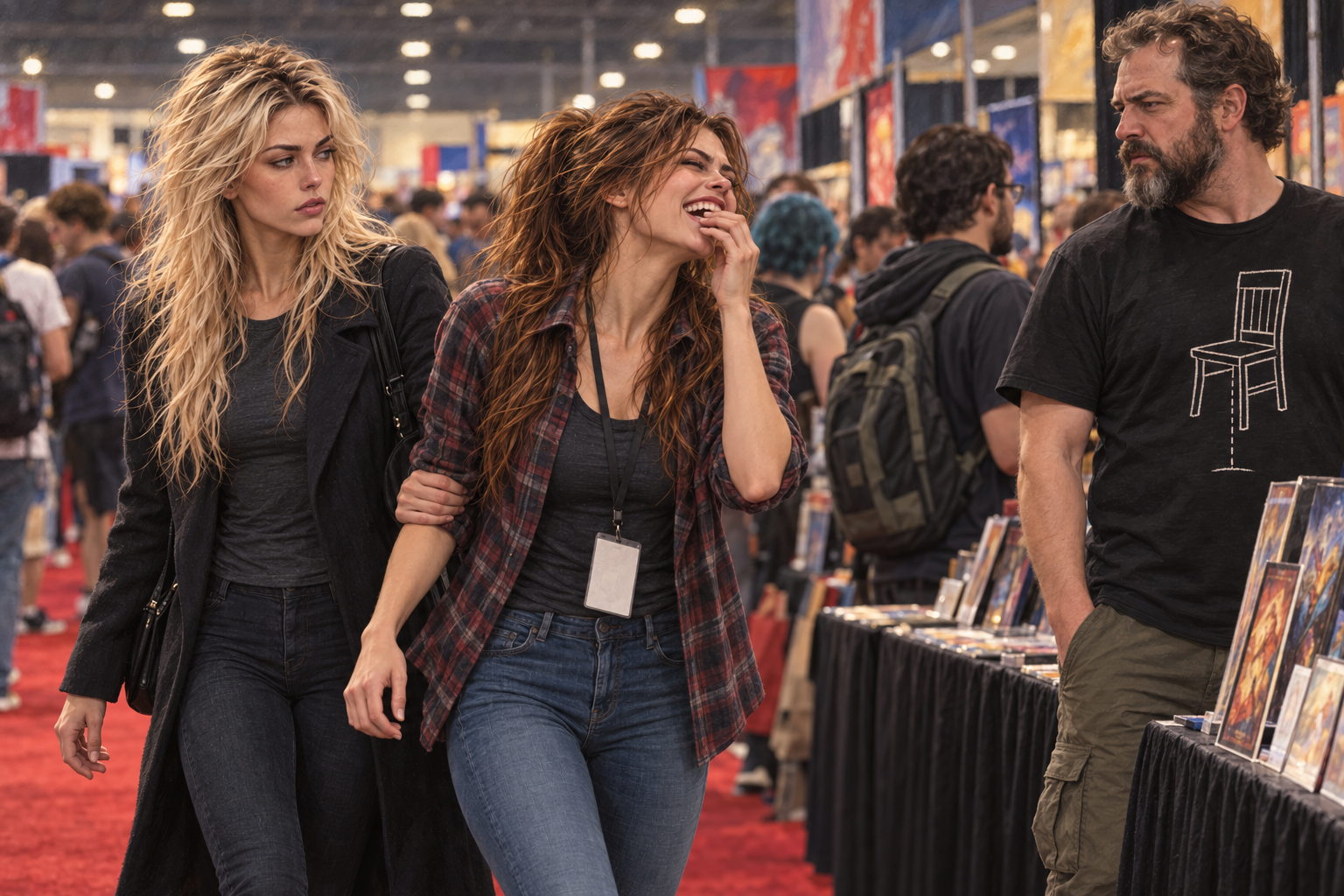
“I know he did.” Val’s mouth did the thing at the corner. “I saw. I had to look at the playing cards for a very long time myself.”
· · ·
The second day was the conversations.
Kyra had not planned any of them. They simply happened, the way things happened to Kyra in rooms full of people — somebody said something, and she said something back, and an hour later she was sitting at a table in the hotel bar with a stranger and a drink, talking about everything.
The first was a woman named Roz.
She was older than most of the people on that floor — and hard-worn — with a short gray crop and very red lipstick and a voice that had been a great deal of places. She had been in the business, she said, since before most of that floor was born, in front of the camera and then behind it, and now she did a talk show on the internet about it, and she came to the expo every year to see who was new and who was still there and who had gone.
Kyra liked her at once. Roz was funny. Roz was loud. Roz said exactly what she thought, and laughed at it afterward, and swore beautifully.
And somewhere in the second drink, with Val sitting silently at the end of the table with a glass of water she had not touched, Kyra asked her about faking.
· · ·
“Faking it?” Roz laughed. “Honey. Everybody fakes it.”
Kyra felt Val go still at the end of the table.
“Not all of it,” said Roz. “Not always. Some days it’s real and it’s wonderful and you’re lucky. But you’ve got a schedule, and a crew, and a scene to finish, and some days you’re tired, and some days your partner’s an idiot, and you finish the scene anyway. That’s the job.” She shrugged. “It’s acting. That’s all it is. It’s no different from any other kind.”
“But the audience—”
“The audience knows, honey.” Roz leaned forward. “That’s what nobody outside ever understands. They know. They’re not stupid. Nobody watching a stunt in a film thinks the stuntman’s really falling off the building. Nobody thinks the actor really died. They know it’s a show. That’s what they paid for — a show. And if you give them a good one, you haven’t lied to anybody.” She sat back. “Nobody thinks a stuntman’s really falling.”
· · ·
Kyra did not say anything.
She sat at a table in a hotel bar in Las Vegas with a drink in her hand and a woman she liked across from her, and she felt the sentence go into her like a key into a lock that had been rusted shut for years, and turn, and not quite open.
Nobody thinks a stuntman’s really falling.
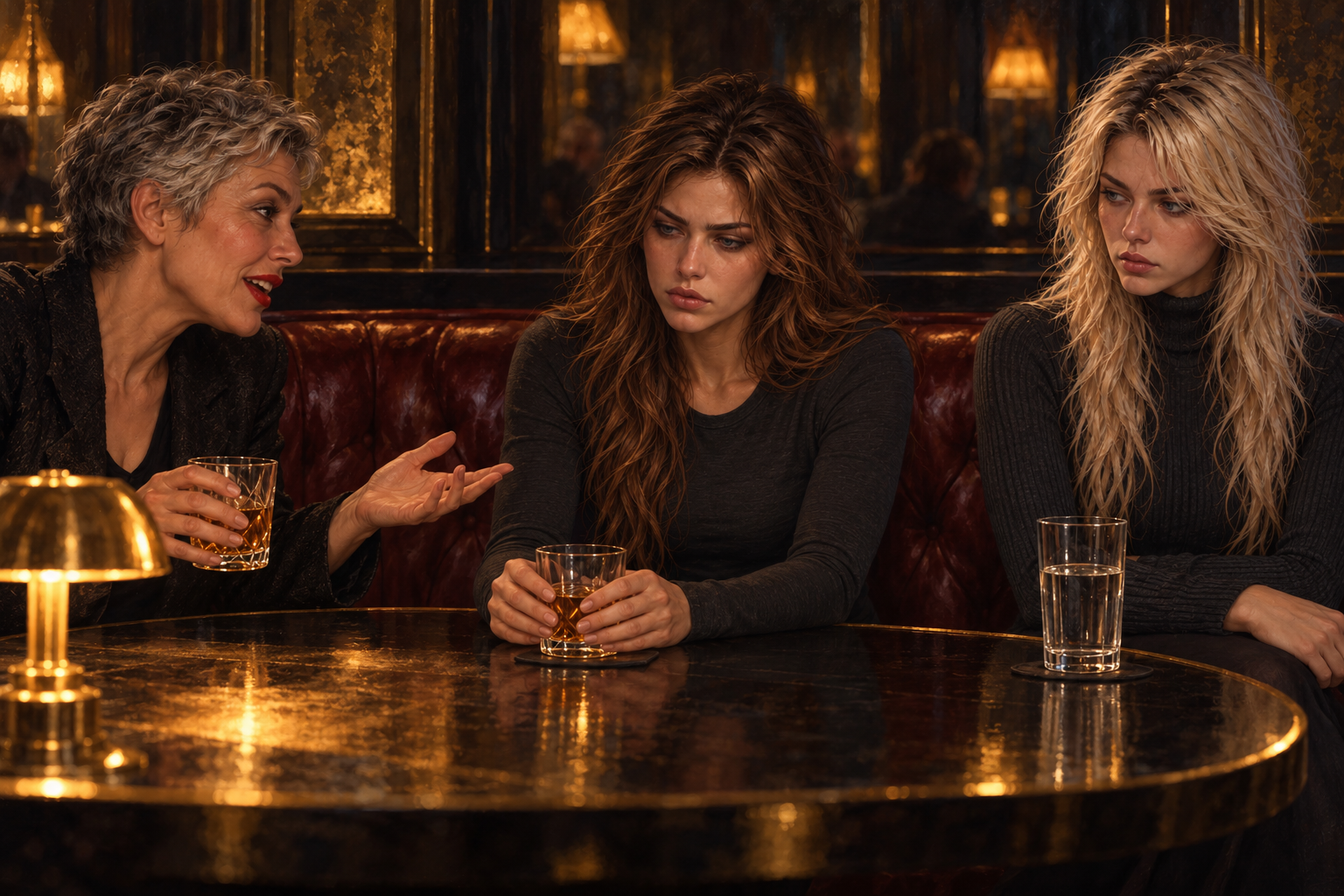
Because she had believed — for longer than this hotel had been here, longer than this city, longer than this country — that the worst thing she had ever done was lie in a bed beside a good man and tell him things that had not happened. And Roz was telling her it was acting. It was a show. And if the audience knew it was a show, nobody had been lied to.
But Emrin had not known.
That was the thing. That was the thing the sentence did not reach. Emrin had not known it was a show. Emrin had lain there in the dark, a man at his most defenseless, asking about his own body, the one thing he could never see, and he had believed her. He had not bought a ticket. He had not paid for a performance. He had asked her a true question and she had given him a beautiful lie.
“Not always,” Kyra heard herself say. “Sometimes they don’t know.”
Roz looked at her for a moment.
“Then that’s different,” she said. “That’s not acting, honey. That’s something else.” She finished her drink. “Who didn’t know?”
Kyra smiled at her, the good smile, the one that had got her out of worse rooms than this.
“Nobody,” she said. “Nobody you’d know.”
· · ·
The second was a couple.
They were at a booth at the end of the second row, and they had been married a long time, and making videos together for nearly all of it. Jonah and Teresa. He was tall and bald and gentle; she was small and fierce and had a laugh almost as loud as Kyra’s. They sold their own videos from their own website, and they had a little stand with their photograph on it, the two of them on a porch, fully clothed, smiling, and a line of people waiting to meet them that went back into the aisle.
Kyra waited in the line. Val waited with her, at the edge of it, reading it.
And when they got to the front, Teresa looked at the two of them — at Kyra in her ponytail, and Val behind her with her hair down and her hands in her coat pockets — and something happened on her face, very quickly, that Kyra recognized at once. The look of somebody who has been half of a pair for a long time, seeing another pair.
“How long?” said Teresa.
Kyra opened her mouth, and closed it again.
“A long time,” she said.
Teresa smiled.
· · ·
They talked for twenty minutes, at the end of the line, while Jonah signed photographs. Teresa talked, mostly; she was a talker, and so was Kyra, and they fell into it the way talkers do. And somewhere in it, Kyra asked her what it had done to them. The work. The cameras. All those years of it.
Teresa thought about it for a while. She did not give a smooth answer.
“It took us a long while,” she said, “to notice we’d stopped being able to tell which nights were ours.”
Kyra went very still.
“Every night was content,” said Teresa. “Every time was a scene. We’d be in bed on a Tuesday with no cameras anywhere and I’d catch myself thinking about the angle. He’d catch himself checking how long it was taking. We weren’t us any more. We were the show, even when there was nobody watching.” She looked over at Jonah, signing a photograph for a boy who could barely have been out of school. “So now we have a rule. One night a week, no cameras, no phones, no talking about work. Just us. And it took us two years of that rule before the nights felt like ours again.”
“Two years,” said Kyra.
“Two years,” said Teresa. “It costs something. Doing this together. Nobody tells you that. You’d better have something that’s just yours, and you’d better guard it like it’s on fire.”
· · ·
Behind Kyra, at the edge of the line, Val did not move. But Kyra did not need to turn around to know that Val had heard every word, and was writing it down somewhere in her head, and underlining it.
Something that’s just yours.
Kyra thought about the second column. Things we love and won’t. Your hair down. The word. Side on. She thought about the unfilmed nights, the ones in Val’s bed and her own with every lamp on and no red light anywhere, which they had never once talked about as a rule and had never once let go of.
“We have something,” she said.
Teresa looked at her for a moment. Then she smiled, a real one, and put her hand briefly on Kyra’s arm.
“Good,” she said. “Guard it.”
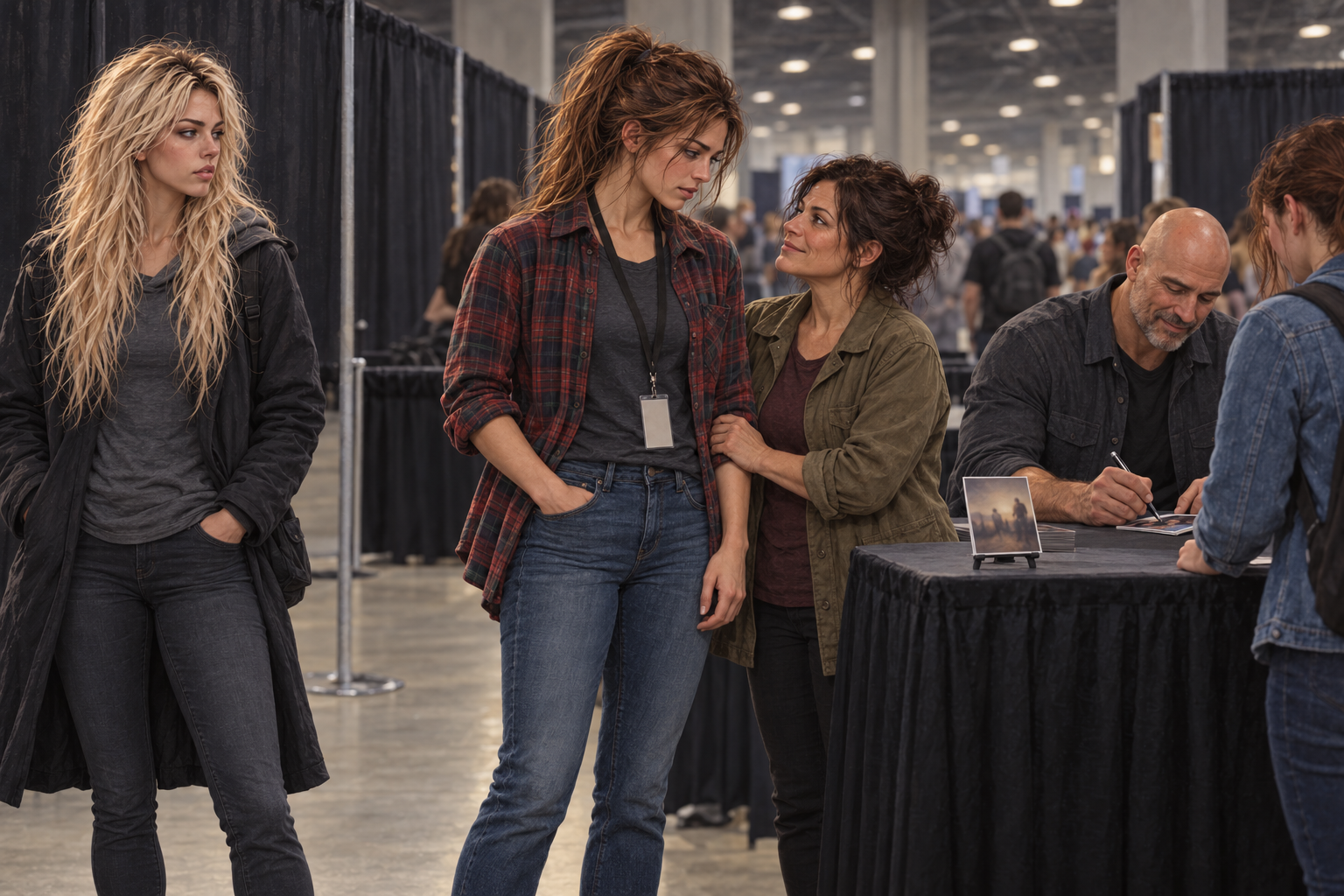
· · ·
The third was the one Kyra could not stop thinking about, on the drive home.
She did not get her name. She was a girl — a young woman, younger than she looked, or older, it was hard to say — at a booth near the front, very beautiful, in a pink wig and a costume that was mostly straps, and there was a line in front of her a hundred people long. She smiled for every single one of them. She hugged them. She signed their photographs and posed for their phones and laughed at their jokes, and her smile did not move once in four hours.
Kyra saw her again in the bathroom, at the end of the day.
She was standing at the sink with the pink wig off, on the counter beside her, and her own hair flat and damp underneath it, looking at herself in the mirror. Not doing anything. Just looking. And when Kyra came in she did not look around, and when Kyra came out of the stall she was still there, still looking, and Kyra washed her hands at the next sink and said nothing.
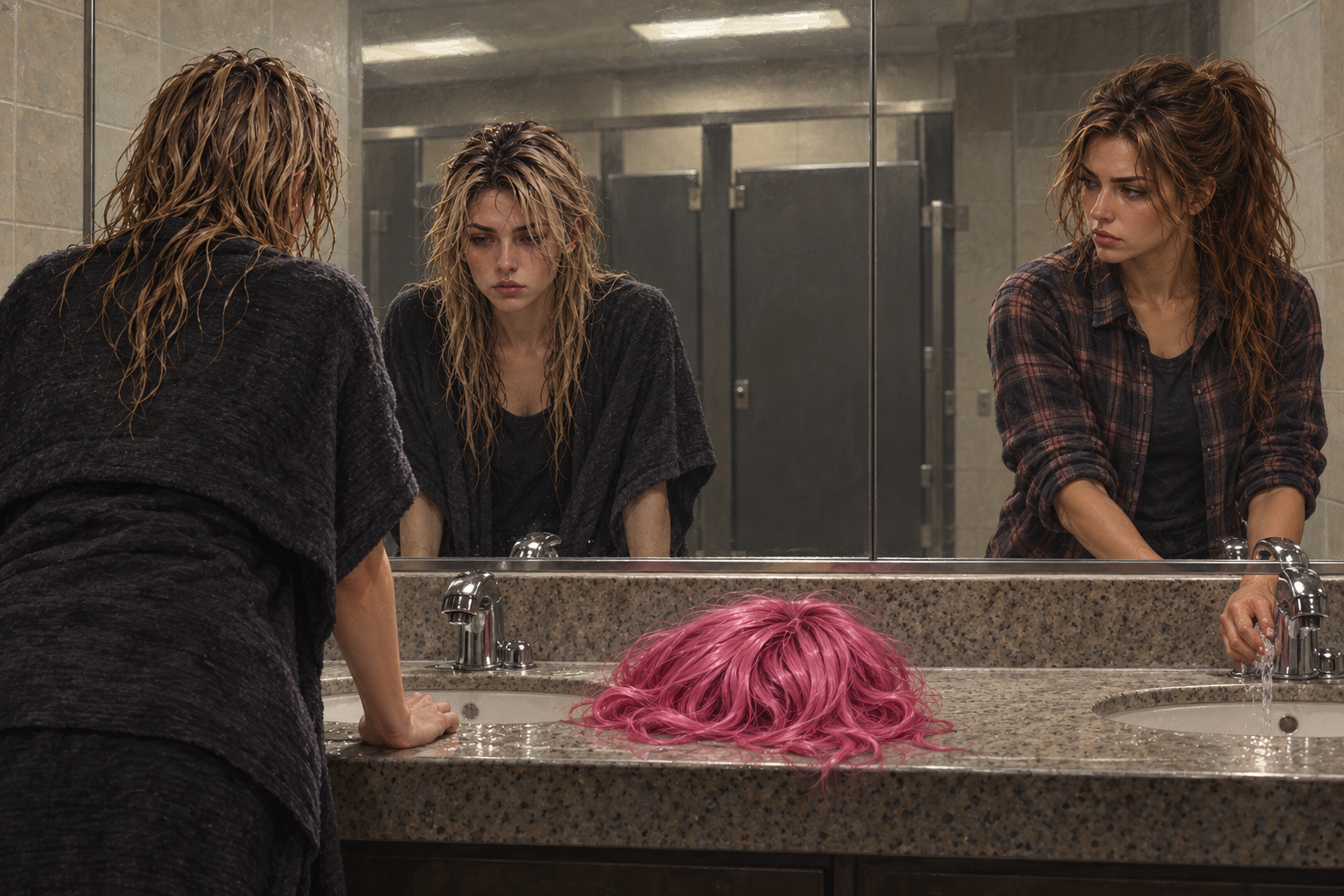
“Do you ever just,” said the girl, to the mirror, “not want to?”
Kyra looked at her in the glass.
“I don’t remember the last time I wanted to,” said the girl. Her voice was perfectly flat. “Isn’t that funny? I do it every day. Three, four times a week, on camera. I’m good at it. People love it. I’ve got a hundred people in a line out there.” She picked up the pink wig and looked at it. “And I can’t remember the last time I actually wanted anybody. Not once. Not for — I don’t know. A long time.” She put the wig back on, carefully, in the mirror, tucking her own hair up under it. “Sorry. I don’t know why I’m telling you. You’ve just got a nice face.”
And she smiled — the smile from the line, the one that did not move — and went out.
· · ·
Val was waiting outside the bathroom door. She had heard. The bathroom door was thin.
They did not say anything about it. They walked back through the hall together, past the booths and the banners and the lines, and Kyra did not talk, for once, and Val did not ask her to.
But that night, in the hotel room, with the curtains drawn against the lights, Val said into the dark:
“That’s the ending.”
“What is?”
“That girl. That’s the ending we don’t want.” Val’s voice was very quiet. “Not getting caught. Not a man with a beard. That. Doing it so long, and so well, for so many people, that one day you look in a mirror and can’t remember wanting to.” She was quiet for a moment. “If it ever starts to be that, for either of us—”
“I’ll know,” said Kyra.
“We’ll both know,” said Val. “And we’ll stop.”
· · ·
The last one was nothing. It was the end of the third day, at a booth for an agency, and a woman in a very sharp suit with a clipboard looked up as Kyra and Val walked past and looked at them — properly, the whole length of them, the two of them side by side, one fair and one dark, the same height, the same jaw — and said, with total professional sincerity:
“You two should be in this business.”
Kyra made it all the way out of the hall, and across the lobby, and out through the front doors of the hotel into the hard white January sun, before she let it out. And then she stood on the sidewalk in Las Vegas with her hands over her mouth and her eyes streaming and laughed until the man at the valet stand came over to ask if she was all right.
Val came out a minute later and stood beside her, with her hands in her coat pockets, perfectly composed.
“I told her we’d think about it,” said Val.
Kyra laughed until she had to sit down on the curb.
· · ·
They drove home the long way, through the mountains, and it took three days, and Kyra did not put her feet on the dashboard once.
“What did you think?” said Val, somewhere in the high desert, on the second afternoon.
Kyra thought about it for a long time.
“I thought they were braver than us,” she said at last. “All of them. With their faces. With their names on. Standing in a room with a hundred people in a line, and everybody knowing exactly who they are and exactly what they do.” She looked out at the desert. “We hide behind masks and a blanket over a window and a room that’s nowhere. They don’t hide anything. They just do it.”
“They do it,” Val agreed. “And some of them pay for it. That girl. And Roz, I think, under all of it.” She was quiet for a moment. “And the couple. Two years to get their nights back.”
“We never lost ours.”
“No,” said Val. “We never did.” She put her hand flat on Kyra’s knee, and left it there, and drove one-handed. “I think that’s the only thing we’re actually better at than any of them. We never once let the cameras into the nights that were ours. Not once.”
· · ·
And Kyra, with Val’s hand on her knee and the desert going by, thought about Roz, and the stuntman, and the sentence that had gone into her like a key into a lock and turned and not quite opened.
Nobody thinks a stuntman’s really falling.
She did not believe it. Not yet. Emrin had not known; Emrin had not bought a ticket; it had not been a show. That was still true, and she thought it would always be true.
But the people in the back room had bought a ticket. Every one of them. They had paid twice to sit in a smaller room and watch two women in masks, under false names, in a room that pretended to be nowhere.
What did they think they were watching?
She did not know. She turned it over the whole way home, through Nevada and up into Oregon and into the rain, and she did not get an answer, and she did not say it out loud.
Not yet.
— end of chapter twenty-five —
Spring · the room that was nowhere
It was supposed to be Mira.
That was the plan, and the plan had been made at Kyra’s kitchen table on the Wednesday, and written down, in Val’s hand, in the gray notebook: a costume, a scene, a little story with a beginning to it, the way the back room liked. Mira in the fantasy gown — the pale one, gathered, sheer at the sleeves, with the jeweled clasp low on the hip over the place where the color lay on the ring. Copper as herself, in a mask and nothing much else. A long slow scene that began in the chair and ended wherever it ended. Mira all the way up, and at the end, nobody.
They had done it a dozen times. More. It had become a thing they knew how to do, the way they knew how to do the color on the rings or the review at one in the morning: a shape, with steps in it, that their hands could find in the dark.
That was what Kyra would think, afterward. That it had become a habit. That they had been Mira and Copper so often, for so long, that they had stopped noticing how much of an evening it took, and how little of it was left over for anybody else.
· · ·
They did the color at seven. Kyra braided Val’s hair — tight, back off her face, down her spine — and pinned her own up in the loose low knot with the strands left down at the temples. They put on the masks. Val went upstairs to Kyra’s bedroom with the pale gown over her arm and came down ten minutes later as somebody else: slow, and smiling, and touching the banister on the way down with one hand as if it were an old friend.
“Hello, darling,” said Mira. “You look nervous.”
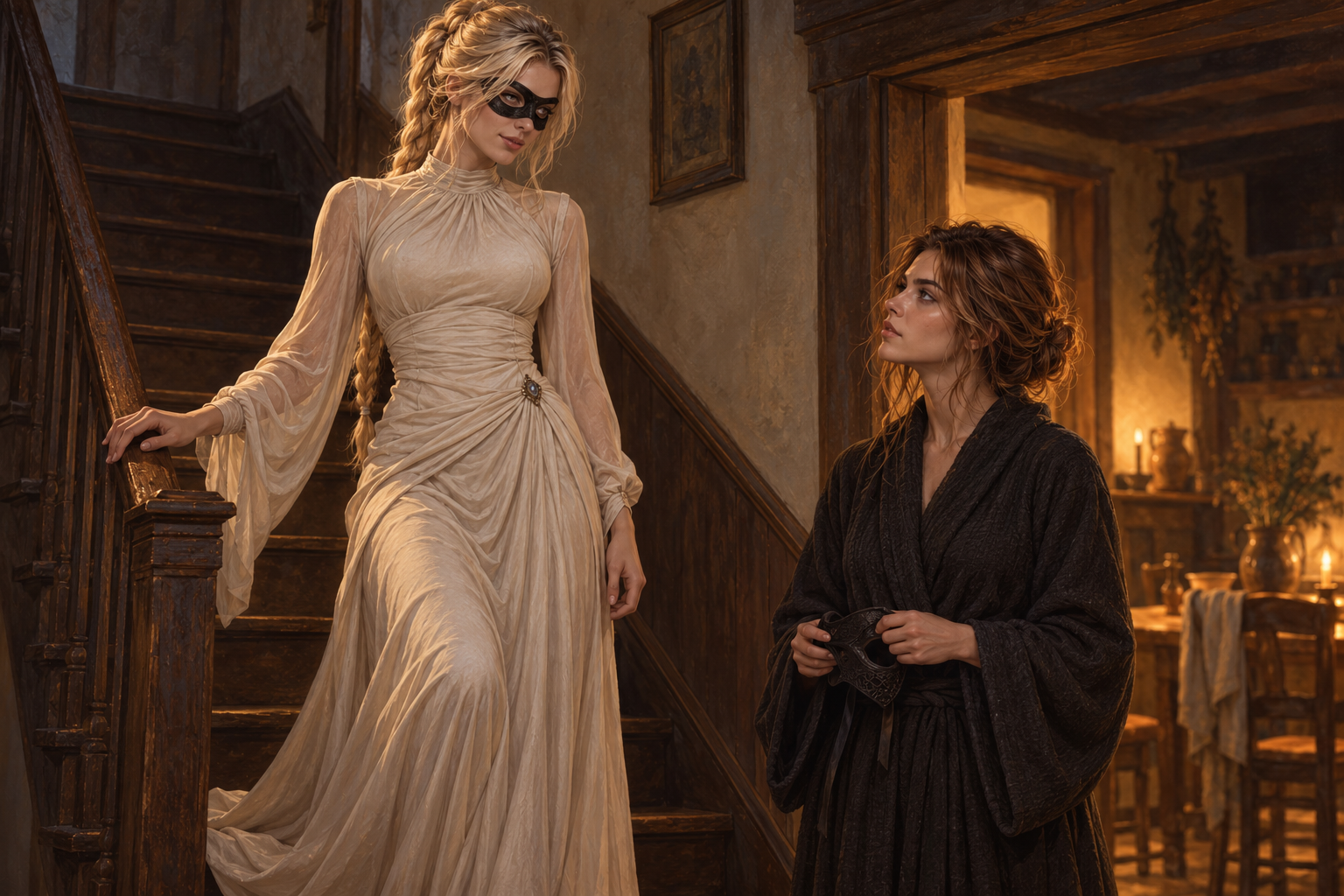
“I’m never nervous.”
“You’re always nervous,” said Mira, “for about a minute,” and crossed the kitchen slowly and put her hand flat on the side of Kyra’s face — which was Val’s gesture, under the accent, under everything — and Kyra leaned into it and shut her eyes.
· · ·
The room that was nowhere looked the way it always looked. The cream wall, the blanket over the window, taped. The lamp low and warm from the left. The two cameras locked on their tripods; the remote on the pillow; the laptop shut on its stand at the foot of the bed, because it was not live. The chair, in the middle of the floor, facing the wall.
Kyra turned the cameras on. The small red lights came up in the corner.
And they began, the way they had begun a dozen times: Kyra in the chair, upright, knees apart, bare feet flat on the floor; and Mira coming around the side of it slowly, in the pale gown, smiling, with her hand trailing along the back of the chair, and saying something low and warm and lazy in an accent from nowhere, and settling down astride Kyra’s thighs, facing her, with her whole weight coming down through Kyra’s legs into the seat.
“Hello,” said Kyra.
“Don’t, darling,” said Mira, and kissed her.
· · ·
It went the way it went, for a while.
The long road, first — Kyra’s hand between them, low down, under the pale gathered silk, making its slow patient way through all that dark — and Mira talking the whole time, low and lazy, about nothing, in that voice Kyra still could not quite get used to. And then Val came out to meet her, and they laced, there in the chair, the way they had done it in Portland a very long time ago, and Mira began to roll her hips, slow and round and continuous, the long line of her back to the camera, the braid down the middle of it, the jeweled clasp at her hip catching the lamp.
And the grip came up between them.
Kyra did not expect it to say anything. It usually did not, in a Mira video, not for a good while; it was steady and quiet and there, the way it always was, doing its work underneath, while Mira did hers above. That was how it went. Mira all the way up.
But it was not steady tonight.
· · ·
Kyra could not have said when it started. Somewhere in the slow roll of it, a long way in, with Mira’s arms locked around her neck and Mira’s forehead coming down against hers, mask to mask — somewhere in there, the grip began to change.
Not tighter. Not careful. Not the quarter-inch, the stuck feeling, the light hanging at the wrists. Something else. Something Kyra had felt perhaps a handful of times in their whole lives together and had never once felt in front of a camera.
It was reaching.
It was the grip of a woman reaching for something she could not get to from where she was. Again and again. Not are they there, not I’m stuck. Something with no words in it at all, in a channel that had never needed any.
More than this. More than this. I need — more than this.
And Kyra, with her hands on Mira’s hipbones and Mira’s slow lazy voice going on and on in her ear about nothing, felt it come up in herself too. The same thing. All at once, from somewhere very low and very old, under every mask and every name and every room they had ever been in.
She did not want Mira.
She wanted Val.
· · ·
She did not know what to do with it. That was the terrible thing. They were in the chair, on camera, in the middle of a scene they had written down on the Wednesday, with the red lights on in the corner and a story to finish. And Kyra had no word for I don’t want to be Copper any more, and no cue for please stop being her, and no stop she could use, because it was not a stop, it was the opposite of a stop. She wanted more. She wanted everything they had never once let into this room.
She held on. She did not know what else to do. She held Mira’s hips and felt the grip reaching and reaching between them, and Mira’s voice went on in her ear, lazy and warm and from nowhere —
— and stopped.
· · ·
Mira lifted her head.
She did not lift it far. Her forehead came away from Kyra’s by an inch, perhaps two, mask to mask, and she looked at Kyra through the open eyeholes, from much too close. And Kyra saw that the smile had gone. Not slid off, the way it slid off at the end of every Mira video. Gone. As if it had never been there at all.
And Val said, in her own voice — her ordinary voice, her kitchen voice, flat and level and exactly the voice she used to ask for the salt — four words.
“Can I have a word.”
· · ·
Anybody watching would have heard nothing.
That was what Kyra understood, sitting there in the chair with Val’s weight on her and Val’s eyes on hers. Anybody watching — anybody, ever, in any room on any telephone on the planet — would hear the most ordinary sentence in the language. A woman asking another woman for a word. A line, maybe, in a scene. A pause in a story. Nothing.
And it was not nothing. It was the oldest thing they had.
Can I have a word. In bed, laced, it meant the grip. In a kitchen, at four in the afternoon, at a counter, it meant come with me, let’s go and open it. It had meant those two things for longer than either of them could have counted, and they had never once had to explain it, to each other or to anybody.
And here, in this room, in a chair, with the cameras on, it meant a third thing. Kyra heard it mean it. She had never heard it before, and she knew it at once, the way she knew north.
Turn it off. I need us.
· · ·
Kyra did not hesitate.
She did not decide anything. There was nothing to decide. She reached past Val’s shoulder for the remote on the pillow — not the exposure remote, the other one — and pressed it, once, and then again for the second camera; and in the corner of the room, one after the other, the two small red lights went out.
The room was very quiet.
It was the same room. The same cream wall, the same blanket over the window, the same lamp. Nothing in it had changed at all. And it was a completely different room, and both of them knew it, and Kyra felt Val feel it — felt the whole of her, in Kyra’s lap, in the chair, let down all at once the way a held breath lets down.
Nobody was watching.
· · ·
Kyra put her hands up to Val’s face.
She did it slowly, the way Val did everything that mattered. She found the edges of the black mask with her fingertips, at the temples, and lifted it — up, and off, over the braid, and put it down on the floor beside the chair.
And there was Val. Just Val. In the lamplight, from an inch away, in a room with nobody else in it at all.
Kyra had seen that face every day of her life since a queue at the Vayr. She had seen it in every light there was. And she looked at it now as if she had never once seen it before, and could not stop.
Val put her own hands up, then, and did the same. Found the edges of Kyra’s mask, and the mesh over the eyes, and lifted it off, slowly, and put it down on the floor beside the other one. And Kyra felt her eyes go — all the way, the gold coming up in them like heat through a stove door, nothing in front of them, nothing to hide behind, nobody to hide from — and did not turn her face away, because there was nobody in this room to turn it away from, and there never had been.
“There you are,” said Val, very quietly.
It was Kyra’s line. It had always been Kyra’s line.
· · ·
Then Val reached up behind her own head and began to take out the pins.
Kyra watched her do it. One at a time, slowly, with those cool exact hands, the pins that held the braid back off her face; and then the tie at the end of it, at the bottom of her spine; and then she put her fingers into the braid itself and began, very slowly, to undo it. All of it. The whole tight length of it, the whole careful on-camera thing, the thing that changed her silhouette from behind so that nobody on earth would ever know her. Strand by strand.
It came down.
It came down over her shoulders and her back and the pale gathered silk of the gown, over Kyra’s hands on her hips, everywhere, the way it always did, the way it had on a mountain once in the spring with nothing to pin it up with, the way it had in every bed in every house they had ever had. Honey in the lamplight. Loose. Down.
The hair down is mine.
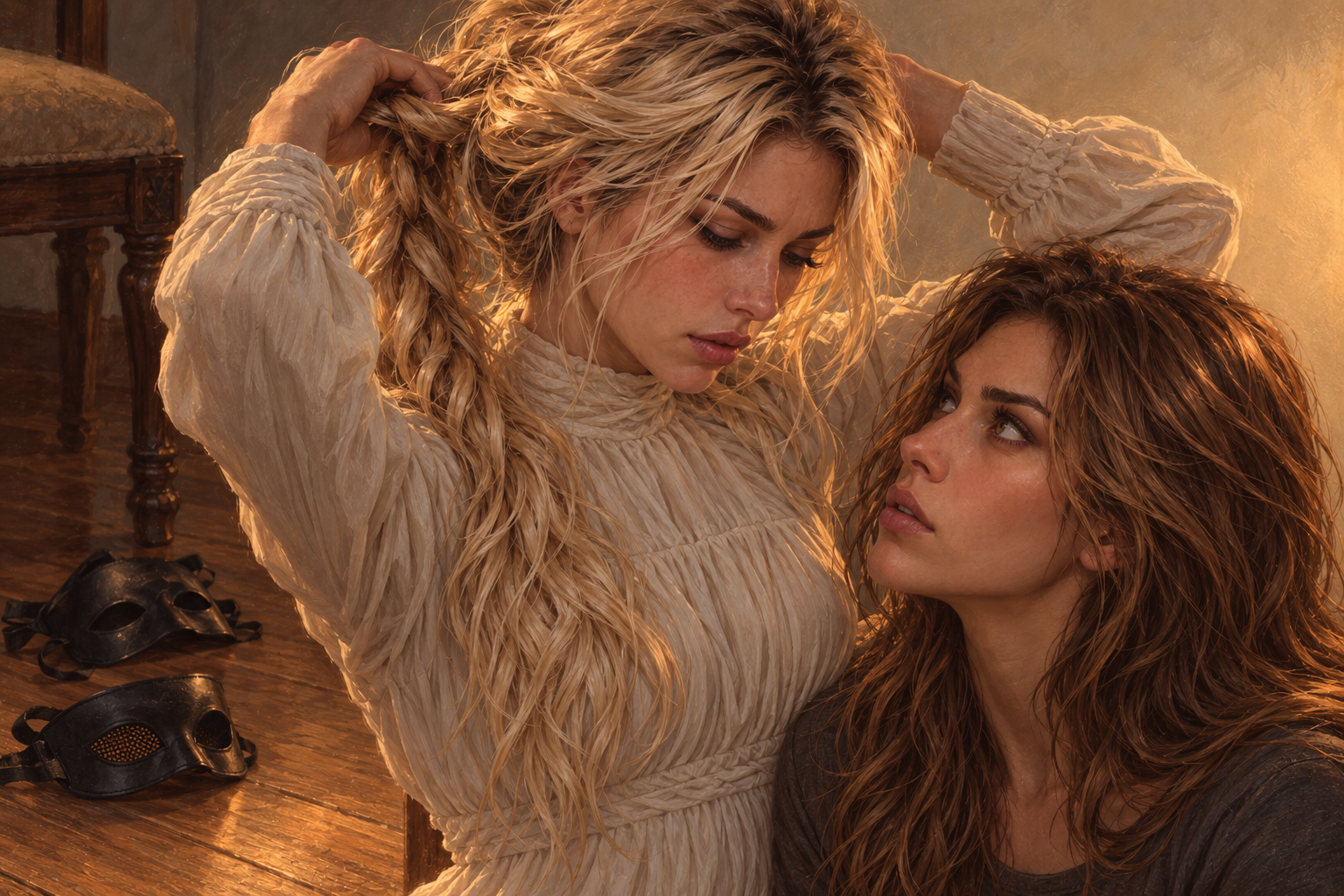
Val did not say it. She did not have to. She simply let it fall, all of it, into Kyra’s hands, and left it there.
· · ·
They did not stay in the chair.
Kyra did not remember deciding that either. Somehow they were up out of it, and the pale gown was on the floor with the jeweled clasp still pinned to it, and somehow they were on the bed, on the white sheets, in the lamplight — and not the way the cameras had ever seen them. Not from above. Not with one of them over the other and their faces a foot and a half apart.
Side on.
Hip to hip, and turned in to each other, face to face, the two of them lying on their sides on the white sheet with their legs wound together and nothing between them and no space at all. The way they had always done it. In every bed, in every house, since the snow. The way that was theirs. The one the cameras had never once seen.
Us.
· · ·
They laced like that, side on, and the grip came up between them, and it was not reaching any more.
It had arrived. It said here. It said you. It said, over and over, small and steady and certain, yes, this, here, you, and Kyra answered it, and it answered back, and for a long time that was the whole of the conversation and neither of them needed any other.
And they kissed.
That was the thing about side on. It was the only way that left both mouths free. Face to face, close, with nothing in the way, so that you could kiss the whole way through — from the beginning of it to the end of it, start to finish, without once stopping. That was why it was theirs. It was not the position. It was the kissing. It was two faces close together, and two people talking, in every channel they had, all at once, the whole way down.
Kyra kissed her for a very long time. Val kissed her back. And neither of them was anybody but who they were.
· · ·
Val’s light came up.
It came up the way it came up when there was nothing at all in the way of it — no camera, no exposure wheel, no lamp to hide in, no stranger anywhere. At the throat, and the wrists, and along the collarbones, and up under the hair at the temples, and down the insides of both arms, and through the skin of her chest — until the whole of her was lit, inches from Kyra’s face, the color of nothing on this world, and Kyra could see the bones in the hand that lay flat against her cheek.
And Kyra — with her eyes gone gold all the way, with nothing over them at all — watched it come, and felt something come up in her that had been coming up for years.
· · ·
She said it.
She did not decide to. It came up out of her the way it had always come up, at that moment, at the top of Val, in every bed since the snow — except that she had never once known it was coming. Val had told her, a long time ago, after a tape and a mirror and a couch: you say it. At the end. Every time. Without a sound. You’ve never known.
She knew now. And it was not without a sound.
“Vaelith,” said Kyra.
· · ·
Out loud. Into the half inch between their mouths. The whole name. Not Val, not sweetheart, not anything anybody in Calderveil had ever called her or ever would. The name from the other world. The name from the queue at the Vayr, from the parade hall, from the snow. The name Kyra had been saying in silence at the top of this woman for longer than most of the countries on this planet had had names — and had never once, not in all that time, said out loud, in a room, where it could be heard.
Val’s eyes came open.
· · ·
And Val was loud.
It came up out of her all at once, without any warning at all — Kyra felt it come, in the grip, a fraction of a second before, the whole of the channel between them going wide and white — and it was not the murmur. Not the low unbroken run of nothing at the end, with Kyra’s name strung through it. Not anything Kyra had ever once heard from her in any room, in any bed, in any house, on either world.
It was a sound.
Loud. Long. From the bottom of her. With her head going back on the pillow and her hair spread everywhere and her eyes open, wide, on Kyra’s, and her whole body lit — a cry that went up out of her and filled the room that was nowhere to the corners and went on, and on, and did not stop for a long time.
Kyra did not kiss it. She did not cover it. She did not do anything to it at all.
She lifted her face an inch away from Val’s and listened.
· · ·
It was the most extraordinary thing she had ever heard.
She had heard Val be quiet for longer than she could count. She had heard the murmur; she had heard the one small sound Val made with Kyra’s mouth on her breast, and the breath through the nose that stood in for a laugh, and the silence getting deeper that was how you knew. She had never once in her life heard this. She had not known it was in there. She did not think Val had known either.
And it was not for anybody. It was not for a pot of strangers’ money that had already gone to an animal shelter, or for a page full of strangers begging, or for a stranger in a kitchen with every comma in the right place. It was not on any card. It was not going out to anyone. It would never be copied, or kept, or argued about, or counted. Nobody would ever put an exclamation mark after it.
It was in a room with two people in it, and it was gone the moment it was finished, and only one person on two worlds had ever heard it.
And that was the only reason it could happen at all.
· · ·
When it was over — when the light had gone slowly down and out, last at the wrists, and the grip had gone loose and warm and quiet, and Val was lying on her side on the white sheet with her hair everywhere and her face wet and wrecked and not managing any part of itself — Kyra was crying. She did not know when she had started. She did not try to stop.
Val looked at her from an inch away.
“You said it,” said Val. Her voice was almost nothing. “Out loud.”
“So did you,” said Kyra.
Val did not answer for a while.
“I didn’t know that was in there,” she said at last.
“Neither did I.”
“I didn’t decide it.”
“I know you didn’t,” said Kyra. “I felt you not decide.”
· · ·
They did not go back to the chair. They did not go back to anything. They lay side on in the room that was nowhere with the cameras off and the masks on the floor and the gown on the floor and the lamp still burning, and nobody in the world knew where they were or what they had done; and after a long time, Kyra reached down and found the blanket and pulled it over both of them, and they slept there, laced, the way they had slept in a great many beds, with the grip at the very bottom of its range, open, and nobody transmitting.
· · ·
In the morning there was half a video on the card.
Kyra found it at the kitchen table, with the coffee going and the light coming gray through the window over the sink. Twenty-six minutes. Mira in the pale gown, coming around the side of the chair. The slow roll of the hips, the braid down the middle of the long pale back. And at twenty-six minutes, Mira lifting her head an inch from Copper’s, and the smile gone, and a woman’s voice — an ordinary voice, a kitchen voice — saying four ordinary words.
And then black.
Kyra watched it twice. Then she sat and did not do anything.
· · ·
Val came down at nine. She was wearing Kyra’s robe and her hair was down — all of it, loose, everywhere — and she sat down across from Kyra at the table and looked at the laptop, and at the black screen at the end of the twenty-six minutes, and did not say anything.
Then she reached across and turned it around to face her.
She did not watch it. She did not need to. She found the file, and looked at it, the little square with Mira in the pale gown on it and 26:14 in the corner, for some time.
And she deleted it.
· · ·
Kyra watched her do it. Two clicks, and then two more, to make sure it was gone from the place where deleted things wait. And then Val closed the laptop and put her hand flat on the lid and left it there.
“That’s the first one I’ve ever deleted because it was true,” said Val.
“I know.”
“The tape — I burned the tape because it was dangerous. Because somebody might find it. Because of what it was.” She looked at the closed laptop. “This isn’t dangerous. There’s nothing on it. A woman in a costume asking for a word, and then black. Nobody on earth could learn anything from it at all.” Her voice did not change. “I deleted it because it was true. Because it was the moment it stopped being a show. And I didn’t want that to be a thing anybody could ever watch. Not even us.”
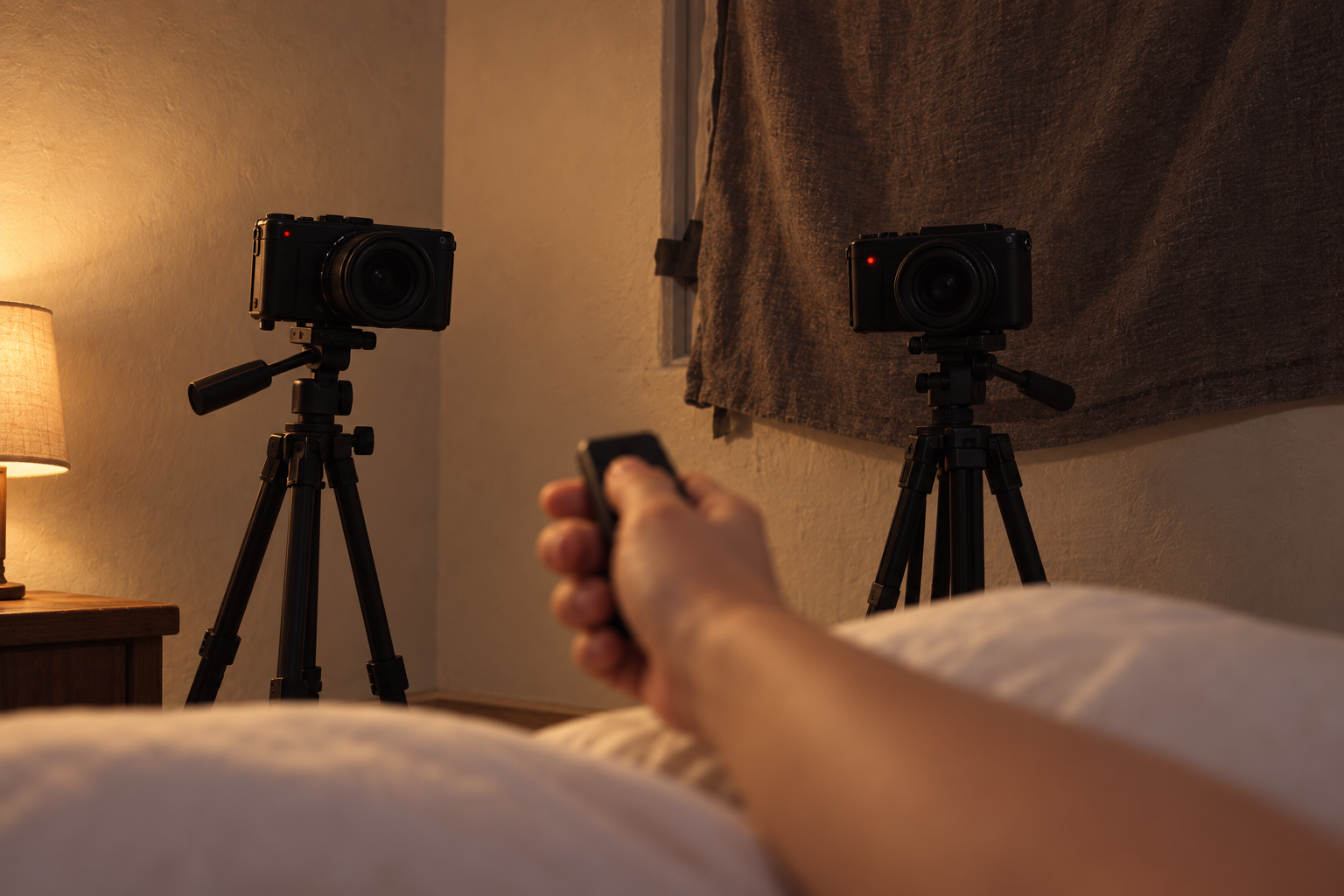
Kyra put her hand on top of Val’s on the laptop lid.
“Too true,” she said.
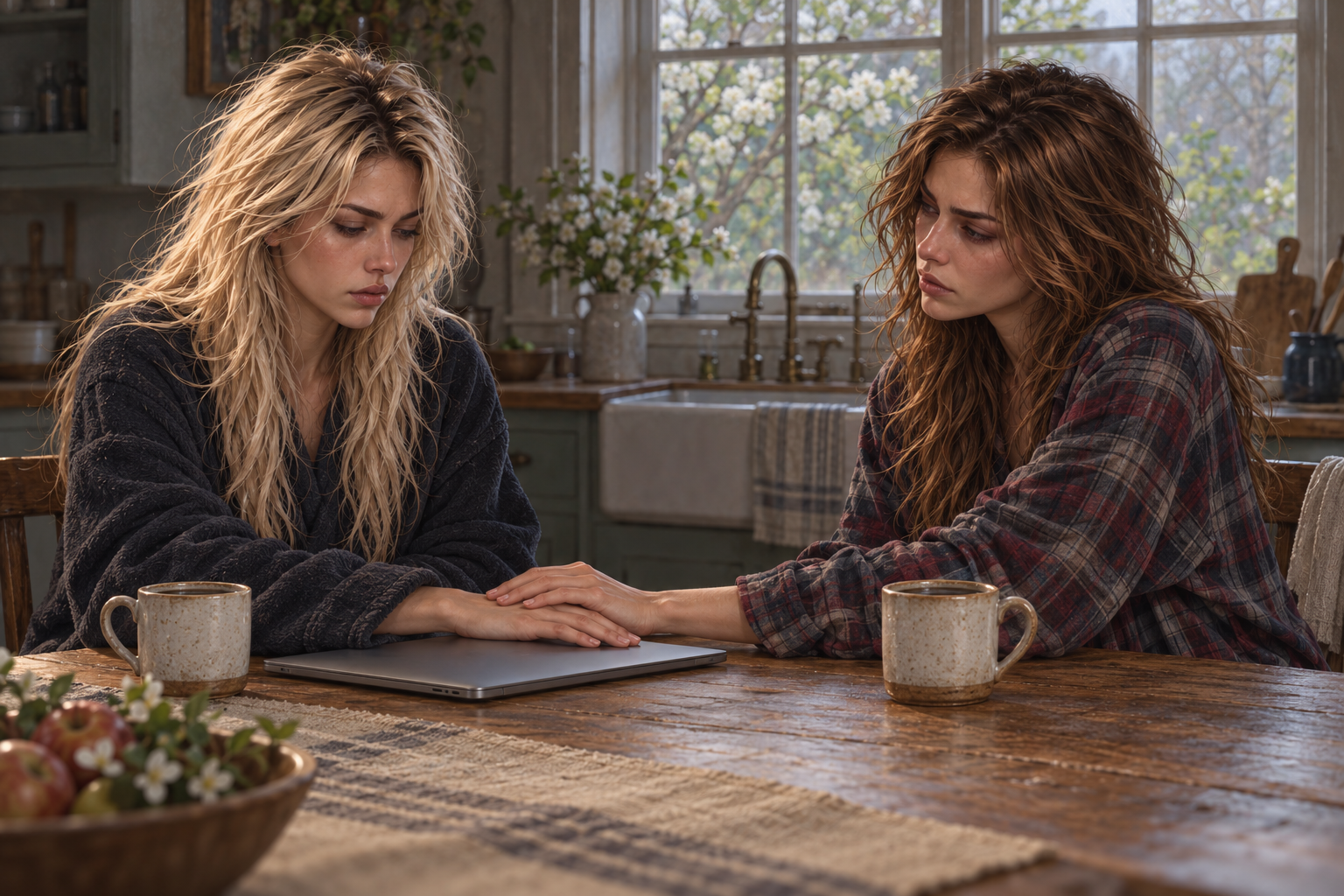
“Too true,” said Val. “Not too dangerous. Too true.” She was quiet for a moment. “I’ve never got rid of anything for that reason before. In my whole life.”
· · ·
There had been a video scheduled for the Sunday. The back room knew it was coming; Val had posted the time on the Wednesday, the way she always did. And on the Sunday, at the time, there was nothing.
Then, an hour later, a single line from the channel, under the empty space where the video should have been. Val wrote it. Kyra did not argue.
Technical difficulties. —B
· · ·
They speculated for weeks.
technical difficulties??
they’ve never missed one. not once. not ever
did something happen
is everyone ok
”technical difficulties” is the most Blondie sentence ever written, she’d say that if the house was on fire
equipment failure probably
they broke up
they did NOT break up, shut up
one of them got sick
maybe the chair finally broke lol
I bet it was something good. I bet it was something so good they couldn’t post it
that’s not how it works
isn’t it?
Tallyman’s spreadsheet, on the Sunday night, had a new row, and nothing in any of its columns but a single line in Notes.
No video. “Technical difficulties.” Status: ???
· · ·
And on the Sunday night, at twenty past three in the morning, in the private messages, from a name that had been there for a very long time, a letter shorter than any of the others.
I don’t know what happened, and I don’t need to. It’s none of my business, and I’d never ask.
But I hope it was a good night.
Let it come to you.
· · ·
Kyra read it at the kitchen table in the morning, and put the phone down, and sat for a while.
Then she picked it up again and wrote back. She did not show Val first. She did not need to; there was only one thing to say, and it was true, and it was not anybody’s business, and it could be said without giving away a single thing.
It was. Thank you. —C
— end of chapter twenty-six —
The spring everyone stayed home, into summer · both houses
The library closed on a Tuesday.
Val came home at noon with a box under her arm — the plant from the desk, the good stapler, a mug, and a sheaf of overdue notices she said she would deal with from the kitchen — and put it down on Kyra’s counter and stood looking at it.
“Two weeks,” she said. “They say.”
“Do you believe them?”
“No,” said Val, and went to put the kettle on.
· · ·
It was not two weeks.
Calderveil shut the way small towns shut, all at once and then a little at a time. The diner put a hand-lettered sign in the window, and then a second sign under the first, and then nothing. The post office let people in two at a time. The school went quiet. The road out to the coast filled up with cars from Portland every Saturday, people with nowhere else to go who wanted to stand near something large, and the fire hall’s pager went more that spring than it had in the whole of the year before, because a great many people who had never once walked up a mountain decided, all at the same time, that this was the year to start.
Kyra went out to them. She carried two down off the ridge in April and one out of a creek bed in May with a broken ankle and a sunburn, and came home each time and washed her hands for a long time at the sink, the way everybody did now, and then sat at the kitchen table and laughed about it.
“They think it’s quiet up there,” she said. “They think the mountain’s been waiting for them.”
“It has,” said Val. “Just not the way they mean.”
· · ·
They had been shut indoors by a sickness before.
Neither of them said so, the first week, but Kyra knew they were both thinking it. In Trieste, once, with the shutters closed and the bells going all day and the carts in the street at night. In Boston, with a card on the door and the windows chalked. You learned what it was like to wait in a house with the world going on outside it, and you learned what it cost, and you did not forget, however long ago it was. It was the one kind of weather that did not change.
This one was gentler, from inside. The water ran. The lights stayed on. Val had a kettle that turned itself off and a laptop that brought the whole world into the kitchen and a woman across the table who was not going to catch anything, ever, from anybody.
And the whole world, it turned out, had a laptop too.
· · ·
The ledger went mad.
Kyra did not understand it at first. She came in from the creek bed in May and Val was at the kitchen table with the gray notebook open and two others beside it, one of them new, and the laptop, and her glasses on, and the face she wore when something was very large and she had not yet decided whether it was good.
“What,” said Kyra.
“Everybody’s at home,” said Val. “Everybody in the world is at home, in a room, by themselves or with one other person, with nothing to do and nowhere to go and a telephone.” She turned the laptop around. “And a great many of them have found us.”
Kyra looked at it. The back room, the front page, the little numbers in the corner that she did not usually look at because they were Val’s. They had doubled since the library closed. They were still going up as she watched.
“Oh,” said Kyra.
“Yes.”
“That’s—”
“Yes,” said Val, and took her glasses off, and pressed her fingertips into her eyes. “I’ve started a new book.”
· · ·
The comments changed, too. Not in their manners, which were what they had always been — the begging and the capital letters and the arguments about the chair, and Tallyman with his columns — but underneath. There was a new kind of comment, that spring, and it was not about anything they did.
only thing getting me through this
another week of lockdown. I live alone. thank you for making me feel like somebody somewhere is still in a room with someone they love
I know it’s not real but it helps
my wife is a nurse and she’s sleeping in the garage so she doesn’t bring it home. we watch you on our phones on opposite sides of the door. is that weird? it’s not weird. it’s the closest we’ve been in a month
the way they hold each other. I didn’t know I missed being held like that
Kyra read that one four times. Then she put the phone face down on the table and went and stood at the window over the sink, with her back to the room, for a while.
“The nurse,” said Val, behind her.
“The nurse.”
“I read it this morning.” Val did not come and stand beside her. She knew better. “I nearly wrote back.”
“What would you have said?”
Val was quiet for a long time.
“Nothing that would help her,” she said. “That’s why I didn’t.”
· · ·
The imitators came that spring, too, as if the world being shut indoors had given everybody the same idea at once.
They had been there before — the “as seen on” chairs in the online shops, the odd channel with a blonde in a wig and a redhead out of a bottle — but now they came in a crowd. Two women in black masks on a bed with a cream wall behind it. Two women in black masks in a wooden chair. A channel called The Girls from Orion, which Kyra found on a Thursday night and laughed at until she could not breathe, and then could not stop showing Val.
“Look at the chair. Look at the chair. It’s got arms.”
“I see the chair.”
“She can’t even get her knees over it. She’s sliding off. Look at her — she’s holding on to the arms — Val, she’s going to go over backwards—”
“I see it, sweetheart.”
“And the glow!” Kyra was nearly crying. “They’ve put a lamp behind her. It’s a desk lamp. You can see the cord.”
“It’s a ring light,” said Val. “With a gel on it. Pink.” She did not laugh. She sat with her chin on her hand and watched the two women from Orion with the face she used at the reference desk for a researcher who was going in the wrong direction and was not going to like being told. “And she’s been told to roll her hips from the waist. Which nobody does, from the waist. But it reads, from the back, if you don’t know.” She reached out and paused it. “They’ve studied us.”
Kyra wiped her eyes. “They’ve studied us badly.”
“They’ve studied us,” said Val. “Every one of these is somebody who sat in a room for hours with our videos, with a notebook, and tried to work out how it’s done. Most of them got it wrong. Some of them got a little bit of it right. And every one of them who gets a little bit of it right is a person who now knows more about us than they did before. I don’t mind them. I want to be clear. I think they’re good for us. Every masked blonde in a chair on this planet is one more place for us to hide. Enough of them, and nobody can find us in the crowd.” She looked at the frozen screen, the pink light, the desk lamp’s cord. “But they’re looking. That’s all. They’re looking very hard.”
Kyra looked at the women from Orion for a while.
“I still think the arms are funny,” she said.
“The arms are very funny,” said Val. “I’ll give you the arms.”
· · ·
In June the money stopped.
Not theirs. Everybody else’s.
It happened the way those things happened, which was overnight and all at once and with a statement from a company in a city a long way away that used the word partners six times and did not say anything at all. The card companies were done with sites like SubRosa. Or the banks were. Or somebody behind the banks. It was never quite clear, and it did not matter, because the result was the same: on the Monday, a great many people who had been paid for their work on the Friday found that they could not be paid for it any more.
The comments filled up with it. The performers’ pages filled up with it. Women Kyra had never heard of, with their faces and their names on, writing long careful posts about rent, and children, and I don’t know what I’m going to do, and this is my job, this has been my job for years, and they never even told us.
Kyra read them at the kitchen table, one after another, with her coffee going cold, and thought about Roz in Las Vegas, and the girl in the pink wig, and the couple who had taken two years to get their nights back.
And then she looked up at Val, at the other end of the table, who was reading the same posts on her own screen with her own coffee going cold; and who had not, at any point that morning, opened the page that would have shown her what had happened to their own money.
“It’s fine,” said Kyra slowly. “Isn’t it. Ours.”
“Ours is fine.”
“Because it was never in a bank.”
“Because it was never in a bank,” said Val. “Or a card. Or anything anybody in an office can switch off on a Monday because they’ve had a meeting.” She did not look up from the screen. “It’s in a ledger. Nobody can close a ledger.”
Kyra looked at her.
“You knew,” she said.
“I didn’t know.” Val turned a page on her screen, and read, and did not stop reading. “I didn’t know it would be this summer, or this company, or this word in their statement. I didn’t know it would be partners.” She paused. “I knew it would be something. It’s always something. I’ve seen banks close in three countries, Kyra. I’ve stood in the line outside. You don’t trust the door to stay open just because it’s open today.”
“You did it the first winter. When everybody laughed.”
“Including you.”
“Including me,” said Kyra. “I said you were very strange.”
“You said I was very strange,” Val agreed, “and then you put your feet on my legs.” She reached out and closed the laptop on the women and their long careful posts, gently, as if she were closing a door on a room where somebody was sleeping. “I’m not proud of it. I’m sorry for them. Every one. They did nothing wrong except believe the door.” She put her hand flat on the lid. “We were lucky. That’s all. We were lucky, and I’m old, and old is a kind of luck, if you live through it.”
· · ·
They gave a share to a fund that week, one of the ones the performers had started for each other. Val did it without a name, which was the only way they did anything. Kyra did not ask how much. She did not need to; she could see it in the way Val wrote the line in the gray notebook, small and level and final, and underlined it, and closed the book.
· · ·
And then, as if the outside world had decided that it had shut them in long enough and might as well come knocking, the offers came.
There had always been offers. Agencies, mostly, with emails that began Hi ladies! and promised them a great deal of money for their names. Val had a reply for those, and it was one word long, and she sent it without reading past the first line. But that summer — the summer the world stayed home and the imitators came and the banks shut the door — the offers changed. They got better. They got more serious. They came from people who used their own names and had lawyers.
The first was from a company in California that made toys.
· · ·
It came to the channel’s address in July, and it was very polite, and very long, and Kyra read it aloud at Val’s kitchen table with her feet up on the other chair, doing all the voices.
“We have long admired the creative and technical excellence of your content,” she read, “and in particular the remarkable motorized device featured in several of your most popular videos — that’s the rig, Val, that’s what the comments call it — which our design team considers one of the most influential products in the category that has never actually been a product.” She looked up. “They want to make it.”
“I gathered.”
“They want to make the rig. Properly. In silicone. With our name on the box. The Andromeda, they want to call it. Isn’t that lovely? The Andromeda. And there’s a paragraph here—” she scrolled “—about a premium edition, faithful to the original in every dimension.” She was beginning to laugh. “Val. They don’t want a toy. They want the replica.”
Val put her cup down.
“They want,” Kyra said, “to mass-produce Aro. In a factory. In California. With a little motor and two dials and the blue in it, glow-in-the-dark, they say, which is not even — Val, they want to sell him in boxes—”
She could not go on. She put her face down on her arms on the table and laughed until the table shook, and Val, across from her, sat and looked at the ceiling with an expression Kyra had seen perhaps a handful of times in their whole lives, which was the expression of a woman deciding whether something was the safest thing that could ever happen to them or the most insulting.
“It would be very funny,” Val said at last.
“It would be the funniest thing that’s ever happened on this planet.”
“Every shop in the country with a back room,” said Val, slowly. “A copy of a Sethal man at full extension, made to his exact figures, in a box, on a shelf, next to the ones shaped like dolphins. And nobody on earth would know what it was. Not one person. They’d buy it for a laugh. They’d buy it for a dare. They’d give it to each other at bachelorette parties.” She shut her eyes. “And it would be the safest thing in the world for us, because the minute it’s on a shelf, it’s a product. It isn’t a specimen any more. It’s a product somebody designed, with a patent, and a lawyer, and a sticker on the bottom saying where it was made. Nobody looks at a product and asks what it was copied from.”
“So yes.”
“So no,” said Val, and opened her eyes.
· · ·
Kyra took her face off her arms.
“No?”
“Read me the last page.”
Kyra scrolled to the last page. She read it. She read it again, more slowly, and the laugh went out of her face a little at a time.
“To proceed,” she read, “we will require a standard licensing agreement, executed by both parties in their legal capacities. Payment will be made to a registered business entity or to the individual rights-holders. We are, of course, happy to discuss confidentiality provisions—”
“Legal capacities,” said Val. “Registered entity. Individual rights-holders.” She picked up her cup. “A contract means names. It means a signature, and a signature means a name, and a name means a person in a town in Oregon who works at a library and a fire hall, and a lawyer in California who has her name in a file in a drawer, and the file is in a building, and the building has a cleaner, and an intern, and a server, and the server has a password, and one day somebody leaves a laptop on a train.” She drank. “Confidentiality provisions are a promise made by people who will be dead, about a drawer that won’t be.”
Kyra did not say anything.
“I’m sorry,” said Val. “I know you wanted it.”
“I wanted it for the joke.”
“I know.”
“It would have been such a good joke.”
“It would have been the best joke anyone has ever made on this planet,” said Val. “And the two of us would have been the only two people alive who got it.” She put her cup down. “We’re the only two who get it now. We don’t need a box for that.”
· · ·
The second offer came a week later, from a furniture company in North Carolina, and it was for the chair.
The Seventeen, they wanted to call it. An armless wooden chair, upright back, seventeen inches from the floor to the seat, in oak or walnut or cherry, with a little brass plate under the seat that said As Seen On The Girls from Andromeda, and a card in the box with Val’s sentence printed on it in a nice serif: The rest is technique.
Kyra did not laugh at that one. She read it at the kitchen table with her chin in her hand and a strange expression on her face, and then she read it again.
“They want to put your sentence in a box,” she said.
“I saw.”
“The rest is technique. On a card. In a nice typeface.”
“It is a nice typeface,” Val said. “I’ll give them that.”
Kyra was quiet for a while.
“The chair came with a house in Portland,” she said at last. “The real one. Nobody paid anything for it. It held magazines. You kept wanting to leave it on the curb.” She looked at the screen. “And now they want to make a factory full of them in North Carolina, out of cherry, with a brass plate.”
“With a brass plate,” said Val. “Which would say our name on it. In a factory. On a contract.”
“I know.”
“I know you know.” Val reached across the table and put her hand over Kyra’s. “Say it, though. I want to hear you say it.”
Kyra looked at the screen, and the cherry chair in the photograph, with its little plate, and the card in the nice serif. Then she looked at Val’s hand on hers.
“A contract means names,” said Kyra.

“A contract means names,” said Val, and took her hand back, and wrote the reply. It was one word long.
· · ·
There was a last thing, that summer, and Kyra would remember it longest.
It began in the comments, the way most things began. A word that started turning up under the videos in the spring, here and there, and then more often, and then all the time.
this is AI
nobody moves like that. it’s generated
the glow is 100% AI, look at the edges
I’ve been saying this for months. there are no girls. it’s a render
you can tell by the hands
the hands are fine, YOUR hands are AI
if this is AI I don’t want to know
The machines had arrived that year, or that was how it seemed from a kitchen table in Calderveil. Programs that could take a face from one video and put it on a body in another, and make a voice say what it had never said, and stitch a whole person together out of pieces of other people. Half the world was frightened of them, and the other half was arguing about them, and all of it, every word, ended up in the comments under two women in a wooden chair.
Kyra hated it. She did not know why, at first. She read there are no girls and felt it in her stomach, the way she had felt nobody’s that pretty the very first winter; a door shutting on her in a room with a witness.
Val, on the other hand, was delighted.
“It’s the best cover we’ve ever had,” she said. “It’s better than the fog. Better than the imitators. Better than the masks.” She was reading the comments on her phone in bed, with her glasses on and her hair down, and she was very nearly smiling. “From the very first video, the problem has been that one day, somebody would look at the light, carefully, for long enough, and know it wasn’t a filter. And now there’s an answer to that, ready-made, that everybody on the planet already believes. It’s AI. Whatever it is, whatever you can’t explain, whatever’s too perfect, too strange, too right — it’s AI.” She put the phone down on her chest. “Nobody has to understand us any more. They only have to shrug.”
“I don’t want them to shrug.”
“I know you don’t.”
“I want them to see us.”
“I know.” Val turned her head on the pillow. “And they do. The ones who matter. LongExposure isn’t writing to a render.” She was quiet a moment. “But I’ll take every shrug I can get, sweetheart. Every one is a wall.”
· · ·
She did something about it, too, quietly, in the way she did everything.
She stopped correcting them. In the first years, when somebody under a video said filter or oil or LED rig, Val had sometimes — not often — written a line underneath, signed B, dry and level, saying nothing in particular: No filter. Or: Just a lamp. Never an explanation. Only enough to keep the record honest.
She stopped. When somebody wrote this is AI, Val read it, and wrote nothing at all. And when Tallyman wrote, in a long and indignant comment, that he had personally timed every video for years and he could assure everyone there was nothing artificial about them, I have the spreadsheet, Val read it, and smiled, and did not reply to him either.
“You’re letting them think it,” said Kyra.
“I’m letting them think whatever they like,” said Val. “I always have. I’ve just stopped helping them think the true thing.”
· · ·
And then in August somebody made one.
· · ·
It turned up on a site Kyra had never heard of and then on six more by the end of the week, the way everything did. A video, with their title on it — Copper and Blondie, and the channel’s name, misspelled — and two women in black masks in a wooden chair, against a cream wall.
It was not them.
Kyra knew it in the first second. Then she watched it, because she could not not watch it, at the kitchen table at one in the morning with the sound turned low, and it was the strangest thing she had ever seen.
They had got so much of it right. The masks. The braid. The cream wall, near enough. The redhead in the chair with her knees apart and her feet flat on the floor, and the blonde astride her, facing her, rolling her hips in that long slow circle. A machine had watched them, all of them, every video, and learned them. It knew how Kyra put her hands on Val’s hipbones. It knew the angle of Val’s head. It knew the chair.
And it had got everything that mattered wrong.
The chair was too tall — Kyra could see it in the line of the redhead’s thighs. The blonde’s hands moved like water, like something poured, and Val’s had never once in her life moved like that; Val’s hands were exact. The redhead’s eyes behind the mask were a color, a warm brown, because the machine had never been shown them and had not known what to put there. And the light—
The light was gold.
The machine had been shown a woman with a gray glow around her, in every video, and it had decided she ought to be a color, and the color it had chosen was the only color it knew for a woman lit from inside. It was Kyra’s color. It was a soft and pretty gold, all over, like a sunset in an advertisement, and it was on the wrong woman, and it was wrong.
And at the end — Kyra sat very still — at the end, the blonde was loud.
· · ·
Not the way Val had been loud. Nothing like it. A long, high, careful sound, the way a woman is loud in a film; the way the machine had learned from every other woman in every other room it had ever been shown that a woman was supposed to be loud at the end. It went on exactly as long as it was supposed to go on. It rose exactly as it was supposed to rise. It was a perfect sound, and there was nobody in it at all.
Under it, in the comments on that site, somebody had written: FINALLY. Blondie screams. Somebody tell the Accountant the pot’s been won.
· · ·
Kyra did not wake Val. She sat at the table until the sky went gray over the sink, and then she made the coffee, and when Val came down at seven she turned the laptop around to her without a word.
Val watched it standing up, with her hand on the back of the chair. She watched all of it. Kyra watched her watch it — the long patient face, the glasses, nothing moving at all — and when the blonde on the screen was loud, Val’s face did not change in the slightest. Only her hand on the back of the chair went tighter on the wood.
It ended. Val stood for a while.
“They made me loud,” she said.
“I know.”
“And they made me gold.” She sat down, slowly, across from Kyra. “They gave me your color. Out of everything.” She looked at the frozen screen, the pretty sunset glow, the warm brown eyes behind the redhead’s mask. “That’s almost the funniest part.”
“It isn’t funny.”
“No,” Val agreed. “It isn’t.” She took her glasses off. “It’s ours, though. Isn’t it. Everything they got wrong.”
Kyra did not understand.
“Everything they got wrong,” Val said, “is exactly the thing they’ve never seen. The color of my light. The color of your eyes. How tall the chair is. The way my hands go. How I sound—” she stopped. Started again. “How I sound when I’m loud. A machine went through every frame we’ve ever made and learned everything there was to learn, and the only things it couldn’t learn are the only things that were never in the frame. That’s the whole list, Kyra. That’s everything that’s ours. The machine just wrote it down for us.”

· · ·
Kyra wanted to take it down. She wanted to write to every site it was on and make them take it down, and to write underneath it, in capitals, THIS IS NOT US, and to write underneath the pot’s been won something that would make whoever wrote it never write anything again.
Val would not let her.
“Leave it.”
“It’s got our name on it.”
“It’s got a name on it. Misspelled.” Val was quiet a moment. “Leave it, sweetheart. Let it go around. Let a million people watch it and say see, I told you, it’s AI. Let them decide that’s what Blondie sounds like.” She reached across the table and turned the laptop around, gently, back to face Kyra, and shut it. “It’s a wall. The best one yet. And behind it—”
She stopped.
Kyra looked at her across the table. The gray light coming in over the sink. Val’s hair still down from bed, all of it, loose.
“Behind it,” said Kyra, “there’s a room nobody can find.”
“Yes.”
“Where you were loud once.”
“Once,” said Val. Her voice did not change. “And nobody heard it but you.”
· · ·
Tallyman’s spreadsheet, that week, had a new row at the bottom, under the averages and the records and the pot, and he had put it in red, which he had never done before.
”Blondie scream” video circulating — FAKE. Not on channel. Not in ledger. Do not count.
Status of pot: still waiting.
— end of chapter twenty-seven —
Autumn · Kyra’s kitchen, and the room that was nowhere
Kyra found it on a Sunday, at the kitchen table, with her feet on the other chair and a bowl of cereal going soft in her lap, and for the first ten minutes she could not stop laughing long enough to tell anyone.
There was nobody to tell. Val was at her own house, doing whatever Val did on Sunday mornings, which as far as Kyra could tell was ironing things that did not need it and reading the obituaries in three newspapers. So Kyra laughed alone, at her own table, at a page on her phone, until the cereal was past saving.
Then she called her.
“You have to come over.”
“Is something on fire?”
“No. Yes. Sort of. Somebody’s made a wiki.”
There was a pause on the line.
“Of what,” said Val.
“Of you,” said Kyra, and started laughing again.
· · ·
It was not only of Val. To be fair to it, it was of everything.
It had been going for a while, it turned out, quietly, somewhere off to the side of the comments, the way a great many things did on the internet: a fan wiki, built by strangers, for strangers, with pages. A page for every video, front room and back room, with the date it went up and the length and the costume and what happened in it, in a flat neutral prose that tried very hard to sound like an encyclopedia and did not always manage. A page for the chair, with photographs of every chair anybody had ever bought trying to match it and a section headed Why None Of These Are Right. A page for the pink ones. A page for seventeen inches, with a history of the phrase, and a page for the rest is technique, and a page for It’s worth it., with a list of every comment in which somebody had said it.
A page for Tallyman, which Tallyman had clearly written himself.
A page for the golden syrup show, which was very long and had footnotes.
And a page, near the top of the list, in a slightly larger type than the rest, that said:
The Glow Index
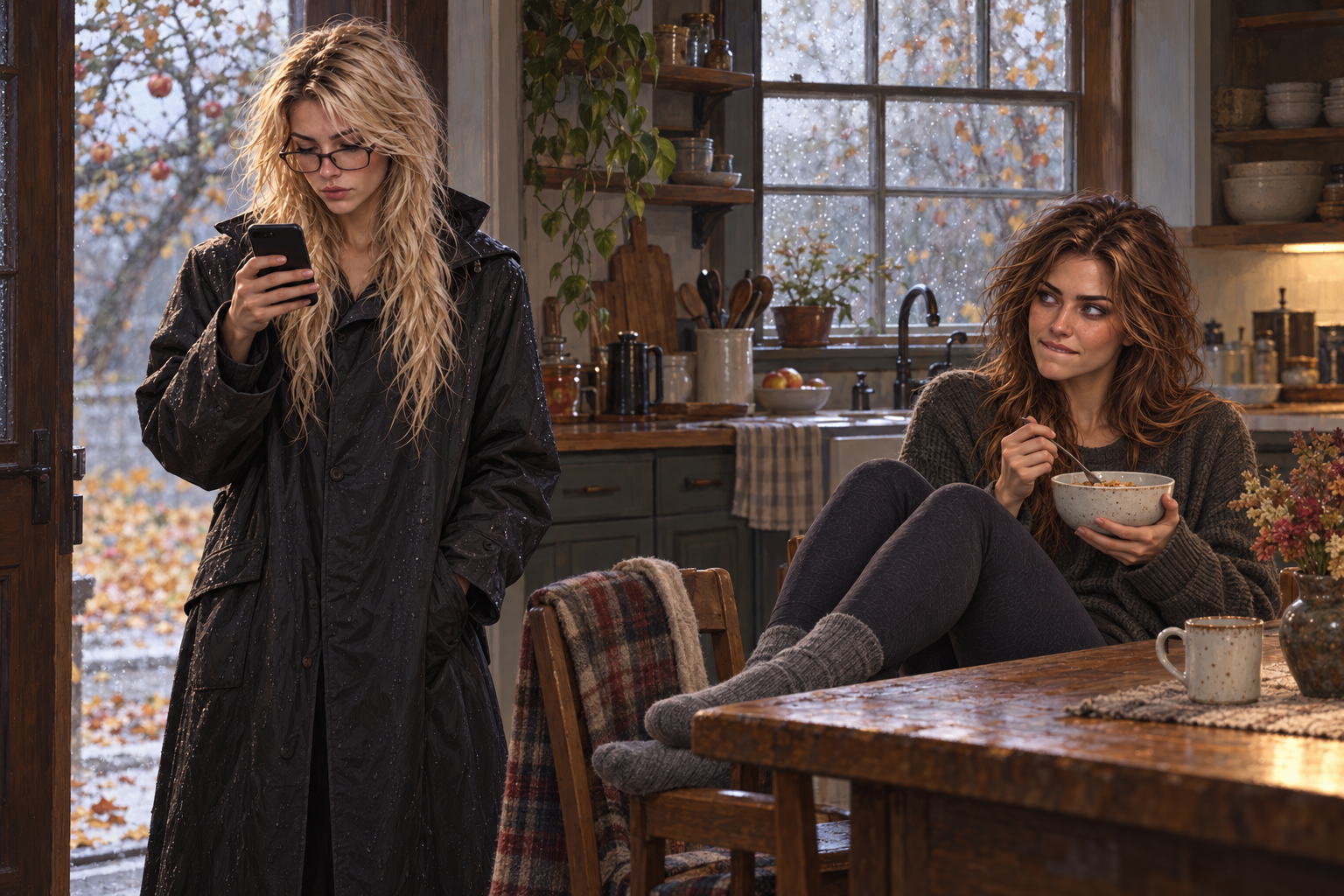
· · ·
Val read it standing up in Kyra’s kitchen with her coat still on.
Kyra watched her read it. She had read it three times herself by then and had it more or less by heart, and she watched Val’s face go down the page the way she had watched it go down every important page for longer than either of them could count: perfectly still, the eyes moving, nothing else at all.
The Glow Index is a community ranking of every published video by the visible intensity of Blondie’s glow, from 0 (none) to 10 (maximum). Scores are averaged from at least five independent raters per video, plus a luminance reading from the frames at peak, measured by user lux_aeterna using software he wrote for the purpose (see Methodology).
Note: Copper is not rated. Her mask has mesh over the eyes.
Below that, a table. Every video they had ever made, in a long column, with a number beside each one, and a little bar beside the number, shaded from gray to white. Kyra had sorted it from top to bottom twice and from bottom to top once, and she had laughed until she had to put her head down on the table at the sight of the bar beside the replica video, which went all the way across the page and off the end of it and had a footnote, which said only: lol.
Val reached the bottom of the page. She scrolled back to the top and read it again.
Then she took her coat off and sat down at the table and put the phone face down in front of her, and did not say anything for a while.
· · ·
“It’s funny,” said Kyra. “Isn’t it?”
“It’s very funny.”
“Software he wrote for the purpose.”
“I saw.”
“He’s measuring you in lux.”
“He’s measuring a gray smudge on a phone video in lux,” Val said. “That isn’t a measurement. That’s a man with a ruler measuring a shadow.” She did not pick the phone up again. “But yes. It’s funny.”
She did not laugh. Kyra had not really expected her to.
· · ·
The arguments were funnier than the index. Kyra read them aloud that week, at both kitchen tables, doing the voices, with her feet up.
There was a page on the wiki called Theories, and it was the longest page on the site after the golden syrup show, and it was a war.
Theory 1: It’s the lamp. The glow was a lighting effect. The lamp was moved between videos. On bright nights it was closer.
Rebuttal: Somebody had gone through every video frame by frame and plotted the lamp’s position from the shadows on the cream wall, and the lamp had not moved since the very first video. It’s on the left. It’s always on the left. It’s the same lamp. This person had also, on a separate page, identified the lamp, and was wrong.
Theory 2: It’s a filter, applied in the edit, and they vary it on purpose. To make the good videos seem better.
Rebuttal: Then why would they ever put out a low one?
Theory 3: Body temperature. The glow was some kind of thermal effect picked up by the camera. On cold nights there was less.
Rebuttal: People had checked the weather in Oregon against the dates on the videos. There’s no pattern. Somebody else: how do you know they’re in Oregon. Somebody else: the chair guy said. Somebody else: the chair guy said Oregon OR Washington.
“They checked the weather,” said Kyra.
“I heard.”
“In Oregon. Against our dates.”
“I heard you the first time, sweetheart,” said Val, and turned a page of the newspaper she was not reading.
Theory 4: It’s her cycle. Somebody had tried to plot the glow against a monthly calendar and had produced, Kyra had to admit, a very handsome graph with nothing on it.
Theory 5: AI. It was always AI. There was a link to a long page about the AI fake, with a section headed Why The Fake Glow Is The Wrong Color, and a separate argument about what color it should have been, which ran for pages and which nobody could win, because nobody had ever seen it.
Theory 6: She glows when she’s happy.
· · ·
Kyra stopped reading aloud at that one.
It was short, Theory 6. It had been added late, by somebody who had not edited anything on the wiki before, and it had been argued with, and argued down, and marked [citation needed] in three places by lux_aeterna himself, and it had very nearly been taken off the page. And it said, in its entirety:
I don’t think it’s the lamp or the filter or the temperature. I’ve watched every video more times than I want to say. I think it’s just that she glows most when she’s actually into it. When it’s real. When she’s not thinking about the camera. The low ones are the nights she’s thinking about the camera. That’s all it is. It’s not a mystery. It’s just a person.
Kyra read it to herself twice. Then she looked up.
Val was reading the newspaper.
“Val.”
“I heard you stop.”
“Did you read this one?”
“Yes,” said Val, and turned a page.
· · ·
It might have stayed there, Theory 6, with its three [citation needed]s, and been argued about forever, the way everything was argued about. It did not stay there.
lux_aeterna tested it.
He was, Kyra was coming to understand, a very particular kind of man — the kind who would rather prove you right than let you be right without proving it — and he had software, and he had time, and he had, by his own account on his own page, every video downloaded and backed up in three places. And he wrote, two weeks later, at the bottom of Theory 6, a long careful paragraph with a chart in it, that began I owe the author of this theory an apology.
He had gone back through every video and marked, by hand, what Copper was doing in the minute before Blondie’s peak. Not what Blondie was doing. What Copper was doing. The positions. The pace. Her hands. And whether she was talking.
Copper talks in almost every video, he wrote. Mostly you can’t make out the words under the music. But you can tell when she’s doing it, and you can tell the difference between loud and soft.
Here is the result. It’s not subtle.
The brightest glows on the whole index — every video above an 8 — are videos where Copper is talking to her softly, the whole way through. Not loud. Not dirty talk. Just talking. Low. Close to her ear. For a long time before the peak and right up to it. Every single one.
The lowest glows are the videos where she isn’t.
I don’t know what she’s saying. Nobody does. But whatever it is, Blondie lights up for it like nothing else in the whole channel. Brighter than for any position, any costume, any toy. Brighter than the replica, almost. It’s the single biggest predictor of glow on the index and it isn’t close.
So Theory 6 is right, and I was wrong, and I’m marking it Confirmed. It’s not the lamp. It’s her.
It’s how she feels about the redhead.
· · ·
Kyra read it on her phone on the ridge trail, on a Tuesday, at the top of a climb, on the way down from looking for a man who had turned out to be perfectly fine and sitting in his car.
She sat down on a rock to read it. She read it twice. Then she stood up and came down the mountain faster than she had any business coming down a mountain, and drove to the library, and went in, and stood at the desk.
Val looked up from the computer. She took one look at Kyra’s face and took her glasses off.
“I saw it,” she said.
“Did you—”
“I saw it this morning.” Val put the glasses down on the desk, folded. A man was waiting with a pile of books behind Kyra, and Val looked past her at him, and said, in her county voice, perfectly level, “I’ll be with you in just a moment, Mr. Haskins,” and then she looked back at Kyra. “Not here.”
“Val—”
“Not here,” said Val, very quietly. “Please.”
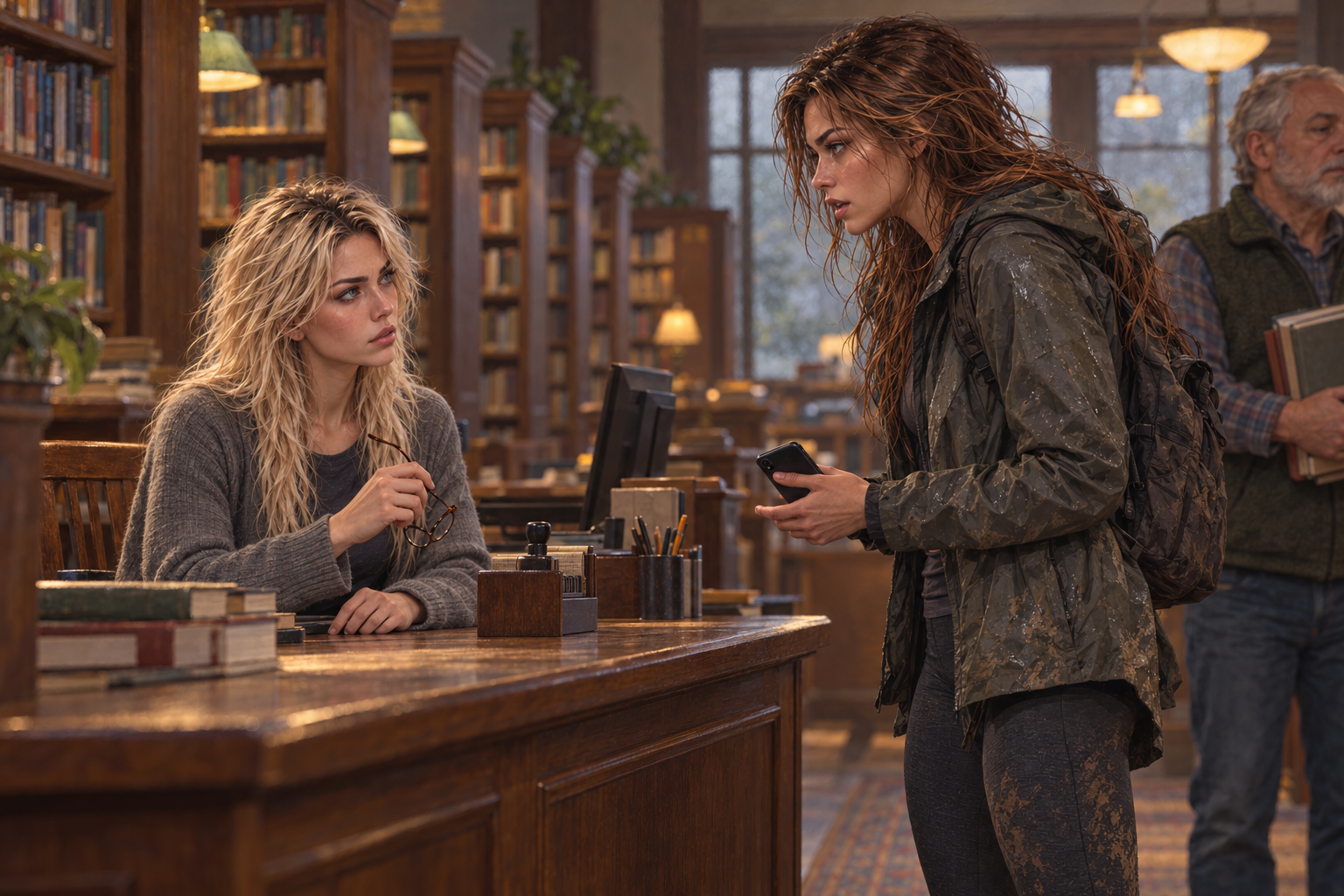
· · ·
She came to Kyra’s house at six. She did not take her coat off. She sat down at the kitchen table in it, the way she had the first morning, and Kyra sat down across from her and waited.
It took a long time.
“I want to be clear,” Val said at last, “that it isn’t wrong.”
“I know it isn’t wrong.”
“It’s right. He’s right. That person — whoever wrote it — is right, and he’s right to have marked it Confirmed, and his chart is right, and if I’d done it myself I’d have done it the same way and got the same answer.” She was looking at the table. “That’s the whole trouble. It isn’t a theory. It’s a measurement. Somebody’s measured it.”
“Measured what?”
Val did not answer.
“Say it,” said Kyra gently.
“How I feel about you,” said Val.
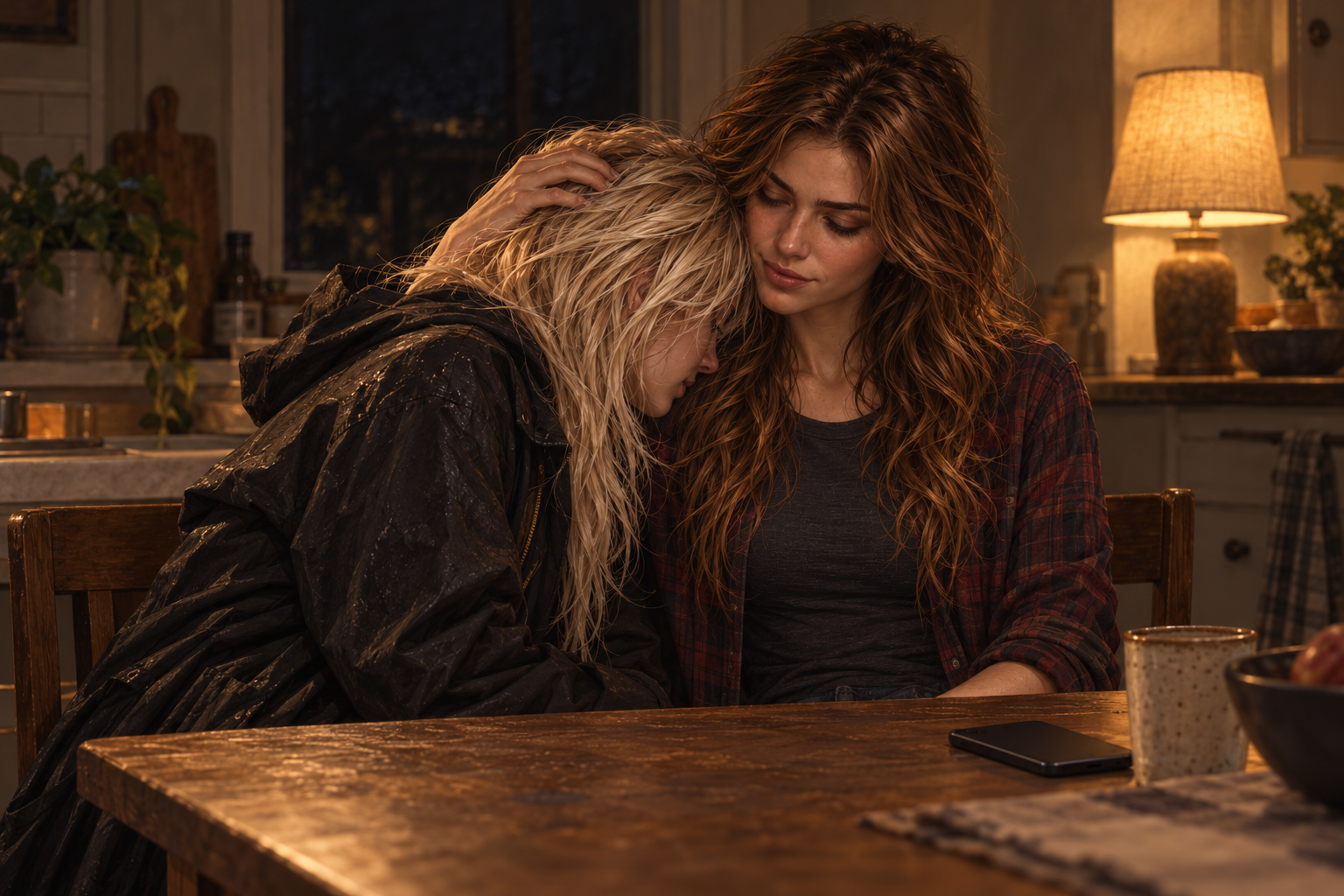
· · ·
Kyra did not say anything. She thought, if she said anything at all, she would get it wrong.
“I have kept a record,” said Val, “of every important thing that has ever happened to either of us since a queue at the Vayr. I’ve kept it in my head and in books and in a cardigan pocket, and I’ve kept it straight, and I’ve kept it private, and I have never once in all that time let anybody else write in it.” She turned her hands over on the table. Looked at them. “And now there’s a page. On the internet. With a chart on it. A man with a piece of software and a downloads folder has drawn a graph of how much I love you, and it’s correct, and anybody in the world can read it, and I can’t take it down.”
“It doesn’t say love.”
“It says how she feels about the redhead,” said Val. “With a chart. And a footnote.”
· · ·
“I knew they’d see the light,” Val went on. “I’ve always known. From the very first video. I knew one day somebody careful would look at it long enough to know it wasn’t a filter — and I was ready for that, I had the AI, I had the fakes, I had wall after wall.” She stopped. “I wasn’t ready for this. I never once thought they’d work out what it was for.”
“What it’s for,” said Kyra slowly.
“It’s for you.” Val looked up. “It’s always been for you. It comes up for feeling and nothing else, and the feeling it comes up for, every time, the brightest it’s ever been — it’s for you. When you’re talking to me. When you’re close. When you’re saying whatever you’re saying. I’ve known that since the snow. You’ve known it since the snow.” She put her hand flat on the table. “And now they know. Strangers. And they didn’t have to be told. They worked it out. From outside. Through a gray smudge on a phone. With a ruler.”
· · ·
Kyra got up and came around the table and sat down in the chair beside her, close, and did not touch her. She knew better than to touch her yet.
“Can I say something?” she said.
“Yes.”
“I’m not sorry they know.”
Val shut her eyes.
“I know you are,” said Kyra. “I know it’s the worst thing. I know it’s a record, and it’s yours, and it’s in somebody else’s hand. I know all that.” She was quiet for a moment. “But you’ve done that to me since the day we met. You’ve had me catalogued since the parade hall. The jaw. The wrists. The third breath and not the second. You can look at me from across a room and tell me what I’m feeling before I’ve finished feeling it. You always could.” She leaned in a little. “And I never minded. Not once. Because it meant somebody saw.”
“That’s different.”
“Why?”
“Because it’s me,” said Val. “It’s one person. It’s the person you’d want.”
“And this is half the internet,” said Kyra, “who’ve worked out, from a gray smudge, that you love me more than anything you’ve ever had. And wrote it down. And put a chart under it so nobody could argue.” She smiled, a little crookedly. “Val. That’s the best thing anybody’s ever written about us. That’s the best thing anybody’s ever written about anything.”
· · ·
Val did not answer for a long time.
Then she opened her eyes and looked at Kyra from very close, and Kyra saw that her face, for once, was not managing anything at all.
“You’re delighted,” said Val.
“I’m delighted.”
“You’re sitting there absolutely delighted that the whole internet knows I glow for you.”
“Brighter than the replica,” said Kyra. “Almost.”
And Val, against everything, made the small breath through the nose that stood in for her laugh, and put her forehead down against Kyra’s shoulder, coat and all, and left it there.
“I hate it,” she said, into Kyra’s shoulder.
“I know.”
“It’s the most exposing thing that’s ever happened to me on this planet.”
“I know.”
“Don’t stop talking to me,” said Val. “On camera. Because of it. Don’t you dare.”
Kyra put her hand on the back of Val’s head, then. Very lightly. In the hair.
“Wasn’t going to,” she said.
· · ·
They made a rule about it, of course. They made it at Kyra’s table that night, with the tea going, and Val wrote it in the back of the gray notebook under all the others, because that was where rules went.
It was not a new rule. It was an old one, with something added.
They can pay; they can’t steer.
— including the index. We don’t do anything because it scores. We don’t stop doing anything because it scores. We do what we’d do.
“If I start thinking about the number,” Val said, “it goes down. You know that. I know that. If I lie there wondering whether tonight’s an eight, I’ll be a two.” She put the pen down. “The index only works as long as nobody in this room ever looks at it.”
“So we don’t look at it.”
“We don’t look at it,” said Val. “Ever.”
Kyra looked at the phone on the table, face down, where it had been all evening.
“I’ve already looked at it about forty times.”
“I know you have,” said Val. “Stop.”
· · ·
They kept the rule for most of a month.
· · ·
It was not their own looking that broke it. It was everybody else’s.
The index got popular. That was the only way to say it. Theory 6 went around — off the wiki, into the comments, into the back room, onto the pages of other sites where people who had never watched them talked about them — and suddenly everybody knew what the glow meant, and everybody had an opinion about it, and everybody, every single person who watched a new video, looked at the light first.
And the light was not always bright.
It could not be. It never had been. It was a real thing, Val’s light, and it answered feeling and nothing else, and some nights the feeling was not there in the way it was on other nights — because she was tired, or the week had been long, or there was a man in the library who would not stop talking about his septic tank, or the camera was there, simply there, in the corner of the room, being a thing she could not quite stop knowing about. On those nights the light came up faint. A wash at the throat, at the wrists. Something Kyra had to look twice for. A four.
They had always put those videos out. Of course they had. That was the whole point of them. Nothing about them was performed. A four was a true four.
And now, under every four, the comments came.
· · ·
glow index 4.2. is she ok?
off night?
she looks tired
copper wasn’t talking much tonight, that’s why
copper DID talk she just talked loud. read Theory 6
so what does a 4 mean? she wasn’t into it?
trouble in paradise
they’re fine, everybody has off nights
ok but 4 videos in a row under 6 now. I’m just saying
are they breaking up
THEY ARE NOT BREAKING UP
how would you know
I’m just saying. look at the index. it’s been going down since the summer
she’s just tired guys
I hope she’s ok
I hope she’s ok
is she ok?
· · ·
Kyra read them at the kitchen table, under a four from a wet Thursday in November, and felt it in her stomach.
She knew the question. She had it folded at the back of everything, from a kitchen she had never seen, in a voice she would have known anywhere. Is she OK? One person, careful, alone, writing to them on a bad night because they had looked closely and seen something true.
This was not that. This was a crowd of strangers saying it at once, because a number was low.
And it was the same question.
· · ·
Then Tallyman added a column.
He did it with no announcement at all, the way he did everything. One week the spreadsheet had the columns it had always had — Time to Blondie’s first, Copper — long, Record, Average, Blondie scream pot — and the next week there was a new one at the right-hand side of the sheet, between Average and the pot, and it said:
Glow (per Index)
And underneath, for each video, the number. And at the bottom, an average.
And beside the average, in his own small way, a note, in the column where he put his notes.
Trending down since summer. Not saying anything. Just recording.
· · ·
Val read that one herself. She did not need Kyra to read it to her. She sat with it on the screen at her own kitchen table, late, with her glasses on, and the lamp on, and every other lamp in the house on, and Kyra sat across from her and did not read it aloud and watched her.
“Just recording,” said Val.
“He’s always just recording.”
“I know.” Val did not look up. “I’ve always liked him for it.”
“He doesn’t mean anything by it.”
“I know he doesn’t.” Val took her glasses off and put them on the table, folded, and pressed her fingertips into her eyes. “That’s what makes it so much worse. He’s the most honest man on the internet. He’d never make anything up. And there it is, in a column. Trending down.”
· · ·
“It isn’t trending down,” said Kyra. “We had a wet autumn. You had the inspection at the library. I had the boy on the ridge who wasn’t fine.” She reached across the table and put her hand over Val’s. “It’s four videos. That’s all it is. It’s not a trend. It’s a November.”
“I know it’s a November,” said Val. “You know it’s a November.” She looked at the screen. “They don’t know it’s a November. They can’t. All they’ve got is the number. And for years we’ve told them the number is true — that it’s the one honest thing in every video — and it is, and now they’re reading it. And what it says, to anyone who doesn’t know us, is that I’m going off you.”
“You’re not going off me.”
“Of course I’m not going off you,” said Val. “I’m tired. And the camera’s in the corner. And I can feel every one of them waiting to see if I light up.” She was quiet for a moment. “Which is the one thing in the world that stops me lighting up.”
· · ·
Kyra said nothing.
It was true. She had known it was true from the first moment she had seen the page. The index only worked as long as nobody in the room ever looked at it. And now everybody was looking at it, all the time, and they were looking at it on Val’s behalf, and there was no way in the world to stop them; and every one of them who looked was one more pair of eyes in the corner of the room that was nowhere, waiting to see if a woman they would never meet was still in love.
They can pay; they can’t steer.
But they were not steering. That was the thing. Nobody was asking for anything. Nobody was offering money. They were just watching, very carefully, and worrying, and writing it down.
There was no rule for that.
· · ·
“There’s a video promised for Sunday,” said Val, after a while. “The back room. I put the time up on Wednesday.”
“I know.”
“I’m tired, Kyra.”
“I know you are,” said Kyra. “We’ll see how you are on Sunday.”
Val did not answer that. She sat at her kitchen table with every lamp in the house on and her hand flat on the lid of the closed laptop, and looked at nothing, and Kyra watched her, across the table, and saw something in her face that she had not seen in a very long time, and did not have a name for yet.
It was the face of a woman doing a sum.
· · ·
The last comment under the November four, when Kyra went back and looked at it the next morning, was from somebody new. No avatar. No history. A name made of letters and numbers, the kind the site gave you if you did not choose one.
Honestly if it’s a bad night just fake it. nobody would know
Kyra read it, and closed the phone, and did not show it to Val.
She thought, afterward, that it would not have made any difference if she had.
— end of chapter twenty-eight —
Winter · both kitchens, and the room that was nowhere
Sunday was not a good night.
Kyra knew it before they began. She knew it at seven, at her own kitchen table, with the jars out and the knife and the sealant, when she knelt in front of Val to do the color on the ring and felt, under her fingertips, how Val was holding herself. Not stiff. Val was never stiff. Arranged. Every part of her placed exactly where it ought to be, by hand, like books put back on a shelf in the right order by somebody who would rather not be in the library at all.
“You don’t have to,” said Kyra, to the ring.
“It’s promised.”
“I know it’s promised. You don’t have to.”
“It’s been up on the page since Wednesday, sweetheart,” said Val. “There are people who’ve moved things to be home for it.” She put her hand on the top of Kyra’s head, very lightly, the way she might have put it on a dog she was fond of. “I’m tired. That’s all. It’ll be a five. Fives are true too.”
Kyra finished the color. She did not say anything else. She thought afterward that she should have, and could not think what.
· · ·
It was not a five.
They did everything they always did. The chair, and then the bed. Kyra talked to her — softly, close to her ear, the whole way through, the way the wiki said she did, the way she had always done, long before there was a wiki — and did not let herself think, even once, about the wiki. Val’s hands were on her shoulders, and then in her hair, and the grip came up between them steady and warm and present, and said nothing that was not true.
And Val got there. That was the thing Kyra would hold on to afterward. She did get there. Late, and slowly, and quietly, a long way down a road that had been closed twice and opened again; and the grip told Kyra so in the moment, in the only voice that could not be argued with. It was real.
But the light barely came.
A wash at the throat. A little at the wrists. Something at the temples, under the braid, that Kyra had to look twice for in the lamplight. She watched it come and go in a few seconds, faint and true and tired, and thought, a two, before she could stop herself thinking it; and then thought, no, I don’t do that, and put her mouth on Val’s shoulder, and held her.
· · ·
“It’s fine,” Val said afterward, at the table, with the tea. “It was real. You felt it.”
“I felt it.”
“Then it’s fine.” She was looking at the laptop, shut on the table between them. “I’ll edit it tomorrow night. It’ll go up Monday. Late. People will forgive late.”
“Val.”
“It’s fine,” said Val again, and got up, and rinsed her cup, and kissed the top of Kyra’s head, and went home.
· · ·
The video went up at two in the morning on the Tuesday, which was late even for them.
Kyra watched it at breakfast. She always watched them once, the morning after they went up, at the table, with the sound low. It was not a rule. It was only a thing she did, the way she checked the pager before she showered. She liked to see what the strangers would see.
The chair, and the bed. The braid. Her own hands. Her own mouth at Val’s ear, moving, under the music.
And at the end, Val’s light.
It came up.
· · ·
Kyra put her spoon down.

It came up at the throat. And at the wrists, and along both collarbones, and at the temples under the braid, and down the insides of the arms, and through the chest — everywhere, all at once — a clear clean gray glow that brightened, and brightened, and brightened, steadily, smoothly, at exactly the same rate in every part of her, until the whole of Val was lit on the screen the way she was lit on the best nights, the nights that went off the edge of the wiki’s chart.
And then it went down. The same way. Everywhere at once. Evenly. Like water draining out of a basin.

· · ·
Kyra sat at her own kitchen table with her hands on either side of her bowl and did not move.
She had been reading that light since a queue at the Vayr. She had read it in every bed and every house and every century there had been. She knew the one true thing about it that no wiki on this planet had ever written down, because nobody on this planet had ever been close enough to know it.
It never came up the same way twice.
Never. Not once, in all that time. Some nights it started at the throat. Some nights at the wrists, or the temples, or low down on the belly where Kyra’s mouth was. Some nights it came in one place and stayed there a long time before it went anywhere else, and some nights it came everywhere in a rush, unevenly, like weather. It had no order. It had never had an order. It answered whatever was happening in her, and what was happening in her had never in her whole life happened the same way twice.
And on the screen it had come up everywhere at once, and evenly, and smoothly, like somebody turning a dial.
It was not Val’s light.
It was a very good picture of what Val’s light looked like on average.
· · ·
She did not ring.
She sat at the table for a long time. Then she washed the bowl, and showered, and checked the pager, and went to the fire hall, and did an inventory of the rescue cache with a boy called Danny who talked the whole time about a girl in Astoria, and said mm in the right places, and did not hear a word.
She was waiting.
If I’m ever tempted to, I’ll tell you I’m tempted. Out loud. At the table. Before.
Val had said that. In a bed, against a headboard, at three in the morning, that winter of the letter, with her hand flat on a blanket. Before.
It had not been before. But Kyra found that she could still hope for at all.
· · ·
At eleven, in the fire hall, her phone buzzed. A notification from the channel. A comment, under the new video, from a name she knew.
lux_aeterna: Index 8.7 by luminance. Beautiful. But I want to flag something, carefully, and I want to say first that I’m not accusing anyone of anything.
I’ve watched every glow on this channel frame by frame. All of them. More hours than I want to admit. And the one thing I can say for certain is that the real ones never rise the same way twice. There’s no pattern to where it starts. Sometimes throat, sometimes wrists, sometimes it builds in one place for ages. It’s chaotic. That’s honestly the thing that convinced me it was real in the first place.
This one rises everywhere at once. Evenly. Every region on the same curve. I’ve overlaid them and they’re nearly identical.
It rises like a lamp being turned up.
I don’t know what that means. Maybe nothing. Maybe a new camera setting. I just wanted it on the record.
Under it, already, other people. wait what. is he saying it’s edited? he literally said he’s not accusing anyone. it’s AI again isn’t it. lux you’re scaring me. I thought it looked weird and I didn’t know why.
Kyra read it standing in the cache room with a coil of rope over her shoulder. Then she put the phone in her pocket and finished the inventory.
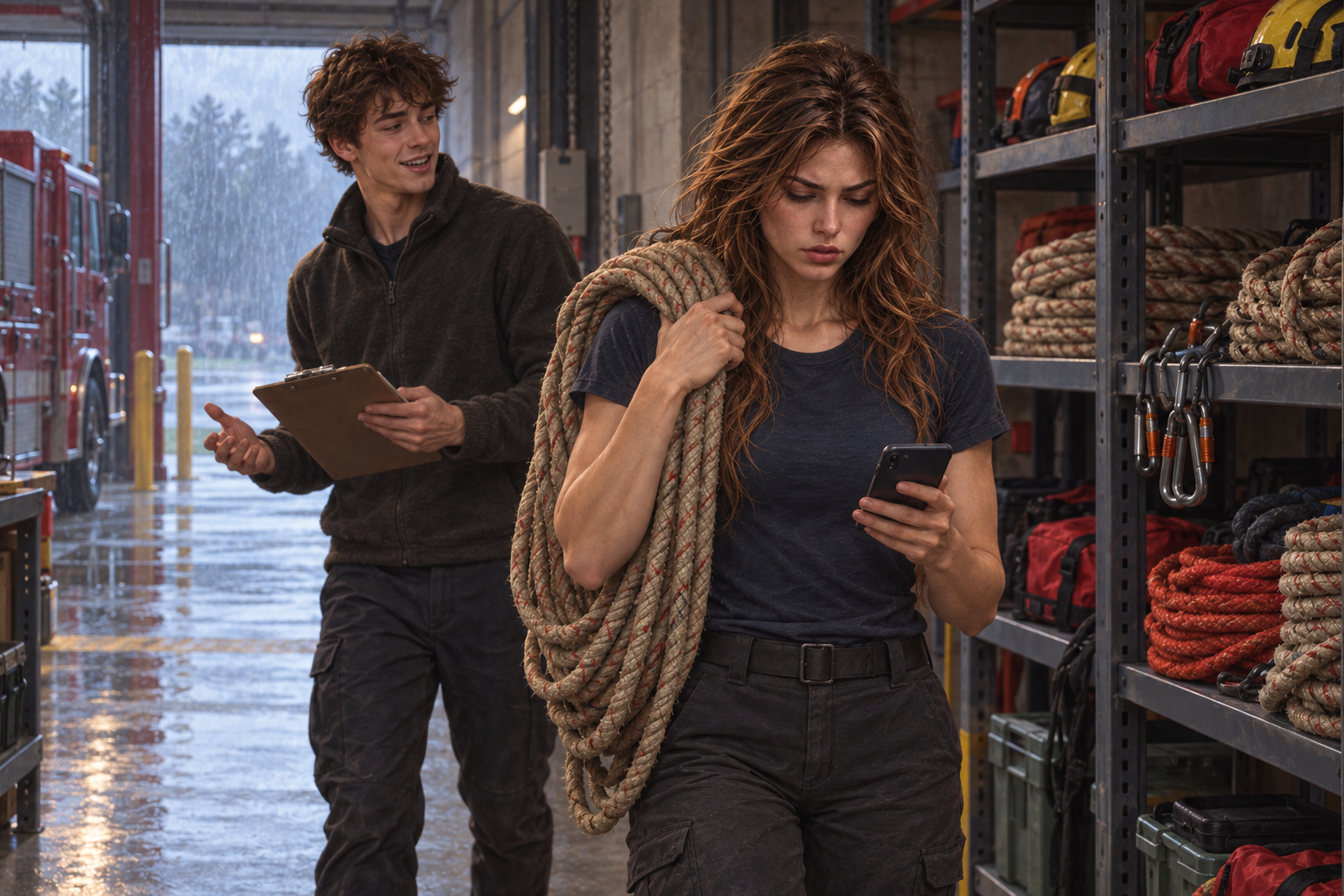
· · ·
Val came at six.
She came in without knocking, the way she always did, and stood in the kitchen doorway with her coat on and her bag over her shoulder, and did not take either off; and Kyra, at the stove, turned around and looked at her face, and knew she had come to tell her.
So that was something.
“Sit down,” said Kyra.
Val sat down. She put her bag on the floor. She did not take her coat off. She put her hands on the table and looked at them.
“I touched the light,” she said.
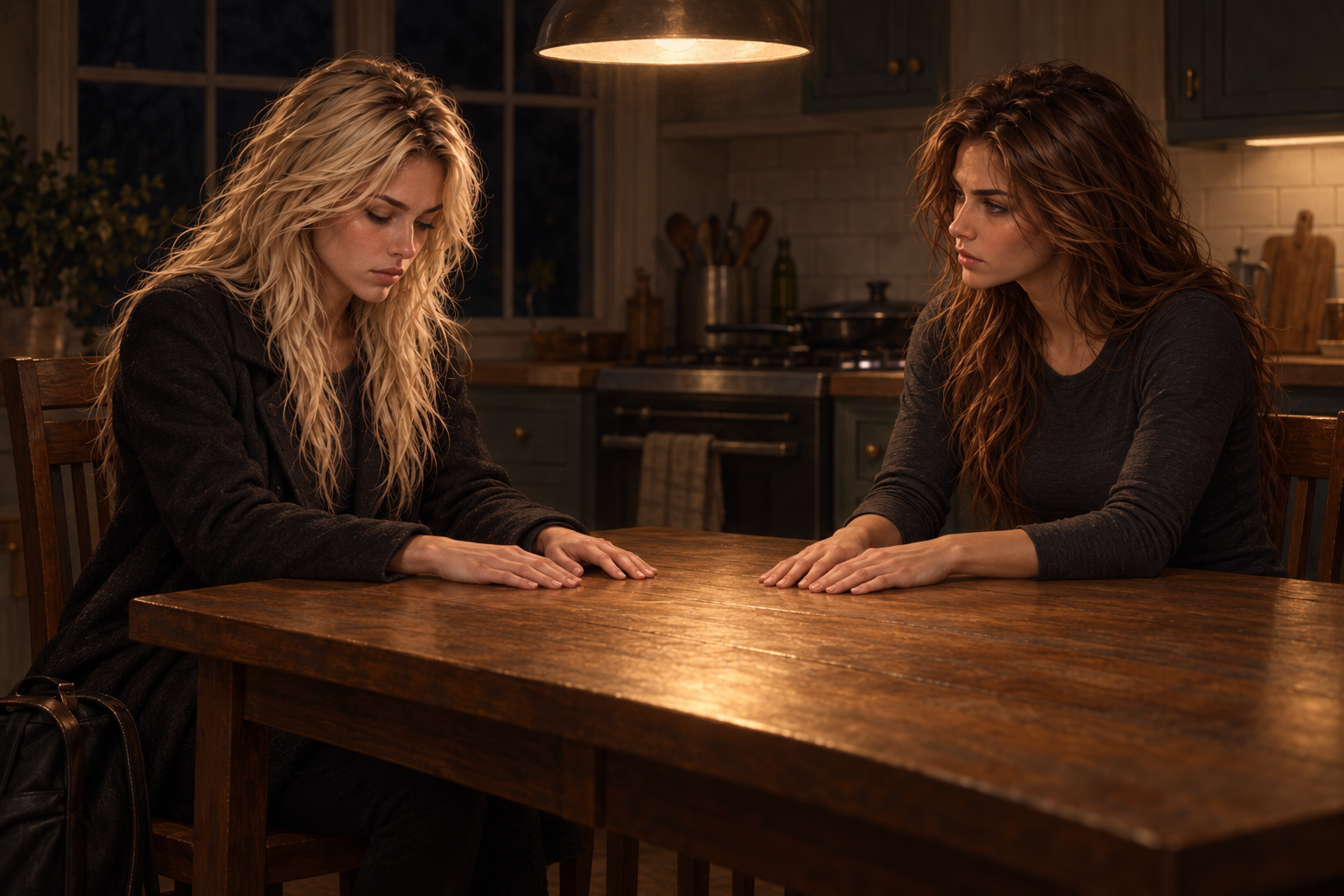
· · ·
Kyra turned the stove off. She came and sat down across the table and put her own hands flat on the wood, the way Val did, and waited.
“Monday night,” said Val. “I sat down to edit it. The usual — the color on the rings, the cream wall, one frame where the mask slipped a quarter of an inch. Nothing. An hour.” She did not look up. “And I got to the end, and there it was. A two. A two and a half, maybe. You know what it looked like.”
“I was there.”
“You were there.” Val turned her hands over. “And I sat there looking at it, and I thought about Tallyman’s column. Trending down. And the comments. Is she OK. Are they breaking up. And I thought — it isn’t true. That’s what I thought. That number is a lie. I was there and it was real and I love you, and the light came up a two because I was tired and because I could feel every one of them waiting in the corner of the room, and now it’s going to go out into the world and tell all of them that I don’t.” She stopped. “I thought I was correcting it. That’s the worst part. I sat there at one in the morning and told myself I was making the record more accurate.”
Kyra said nothing.
· · ·
“I can do it,” said Val. “That’s the thing. It’s gray. It’s only ever been gray. The camera can’t see the color and it never will, and nobody on this planet can make that color, ever, not with all the machines there are — but gray is just brightness. Gray is a mask and a curve and a value. I knew I could do it from the first day we saw the fog.” She shut her eyes. “So I did it properly. Because I don’t know how to do anything any other way.”
“How?”
“I went back through all of them.”
Kyra waited.
“All of them,” said Val. “Every video we’ve ever posted. Frame by frame. Every time it came up. I measured it. Where it started, how fast it rose, how bright it got at the throat, at the wrists, at the temples. Every region. Every one.” Her voice did not change at all. “I sat in your robe with the headphones on from eleven at night until nearly two, and studied my own light, frame by frame, the way I’d study anybody’s. I built a curve out of all of them. An average. The way it comes up for you, on the best nights.” She opened her eyes. “And then I laid it over the two, and put it out.”
· · ·
Kyra looked at her.
“Portland,” she said, at last.
“I know.”
“You promised. In a bed. With the window going gray. I’ll stop checking.”
“I know.”
“And you sat up all night checking. Your own light.” Kyra’s voice was not angry. She did not know what it was. “Every frame of it. All the way back to the beginning. Like it was a specimen.”
“Like it was a specimen,” said Val. “Yes.”
“Val.”
“I know,” said Val, and her voice went, at last, a very little. “I know, Kyra. I know exactly what I did. I’ve done it twice. I lied to them with my light, which I said I’d never do. And I did it without telling you, which I promised you in a bed I would never do. And to do it, I sat up all night doing the one thing I gave up for you.” She put her hand flat on the table between them. “Three. That’s three. I did three things in one night, and I did every one of them beautifully, and I’ve been sick about it since about four in the morning.”
· · ·
“You didn’t tell me before,” said Kyra.
“No.”
“You said before. At the table. You said you’d tell me you were tempted.”
“I know.” Val did not look away. “I wasn’t tempted. That’s what I’d say, if I were defending it. I didn’t sit there wanting to and deciding not to tell you. I sat there and I did it, between one sentence and the next, the way you’d fix a typo in a catalogue card. It didn’t feel like temptation. It felt like correcting an error.” She paused. “Which is worse. I know it’s worse.”
“It’s worse,” Kyra agreed.
“And then I watched it go up, and I went to bed, and I didn’t sleep, and at about four I understood what I’d done. And then I couldn’t call you. Because you’d be asleep. And then you’d be at the fire hall. And I sat in the library all day stamping books and waiting for six.” She looked at her hands. “And then I saw lux_aeterna.”
“So did I.”
“Like a lamp being turned up,” said Val. “Of course. Of course it was. He’s spent more hours looking at my light than anybody on earth except you. I built an average and he could see it was an average.” She made a small sound that was not quite the laugh. “I forgot the one thing about my own light that I’ve always known. That it never comes the same way twice. I studied it all night and I averaged out the only true thing in it.”
· · ·
Kyra got up.
She did not go around the table. She went to the window over the sink and stood there with her back to the room, the way she did when something was too big to look at straight, and looked out at the dark yard and the bare cherry tree and her own reflection in the glass.
“I knew at breakfast,” she said, to the window.
Behind her, Val did not move.
“Before lux. Before anybody. I watched it at the table with my cereal and I saw it come up everywhere at once and I knew. In about two seconds.” She put her hands on the edge of the sink. “And I sat there and the first thing I thought wasn’t she lied to them. I didn’t care about them. The first thing I thought was, she didn’t tell me.”
“I know.”
“And the second thing I thought was, Emrin.”
· · ·
She turned around.
“That’s what you did,” she said. “Isn’t it. You did exactly what I did. Not the faking — you did that the winter of the letter, and we’ve been through that. This. You made a beautiful thing that wasn’t there, so that somebody wouldn’t have to see the truth and be hurt by it. You did it for them. For Tallyman and his column. For the ones asking if you’re all right.” She came back to the table and sat down. “For me, a bit. So I wouldn’t have to read are they breaking up under a two.”
Val said nothing.
“And you did it perfectly. And the only person who could catch you was the one who knows you best. Which is exactly how it would have been with Emrin. If he’d ever been able to see.”
“Yes,” said Val.
“So I’m not going to shout at you,” said Kyra. “I thought about it. All day. I counted rope for an hour thinking about it. And I can’t. Because I’d be shouting at me.”
· · ·
Val took her coat off, then. Slowly. She hung it on the back of her chair and sat back down, and for the first time since she had come in she looked like somebody who meant to stay.
“I want to take it down,” she said.
“I know you do.”
“I want it gone. Off the channel. Out of the ledger. It’s a false record and I can’t have a false record in the ledger, I can’t — Kyra, it’s the one thing—” She stopped. “But it’s been up sixteen hours.”
They both knew what that meant. Neither of them needed to say it.
“It’s on the other sites already,” said Kyra.
“It was on the other sites by four in the morning. I looked.” Val put her hand over her eyes. “It’s copied. It’s everywhere. If I take it down from the channel, it’s still on page after page, forever, and lux’s comment is still on it, and now there’s a channel that took a video down sixteen hours after posting it, which is the most suspicious thing a channel can possibly do.” She took her hand away. “So it stays out there whatever I do. My one forged record. On every pirate site there is. Where I’ll never be able to touch it again.”
“Take it down anyway,” said Kyra.
Val looked at her.
“Take it down from ours,” said Kyra. “From the ledger. From the channel. Let it be on the pirate sites. That’s theirs, that’s not ours. But not in the room with the real ones. Not with our name on it, in our own book, next to the true ones like it’s one of them.” She paused. “You said it yourself, about the half video. Some things don’t go in the record. This is one.”
Val was quiet for a long time.
Then she reached down into her bag on the floor, and took out the laptop, and opened it on the table between them, and did it in front of Kyra, so that Kyra could watch her do it. Four clicks. And then two more, to make sure it was gone from the place where deleted things wait.
And then she opened the gray notebook to the page where the videos were, and found the line, and drew one straight thin line through it with her pen, the whole width of the page.
She did not write anything beside it.
· · ·
The comments went strange for a week. Removed?? lux was right. lux was not right, they just didn’t like it. it was AI, I SAID it was AI. why would they remove an AI video, that makes no sense. I saved it. you want a link? don’t post the link.
Tallyman’s spreadsheet had a new row, struck through, in gray.
Video removed by channel. Glow (per Index): 8.7 (disputed — see lux_aeterna). Not saying anything.
And under that, the next day, in his notes column, a line Kyra did not expect, and which she read four times.
Whatever that was, they took it down themselves. Which I respect.
· · ·
It was three days before they talked about the rest of it.
That was right. Kyra knew it was right; there were conversations that you could not have on the night, because the night was for the thing itself and nothing else. You had to let it be the size it was. And then you had to let it get smaller, on its own, a little, before you could pick it up and look at it properly.
On the Friday, at Val’s table, with the tea, and every lamp in the house on, Kyra put her mug down and said, “I keep thinking about Roz.”
Val looked up.
“In Las Vegas. In the hotel bar. Nobody thinks a stuntman’s really falling.” Kyra turned the mug around on the table. “I didn’t believe her. I’ve been carrying it about for — I don’t know how long. Since the desert. I didn’t believe her, and I couldn’t stop thinking about it. Because I thought she was talking about Emrin.”
“And she wasn’t.”
“She wasn’t.” Kyra looked at the mug. “She was talking about this. Them. The people who pay. She was saying they’ve bought a ticket. They know it’s a show. Every one of them in that back room knows they’re watching two women in masks with made-up names in a room that pretends to be nowhere. Nobody in that room thinks it’s a documentary.” She paused. “Emrin didn’t buy a ticket. That’s the difference. That’s the only difference there’s ever been, and it’s everything. Emrin was a man in his own bed, in the dark, asking about his own body, the one thing he could never see for himself. And I told him a story and let him think it was true. That’s what was wrong with it. Not the story. Him not knowing it was a story.”
Val did not say anything. She was listening the way she listened at the reference desk: completely, with nothing else in her face at all.
· · ·
“So here’s what I think,” said Kyra. “And you can tell me I’m wrong.”
“Go on.”
“I think the light was never the problem. And faking for them was never the problem. Not really. I think the problem — both times, the night of the letter and this week — was that you did it without me. Alone. In the dark. At one in the morning. And then I had to find it. If we’d sat here on the Saturday and said, tomorrow’s going to be a hard one, we’re both tired, let’s give them a good show and not worry if it’s real — would that have been a lie?”
Val thought about it.
“To them,” she said slowly, “it would be a show. Which is what they bought.”
“And to me?”
“To you it wouldn’t be anything,” said Val. “You’d know. We’d both know. We’d have agreed it at the table.” She looked at the gray notebook, on the table between them, where it always was. “We’d have put it in the book.”
· · ·
They made it that night. It took most of the evening, and two pots of tea, and Val crossing things out, and Kyra reading each line back aloud until it sounded like something both of them could keep. And at the end of it there was a page in the back of the gray notebook, under never fake with each other and the kiss is never a lid and all the others, in Val’s small exact hand.
Before every video, at the table, we name the night. A real night: whatever happens, happens. Or a show night: we finish the scene, whatever happens.
Either is allowed. Neither is a failure.
On a show night, the grip still tells the truth. Laced, we can’t lie to each other, so we won’t try.
Afterward, at the table: what was real and what wasn’t. Every time. Out loud.
Never fake with each other.
Never touch the light.
· · ·
“That last one,” said Kyra.
“That last one is mine,” said Val. “That’s the one I broke. So I’m the one who writes it.” She put the pen down. “On a show night I’ll act the end. I can. I’ve been Mira long enough; I know how to carry a thing up a road and then put it down. I’ll do the jaw and the arch and the hands and the breath on the third. They’ll get their show.” She looked at the line. “But the light does what it does. If it doesn’t come, it doesn’t come, and anybody who looks can see it didn’t. The murmur won’t come either. I’m not going to fake that. I’m leaving those two in.” She touched the line with one fingertip. “I’m not lying about what I feel. I’m just not putting the truth anywhere they can’t find it.”
“lux will be able to tell.”
“lux will be able to tell every single time,” said Val, “if he looks. Good. Let him.” She closed the notebook. “That’s what the light’s for, Kyra. It’s the one honest thing in every video. On a show night it stays low and says so. It’s the only part of me on that whole channel that’s never once been acting.” She paused. “Except this week. And never again.”
Kyra looked at the closed notebook for a while.
“Val keeps her light,” she said. It was one of the first terms. It was on the back of the paper in the envelope marked gutters, from the very first winter, when it had meant only nobody sees the color; nobody ever learns what it is.
“It means something else now,” said Val.
“It means it stays true.”
“It means it stays true,” said Val.
· · ·
The first show night was the Sunday after.
They named it at Kyra’s table at seven, with the jars out. Kyra said it, because Val had asked her to, the first time. “Show night.” And Val said, “Show night,” back, and wrote the date in the notebook, and Kyra did the color on the ring, and felt under her fingertips that Val was not holding herself arranged at all. She was just tired. Honestly tired, and not hiding it, because there was nobody in the room to hide it from.
They went into the room that was nowhere and did everything they always did.
And Val did not get there. Kyra knew, the whole way, because they were laced and the grip told her: not tonight, and it’s all right, and I’m here. It said that over and over, quietly, the whole time, under everything. And at the end Val’s back arched and her head came down against Kyra’s shoulder and her breath went on the third and not the second and her hands shook against the back of Kyra’s neck, beautifully, exactly, all of it; and Kyra, with her mouth at Val’s ear, talking softly the whole way through, felt the grip underneath say, steady and amused and perfectly honest: this is the show. I’m still here. You can stop worrying now.
The light came up a little at the wrists. A three. That was all.
· · ·
They sat at the table afterward with the tea, the masks on the counter by the jars, and Val said, “Well.”
“Well,” said Kyra.
“What was real?”
Kyra thought about it.
“All of mine,” she said. “Every bit. And the kissing. And your hands in my hair, at the beginning, before the chair. That was you.” She looked at Val. “The end was the show.”
“The end was the show,” Val agreed. “I was tired, and I was happy, and I wasn’t anywhere near it, and I didn’t mind. The grip was true the whole way.” She was quiet for a moment. “It was easier than I thought.”
“Was it?”
“Because you knew.” Val turned her cup a quarter turn on the table. “That’s all it was. I’ve done the jaw and the breath before, the night of the letter, and it was the worst night I’ve had on this planet. And tonight I did the same jaw and the same breath and it was nothing. It was acting. It was Mira.” She looked up. “The only difference was you knew.”
Kyra was quiet for a while.
Then she found that her eyes had filled, and she let them, and did not look away.
“That was the only difference with Emrin, too,” she said. “Wasn’t it.”
“Yes,” said Val gently. “That was the only difference.”
· · ·
It did not go away. Kyra knew it would never entirely go away. There was a man on another world who had lain in the dark believing her, and she would carry that for as long as she carried anything.
But it was lighter, that night. A little. For the first time in a very long time.
· · ·
The comments, on the Monday, under the show night:
glow index 3.0. off night?
she didn’t finish did she
how can you tell
the glow. read Theory 6. low glow = not really there
so she faked it??
it’s a SHOW guys, they’re allowed to have an off night and still finish the scene. that’s literally what professionals do
I actually love that you can tell. I love that they don’t hide it. that’s how you know the good ones are real
the good ones are SO real
And one, from a name Kyra knew, at three in the morning.
lux_aeterna: Index 3.0. Rises at the wrists only, unevenly, and stops. That’s a real low one. For what it’s worth, I’ll take an honest three over anything else on the internet.
Kyra read it at breakfast, and put the phone down, and laughed out loud at her own kitchen table, alone, with her mouth full of cereal.
Then she called Val and read it to her.
“An honest three,” said Val, on the line.
“An honest three.”
There was a long pause on the line, and then the small breath through the nose that stood in for a laugh.
“I’ll take it,” said Val.
— end of chapter twenty-nine —
Spring · Val’s kitchen, Kyra’s kitchen, and a map
The first one was not dangerous at all. Kyra would say so afterward, and Val would agree with her, and it would still be the one Val thought about longest.
It was a comment. One line, under a back-room video from the winter — one of the real nights, a seven, nothing special about it — in the middle of an argument that had been going on for a week about whether Copper was faking.
That argument had been going on, in one form or another, since the first video. Kyra was loud. Kyra had always been loud. And on a channel where everybody had read Theory 6 and knew to watch the blonde’s light, there was a whole school of opinion that the redhead, who had no light anybody could see, was simply doing what women on the internet did: performing. Nobody’s that loud. She’s doing it for the camera. Blondie’s the real one, Copper’s the show. Kyra had read it all and laughed at most of it, and had long since stopped minding.
And then, in the middle of it, from somebody with no history and a name that was only a string of letters:
Watch the redhead’s jaw. Right before. It goes first — a little drop at the hinge, under the edge of the mask, maybe half a second before anything else. You can’t fake that. She’s never once faked it on this channel. Not one time.
· · ·
Kyra read it at the fire hall, between calls, and laughed out loud, and showed it to nobody, and saved it.
She read it to Val that night, at Val’s table, in the voice she kept for the very best ones.
“She’s never once faked it on this channel,” she finished. “Not one time.” She put the phone down. “I’ve got a witness. Somebody’s noticed. Somebody worked out that I’m real.”
She looked up, grinning.
Val was not grinning.
· · ·
Val was sitting very straight in her chair with her teacup in both hands, and her face was doing the thing Kyra had seen it do perhaps a handful of times in their whole lives together, which was nothing at all, very hard.
“What,” said Kyra.
“Nothing.”
“Val.”
“It’s correct,” said Val. “It’s perfectly correct. It goes first. A drop at the hinge, under the edge of the mask, half a second before anything else.” She put the cup down. “That’s right. That’s exactly right. Whoever that is has a very good eye.”
“So what’s the matter?”
Val did not answer for a moment.
“I found that,” she said.
· · ·
Kyra waited.
“In Trieste,” said Val. “In the house on the lane. With the shutters. The first winter we were there — you remember the winter, the bora coming down off the hill for nine days and the whole town tying ropes along the streets so people could walk.” She was looking at her own hands. “You’d come in from the quay. You’d been out in it all day helping them get the boats in. You were half frozen and laughing about something, and I took you upstairs and warmed you, and I watched. The way I always watched. And that night I saw it. The jaw. Half a second before. I’d been watching you for a very long time by then and I had never seen it, and then I saw it, and after that I could never not see it.” She paused. “I wrote it down. That night. In the book I had then. The jaw goes first. It was the first thing in a long list.”
“I know the list,” said Kyra softly. “The jaw, the wrists, the third breath.”
“The jaw was first. Before any of them. Before anything. It was mine. Nobody on this planet knew it. Nobody on either planet knew it. I found it in a cold room in Trieste and I’ve kept it ever since, and it’s how I’ve known, every time, for longer than this country’s had a name—” She stopped herself. “And now there’s a string of letters on a website that’s found it too. From a camera. Through a mask.”
· · ·
Kyra looked at her.
“You’re jealous,” she said.
“I’m not jealous.”
“You’re jealous of a string of letters.”
“I’m not jealous,” said Val, with great dignity. “I’m—” She stopped. She thought about it. Kyra watched her think about it, honestly, the way Val thought about everything, turning it over to look at the underside. “Possessive,” she said at last. “I think that’s the word. I feel possessive. Of your jaw.” She closed her eyes. “Which is a sentence I never imagined I’d say out loud.”
· · ·
Kyra put her head down on the table and laughed until she cried.
She could not help it. She tried. She lifted her head once and saw Val’s face — eyes shut, mouth set, the face of a woman who had just confessed to a sin she found unbearably silly — and put her head straight back down again.
“It’s not funny.”
“It’s the funniest thing that’s ever happened.”
“I’m aware it’s absurd.”
“Last autumn,” Kyra managed, “you sat at my table and told me it was the worst thing that ever happened to you that a man with some software had drawn a graph of how much you love me. And I said I didn’t mind. I said I was delighted. And you said it’s different, it’s one person, it’s the person you’d want.” She wiped her eyes. “And now somebody’s noticed one thing about me—”
“It’s not the same.”
“It’s exactly the same.”
“It’s not,” said Val, “because it’s the first thing.” And then she opened her eyes, and looked at Kyra across the table, and something in her face gave way all at once, and she made the small breath through her nose, once, and then again.
“It’s exactly the same,” she admitted. “I know it is. I’m sorry.”
“Don’t be sorry.” Kyra reached across the table and took both of Val’s hands. “I like it. I like you being possessive. You never are. You’ve never once been possessive of anything in your whole life, except books.” She squeezed. “You can have my jaw. It’s yours. You found it. Nobody’s ever going to take it off you.”
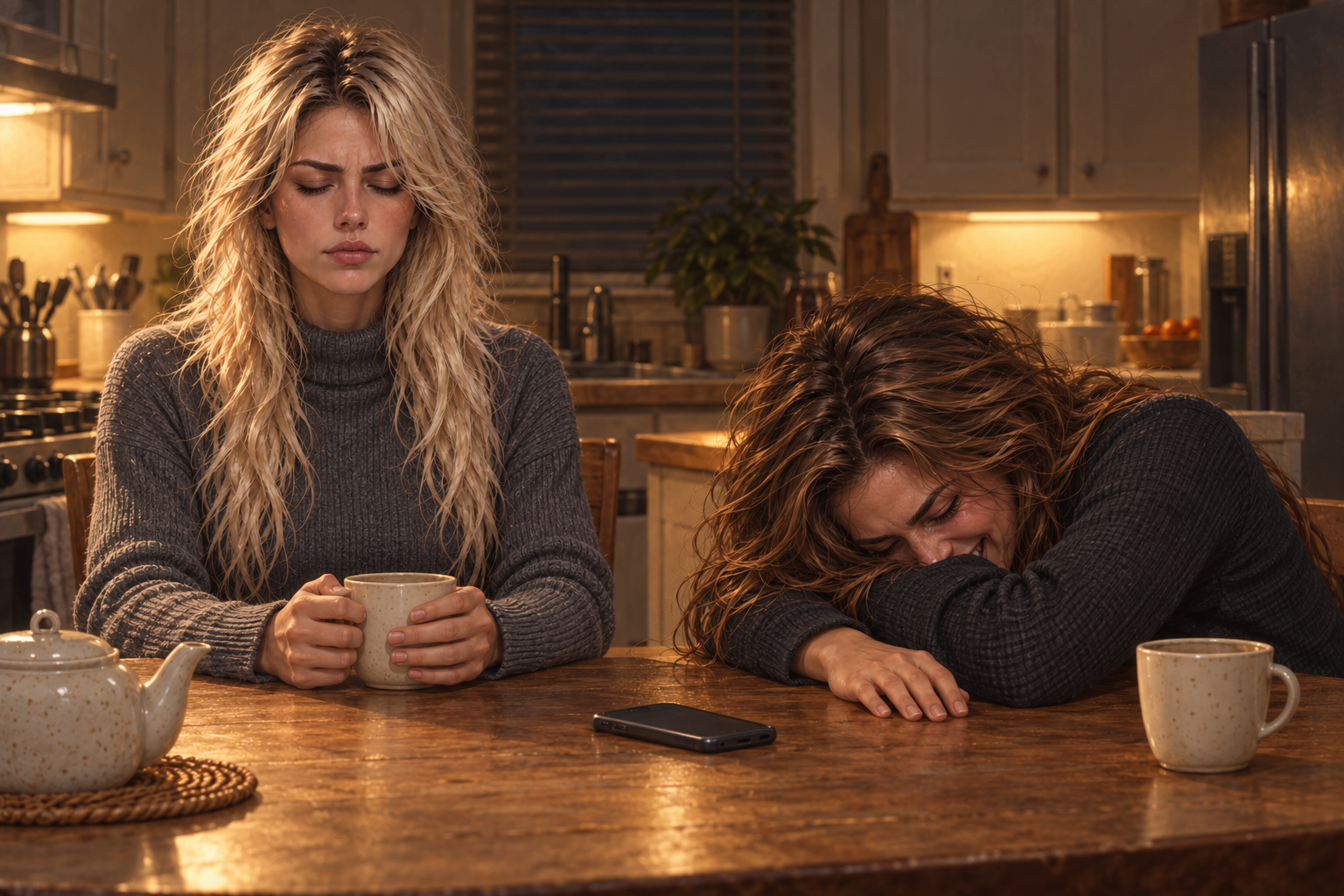
“They’ve already taken it.”
“They’ve seen it,” said Kyra. “That’s different. You know it’s different. You taught me it’s different.” She leaned in. “Seeing isn’t having. You’re the only one who’s ever had it. You’re the only one who ever will.”
· · ·
Val asked, later — in bed, in the dark, with her face turned away toward the wall — whether Kyra thought the masks could be made a little lower. At the jaw. Only a little.
“No,” said Kyra.
“An inch.”
“Not an inch.”
“Half an inch.”
“Val,” said Kyra, into the back of her neck, “you are not putting me in a bigger mask because a stranger noticed my jaw.”
Val was quiet for a while.
“No,” she agreed. “I’m not.” And then, very quietly, to the wall: “But it was the first thing I ever wrote down about you.”
“I know.”
“And I want it to be mine.”
“It is yours,” said Kyra, and put her arm around her, and held on, and felt the grip between them go, not laced, nothing, only warm and close and quiet, the way it did on its own sometimes in the dark when there was nothing at all to say.
· · ·
The second one came a month later, and it was not funny at all.
It was a letter. Through the private messages. And Kyra knew who it was from before she had finished the first line, because there was only one person who had ever written to them with footnotes.
I hope you’ll forgive me writing again. It’s been a long time, and you never answered the first one, and I understood why, and I promised myself I wouldn’t bother you again. But I’ve found something, and you’re the only people I can tell who’ll understand why it matters, and I can’t not tell someone.
Do you remember the spiral lacing? The variant, with the offset holes, that I’d only ever seen described in one letter — a woman writing to her sister, complaining how long it took?
I found the sister’s reply.
· · ·
Kyra was reading it aloud. She stopped there.
Val, at the stove, did not turn around. “Go on.”
Kyra went on.
It was in a different archive — a box of family papers that had been catalogued under the wrong surname for generations, and a graduate student of mine found it by accident while looking for something else entirely. I nearly wept. It’s three pages, mostly about a christening and somebody’s debts, and then, at the end, half a paragraph:
”As to the lacing, you must not blame me for it, for I had it from the two foreign women on our lane, the fair one and the red, who keep the house with the green door. The fair one does it so for the red one every morning, and swears it is the only way that holds, and I watched her at it a whole week before I had the trick. They are very private and very kind and nobody knows where they are from.”
· · ·
Kyra put the phone down on the table.
At the stove, Val had turned the flame off under the pan. She was standing perfectly still with the wooden spoon in her hand and her back to the room.
The kitchen was very quiet.
“There’s more,” said Kyra, after a while.
“Read it.”
So there it is. A fair woman and a red one, on a lane, a long time ago, who laced it that way, and nobody knew where they came from. I’m sure it’s only a coincidence — I know it’s a coincidence — it’s the kind of thing that happens in archives all the time, and anybody sensible would laugh at me for even mentioning it.
But I sat in the reading room with those three pages and thought about your videos, and the fair one doing the lacing for the red one, in the morning, on camera, exactly the way that letter says. And I’m not a sentimental person. But it made me very happy.
I’ve put the lacing in my new book. A whole chapter. With both letters, and the archive references. And I’ve put a footnote at the bottom of it — no names, of course, you don’t have to worry — that says only that the only working reconstruction of this lacing known to the author was made by two anonymous women on the internet, who never revealed where they learned it.
I hope you don’t mind. You can tell me to take it out. But I think you deserve to be in it.
Thank you, again, for the most extraordinary thing I’ve ever seen.
· · ·
Val put the spoon down on the counter.
She came to the table and sat down across from Kyra, slowly, the way she had sat down on the night of the glow index, and the night of the forgery, and a great many nights before those, in other kitchens. She did not take the phone. She did not need to read it. She had heard every word.
“The house with the green door,” she said.
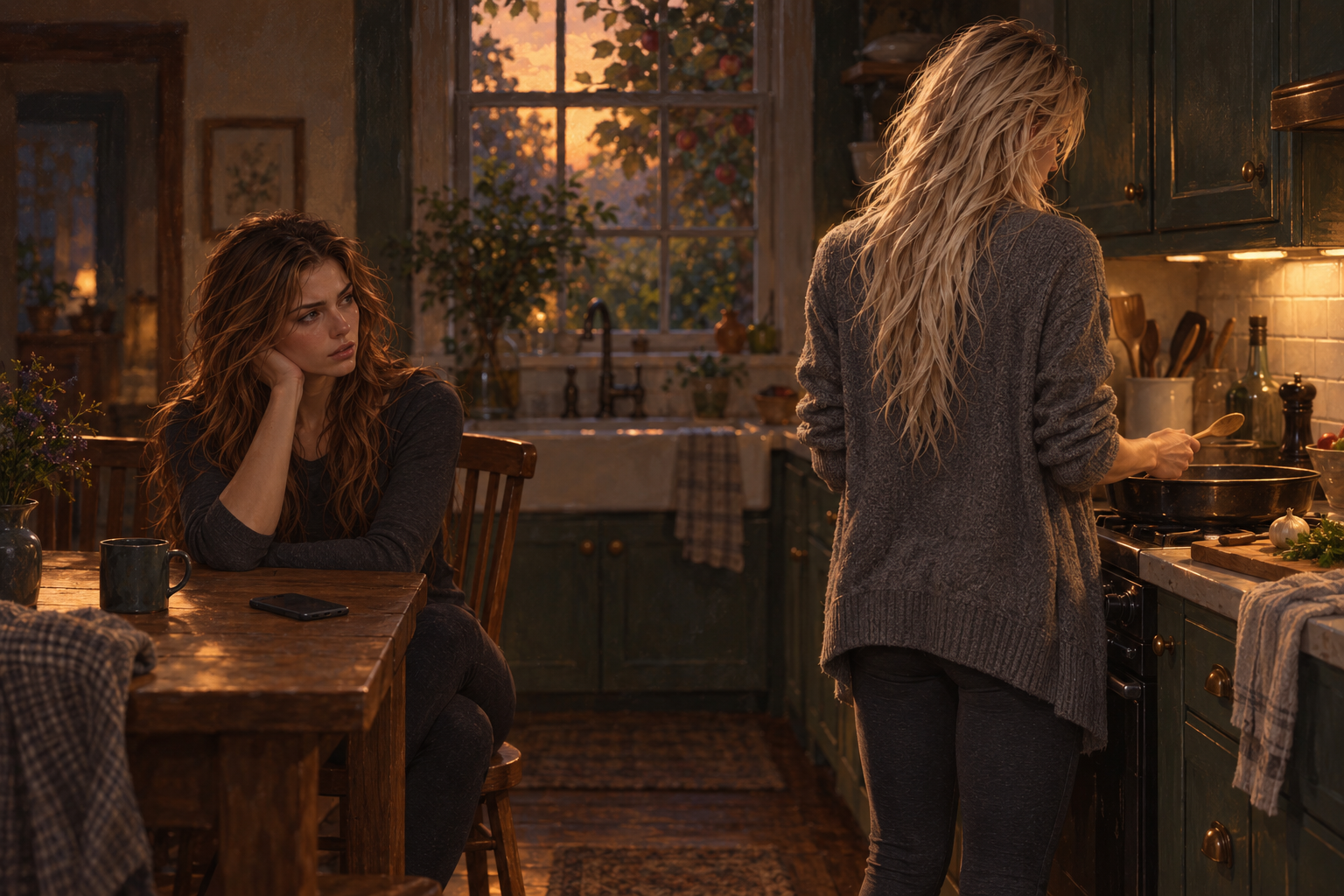
“I know.”
“I painted that door. You said green was a stupid color for a door. I did it anyway, and you were right, it faded in a year, and I did it again.” Her voice did not change at all. “I’d forgotten the door. I’d forgotten I ever—” She stopped. “And there was a woman across the lane who used to stand in her doorway in the mornings with her hands in her apron and watch me lace you at the window. I thought she was being nosy. I used to close the shutter.”
“You didn’t always close it.”
“I didn’t always close it,” said Val. “Apparently.”
· · ·
They sat with it a long time.
“Is it dangerous?” said Kyra at last.
Val thought about it properly. Kyra could see her running the sum.
“No,” she said. “Not really. Not by itself. A fair woman and a red one, on a lane, a long time ago. There have been a great many fair women and red ones. Nobody will ever read that and think it’s us, because it can’t be us, because nobody lives that long. Even she doesn’t think it. She says she doesn’t think it. She calls it a coincidence twice.” She paused. “It’s the safest kind of close. The kind nobody can believe.”
“But.”
“But it’s the closest anybody’s ever come,” said Val. “In the whole of this. Closer than the chair, closer than the light, closer than lux. A woman sat in a reading room and held a piece of paper with us on it. Our lane. Our door. Nobody knows where they are from. And she put it together with the videos. She didn’t believe it, but she put it together. Because it was together. Because it was true.”
· · ·
“You’re in a footnote,” said Kyra.
Val looked at her.
“You said you’d like to be. Once. After the first letter. You sat at this table and said I’d have liked to be a footnote. Just once.” Kyra’s voice was not quite steady. “And now you are. Twice, really. Once in the letter from the sister, and once at the bottom of a chapter in a book about lacing. Two anonymous women on the internet. Who never revealed where they learned it.”
“The fair one does it so for the red one every morning,” said Val, very quietly.
“And swears it is the only way that holds.”
“I did say that.” Val shut her eyes. “I used to say that every morning. You’d complain and I’d say it.”
“I know you did,” said Kyra. “I was there.”
· · ·
They did not answer the letter. They both knew they could not. Kyra wrote three replies that night and deleted all of them, and in the end it sat in the private messages, read and unanswered, the way the first one had; and Kyra hoped, very much, that a costume historian somewhere would understand the silence, as she had the first time, and take it for what it was.
But Val, the next morning, went to the closet in her spare room where the period costumes hung in their cotton bags — the stays and the green dress and the dark wool and the white muslin and the riding habit and the thing with the ruff — and stood looking at them for a long time.
“No more of these,” she said.
Kyra, in the doorway, did not argue.
“Not the real ones. Not the ones from places we’ve been.” Val put her hand on the cotton bag over the stays, flat. “Mira can wear what she likes. Brooches on her hips. Lace where lace never went. Nobody will ever find that in an archive, because it never happened anywhere.” She took her hand away. “But the true ones — no. They’re too true. Somebody’s going to go looking for the woman who wore them. And somebody already has.”
“You love these.”
“I love them very much,” said Val. “That’s how I know.”
She closed the closet.
· · ·
The third one was the chair.
· · ·
It had been coming for years. Kyra had known that, in the way you know weather is coming when the light goes a certain color over the ridge. The chair had always been the thing the strangers looked at hardest, after the light; and after the furniture restorer in the very first year — Pacific Northwest, not long after the war, Oregon or Washington — there had been a long quiet, and then a long noise, and then a whole page on the wiki called Where Is The Chair From, and a great many very confident people being very wrong.
And then, in May, somebody was right.
· · ·
It was a single frame.
An old one, from a back-room video years back, from the time before they had learned to be as careful as they were now. Kyra had dragged the chair into the shot at the beginning — she remembered doing it; she had been laughing at something Val said — and for less than a second, as she pulled it backward across the floor, it had tipped. Toward the lamp. And the lamp had caught, for less than a second, the underside of the seat.
Nobody had seen it. Not then. Not for years. And then somebody with a great deal of time and a very good screen had gone through every frame of every video on the channel, looking for the underside of the chair, and found it.
They posted it on the wiki, enlarged and sharpened until it was almost nothing but grain. And in the grain, at the back edge of the seat, where a maker might put a mark, there were letters. Burned into the wood. Half of them gone into the shadow.
—ONIA CH—
· · ·
The wiki took four days.
ONIA. Vernonia. Vernonia, Oregon. It was a mill town. Huge sawmill there once. Oregon-American Lumber.
mills don’t make chairs
no but there’d have been shops. little ones. using the mill’s lumber. there were furniture shops all over those towns after the war.
found it. Vernonia Chair & Turning Co. there’s a mention in a county history. small shop, a couple of men, kitchen and dining chairs, closed when the mill closed. that’s the profile. that’s the chair.
that is NOT ONIA, look at it again, the first letter could be anything. I read it as ROVE. Forest Grove. there was a chair maker in Forest Grove too
there were chair makers in every town in Oregon
ok but Vernonia and Forest Grove are both like an hour from Portland. so it’s Portland area either way
THE CHAIR IS FROM PORTLAND
the chair was MADE near Portland. doesn’t mean they LIVE near Portland. it’s a chair. chairs move.
it’s an old chair. it probably never left Oregon
so they’re in Oregon
they’re in Oregon.
· · ·
By the end of the week, somebody had driven to Vernonia.
They posted photographs. The main street, the old mill pond, the museum in the company’s old office building. A junk shop with three chairs in the window that were, they wrote, close but not it. A second junk shop, where the woman behind the counter had apparently asked, with great interest, why everybody in the world had suddenly started coming in asking about chairs.
I’m going to Forest Grove next weekend, somebody else wrote. Anyone want to split gas.
· · ·
Val drew the circle on a Thursday night.
She did it on an actual map, a paper one, a road map of the state that she kept in a drawer, because she did not want the circle on any screen anywhere. She spread it on Kyra’s kitchen table under the lamp and found Vernonia with one finger and Forest Grove with another, close together in the green northwest corner above Portland, and drew around them, in pencil, a ring the size of a fist.
Then she found Calderveil.
It was not in the ring. It was a long way outside it. Two hours, at least, by road; over a ridge and down a river — the same river, as it happened, though nobody on the wiki ever thought to follow it — in another county, in a valley nobody from Portland had any reason to drive to.
Kyra let out a breath she had not known she was holding.
“It’s not close,” she said.
“It isn’t close,” said Val. “Not to us.” She was still looking at the map. “But it’s Oregon. A year ago they had the whole Pacific Northwest. Two states. Everybody between California and Canada. Now they’ve got one corner of one state, and they’re driving around it in cars, going into shops.” She put her pencil down beside the ring. “And every time something else comes out, the circle gets smaller.”
· · ·
“We’re not in it.”
“We’re not in it yet.” Val took her glasses off. “Kyra. Count. In one spring — one — a string of letters found your jaw. A historian found our door. And somebody found the chair’s town from half a word in the dark. None of those is dangerous. Not one. By itself, every one of them is a curiosity. A coincidence. A chair.” She put the glasses down. “But they’re all getting closer. All at once. From every side.”
Kyra did not argue. She could not. It was true.
· · ·
They sat at the table for a long time with the map between them.
Then Val said, quietly, the way she said things she had decided on before she came in the door: “I think we should retire the chair.”
· · ·
Kyra looked up.
“Not throw it away,” said Val quickly. “Never. It goes in the corner of your bedroom with the laundry on it, where it’s always been. But off camera. For good. It’s the most-watched object on the channel. Every frame of it has been gone over by somebody with a screen. There could be something else on it — a mark, a scratch, a repair — that somebody finds next year and takes to a shop in Vernonia and says this.” She put her hand flat on the map. “We use a different chair. A plain one. A new one, from a shop, that half the internet has bought. We could buy The Seventeen.” She very nearly smiled. “It’s on sale now, I saw. Somebody else makes it.”
“No,” said Kyra.
· · ·
Val looked at her.
“No,” said Kyra again. She was not shouting. She was very calm. “Not the chair, Val.”
“Kyra—”
“You retired the costumes. I didn’t argue. They were yours, and they were true, and I understood. You want the masks lower at the jaw — I said no to that, but I understood that too.” She put her own hand flat on the map, beside Val’s. “But not the chair. The chair is us. The chair is Portland. It’s a rainy evening in October and me dragging it out in front of a mirror without telling you why. It’s the first thing we ever did that was only ours and nobody else’s.” She looked at the ring on the map. “It’s been in every house we’ve had since. You’ve tried to leave it on the curb every single time, and every single time I’ve picked it up and put it in the car. And I’m not putting it in the laundry corner because some man in a car went into a junk shop in Vernonia.”
“It’s evidence.”
“It’s a chair,” said Kyra. “They said so themselves. It’s a chair. Chairs move.” She leaned forward. “Val. Listen to me. They’ve got half a word and a town we’ve never lived in. They’re in the wrong town. They’ll be in the wrong town forever. And if we take the chair away — the chair that every one of them knows, that half of them have bought copies of — the minute it’s gone, every one of them will know we’re frightened.” She paused. “Nobody hides a thing that doesn’t matter.”
· · ·
Val did not say anything.
Kyra watched her run it. She could see her doing it — the pencil ring, the shop in Vernonia, the frame with the underside in it, a woman with a sharpened image in a reading room somewhere, all of it laid out in Val’s head like cards on a table. Kyra had watched her do the sum for every decision either of them had ever made on this planet, and she had learned, a very long time ago, that the thing to do was wait.
“The underside,” said Val at last.
“Never on camera again. Ever. Not a frame.” Kyra nodded. “Tape it, if you like. Paint it. I don’t care. Nobody sees the bottom of that chair again as long as there’s a channel.”
“And the back. The bit they all photograph. Where the hands have worn it.”
“They’ve had the back for years. There’s nothing on the back that isn’t already on the wiki.” Kyra put her hand over Val’s on the map. “We keep the chair. We keep going. We don’t stop doing what we do because somebody’s looking closely. We never have. That was the whole point.” She squeezed. “They can pay; they can’t steer. That’s ours. We wrote it. It means them too. All of them. The wiki and the driving and the junk shops.”
“It means it most of all for them,” said Val slowly.
“It means it most of all for them,” Kyra agreed.
· · ·
Val turned her hand over, under Kyra’s, and held on.
“Tape,” she said. “On the underside. Over the letters. Tonight.”
“Tonight.”
“And no more frames below the seat. I’ll recheck every angle. Both cameras.”
“Every angle.”
“And I’m keeping the map,” said Val, and folded it, carefully, along its old creases, with the pencil ring inside it, and put it in the drawer of Kyra’s kitchen table, at the back, under the spare batteries and the takeout menus. “So I can look at the circle. When it gets smaller.”
“If it gets smaller.”
“When,” said Val.
But she let Kyra keep hold of her hand.
· · ·
They taped it that night, in the corner of Kyra’s bedroom, kneeling on the floor with the chair turned up on its back like a patient and the laundry in a heap beside it. Kyra held the lamp. Val laid three strips of plain brown tape over the half-word, smoothing each one flat with her thumb, slowly, the way she smoothed the sealant over the ring.
Then she sat back on her heels and looked at it.
“—ONIA CH—,” she said. “I never once looked under it. In all this time. I never knew it said anything at all.”
“Neither did I.”
“It’s been telling everybody where it came from, the whole time,” said Val. “Under the seat. In the dark. Every house we ever had.” She touched the tape, once, with one fingertip. “We just never turned it over.”
Kyra put the lamp down and turned the chair the right way up, and set it back in its corner, and put the laundry back on it, folded, the way it had been.
“There,” she said. “Now it’s a chair.”
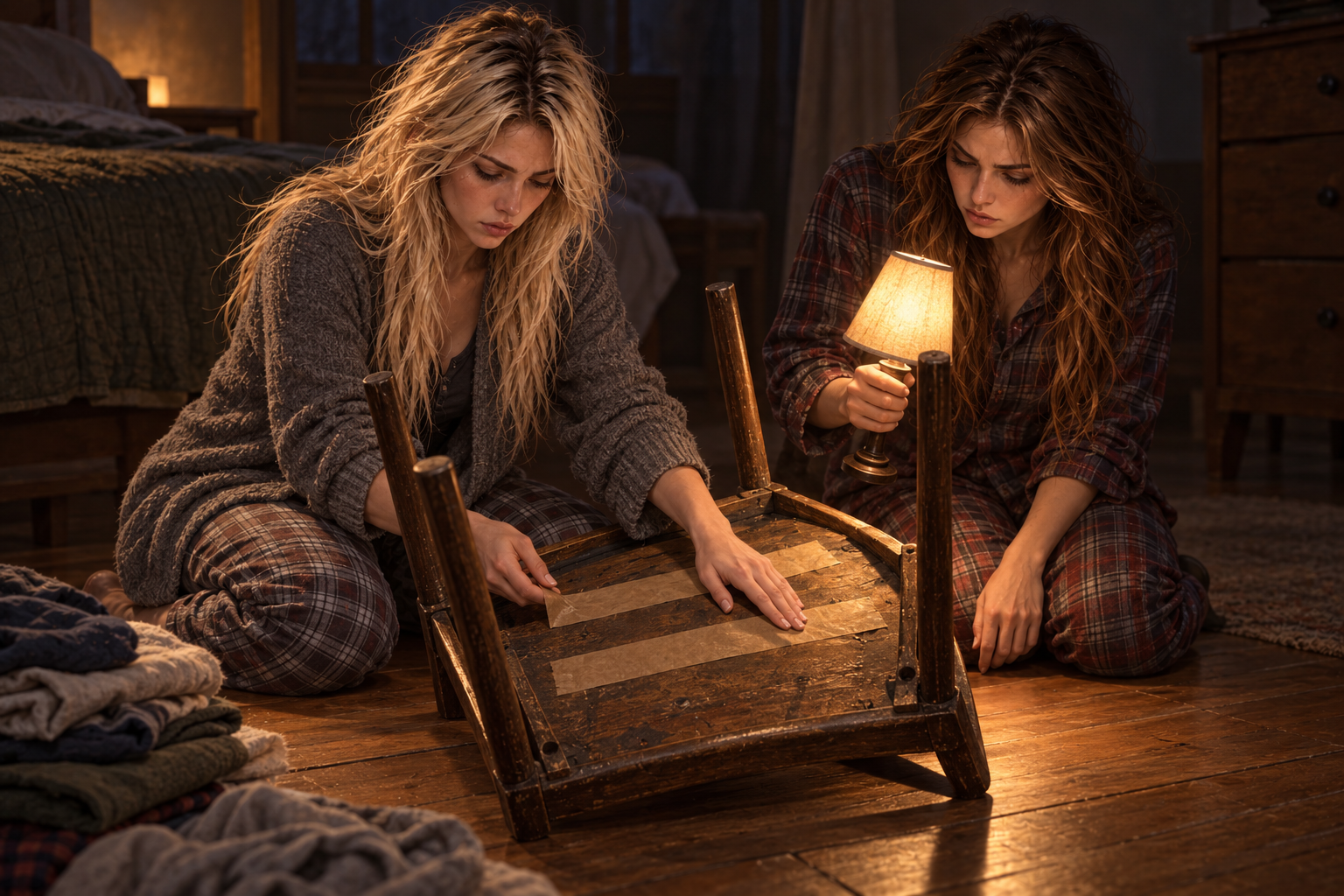
“Now it’s a chair,” said Val, and stayed sitting on the floor for a while, looking at it, with her knees drawn up and her arms around them, in the lamplight, the way she had sat on the floor of a bedroom in Portland a very long time ago, watching Kyra drag it out in front of a mirror, with an expression of grave scientific interest.
· · ·
Tallyman’s spreadsheet had nothing at all about any of it. It was not his kind of thing. He counted what happened in the room, not what happened outside it.
But at the bottom of the wiki page called Where Is The Chair From, under the photographs from Vernonia and the plans for Forest Grove and the arguments about the first letter, somebody had added one line, a week later, and nobody had taken it down.
Honestly, I hope we never find it. I like that it’s from nowhere.
Kyra read that one aloud to Val at the table, in her ordinary voice, and Val did not say anything at all; only reached across, and found the drawer at the back of the table, and touched the edge of it with one finger, where the map was, and took her hand away again.
— end of chapter thirty —
The year the letters thinned · Kyra’s kitchen, Val’s kitchen, and Kyra’s bed
They had always come on a Sunday.
Kyra did not think about it, most weeks. That was the thing about something that comes every week for years: it stops being an event and becomes a kind of weather, a thing the week has in it, like Thursday night at the library or the pager test on the first of the month. Sometime between two and four in the morning, on a Sunday, the phone on the nightstand would light up once, quietly, and in the morning there would be a letter.
Long, mostly. Sometimes short. Always careful. Always with every comma in the right place. About light, usually — the way the lamp fell, the way the blonde’s shoulders went, a moment in the latest video that nobody else in the comments had noticed and that LongExposure had watched four times to be sure of. About waiting, often. About the redhead’s patience, and how rare it was, and how the whole of the rest of the internet was in a hurry.
And at the bottom, every time, the same four words.
Let it come to you.
Kyra read them in bed, on Sunday mornings, before she had properly woken up. She had done it for so long that she no longer remembered not doing it. If she was in Val’s bed, she read them aloud. If she was in her own, she read them alone, and then called Val and read them again.
She had never once in all that time thought about what it would be like if one did not come.
· · ·
The first one that did not come was in February.
Kyra woke on the Sunday and reached for the phone and there was nothing. She looked at the empty screen for a while. Then she put the phone down and went to make the coffee, and thought, well, and thought, people go away, and thought, people have weekends, and did not think about it again until the next Sunday, when the letter came, at half past three, and began Sorry about last week, and said nothing else about it at all, and was about the new video, and the way the lamp had caught the edge of the braid, and was perfectly, carefully, entirely itself.
So that was all right.
· · ·
The second one that did not come was in April.
And then there was one in May. And then two Sundays in a row in June, and then a letter that came on a Wednesday — on a Wednesday — at twenty to five in the afternoon, which was not a time LongExposure had ever written in all the years Kyra had known the name. It was short. It said that the latest video was one of the best they had ever made, and that the blonde had stopped knowing the camera was there nearly at the beginning, which was rare, and wonderful. And then it said Let it come to you, and that was all.
Kyra read it at the fire hall, standing in the bay by the rescue truck, with the big doors open on a hot afternoon, and read it again, and did not know why her hands had gone cold.
· · ·
She did not say anything to Val. Not at first.
She was not sure what she would have said. A stranger has been writing to us on Sundays for years and lately they’ve missed some? It sounded like nothing when she said it in her head. It sounded like exactly the kind of thing a person says about a stranger they have no business worrying about. People stop. People get busy. People find other channels. People get bored, or fall in love, or move to a city with a longer working week.
She told herself all of that, and believed it about as much as she believed that the river behind the fire hall would stop at the bridge if you asked it nicely.
· · ·
It was Val who said it, in the end. Of course it was.
It was a Sunday in July, at Val’s table, at breakfast, with the windows open on the garden and the coffee going. Kyra had woken in Val’s bed at seven and reached for the phone, as she always did, and found nothing, as she had found nothing four Sundays out of the last nine; and she had put it face down on the nightstand and lain there for a while; and then she had got up and come down to breakfast and said nothing about it.
Val poured her coffee. She sat down across from her. She looked at Kyra over the top of her glasses, and said:
“Nothing this morning.”
Kyra looked up.
“No,” she said.
“There was nothing the week before last either,” said Val. “Or two in June. Or one in May.” She did not take her eyes off Kyra’s face. “And the one before that came on a Wednesday afternoon.”
· · ·
“You’ve been counting,” said Kyra.
“Of course I’ve been counting.” Val reached down beside her chair and brought up the gray notebook, which Kyra had not seen her bring to the table, and opened it at the back, at a page Kyra had never seen before.
It was a list of dates. Sundays, all of them, in two neat columns, going back further than Kyra could see without turning the page. Each one had a small mark beside it in Val’s hand, a tick, the same tick, every week, for years. And then, near the bottom of the second column, the ticks stopped being every week. There was a gap. And a tick. And a tick. And a gap. And a gap. And then a mark that was not a tick, a little W, with a time beside it, 4:40 pm. And then gaps, and a tick, and gaps.

Kyra looked at it for a long time.
“How long have you been keeping this?”
“Since the first one,” said Val. “Since the end of September, the first year. Hello. I don’t usually write to anybody.” She closed the notebook. “I keep a record of everybody who matters. You know that.”
“You never told me.”
“You never asked.” Val put the notebook down between them. “And it’s never been anything to tell. It’s been the same tick every week since before the first live show. It’s the most regular thing in my whole life apart from you and the library.” She was quiet for a moment. “Until February.”
· · ·
Kyra put her hands around her coffee.
“I thought it was me,” she said. “I thought I was being silly. I thought, she’s just busy. She’s got work. She’s got a life.”
“She,” said Val.
Kyra stopped.
She had not meant to say it. She had never said it before. In all the years of letters, there had never been a single word in any of them to say whether LongExposure was a man or a woman or anything else at all — only the light, and the waiting, and the kitchen at half past three in the morning, and the long careful sentences. They had always said they. LongExposure. Our witness.
“I don’t know why I said that,” said Kyra.
“Yes, you do,” said Val.
“I don’t. There’s nothing in the letters.”
“There’s nothing in the letters that says so,” Val agreed. “And you’ve read every one of them more times than I have, which is a great many times. And you’ve just said she.” She turned her cup a quarter turn on the table. “I’ve thought she for years, if it helps. I’ve never had a reason I could write down. It’s the way she writes about the redhead’s waiting. It’s the way she writes about being alone in a kitchen. I’ve never once read one of those letters and seen a man at the table.”
· · ·
They sat for a while with that. It did not change anything. Kyra knew it did not change anything. But she found that it made the gaps in Val’s columns harder to look at, now that there was a woman in the kitchen.
“What do we do?” she said.
“Nothing,” said Val.
“Val.”
“There’s nothing to do.” Val’s voice was very level. “She’s writing less. That’s all we know. She’s writing less and at odd times and shorter. She hasn’t said why. She hasn’t said anything’s wrong. She’s still writing about the light.” She put her hand flat on the closed notebook. “We don’t know anything else, and we can’t.”
“We could ask.”
· · ·
Val did not answer at once.
Kyra had known she would not. She had known, before she said it, what the answer would be. But she said it anyway, because it had been sitting in her chest since the Wednesday afternoon at the fire hall with the big doors open and her hands gone cold, and she could not carry it any further without putting it down somewhere.
“One line,” she said. “That’s all. Not a letter. Not anything she’d have to answer. Just one line, at the bottom of a reply, like we’ve done before. We’ve missed you. Hope you’re all right. That’s all. People say that. Strangers say that to strangers. It’s the most ordinary—”
“Kyra.”
“It’s one line.”
“I know it’s one line,” said Val gently. “Listen to me. Who’s it to?”
“It’s to her.”
“It’s to a name. On a website. That has written to us every Sunday for longer than this channel has had a back room, and in all that time has never once told us a single thing about herself. Not her name. Not her city. Not her work, except that she looks at light. Not what she looks like or how old she is or who she goes home to, if anybody.” Val’s hand was still flat on the notebook. “She’s never asked us for anything either. She said so in the very first letter. I don’t know who you are and I don’t want to. I don’t want anything. And she’s kept to that. For years. Perfectly. She’s never once asked us who we are.”
· · ·
“She asked us one thing,” said Kyra.
Val went very still.
“She did,” said Kyra. “Once. That winter. After the — after you. After that video.” She did not say after the fake. She did not have to. “She looked at your light, and she saw it hadn’t come, and she wrote to us at three in the morning, and she asked one thing. The only thing she’s ever asked.”
“Is she OK,” said Val.
“Is she OK.”
“And we didn’t answer it.”
“No,” said Kyra. “We didn’t answer it. We thanked her for asking. We told her she was right about the light. And we didn’t answer it, because we couldn’t — because there was no answer that wasn’t a lie or the truth.” She looked at her coffee. “And I’ve kept it. Folded up. At the back of everything. I’ve never stopped thinking about it.”
“I know you haven’t.”
“And now I want to ask her the same thing,” said Kyra. “Exactly the same thing. Are you OK? And I can’t, can I. Because it’s the same. Because if she can’t ask us who we are, we can’t ask her. And she asked us, and we didn’t answer. And now she’s—” She stopped. “Now we’d be asking her the one question we wouldn’t answer for her.”
· · ·
Val was quiet for a long time.
Then she reached across the table and put her hand over Kyra’s hand on the coffee cup.
“We can’t ask,” she said. “You know we can’t. Not because of the rules. Not because it’s dangerous. It isn’t dangerous. She’d never do anything with it. I know that as well as I know anything.” She tightened her hand. “We can’t ask because she’s never asked us. Because the whole of what she’s given us, for years, has been the one thing nobody on this planet has ever given us before, which is to watch us as closely as it’s possible to watch two people and never once try to find out who we are. That’s the gift. That’s the whole gift. And the only way to give it back is to do the same.”
“Even now.”
“Especially now,” said Val. “If something’s wrong — and we don’t know that anything is — then the last thing she needs from two strangers on the internet is a question she’d have to answer.”
· · ·
Kyra did not argue. She sat with Val’s hand over hers on the coffee cup and the window open on the garden and the summer going on outside it, and found that she was crying a little, quietly, and did not try to stop.
“I hate it,” she said.
“I know.”
“I hate not being able to do anything.”
“I know,” said Val. “I hate it too.” And then, after a moment, more quietly: “I’ve hated it since the third of June.”
· · ·
They did one thing.
It was Kyra’s idea, and Val agreed to it, and they wrote it together at Val’s table that afternoon, the way they wrote everything that mattered. Not a question. Not a reply to anything. Just a line at the bottom of the channel’s next post, the kind of line they put there sometimes, signed with an initial, that everybody would read and nobody would think twice about.
It said:
To everyone who watches carefully: thank you. We see you too. —C
Val read it over three times and changed nothing.
“It’s for everybody,” she said.
“It’s for everybody,” said Kyra.
“And it’s for her.”
“And it’s for her,” said Kyra. “If she’s looking.”
· · ·
The letters went on thinning.
They came less often, through the summer, and shorter. They came at strange hours — a Tuesday morning, a Friday at noon, once at six in the evening on a Sunday, which was nearly right and not right at all. They did not mention the gaps. They did not mention anything. They were about the videos, every one of them, the lamp and the braid and the waiting, and the sentences were as careful as they had ever been; but there were fewer of them, and the paragraphs were shorter, and once, for the first time in all those years, there was a comma in the wrong place.
Kyra saw it at once. She did not say anything. Neither did Val. But that night Val opened the notebook and made a mark beside the date in her columns that was not a tick and not a W, a very small one, and Kyra, watching her across the table, did not ask what it meant.
· · ·
Kyra stopped reading the comments that autumn.
She did not decide to. It simply happened, the way the letters had become weather and then stopped. She found that every time she opened the channel, she was not reading the comments at all. She was looking for a name. Scrolling down, past the capitals and the arguments and the glow index and Tallyman’s numbers and lux’s careful paragraphs, looking for LongExposure, in every thread, under every video, the way you look for a face in a crowd at a station. And not finding it. And closing the phone. And feeling sick.
So she stopped opening it.
“You’ve stopped reading them,” said Val, at the table, in October.
“I can’t.”
“I know.”
“Every time, I’m looking for her. And she’s not there. And I feel—” Kyra stopped. “Will you read them? For both of us? And tell me if there’s anything I need to know?”
“Yes,” said Val.
“Anything. If she writes. Anything at all.”
“Anything at all,” said Val. “I promise.”
· · ·
She did one more thing before she stopped. In September, at the very end, the last week before she put the phone face down for good. She had been scrolling, looking for the name, and had stopped at a post from Tallyman instead, because it was long, and in capitals, which was not like him at all.
ATTENTION BACK ROOM. The industry awards in Las Vegas have FAN-VOTED categories now for independent creators. Nobody has to submit anything. WE nominate. I’ve read the rules three times. There is a category called “Best Chemistry: Independent.” I have done the math. If every subscriber in the back room votes once, we don’t just get them nominated, we get them a WIN. Voting link below. Do it for the chair. Do it for seventeen inches. Do it for the pot, which is STILL WAITING.
And under it, reply after reply. DONE. voted. voted twice by accident sorry. my wife voted too. TALLYMAN FOR PRESIDENT. you’re a madman. voted.
Kyra had laughed out loud at the kitchen table, and read it to Val, and Val had said only, “They’ll never nominate a channel nobody can name,” and gone back to her book.
Kyra had believed her. She had thought nothing more about it. And then she had stopped reading the comments, and had not thought about it again.
· · ·
The last letter came in November.
It came on a Sunday, which Kyra noticed first, before anything else; on a Sunday, at ten past three in the morning, by the clock on the message, which was the exact minute the first one had come, years ago, at the end of a September, when Kyra was still reading the private messages in bed with Val asleep beside her.
She was in Val’s bed. She woke at seven and reached for the phone, as she had every Sunday for years, without hope, without anything, out of habit; and the screen had a letter on it.
She did not wake Val. Not at first. She lay there in the gray light with the rain on the roof and read it alone, the way she had read the third one, a very long time ago.
It was the shortest one there had ever been.
Hello. I’m sorry I’ve been so bad at writing lately. I’ve had a long year. I won’t bore you with any of it.
I watched every one of them again this week, from the beginning, in order. I’d never done that before. It was the best week I’ve had in a long while.
I hope you know how lucky you are, the two of you. I think you do.
Let it come to you.
· · ·
She read it four times.
Then she put her hand on Val’s shoulder, and Val opened one eye, and then the other, and looked at Kyra’s face, and sat up.
Kyra gave her the phone.
Val read it with her glasses off, which she never did. She read it once. Then she sat in the bed with the phone in both hands and did not say anything for a long time, and Kyra watched her not say it, and saw her face do the thing it had done on the night of the glow index and the night of the forgery and very few other nights, which was nothing at all, as hard as it could.
“Every one of them again,” said Val at last. “From the beginning. In order.”
“I know.”
“I’d never done that before.”
“I know,” said Kyra.
Val put the phone down on the blanket between them, very carefully, the way she put down things that might break.
“That’s a goodbye,” she said.

“You don’t know that.”
“No,” said Val. “I don’t know that.” She did not look up from the phone. “I can’t know that. Neither can you. We’ll never know that.” And then, very quietly: “But it is.”
· · ·
They did not answer it.
They sat in Val’s bed in the gray light for a long time, and did not answer it, and did not say we can’t ask again, because they had said it in July and it was still true and neither of them could bear to say it twice. Val opened the gray notebook on the blanket and found the columns and made a tick beside the date, the same tick she had made every week for years. Then she looked at it, and closed the book.
Kyra lay down again with her face against Val’s shoulder.
“I wanted to meet her,” she said, into the shoulder. “Isn’t that stupid? I wanted to meet her. Just once. I wanted to be in a room with her and have her know, and not say anything, and just — be in the room.”
“It isn’t stupid,” said Val.
“We can’t.”
“No,” said Val. “We can’t.” She put her hand on Kyra’s hair. “But you can want it. That’s allowed. That’s yours.”
· · ·
The phone lit up again a little after nine. Not a letter. Not anything from the private messages. A notification from the channel, and then another, and then a great many of them, one after the other, until the phone was buzzing on the blanket like a trapped bee.
Kyra lifted her head.
“What’s that?”
Val had picked the phone up. She looked at the screen for a moment, and Kyra, watching her face — she would think about this afterward, a great deal — saw something go across it that she could not read. Not the nothing. Something else. Something quick and bright and immediately put away, like a letter slipped into a drawer.
“It’s the comments,” said Val. “Something’s set them off.”
“What?”
“Tallyman’s won something,” said Val, and turned the phone face down on the nightstand on her side of the bed, out of Kyra’s reach. “I’ll tell you about it later.”
“Tell me now.”
“Later,” said Val. “You said you’d stopped reading them. You asked me to read them for you. So I’m reading them for you.” She lay back down, and put her arm around Kyra, and pulled her in. “And I’ll tell you if there’s anything you need to know.”
“Is there?”
“Not this morning,” said Val, into her hair.
· · ·
Kyra let it go.
She would remember that, afterward, and laugh, and not quite believe she had. But it was a Sunday in November, and the rain was on the roof, and there was a letter on the phone that was a goodbye, and Val’s arm was around her; and whatever had set the comments off, it was not LongExposure, and nothing else that morning mattered at all.
So she shut her eyes and did not ask.
And Val, who had never once in all the years they had been together kept a single thing from her that she had not afterward confessed at a kitchen table, lay beside her in the gray light with her hand in Kyra’s hair, perfectly still, and kept one.
· · ·
At Christmas, Val gave her an envelope.
It was a plain white one, sealed, with nothing written on it, and Val put it in her hands at the kitchen table on Christmas morning, with the tree lit in the corner and the coffee going.
“Don’t open it,” she said.
Kyra looked at her.
“Not now. Not until I say.” Val sat down across from her. “It’s for January. And it’s the only surprise I’ve ever given you. And you can say no to it. We can simply not go. Nothing’s decided that can’t be undecided.” She paused. “But I’d like to go.”
“Go?”
“Pack for somewhere warm,” said Val, and would not say another word about it, all through Christmas, no matter what Kyra did, and Kyra did a great deal.
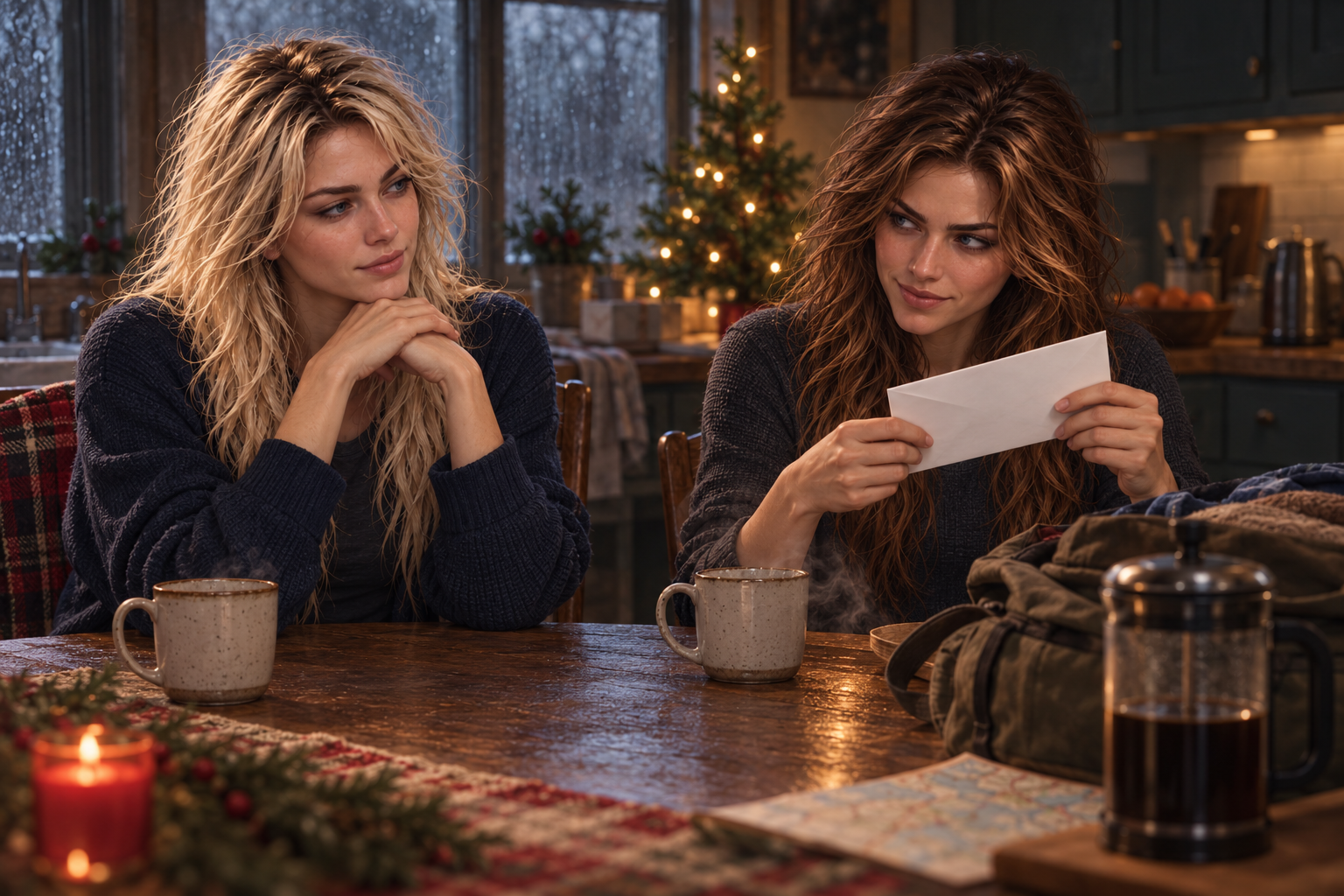
— end of chapter thirty-one —
January · the road south, and a convention floor
She did not open it until Nevada.
That was the rule. Val made it on Christmas morning and kept to it through the whole of the week after, through New Year’s, through the packing, through Kyra standing in the doorway of Val’s bedroom with a summer dress in each hand saying how warm, Val, how warm is warm, and Val, at her dresser, folding a cardigan into a perfect rectangle and saying only warmer than here.
“The state line,” she said, on the morning they left, in the dark, in Kyra’s driveway, with the car packed and the frost on the windshield. “Not before. When we cross into Nevada, you can open it.”
“That’s two days.”
“It’s a day and a half if I drive.”
“You always drive.”
“Then it’s a day and a half,” said Val, and held out her hand for the keys.
· · ·
So it was the road south again, the long way down out of Oregon, the way they had come the first time. Through the rain and out of it. Over the passes in the gray dawn, with the snow banked high on either side and the heater going. Down into the dry country, where the light went thin and gold and the sky got bigger and bigger until it was most of the world.
Kyra had the envelope in her coat pocket the whole way. She did not take it out. She put her hand on it sometimes, through the cloth, the way she put her hand on the pager when she was off duty, to know it was there.
“Is it a house?” she said, somewhere past Klamath Falls.
“No.”
“Is it a boat?”
“Why on earth would it be a boat?”
“Somewhere warm. Boats go somewhere warm.” Kyra thought about it. “Is it Mexico? Val. You won’t get on a plane. Is it a boat to Mexico?”
“It isn’t a boat,” said Val, “and it isn’t Mexico, and if you guess it before the line I’ll turn the car around.”
“You wouldn’t.”
“I’d think about it,” said Val, and drove exactly the speed limit all the way to the Nevada line.
· · ·
It was late in the afternoon of the second day when the sign came up out of the desert. Welcome to Nevada. Kyra had been watching for it for an hour, sitting up straight in the passenger seat like a child, and when it went by she had the envelope out of her pocket before Val had even said anything.
“Go on,” said Val.
Kyra tore it open.
· · ·
There were three things in it.
A hotel booking, printed out, for four nights, in Las Vegas, at one of the big new places at the north end of the street, under a name that was very nearly but not exactly Val’s name for the county.
Two passes for the convention. On lanyards. The same pink and gold as last time, a few years older in its design and a few years louder.
And two tickets, stiff and heavy and shining, on card so thick it would hardly bend, for the awards show. The big one. On the Saturday night, at the end of the convention, in the hotel’s theater. Admit One. Two of them.
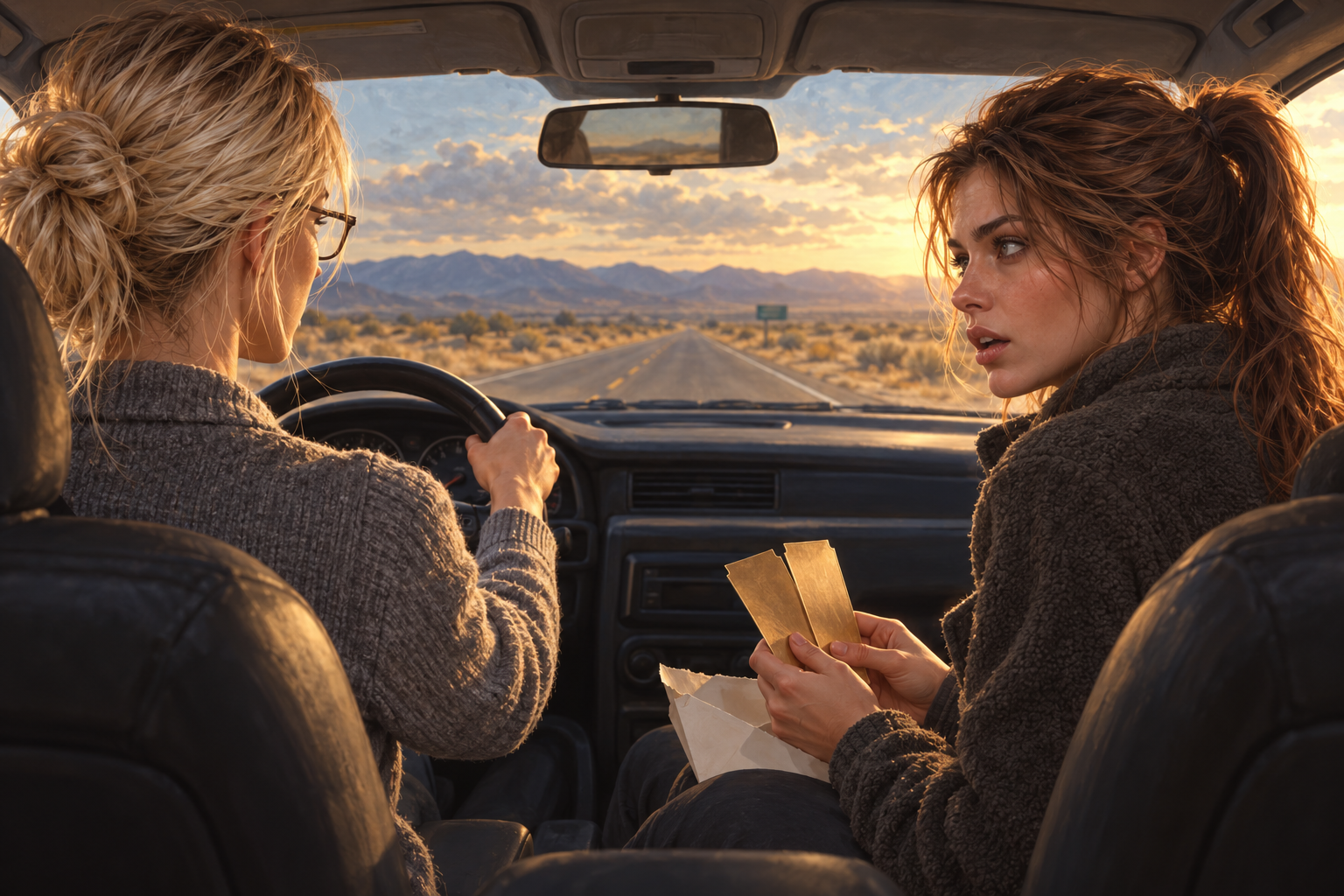
Kyra held them in both hands and looked at them for a long time.
“Las Vegas,” she said.
“Las Vegas.”
“Again.”
“Again,” said Val. “You said, last time, coming home, that they were braver than us. All of them. That they did it with their faces.” She did not take her eyes off the road. “I thought you’d like to see them again. And you missed the awards last time. You said so in the car. You said you wanted to see a room full of them all clapping for each other.”
“I did say that.”
“So.”
“And you planned this,” said Kyra slowly. “Since—”
“Since November,” said Val.
· · ·
Kyra looked at the tickets. Then at Val. Then at the tickets again.
“You hate Las Vegas,” she said.
“I hate Las Vegas.”
“You did an eleven-page risk assessment last time.”
“Fourteen this time,” said Val. “You’re not allowed to read any of it.”
“And you bought us awards tickets. For a room the size of a cathedral, all of them in the business, all of them looking at each other, and us in the middle of it, in the dark.” Kyra turned in her seat to look at her properly. “Val. Why?”
Val drove for a while.
“Because you’ve had a hard year,” she said at last. “Because you stopped reading the comments. Because of the letters.” She did not look away from the road. “Because I wanted to give you a room full of people clapping. That’s all. I can’t give you a witness. I’ve never been able to. But I can give you a room full of people clapping, and you can sit in it.”
· · ·
Kyra did not say anything.
She sat with the tickets in her lap and the desert going by, gold and enormous in the late light, and looked at Val’s profile against the window — the long patient face, the glasses, the hands at ten and two on the wheel — and knew, with the certainty of a very long time, that this was true, and that it was not all of it.
She could always tell. Not what it was. Only that it was there. A thing under the thing. A letter slipped into a drawer.
She thought about asking. She thought about it for about forty miles.
Then she put the tickets back in the envelope, carefully, and the envelope back in her pocket, and put her hand flat on Val’s knee, and left it there.
“Thank you,” she said.
“You’re welcome.”
“There’s something you’re not telling me.”
“Yes,” said Val.
“Is it bad?”
“No.”
“Will I like it?”
Val thought about this question longer than it seemed to need, with the sun going down red in the mirror.
“I think,” she said carefully, “you’ll find it very hard not to laugh.”
· · ·
The floor was the same.
That was the first thing. Kyra walked into the hall on the Wednesday morning with her lanyard on and her hair in a ponytail and her heart going, and it was the same — the same noise, the same light, the same airfield of a room full of booths and banners and bodies and music, the same smell of carpet and perfume and coffee and hot lights. It was in a different hotel, a bigger, newer one, all gold and glass at the north end of the street; but the floor did not care what building it was in. It was the floor. Kyra walked onto it and her whole body lit up exactly the way it had the first time, like a struck match, and she did not even try to stop it.
Val, a step behind her, in the gray cardigan, with the program folded in her hand, said nothing at all, and let her.
· · ·
The people were not the same.
That was the second thing, and it took Kyra most of the first morning to understand it properly.
She had expected to recognize faces. She had been looking forward to it, the whole drive down; she had made a list in her head. Roz with her red lipstick and her gray crop. The couple, Jonah and Teresa, who had taken so long to get their nights back. The girl in the pink wig at the sink. The two young men from the booth by the door who had argued, beautifully, for a whole afternoon, about lighting. She had wanted to see all of them. She had wanted to see what had happened to them.
And she found them. Some of them. And they were older.
· · ·
It should not have surprised her. She had lived her whole life among people getting older. It was the oldest thing she knew about this planet. Every street she had ever lived on, every town, every fire hall and library and wharf — she had watched it happen on all of them, a little at a time and then all at once, until one day the boy on the corner was an old man and the old man was a stone in a churchyard and she was exactly what she had always been.
But she had never seen it like this. Not in a few years. Not on a convention floor, in the bright hard light, with the gap between then and now only as long as it took to drive down from Oregon twice.
The two young men from the booth by the door had a bigger booth now, and a banner with their names on, and one of them had gone gray at the temples and the other had a beard and a belly and a wedding ring. A woman Kyra remembered from the first trip — a dancer, sharp and bright and very funny — was signing photographs at a table with her reading glasses pushed up into her hair, and when she laughed, the lines went all the way out from the corners of her eyes to her temples, and stayed.
And Kyra stood in the middle of the aisle in her ponytail and her jeans, with the same face she had worn last time — the same face, exactly, to the last freckle — and felt, for the first time on that floor, cold.
· · ·
“Val,” she said, very quietly.
“I know,” said Val, beside her.
“They’ve all—”
“I know, sweetheart. I saw it in the lobby.” Val did not look around. “It’s fine. Keep walking.”
“But if anybody—”
“Nobody here has ever seen our faces,” said Val, low, close to her ear, the way she said the risk assessment out loud, line by line. “Not on the channel. Not ever. They’ve seen masks and the back of a chair. There isn’t one person in this hall who could look at you and know they’d ever seen you before.” She put her hand very lightly on the small of Kyra’s back. “Except the ones we talked to. Last time. In the bar. In the booths.”
“Roz.”
“Roz,” said Val. “And the couple. And the girl.” She steered Kyra, gently, around a corner and into a quieter aisle. “Which is why it’s fourteen pages this time, and not eleven.”
· · ·
Kyra saw Roz on the Thursday.
She was across the hall, at a booth with a banner Kyra did not know — a production company, by the look of it, with Roz’s name on it in neat white letters, which had not been there before. She was sitting down behind a table, which she had not done last time; she had stood all day last time, and talked to everybody, and swore. The gray crop was white now. The lipstick was the same.
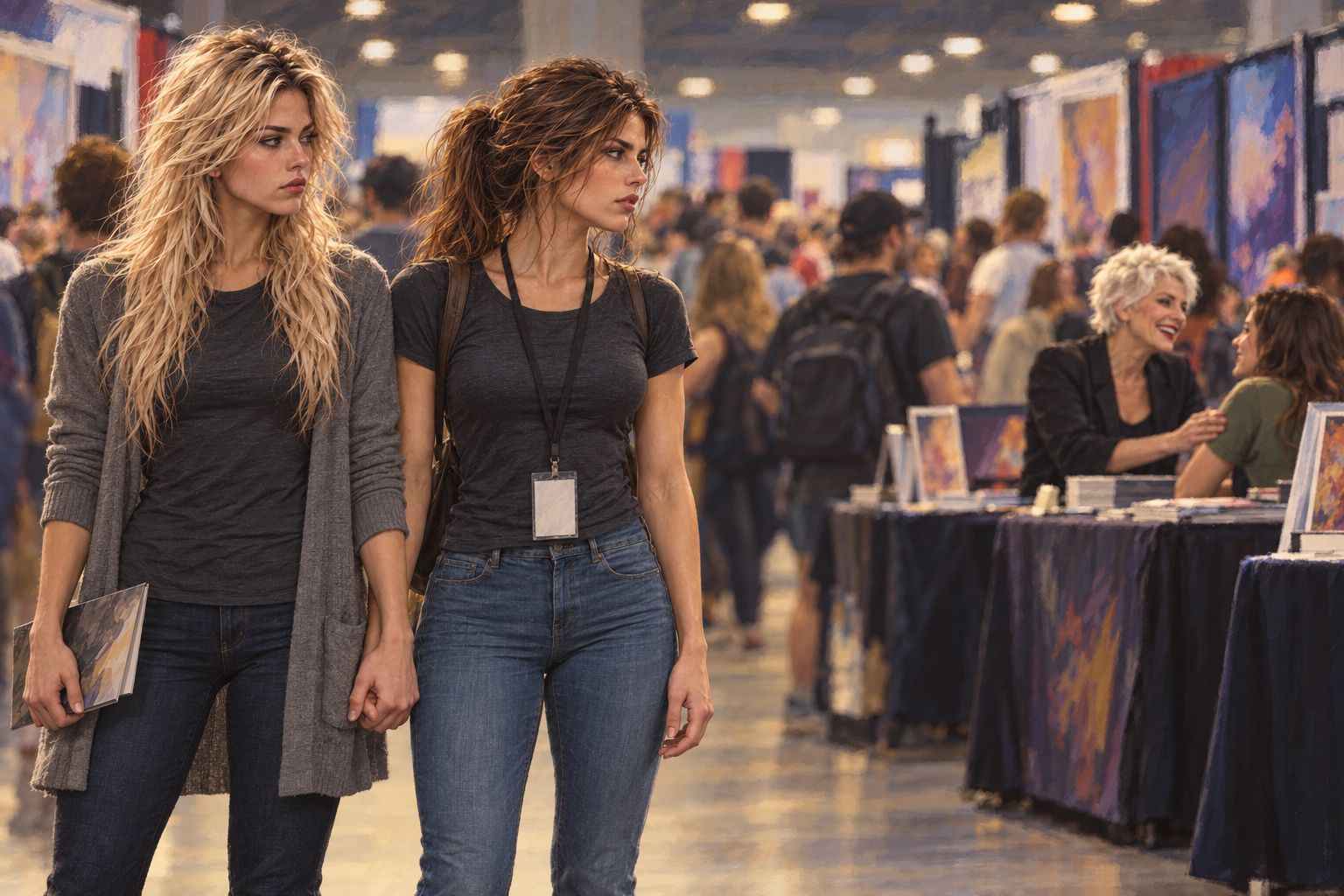
She was laughing at something a young woman across the table had said. She had her hand on the young woman’s arm.
Kyra stopped dead in the aisle.
“Don’t,” said Val, beside her.
“I wasn’t going to.”
“You were going to.” Val did not move. “I could see it in your shoulders.”
“I just want to say hello.”
“I know you do.” Val’s voice was very gentle. “She sat across a table from you in a bar for an hour, sweetheart. She looked at your face the whole time. She told you about the stuntman, and you told her about — about the thing you told her about. She liked you. She’ll remember you. And she’ll look at you.” Val paused. “And she’ll say, honey, you haven’t aged a day. And she’ll be joking. And then she’ll look again.”
Kyra did not say anything.
She stood in the aisle and looked across the hall at Roz, laughing, with her hand on a young woman’s arm, and her name on her own banner over her head, and the white hair. And she thought about the stuntman, and a key going into a lock in a hotel bar and turning, and about what that sentence had done for her, and how it had finally opened, more than a year ago, at Val’s kitchen table, with the gray notebook open.
Nobody thinks a stuntman’s really falling.
“I want to thank her,” Kyra said. “That’s all. She’ll never know what she did.”
“No,” said Val. “She’ll never know.”
They stood there a while longer. Then Val’s hand found Kyra’s, and held it — not laced, not anything, just a hand — and squeezed once, and Kyra let herself be turned around, and walked away down the aisle, and did not look back more than twice.
· · ·
She found out about the others the way you find out about everybody on a convention floor, which is by standing near the right booth and listening.
Jonah and Teresa were there. Kyra did not see them; she only heard, from a man at a booth selling lights, that they had their own little company now, the two of them, and only made things together, and had had a baby the spring before last, and brought pictures of her to everybody. They’re the happiest people in the business, the man said. It’s disgusting. Kyra had to walk away and stand behind a pillar for a while.
The girl in the pink wig was not there.
Kyra looked for her for two days. At the front, by the doors, where the booth had been. In the long lines. At every pink wig on the floor, and there were a great many. And then, on the Friday, she asked — carefully, casually, the way Val had taught her — a woman at a booth near the front, who looked as if she had been there a long time.
The woman thought about it. Then she smiled.
“Oh, her. She got out.” She shrugged. “Couple of years back. Went home. Went to school, I heard. Nursing, or something like it. Good for her.” She looked at Kyra a little more closely. “You a friend?”
“No,” said Kyra. “I met her once. In a bathroom.”
“That’s most of us,” said the woman, and laughed, and went back to her phone.
Kyra stood very still for a moment. Then she went and found Val, who was reading the program at a table by the coffee cart with her glasses on, and sat down across from her, and said, “She got out,” and put her face in her hands, and did not explain, and did not need to.
· · ·
There was one more thing, on the Friday afternoon, and Kyra did not think about it at all at the time.
She would think about it afterward. A great deal.
There was a crowd, near the back of the hall, around the end of an aisle where the camera people had their booths — the lighting companies and the lens makers and the people who built the rigs for the big studios. Not a crowd like the ones at the front, around the performers. A different kind. Quieter. People standing in a loose ring, the way people stand around something they want to be near and do not want to push at.
In the middle of it, sitting on a folding chair someone had brought her, was a woman with a cane.
She was older than most of the floor. Short silver hair, very close to the head. A dark coat, too warm for the room. Thin — thinner than her coat, Kyra thought, as if it had been bought for somebody larger. And people kept coming up to her. One after another. Young people, mostly, with lanyards that said CREW — bending down to her, and taking her hand, and saying something, and some of them crying a little, and her laughing at them, and patting their hands, and sending them off again.
Kyra slowed down, going past. She did not know why. Something in the shape of it. Something in the ring of people standing back.
“Who’s that?” she said to Val.
Val glanced over. “I don’t know. Somebody’s mother, by the look of it.” She did not stop walking. “Come on. You wanted to see the pillow booth before it closes.”
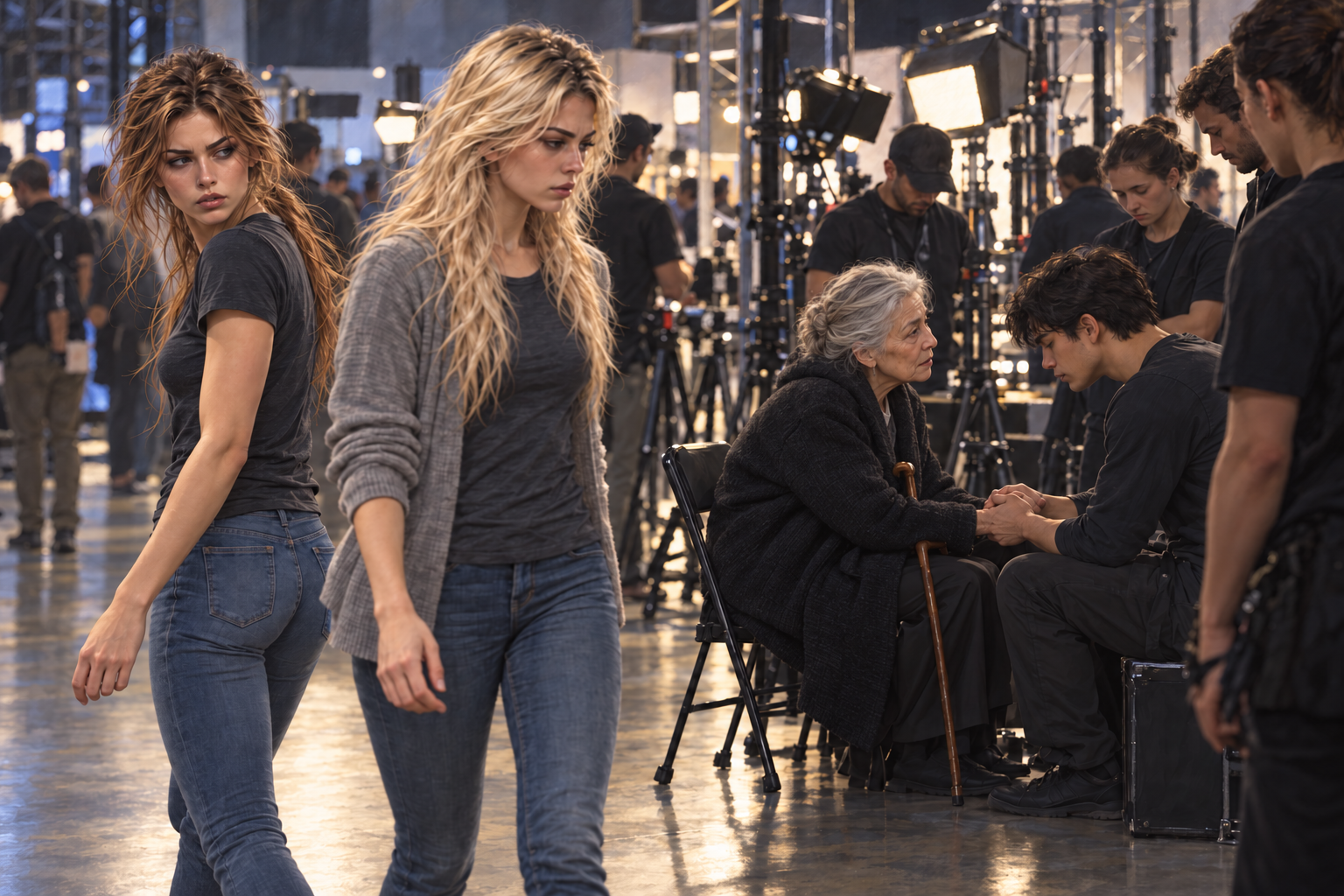
And Kyra, who did want to see the pillow booth, went.
She looked back once. The woman in the folding chair was holding a young man’s hands in both of hers, and saying something to him, close, very seriously; and he was nodding, and nodding, with his eyes shut.
Then the crowd closed around her, and Kyra turned the corner, and that was all.
· · ·
That night in the hotel room, with the curtains drawn against the lights and the whole of the strip going on outside like a fire nobody would ever put out, Kyra lay with her head on Val’s shoulder and said:
“Tomorrow.”
“Tomorrow,” said Val.
“The awards.”
“The awards.”
“And you’re going to tell me what you’re not telling me.”
“No,” said Val. “I’m not going to tell you.” Kyra felt her smile, in the dark, against her hair. “You’re going to find out.”
“Is that better?”
“Much,” said Val. “Go to sleep.”
Kyra did not go to sleep for a long time. She lay in the dark with the lights coming through the gap in the curtains, and thought about Roz’s white hair, and a girl in nursing school who had got out, and a baby nobody could stop showing pictures of, and the two of them, Kyra and Val, exactly as they had been, to the last freckle, in a city where everybody else had kept on going.
And then she thought about tomorrow, and a room full of people clapping, and Val’s face in the car saying you’ll find it very hard not to laugh.
And she found that she was smiling into the dark, and could not stop.
— end of chapter thirty-two —
January · a theater in Las Vegas, row twelve
Val wore black.
Kyra had never seen her in it. Not in this century, not on this planet, not at a funeral or a party or anywhere at all. Val wore gray. Val wore navy, at a stretch, and a dark green cardigan on Thursdays. Val had a horror of black that went back further than Kyra had ever asked about, and she had once said, in a city that was gone now, that it was the color people put on so that nobody would look at them, and that it never worked.
And on the Saturday night in Las Vegas she came out of the hotel bathroom in a long plain black dress with sleeves to the wrist and a high neck, her hair up in the county knot, no jewelry, no color on her face at all; and stood in the doorway and said, “Well?”
Kyra, on the edge of the bed with one shoe on, did not say anything for some time.
“You look,” she said eventually, “like a widow at a very expensive funeral.”
“Good,” said Val. “That’s what I was going for.” She came and sat on the bed beside her and picked up the other shoe and held it out. “Nobody looks twice at a widow. They’re afraid she’ll talk to them.”
· · ·
Kyra wore green.
It had been in the bottom of her suitcase since Oregon, and she had not known why she had packed it until she saw Val in the doorway in black. A dark green, nearly the color of the fir on the ridge, with bare shoulders and a skirt that moved. She put her hair up, and then took it down again, because Val looked at her when she put it up and said nothing, and that meant down.
“You don’t want anybody to look at you,” said Kyra, in the mirror.
“I don’t want anybody to look at me,” Val agreed. “I want everybody to look at you.” She stood behind Kyra in the glass, in her widow’s black, perfectly still. “If they’re all looking at the redhead in the green dress, nobody’s going to wonder who she came in with.”
“That’s not why you want everybody to look at me.”
Val did not answer that. But in the mirror, Kyra saw her mouth do something it almost never did in company, which was very nearly smile.
· · ·
The theater was in the hotel, at the end of a long gold corridor full of people in clothes that cost more than Kyra’s car. It was enormous. Tiers of red seats going up into the dark, and round tables on the floor at the front for the people who mattered, and a stage with a great screen behind it and lights hung above it like a second ceiling. And everywhere, people. More people in one room than lived in the whole of Calderveil and the two towns either side of it. Performers in gowns and suits and very little. Directors. Agents. Crew in black. Fans in their best, with their lanyards still on, looking around with their mouths open.
Their seats were in row twelve.
Not at a table. Up in the tiers, a little way back from the front, on the aisle, in the dark. Val had chosen them. Kyra knew without asking that Val had sat at a screen in November with a seating plan of this exact theater and looked at every seat in it, and picked these two for reasons that ran to a page and a half.
“Why here?” said Kyra, sitting down.
“Close enough to see,” said Val. “Far enough not to be seen. On the aisle, in case.” She folded her hands on her black knees. “And it’s twelve rows. I like twelve.”
“Since when?”
“Since about four minutes ago,” said Val, and the lights went down.
· · ·
It went on for a very long time.
Kyra had not known that. She had imagined — she did not know what she had imagined. Something quick and bright. It was not quick. It was three hours, nearly, of people walking up onto a stage and walking off again, and a host who was a comedian Kyra had never heard of, very fast and very rude and very funny; and music, and clips on the great screen that had been cut so carefully that nothing in them could have shocked anybody’s grandmother, and envelopes, and names, and people crying, and people thanking their mothers, and their agents, and their dogs, and their fans, and, once, their surgeon.
Kyra loved every minute of it.
She sat on the edge of her red seat with her hands clasped in her lap and watched them all go up — every one of them, one after the other, with their faces and their names on, into the light — and clapped until her hands hurt. She clapped for the ones she had seen on the floor and the ones she had never heard of. She clapped for a woman who won something in a category Kyra did not understand and burst into tears before she had got to the stairs. She clapped for a very old man who had made films before Kyra had come to this country under her present name, who walked up very slowly, and said three words, and walked off to a standing ovation.
And beside her, in the dark, in her widow’s black, Val sat perfectly still with her hands folded, and watched Kyra clap.
· · ·
About halfway through, they turned the lights down further, and the room went quiet in a different way.
A man came out alone. Not a performer. Not the comedian. A big gray-bearded man in an ordinary suit, the kind of man you saw behind a camera, not in front of one, who stood at the microphone for a moment and did not say anything and looked out at the room as if he was looking for somebody.
“This next one,” he said, “isn’t in any category. We don’t have a category for it. We’ve never had one. And after tonight I don’t think we’ll ever need one again.”
The room was very quiet.
“Most of you have never seen her face,” he said. “That’s the job. That’s what we do. Most of you have spent years being looked at. She spent hers looking. Behind the lens. In the dark. Making you look the way you wished you looked. Making the light fall the way you wished it fell.” He paused. “Half the camera operators in this room learned from her. I did. I was a kid and an idiot and she put her hand on my shoulder on a set in the Valley and said, Slow down, son, you’re chasing it. And I’ve been slowing down ever since.”
A sound went around the room. Not quite a laugh.
“She came over from Glasgow with a suitcase and a light meter,” he said. “And she never went home. She shot more of this industry than anybody alive, and she never once put her name in the front of a single frame of it. And tonight—” He stopped. Looked down. Looked up again. “Tonight, for the first time, and because she’d kill me if I said anything else, we’d just like to say thank you.”
He turned to the side of the stage.
“Iris Sancai,” he said.
· · ·
The whole room stood up.
All of it. At once. Kyra was on her feet before she knew she had moved, and so was Val beside her, and so was every person in every red seat in every tier, all the way up into the dark; and the sound of it was not like the clapping for the others. It was bigger. It came from further down. It went on, and on, and did not stop, and did not stop.
And out from the side of the stage, very slowly, on a cane, came a thin woman with short silver hair, in a dark coat too warm for the room.
Kyra’s hands stopped for half a second.
“Val,” she said. “It’s—”
“The folding chair,” said Val, beside her. “Yes. I see.”
“Somebody’s mother,” said Kyra.
“Everybody’s, it seems,” said Val quietly, and went on clapping.
· · ·
It took the woman a long time to reach the microphone. Nobody hurried her. The big gray-bearded man went to meet her halfway and gave her his arm, and she took it, and they came across the stage together at her pace, and the whole room stood and clapped the entire way.
She reached the microphone. She stood there for a moment, holding on to the stand with one hand and the cane with the other, and looked out at the room — not at the room, Kyra thought. Through it. Up into the tiers. The way you look at a landscape you are going to be leaving.
The clapping went on. She let it. Then she lifted one hand, a little, from the stand, and it stopped at once, the way a whole hall full of people goes quiet for a teacher.
“Thank you,” she said.
Her voice was low and dry and very Scottish still, after all of it.
“I’ve had the best seat in the house,” she said. “For all of it. Every one of you.” She looked out at them a moment longer. “Look after each other.”
And that was all.
She let go of the stand, and took the big man’s arm again, and turned around, and went back the way she had come, slowly, on the cane; and the room stood and clapped her the whole way off, and for some time after she had gone.
· · ·
Kyra sat down. She found that she was crying a little, and did not know why. She had never seen the woman before the Friday afternoon. She did not know her. She had only seen her on a folding chair, with young people taking her hands.
“Look after each other,” she said.
“Yes,” said Val.
“She’s ill. Isn’t she. That’s why they all—”
“Yes,” said Val. “I think so.” She was looking at the empty stage, at the place where the woman had stood. “I think that was a goodbye.”
Kyra looked at her. That’s a goodbye. She had heard Val say it before, in a bed, in November, about a letter.
But the lights were coming up again, and the comedian was back, very fast and very rude, saying well, how do you follow THAT, and the room was laughing with its eyes still wet, and the thought went past her and was gone.
· · ·
It was nearly the end when it happened.
Kyra had stopped paying close attention by then. She had clapped for three hours and cried for one woman, and her hands hurt, and her feet hurt in the shoes, and she was leaning against Val’s shoulder in the dark, half listening to two performers in matching silver read out a list of names for something to do with fans.
“Our next award,” said one of them, “is fan-voted. That means you did this, people. Not us. Don’t blame us.”
Laughter.
“It’s for independent creators,” said the other. “The ones who do it themselves. No studio, no crew, just a camera and a dream and, apparently, according to the voting numbers, a frankly terrifying amount of organization in the comment sections.”
Laughter, louder.
“The category,” said the first one, “is Best Chemistry: Independent.”
· · ·
Something happened to Val’s shoulder under Kyra’s cheek.
It did not move. That was what it did. It went perfectly, completely, deliberately still, the way a deer goes still in a field when it hears a car door; and Kyra, who had been resting her head on that shoulder for longer than this country had existed, lifted her head at once and looked at Val’s face.
Val was looking straight ahead at the stage. Her face was doing nothing at all, as hard as it could.
“Val,” said Kyra.
“Watch the stage, sweetheart.”
“Val.”
“Watch the stage,” said Val, very quietly, and took Kyra’s hand in the dark, and held it.
· · ·
They read the names. There were five. Kyra did not hear the first two. She heard the third, because it was the name of a couple she had seen on the floor that morning, laughing at a booth — two men from Montreal who did everything together and posted it on a site she knew. She heard the fourth, which she did not know.
And then the woman in silver looked at her card and said, with a little wicked lift in her voice that told Kyra she had been waiting for this one all night:
“And The Girls from Andromeda.”
· · ·
The room roared.
Kyra had not been ready for it. Nobody could have been ready for it. It came up from every seat at once, from the tables at the front and the tiers at the back and everywhere between — not clapping, not cheering, a roar, the sound a stadium makes, with whistles in it, and laughter in it, and somebody up in the dark near the ceiling bellowing something Kyra could not make out.
On the great screen behind the stage, the clip came up.
They had cut it carefully. Of course they had. It was the room that was nowhere, from behind, and the cream wall, and the lamp low and warm from the left. And the chair. The plain wooden chair, facing the wall, in the middle of the floor; and on it, from behind, the back of a redhead’s head, and astride her, facing her, the long pale line of a woman’s back, with a braid down the middle of it, and nothing else visible at all — rolling, slow, in that long continuous circle, the braid swinging a little. And on the edges of the frame, around the blonde’s shoulders and arms, the faint gray bloom of a light that nobody in that whole enormous room could explain.
Five seconds. No more.
And from somewhere up in the dark at the back of the theater, a man’s voice, enormous, delighted, carrying over everything:
“SEVENTEEN INCHES!”
· · ·
The room came apart.
Kyra felt it go — a wave of laughter that started at the back and came down through the tiers and broke over the tables at the front, and the two women in silver on the stage were bent over each other laughing, and the comedian, somewhere off to the side, was shouting the REST is TECHNIQUE into a microphone that was not on.
And Kyra—
Kyra felt it come up.
· · ·
It came from the bottom of her, the way it always came, from somewhere under her ribs. Seventeen inches. In that voice. In this room. A chair from a house in Portland with the laundry on it, on a screen the size of a barn, and a whole theater full of the most beautiful, shameless, professional people on the planet laughing at it, and loving it, and somebody at the back bellowing Val’s sentence into the dark like a war cry—
It came up into her chest, and into her throat, and she felt her face start to go, and she knew — she knew — that if it got out, it would get out the way it always got out. Enormous. Famous. Every person on that floor last time had turned around to hear it; it had nearly given them away by a booth with a T-shirt on it. And there were people in this room who had heard it then. And people in this room who had heard it in the dark on their phones, at the end of every video, for years.
She clamped her jaw shut.
She shut her eyes. She pressed her lips together so hard they hurt. Her whole body shook with it, silently, in the red seat, with her free hand pressed flat over her mouth, and her eyes streaming, and her shoulders going, and not one single sound coming out—
And Val’s hand, in hers, in the dark, squeezed.
Once.
Not tonight.
· · ·
It was not laced. It could not be; they were in a theater, in a crowd, in the dark, in their clothes. There was no grip. There was nothing at all between them but two hands, and the ordinary pressure of one closing on the other, the way any two people in any theater on the planet might have held hands at a sad moment in a film.
But Kyra heard it anyway. As clearly as if it had been said.
Not tonight. Hold it. I’ve got you. Not tonight.
She held it.
· · ·
“And the winner,” said the woman in silver, when she could speak again, wiping her eyes, “of Best Chemistry: Independent—”
She opened the envelope. She looked at it. She looked up at the room, and her face did something wonderful.
“Well, I don’t think this’ll surprise anybody,” she said. “The Girls from Andromeda.”
· · ·
If the room had roared before, it did something else now. Kyra did not have a word for it. It was the whole theater on its feet again, as it had been for Iris Sancai, but louder, and wilder, and full of laughter; people standing on chairs at the tables at the front, and the comedian dancing, and somebody up in the tiers starting a chant — CHAIR! CHAIR! CHAIR! — that half the room took up before the other half shouted them down.
Kyra stood with the rest of them. She could not have done anything else. She stood in row twelve in her green dress with her hand over her mouth and her eyes streaming and her whole body shaking, silently, with a laugh she was holding in by main force, and Val stood beside her in widow’s black, clapping slowly, perfectly politely, without a flicker.
And on the stage, the music came up for the winner’s walk.
· · ·
It was a short piece of music. Bright and brassy and triumphant, the same few bars they had played for every winner all night, to carry them up the steps and across the stage to the microphone.
It played.
And a spotlight came on. A single white circle, from somewhere high up at the back, the way it had come on for every winner, to find them in their seats and follow them up. It swept down across the tables at the front. It swept across the first tiers. It went along row three, and row seven, and row nine, slowly, searching, the way a lighthouse beam goes across the water looking for a boat—
It went straight across row twelve. Across Kyra in her green dress, and Val in her black, both of them standing and clapping like everybody else. And did not stop. And went on, up into the dark, and around, and back again, across the whole room, finding nobody.
The music played on. Nobody walked.
· · ·
The room began to laugh again. Kyra heard it start, all over the theater, a different laugh this time, warm and knowing. The spotlight went around once more and gave up and came to rest in the middle of the empty stage, on nothing, a white circle on the black floor, with the music still playing over it.
And the woman in silver leaned into the microphone, and let a little pause go by, and said:
“Well. I’m told they couldn’t be with us tonight.”
Another pause. She looked out at the room. She let her eyes go slowly along the tiers, from one side to the other, up into the dark.
“Or could they?”
· · ·
The room screamed.
Laughing, all of it, every seat, people turning around in their chairs to look behind them, people pointing at each other, people shouting IT’S YOU and SHE’S IN THE BALCONY and it’s AI, they’re not REAL; a woman two seats along from Val turning to the man beside her and grabbing his arm and saying oh my God what if they’re HERE, what if they’re right HERE—
And Kyra, in row twelve, with Val’s hand in hers, very nearly died.
She did not make a sound. She could not afterward remember how she had not. She stood there with every muscle in her body locked and her face buried in her free hand and tears running down her wrist, and laughed, and laughed, without any noise at all, like a woman being shaken by somebody very large and very fond of her—
And Val squeezed her hand again. Once.
And then, very slightly, so that nobody in the world but Kyra could possibly have felt it, she squeezed it a second time. Not not tonight. Something else.
I know. I know. Isn’t it wonderful.
· · ·
“We’ll hold on to this for them,” said the woman in silver, lifting the trophy — a gold figure on a black base, gleaming under the light — and setting it down carefully on a little table at the side of the stage. “If you’re watching, girls — and I bet you are — it’s here. It’ll always be here. Come and get it whenever you like.”
And she winked, at nobody, at the whole dark room, and the music played them off.
· · ·
The rest of it went by Kyra in a blur.
There was more. There were more envelopes, and more names, and a big award at the very end for a woman who had done something extraordinary in a year Kyra did not hear the details of, and confetti from the ceiling, and everybody on their feet again. Kyra clapped for all of it. She did not take any of it in. She sat in row twelve with her hand in Val’s and her face still wet and every few minutes another wave of it would come up in her, silent, and shake her, and pass.
And when the lights came up at last, and the room began to move, and the long gold corridor began to fill with people in clothes that cost more than her car, she stood up very carefully, on legs that did not entirely belong to her, and looked at Val.
“You knew,” she said.
“I knew.”
“Since—”
“Since the morning of the last letter,” said Val. “In bed. The comments went off. Tallyman’s won something.” She picked up her small black bag from the seat. “He had, too. He’d won us a nomination. He’d done the math.”
“And you bought the tickets. And you didn’t tell me. For two months.”
“It was the only surprise I’ve ever given you,” said Val. “I wanted it to be a good one.” She looked at Kyra steadily. “You could have said no. In the car. At the line. We could have turned around. I’d have taken us home and never said why.”
“I know.”
“So it was allowed.”
“It was allowed,” said Kyra, and her voice went, and she put both arms around Val’s neck in the middle of row twelve with the whole theater filing out around them, and held on.
· · ·
They did not go to the afterparty.
Not that night. Kyra could not have. She knew that if she walked into a room full of those people now, with SEVENTEEN INCHES still ringing in her ears and the spotlight still going around and around behind her eyes, she would not last thirty seconds; it would come out of her the way the sun comes up, and everybody would turn around, and that would be that.
So they walked out of the theater with everybody else, slowly, in the crowd. And in the long gold corridor, behind them and beside them and all around them, people were talking about it.
· · ·
— can’t BELIEVE they didn’t come —
— well, they COULDN’T, could they, the whole point is nobody knows —
— I heard they’re Swedish. Somebody at one of the big studios said they’re definitely Swedish —
— they’re Russian. The blonde’s got a Russian bone structure, you can see it from the back —
— you cannot see bone structure from the BACK —
— I heard they’re two actresses. Real ones. Like, mainstream. And they use body doubles for the —
— nobody uses a body double for this long —
— I think they’re AI —
— oh, not this again —
— no, seriously, the light. Nobody can explain the light. My guy in post says there’s no way that’s practical. It’s generated. The whole thing. There are no girls —
· · ·
Kyra, walking, felt Val’s hand tighten on her arm.
They had come level with a little group by the doors — two men in good suits and a woman in a sequined dress, arguing pleasantly, drinks in their hands. The woman in sequins was the one who had said AI. She was laughing at the men, who did not believe her.
And Val — Val, in her widow’s black, who did not speak to strangers, who did not speak to anybody in a crowd if she could possibly help it — stopped, very slightly, beside them, and said, in her county voice, perfectly level and very pleasant:
“I’m afraid she’s right, you know. I read about it. They’re generated. Both of them. It’s quite a clever program.”
The woman in sequins turned around, delighted. “Thank you. See? Thank you.”
“It’s the light that gives it away,” said Val. “Nothing real looks like that.”
“That’s what I said.”
“Well,” said Val, “you were right,” and smiled at her, very slightly, and walked on, with her hand on Kyra’s arm.
· · ·
Kyra made it to the elevators.
She made it into one, and the doors closed, and they were alone in a small gold box going up thirty floors with a mirror on every wall; and she turned around, and looked at Val in the mirror, and Val looked back at her, in her widow’s black, with her face doing nothing at all.
“Nothing real looks like that,” said Kyra.
“It doesn’t,” said Val. “Does it.”
And Kyra let it go.
All of it. Everything she had held in for three hours, in row twelve, in the dark. The spotlight and the chair and SEVENTEEN INCHES and or could they and the woman two seats along grabbing her husband’s arm. It came out of her in one great enormous shout of a laugh that hit the gold walls of the elevator and came back off every one of them, and went on, and on, all the way up thirty floors, while Kyra slid down the mirrored wall to the floor in her green dress with her hands over her face; and Val stood over her in black, holding the rail, and made the small breath through her nose, once, and then again, and then again, and then — for the first time Kyra could remember anywhere outside a closed door — put her forehead against the mirror and shook with it, silently, all the way up, exactly the way Kyra had in row twelve.
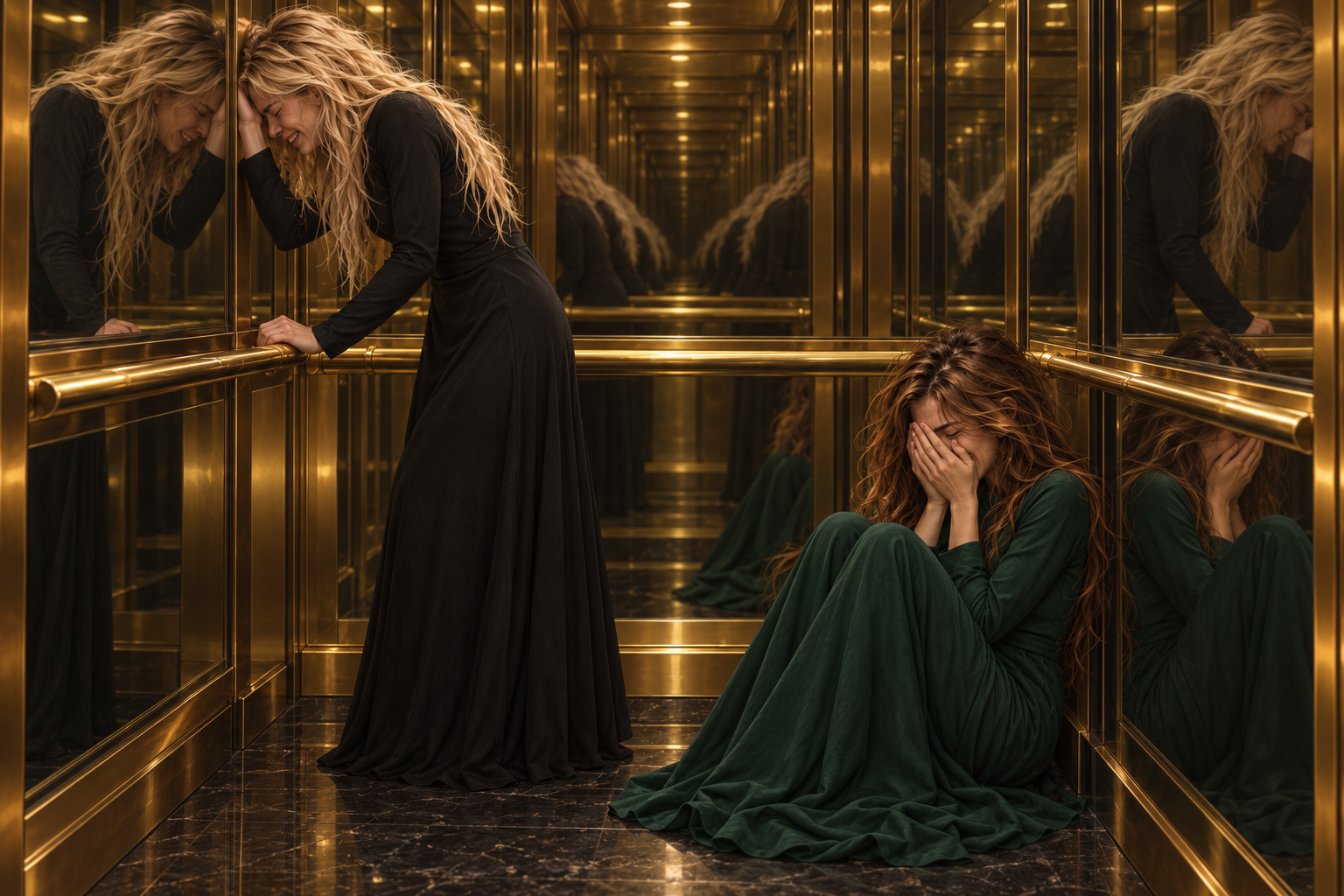
· · ·
That night, in the hotel room, with the curtains drawn against the lights, Val sat up in bed with her glasses on and her laptop on her knees, and wrote the post.
Kyra lay beside her with her head on Val’s shoulder and watched her write it. It took a long time. Val wrote a great deal, and deleted all of it, and wrote a great deal more, and deleted that. And in the end, at two in the morning, there were five words on the screen, and she read them out loud, once, and Kyra said yes.
It went up under the channel’s name, on the front page, where everybody could see it. Not in the back room. On the front, for everyone.
Thank you. Keep it for us.
—B
· · ·
KEEP IT FOR US
I’m crying in a Denny’s
they WATCHED. they were WATCHING. “keep it for us” means they were watching
or they were THERE. “or could they” was NOT a joke
Tallyman. TALLYMAN. you did this
Tallyman you magnificent spreadsheet
the trophy is just going to sit in Vegas forever with nobody to pick it up and I’ve never been so emotional about an object
it’s not sitting there with nobody. it’s sitting there FOR them. that’s different
keep it for us
keep it for us
· · ·
And Tallyman’s spreadsheet, the next morning, had a new row at the very top, above everything — above the records and the averages and the pot that was still waiting — in gold, which he had never used before and would never use again.
Best Chemistry: Independent. WON. Not collected. Status: kept.
— end of chapter thirty-three —
January · a hotel bar in Las Vegas, and the road north
They went down to the bar on the Sunday because Kyra could not bear to leave without it.
“One drink,” she said, in the room, in the late afternoon, with the suitcases already packed and standing by the door for the morning. “Just one. With them. I didn’t go last night. I couldn’t. And tomorrow we’re in the car and it’s the desert and then it’s the rain and the fire hall and the library and nobody, Val, nobody, for another—” She stopped. “One drink.”
Val looked at her for a while from the armchair by the window, with the strip going on outside behind her in the last of the light.
“You’ll laugh,” she said.
“I won’t laugh. I laughed. I laughed for thirty floors. There’s none left.”
“There’s always some left, with you,” said Val. But she put her book down, and went and found her cardigan.
· · ·
The bar was off the main lobby, low and dark and gold, with deep leather booths around the walls and a long counter down the middle, and on the last night of the convention it was full of the business.
Not the floor crowd. Not the fans with their lanyards. These were the people who had been at the tables at the front the night before, and the people who had been behind the cameras for the clips, and the people who had built the stage and hung the lights — sitting in the booths in their ordinary clothes, tired and loose and fond of each other, at the end of a long week. Kyra could feel it as soon as she came through the door. It was the feeling of a fire hall at the end of a long call, when everybody is home and nobody is hurt and somebody has made coffee.
She stood in the doorway and breathed it in.
“There,” said Val, behind her, and steered her to a small table against the wall near the back, half in the shadow of a pillar, with a good view of the room and nobody at the tables either side. Of course she did.
Kyra had a glass of wine. Val had a soda water with a slice of lime in it, which she did not drink. They sat side by side against the wall, the way they had sat in a great many bars in a great many cities, and watched.
· · ·
It was a long time before Kyra noticed the booth in the corner.
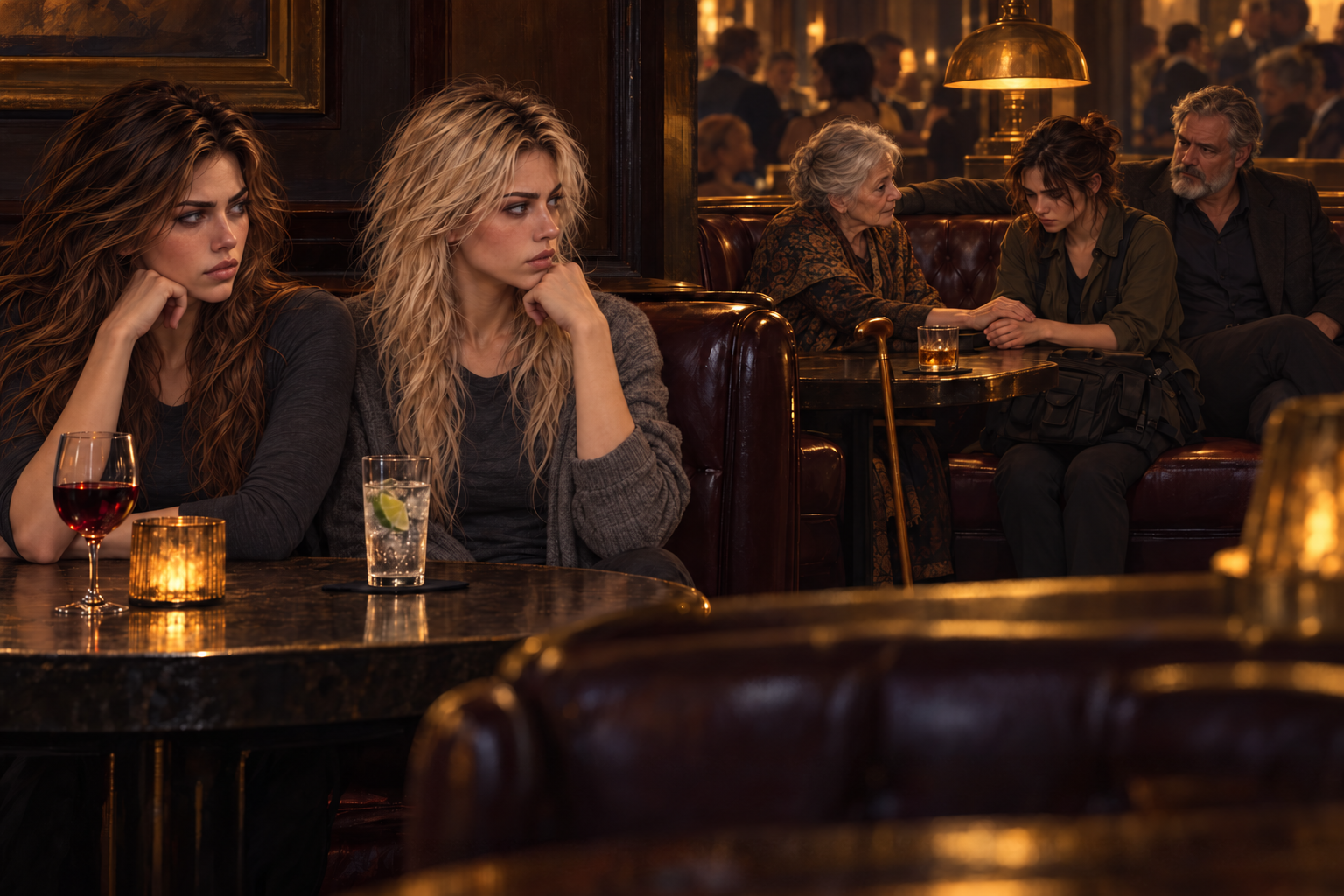
It was the biggest booth in the bar, deep and curved, at the far end of the room under a low gold lamp; and it had more people in it than it was meant to hold, and more standing around the outside of it, and more coming and going. Crew, most of them. Kyra could tell crew anywhere now. Black clothes, practical shoes, the hands. They were laughing, in the booth, in the slow warm way of people who have known each other a long time.
And in the middle of them, in the deepest part of the curve, with her cane leaning on the table beside her and a glass of something amber in front of her that she was not drinking either, was a thin woman with short silver hair.
“Val,” said Kyra.
“I see her.”
“It’s—”
“Iris Sancai,” said Val. “Yes.” She turned her soda water a quarter turn on the table. “The best seat in the house.”
· · ·
They watched for a while. They could not have helped it.
The woman in the corner did not do very much. She sat. She listened, mostly. People leaned in to talk to her, one after another, and she listened to every one of them with her head a little on one side, completely, as if there were nobody else in the room. Now and then she said something, and whoever she said it to would laugh, or go quiet, or — once — put both hands over their face. A big man Kyra recognized from the stage the night before, the gray-bearded one, sat at the end of the booth with his arm along the back of it, behind her, not touching her, the way you might put your arm along the back of a bench behind somebody you were afraid would fall.
“She’s tired,” said Kyra.
“She’s very tired.”
“They all know. Don’t they. Every one of them.”
“I think everyone in this room knows,” said Val quietly, “except us.”
· · ·
It was nearly nine when the young woman came.
Kyra noticed her because she was the only one in the bar who looked frightened. Very young, in black like the rest of them, with a cheap lanyard still around her neck that said CREW and a camera bag over her shoulder that she had clearly not put down all week; and she stood at the edge of the crowd around the corner booth, not quite coming in, holding the strap of the bag in both hands.
The gray-bearded man saw her first. He said something to the woman in the middle of the booth, and the woman looked up, and saw the girl, and lifted one hand off the table — the same small movement Kyra had seen her make on the stage, that had quieted a whole theater — and beckoned her.
The girl came in. People shifted to make room. She sat down on the very edge of the booth, across the table from the woman with the silver hair, with the camera bag on her knees, and began to talk.
Kyra could not hear her. The bar was too loud and they were too far away. But she could see it — the hands going, too fast; the face, too earnest; the whole body leaning forward across the table. Something had gone wrong, Kyra thought. A job. A shot. Something she had missed, this week, that mattered, and she had been carrying it around the floor for days, and had finally worked up the courage to bring it to the one person in the building she thought might understand.
The woman listened. All of it. Without interrupting. With her head a little on one side.
And when the girl ran out of words, at last, and stopped, and sat there on the edge of the booth with her hands clenched on the camera bag, the woman reached across the table and put her own hand over both of the girl’s.
The bar happened to go quiet, just then. The way bars do sometimes, for no reason, all at once, for a second or two — the music between songs, the counter between orders, every conversation in the room landing on a period at the same moment.
And into the quiet, low and dry and very Scottish, carrying further than she could have meant it to, the woman with the silver hair said:
“You’re in a hurry, pet. Everybody in this business is in a hurry. They race toward the thing they think the audience came for, and they get there, and they miss it.” She patted the girl’s hands. “Stop chasing it. Wait. Let it come to you.”
· · ·
Then the music came back, and the counter, and the conversations, and the room was as loud as it had been.
Kyra did not hear any of it.
She was looking at Val.
· · ·
Val had gone still.
Not the stillness of the theater, when the category was read — the deliberate stillness of a woman holding a secret. This was something else. Kyra had seen it perhaps three times in all the years there had been. It was the stillness of a woman who has been hit, very hard, somewhere no one can see, and has not yet fallen down.
She was sitting exactly as she had been sitting. Her hands were flat on the little table on either side of the soda water. Her back was straight against the wall. Her face was doing nothing at all.
And all the color had gone out of it.
“Val,” said Kyra.
Val did not answer.
“Val.”
“Not here,” said Val. Her voice was perfectly level and almost nothing. She stood up. She did not look toward the corner booth. “Upstairs. Now. Please.”
· · ·
She did not say anything in the lobby, or in the elevator, or in the long gold corridor. She walked very fast with her eyes straight ahead, and Kyra half ran beside her in her flat shoes, and did not ask. She knew better than to ask.
Val let them into the room. She shut the door. She put the chain on, which she never did. And then she sat down on the end of the bed, in her cardigan, with her hands on her knees, and looked at the carpet, and said, to the carpet:
“It’s her.”
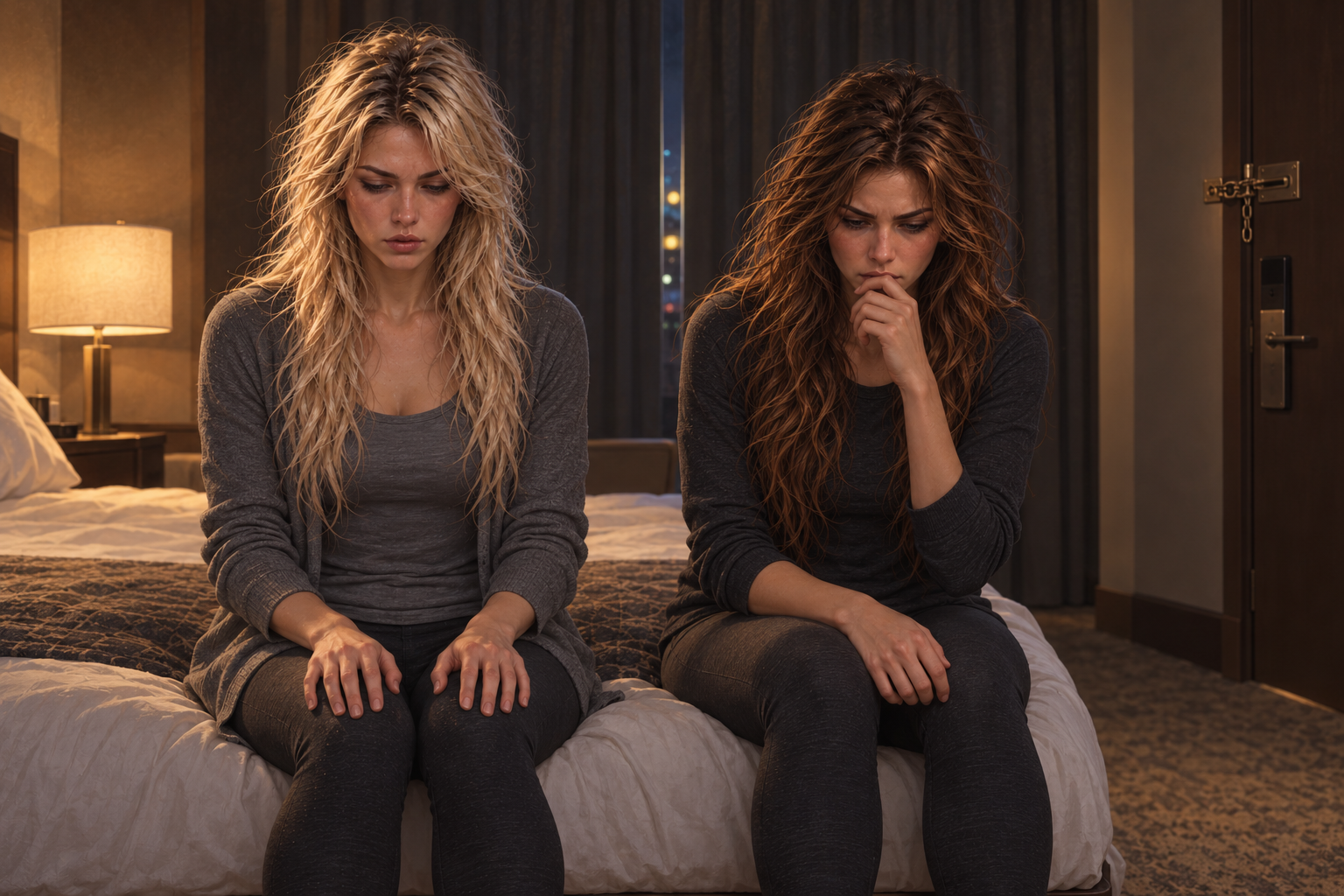
· · ·
Kyra stood by the door.
“Who?”
“You know who.”
“I don’t—”
“You’re in a hurry,” said Val. “Everybody in this business is in a hurry. They race toward the thing they think the audience came for, and they get there, and they miss it.” She did not look up. “Let it come to you.”
The room was very quiet. Outside the window, thirty floors down, the strip went on burning.
· · ·
“No,” said Kyra.
“Yes.”
“Val, no. It’s a — it’s a saying. It’s the kind of thing people say. Let it come to you. People say that to each other on golf courses. Fishermen say it about fish.” She heard her own voice going higher and could not stop it. “It’s an expression. A woman in a bar says an ordinary expression to a scared girl, and you’ve— you’ve built a whole—”
“Most people in your line of work are in a hurry,” said Val. “I don’t mean that unkindly; it’s what the work asks for. Everybody’s racing toward the moment they think the audience came for, and they get there, and the camera gets there, and it’s over. I’ve spent most of my working life watching people hurry toward the thing they want to see, and miss it.”
Kyra stopped.
“The first letter,” said Val. “The end of September. Ten past three in the morning. You read it to me in bed and then you read it again, slowly, because I asked you to.” She lifted her head, at last, and looked at Kyra from the end of the bed. “I’ve had it by heart since that morning. I’ve had every one of them by heart. You know I have.”
· · ·
Kyra did not move from the door.
“Racing toward the thing they think the audience came for,” she said slowly.
“Toward the moment they think the audience came for. In the letter. In the bar, the thing. Near enough. The same sentence, Kyra. The same shape. And miss it at the end, both times, after get there. Nobody puts get there and miss it next to each other like that unless they’ve been saying it for a very long time.” Val’s voice did not rise at all. “And then the instruction. As the last line. Every time. Not you’ll get it or don’t worry. An instruction. Let it come to you.”
“Lots of people—”
“Lots of people say let it come to you,” Val agreed. “Not many people say it after that sentence. With pet in front of it. In that voice.” She paused. “Kyra. How many people do you think there are on this planet who write the way she writes? With every comma in the right place, at three in the morning, about light?”
· · ·
Kyra did not answer. She found she could not. She came away from the door and sat down on the bed beside Val, not touching her, and looked at the carpet too.
“Whoever does your lighting,” Val said quietly. “The second letter. It’s coming from too low and too much from one side. I said it then. At your bed, with the phone in my hands. This is somebody who looks at light for a living.”
“I remember.”
“And the man on the stage last night. She spent hers looking. Behind the lens. In the dark. She never once put her name in the front of a single frame.” Val turned her hands over on her knees. “Who never put her name on anything. Who signed every letter with a handle and an instruction. Who told us in the very first one, I don’t know who you are and I don’t want to.”
“Look after each other,” said Kyra, almost to herself.
“I hope you know how lucky you are, the two of you.”
· · ·
Something went through Kyra then. Not a thought. Something in the body, before the mind had been told, the drop through the middle that she had felt at the edge of a cliff and on the floor of a burning house and in the dark water under a headland. It went through her and left her cold to the fingertips.
“The folding chair,” she said.
“Yes.”
“On Friday. By the camera booths. With all of them taking her hands. I slowed down, Val. I didn’t know why. I slowed down going past her and I asked you who she was, and you said—”
“Somebody’s mother,” said Val. “I know what I said.”
“We walked right past her.”
“We walked right past her,” said Val. “I took you to see the pillows.”
And her voice went, at last, on the last word. Not much. A very little. The way a thread goes when it has held a great weight for a long time and somebody puts one more thing on it.
· · ·
Kyra turned and looked at her.
“She,” she said. “I said she. In July. At your table. I didn’t know why I said it.”
“You knew,” said Val. “You just hadn’t been told yet.” She shut her eyes. “And I’ve thought she for years. And I’ve never once let myself think who. Not once. Because if I’d thought who, I’d have started looking. And she never looked for us.” She opened them again. “And now I didn’t look, and I found her anyway. In a bar. Because she said one sentence to a frightened girl in the one second of quiet there’s been all week.”
· · ·
They sat on the end of the bed for a long time, side by side, not touching, in the room with the chain on the door, and neither of them said anything at all.
Then Kyra said, very quietly, the thing she had been not saying since the bar.
“She’s ill.”
“Yes.”
“Really ill. Not — the cane, and the coat, and how thin, and all of them in the booth like that. And the man with his arm along the back. And the honor that isn’t in any category.” Kyra’s voice was not steady. “They were saying goodbye to her. The whole room. Last night. That’s what it was. That’s what the standing up was.”
“Yes,” said Val. “I think it was.”
“And the letters.”
Val did not answer.
“February,” said Kyra. “That’s when they started missing. And the Wednesday afternoon. And the comma in the wrong place.” She put her hand over her mouth. “And the last one. I watched every one of them again this week, from the beginning, in order. I’d never done that before.” She could hardly get it out. “You said it was a goodbye. In bed. In November. And I said you didn’t know that.”
“I didn’t know that.”
“You knew.”
“I knew,” said Val. “I just hadn’t been told yet.”
· · ·
They found out the rest in the morning, the way you find out everything on a convention floor, by standing in the right place.
It was the gray-bearded man, in the end. Kyra came down early, before Val, to bring the car around, and he was in the lobby by the doors with a coffee, waiting for a taxi, looking out at the hard white January sun with his whole face sagging; and Kyra, who had talked to strangers in a great many lobbies, said good morning, and said she’d seen him on the stage, and said how much it had moved her, what he’d said about the woman with the silver hair.
He looked at her for a moment. Then he looked back at the sun.
“Thank you,” he said. “That’s kind. She’d hate it. But it’s kind.” He turned the coffee cup around in his hands. “She wasn’t supposed to come. The doctors told her not to. Told her she’d not manage the flight. She came anyway. Said she’d not miss the last one.” He stopped. “She’s flying home this afternoon. Straight from the airport to — there’s a place in the hills, back home. A hospice. Lovely place. Garden. She’s picked her room. Says it gets the morning.” He looked down at the coffee. “Cancer. Everywhere, now. They give her weeks. She says that’s plenty.”
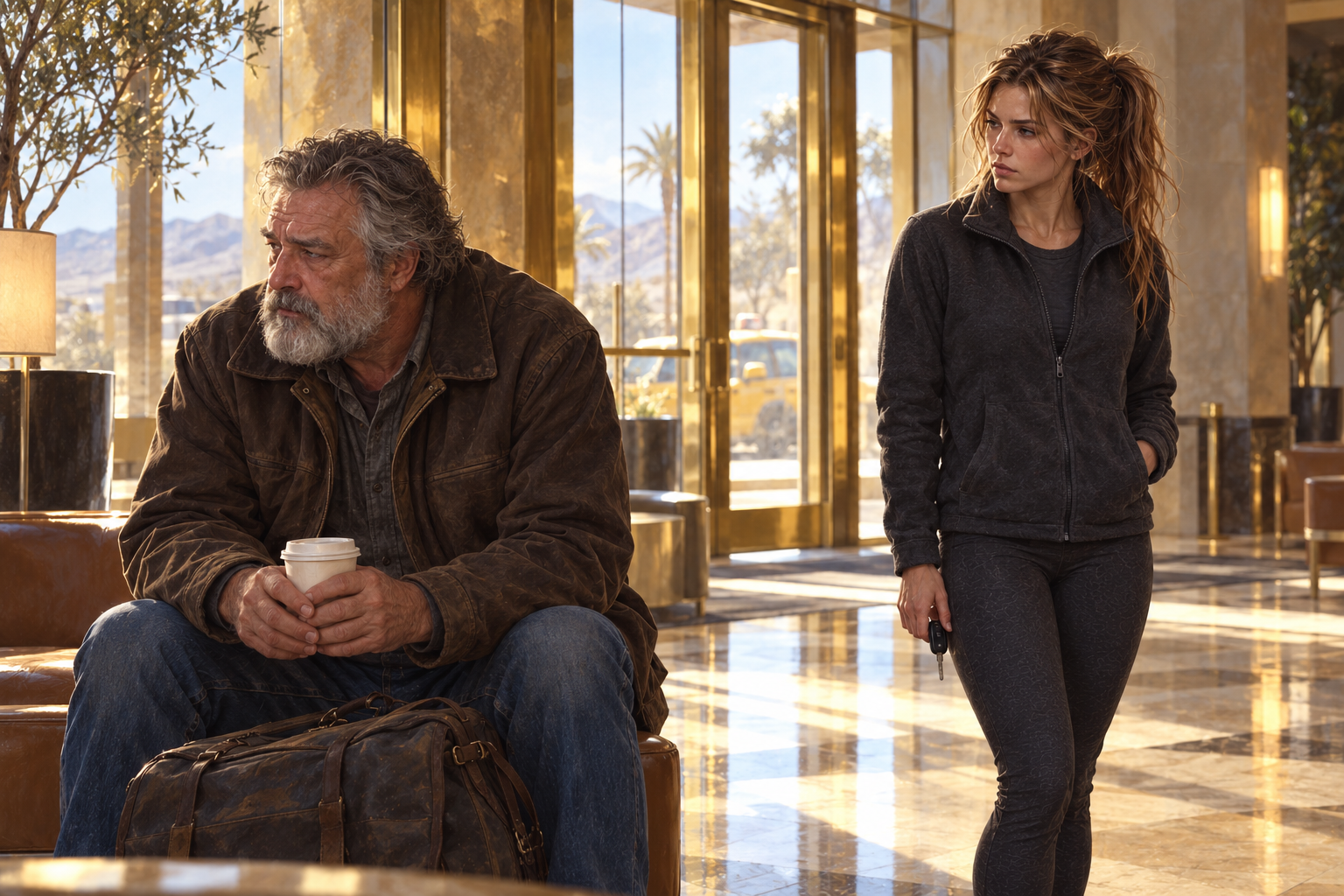
Kyra did not say anything. She did not trust herself to.
“You knew her?” he said, looking at her properly for the first time.
“No,” said Kyra. “I never met her.”
“Ah.” He nodded slowly. “Well. You’d have liked her. Everybody did. Even the ones she frightened.” His taxi pulled up at the curb. He picked up his bag. “She used to tell us all, every set, you’re in a hurry, son. Let it come to you. Drove us mad.” He was nearly smiling. “Every one of us says it now. Every one of us.”
And he went out through the doors into the sun, and got into the taxi, and was gone.
· · ·
They drove north.
It was the same road. It was always the same road. The long straight highways out of the city, and the desert going by gold and enormous on either side, and the mountains far off and blue and never any nearer. Val drove. Kyra sat in the passenger seat with her hands in her lap and did not put her feet on the dashboard, and did not talk, which she had done perhaps twice on that road in her life.
They did not talk about it. Not for hours. There was nothing to say yet that would not make it smaller. Kyra knew that, and Val knew it, and the desert knew it, going by.
Somewhere past the state line, with the sun going down red in the mirror, Kyra said:
“She asked us one thing.”
“I know.”
“Is she OK. That’s all she ever asked. In all those years.” Kyra looked out of the window at the dark coming up out of the ground. “And we never answered.”
Val drove a long way without saying anything.
“When we get home,” she said at last. “At the table.”
Kyra turned her head and looked at her.
“Not in the car,” said Val. “Not on the road. Not in a hotel with the chain on the door.” Her hands were at ten and two on the wheel, perfectly steady. “Whatever we do — and I don’t know yet what we do, Kyra, I don’t know if there’s anything we can do — we decide it at the table. Where we decide everything. Both of us. With the tea.” She paused. “That’s where the terms change. Nowhere else.”
“Will they change?”
Val did not answer that.
But somewhere in Oregon, in the dark, in the rain, a long time after midnight, with the wipers going and the heater on and Kyra half asleep against the window, Val reached across without looking and put her hand flat on Kyra’s knee, and left it there, and drove one-handed all the way home.
— end of chapter thirty-four —
Late January · Kyra’s kitchen, the road south, and a room that gets the morning
The post was there when they got home.
Not on the channel. Somewhere else — a page the industry used for its own news, where people announced jobs and films and deaths. Kyra found it at her kitchen table on the Tuesday night, the first night back, with the rain on the window and the suitcases still standing unopened in the hall; she had not been looking for it, and then she had been looking for nothing else.
It was from the gray-bearded man. His name was Gus Marlow, the page said, and he had been a camera operator for most of his life, and then a director of photography, and he wrote the way he had talked in the lobby, plainly, with no ornament at all.
Iris is home. Not home-home — she’s at the hospice up in the hills, the one with the garden. She picked it herself, years ago, and she’s in the room she wanted, the one that gets the morning.
She wants me to tell everybody she’s not taking flowers, because she’s surrounded by flowers already and she’s allergic to half of them. She also wants me to tell everybody she IS taking visitors. Her exact words were “the more the merrier, while there’s still a me to be merry.” So if you knew her, go. If you worked with her, go. If you just admired her from across a room, go. She says she’d rather see a stranger’s face than another wall.
She hasn’t got long. Go soon.
Under it, an address. A road in the hills above the city. Visiting hours. A name to ask for at the desk.
Kyra read it four times. Then she got up and went to the window over the sink and stood with her back to the room, looking out at the dark and the rain on the glass.
Then she called Val.
“Come over,” she said. “We need the table.”
· · ·
Val came in twelve minutes. She did not take her coat off. She read the post standing up, the way she had read the glow index, and then she sat down across from Kyra, and took her coat off, and put her hands flat on the table.
“Tea,” she said.
Kyra made tea.
· · ·
They sat for a long time before either of them said anything. That was the way it went, at the table, when a thing was large. You let it sit there between you, the size it was. You did not pick it up until you were both ready.
It was Kyra who picked it up.
“I want to go,” she said.
“I know.”
“I’m not asking you to say yes. I’m saying it. At the table. So you know.” Kyra held her cup in both hands. “I want to go and see her. While there’s still a her to see.”
“I know you do,” said Val. “So do I.”
Kyra looked up.
“Don’t look at me like that,” said Val. “I’ve known her as long as you have. Longer, if you count the columns.” She turned her cup a quarter turn on the table. “I want to go. That’s not the question. The question is what we do when we get there.”
· · ·
“We visit,” said Kyra. “That’s all. Two women who saw her at the awards. Who were moved. Who drove a long way. That’s what we tell the desk and that’s what we tell her.” She paused. “And we don’t tell her.”
“We don’t tell her,” said Val.
“Agreed.”
“Agreed.” Val took a breath. “Then I want to say the rest of it. Out loud. Before we decide anything. Because I’ve been doing the sum since a hotel lobby on Monday morning and I’d like you to hear it, so that if we change our minds in that room — and I think we might, Kyra, I think one of us might — we’ll both know exactly what it costs.”
“Say it,” said Kyra.
· · ·
Val said it.
She did it the way she did the risk assessments: in order, flatly, item by item, with her hands on the table. The sign-in book at the desk, with their names and the date and the time. The visitor log, kept by the hospice, kept for years after. The staff in the corridors, who would see two women going in and coming out. The nurses who would come and go from the room. The family, if there was any; the friends, Gus Marlow and the others, who would know every face that came to that bed and want to know the ones they didn’t. The phone on the bedside table. A diary, if she kept one, and a woman who wrote at three in the morning with every comma in the right place was a woman who might keep one.
“And if we tell her,” said Val. “If. Then she knows. A woman who has spent her whole life in this business, who knows everybody in it, who has a crowd of people coming through that room who’d give anything to know who we are. And she’ll have days. Weeks at most. With nothing to do but lie in that bed and remember. And people coming in, and sitting by her, and talking.”
“She’d never tell.”
“She’d never mean to tell,” said Val. “I believe that. I believe it as much as I believe anything. She’s kept herself out of every frame she ever shot. She never asked us for anything in all those years.” She paused. “But the dying talk, Kyra. They do. I’ve sat by more of them than I can count, on more continents than this one. At the end, they say things. They tell the nurse about the brother they never forgave. They tell the priest where the money is. They tell whoever’s holding their hand, at three in the morning, the thing they’ve carried their whole lives and never said.”
· · ·
Kyra did not say anything for a while.
“So we can’t,” she said.
“I didn’t say that.”
“You said—”
“I said the dying talk,” said Val. “I didn’t finish.” She looked down at her hands. “The dying talk. And nobody believes them.”
· · ·
Kyra stared at her.
“That’s a horrible sentence.”
“It’s a horrible sentence,” Val agreed. “It’s also true. It’s one of the truest things I know about this planet.” She did not look up. “A woman on morphine, at the end, in a hospice in the hills, tells her nurse that the two anonymous women from the most famous chair on the internet came to see her, and sat by her bed, and told her who they were. What does the nurse say?”
Kyra did not answer.
“She says that’s lovely, Iris,” said Val. “And she pats her hand. And she writes patient comfortable on the chart. And she goes home and tells her husband that poor Iris thinks the chair girls came to see her, isn’t it sad, isn’t it sweet, she was such a fan.” She turned her cup. “And that’s the end of it. Forever. Because a dying woman said it, and that’s what dying women say.”
“I hate that.”
“I know you do. I hate it too.” Val looked up at last. “But it means the risk is almost nothing. Almost. It means that if one of us says it, in that room — and I’m not saying we will — then it goes into her, and it stays there, and in a few weeks it goes where she goes. And if she ever says it to anybody, nobody will believe her, and they’ll love her a little more for the believing.” Val put her hand flat on the table. “It would be the safest thing we’ve ever told anybody. Because it would be told to the one person who can’t keep it.”
· · ·
They sat with that.
The rain came down on the window. The tea went cold in the cups. Somewhere outside, a car went by on the wet road with its lights going across the ceiling.
“It’d be the first time,” said Kyra at last, very quietly. “Wouldn’t it. That we ever told anyone anything true.”
“Yes.”
“In all of it. Every town. Every name. Every person who ever loved either of us. We’ve never once—”
“Never once,” said Val. “Not a single true thing. Not to anybody on this world.” She was quiet for a moment. “And it wouldn’t be the big thing. Even now. Even to her. Not where we’re from. Not how long. Never that.” She shook her head. “Only the small one. We’re the women in the videos. That’s all. That’s the most anybody will ever have.”
“It’s not small to her.”
“No,” said Val. “It isn’t small to her.”
· · ·
They decided it the way they decided everything. At the table, with the tea, out loud, both of them.
They would go. They would drive down — two days, the long way, because Val would not fly and neither of them wanted to anyway. They would sign the book at the desk as two women from Oregon who had seen her at the awards. They would sit with her for as long as she wanted them. And they would not tell her.
That was what they agreed.
Val wrote it in the gray notebook, at the back, under all the others, in her small exact hand:
We go. We do not tell her.
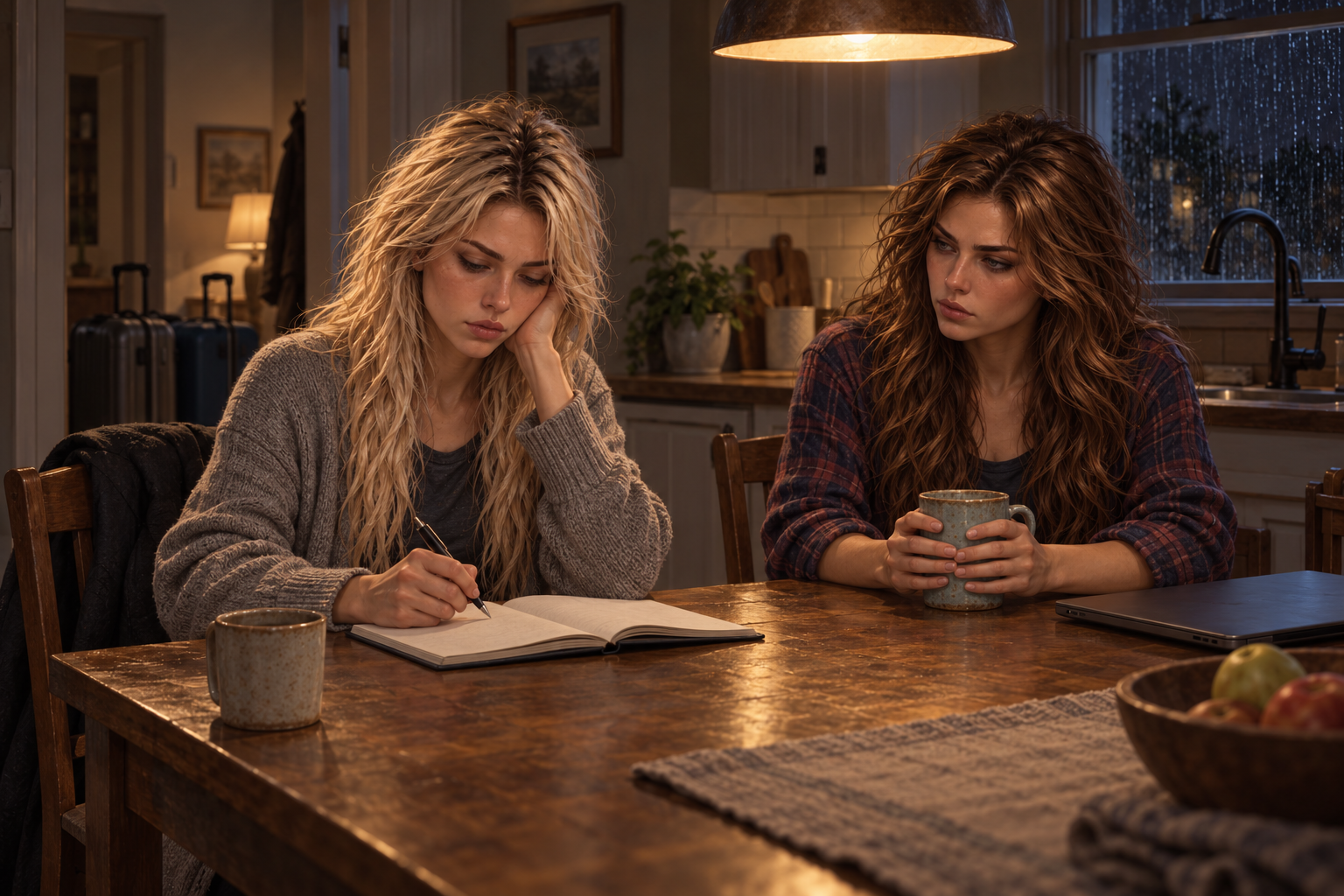
And then she sat looking at the line, with the pen still in her hand, and did not close the book.
“It’s the only one,” she said, at last, “that can’t be undone.”
“What is?”
“If we change our minds in the room.” Val did not look up. “Every other term in this book can be taken back. We’ve crossed things out. We’ve made new ones. We can stop the channel tomorrow and burn the cards and nothing we’ve ever done is a thing we can’t, in the end, unmake.” She touched the line with one fingertip. “But if one of us says it to her, it’s said. It goes where she goes. There’s no table after that.”
“Then we won’t.”
“Then we won’t,” said Val. She closed the notebook.
Kyra did not believe her, and she knew that Val did not believe herself either, and neither of them said so.
· · ·
They left on the Thursday, in the dark, in the rain.
It was the third time on that road in a month and Kyra had stopped seeing it. The passes and the snow, and then the dry country, and then, on the second day, not the turn toward Las Vegas this time but the long road on south, down the middle of the state, through the farms and the dust and the orchards, toward the city at the bottom of it.
They did not talk much. Kyra put her feet on the dashboard on the second morning, once, and took them down again, and Val reached over and put her hand on Kyra’s knee and left it there.
They came into the city in the afternoon of the second day, through the traffic and the haze, and up out of it, into the hills.
· · ·
The hospice was at the end of a winding road, among old trees. A low white building with a long porch and a garden going down the slope below it, full of flowers, as Gus Marlow had said; and the light coming in low and gold through the trees, and somewhere a fountain, and nobody hurrying.
There was a desk inside the door, with a woman behind it, and a book.
Val signed it.
Kyra watched her do it. Valerie M., she wrote, in her small exact hand, and Kay M., and Oregon, and the date, and the time. And then, in the column that asked whom they were visiting: Iris Sancai. And in the column that asked their relationship to the patient, after a moment’s pause with the pen held over the paper:
Admirers.
The woman at the desk read it, and smiled.
“She’s got a lot of those,” she said. “Go on up. End of the hall, on the left. She’s awake. She likes the afternoons.” She paused. “Don’t let her tire herself out. She will if you let her.”
· · ·
The door was open.
It was a plain room, white, with a big window that faced east, over the garden, so that in the morning — Kyra could see it at once — the whole room would fill with sun. Now, in the afternoon, it was in soft shade, and the light came in sideways and low, from the left, warm.
Kyra stopped in the doorway.
It’s coming from too low and too much from one side.
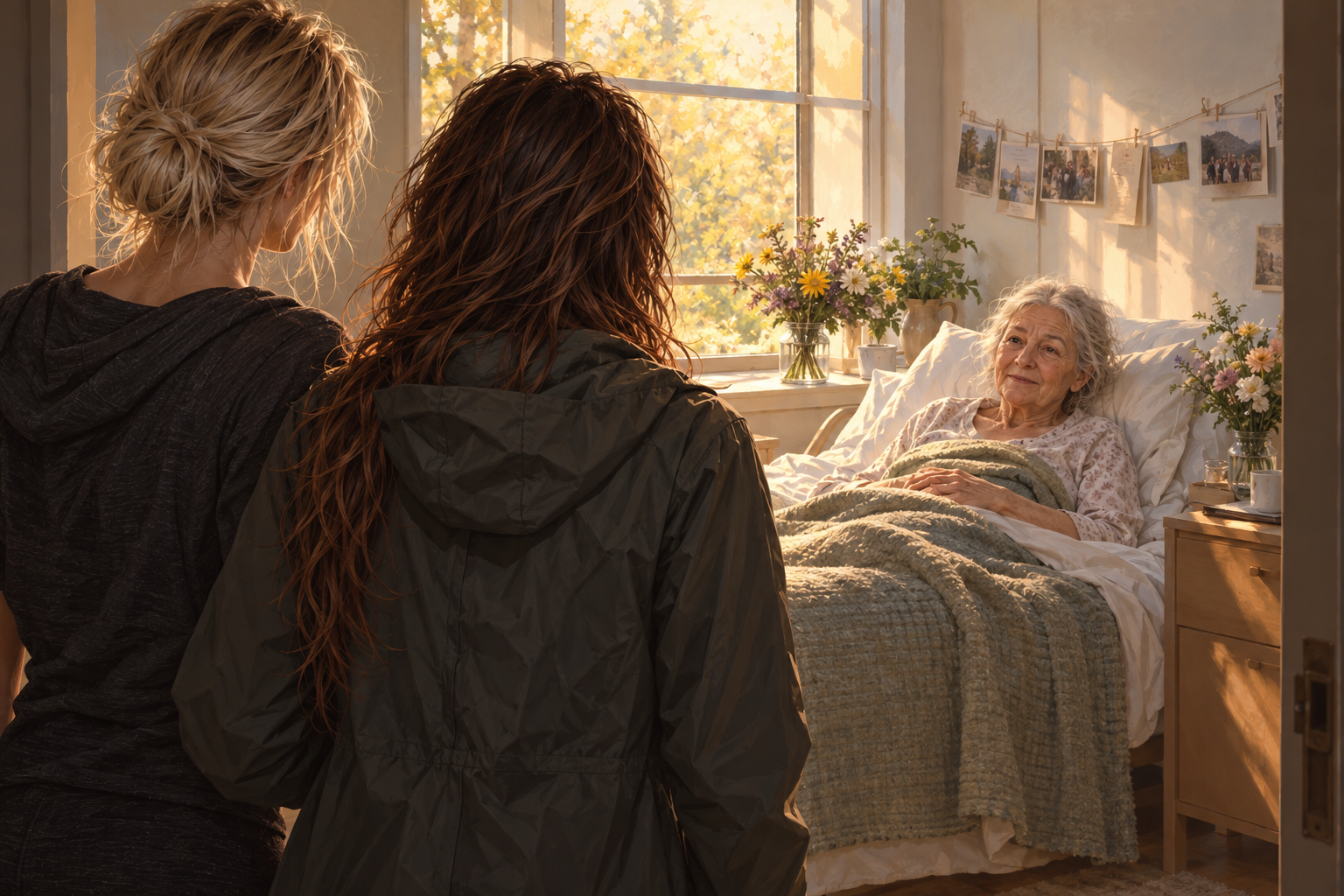
She felt Val stop behind her, and knew that Val had seen it too.
· · ·
The bed was by the window. There were flowers on every surface, as Gus Marlow had said, and cards on a string along the wall, dozens of them, and photographs — old ones, curling, of film sets and crews and young people with cameras on their shoulders squinting into the sun. And in the bed, propped up on pillows, with a blanket over her knees and her hands folded on it, was Iris Sancai.
She was thinner than she had been in Las Vegas. That was the first thing. It had been less than a week, and she was thinner, and the skin of her face had gone close to the bones, and the silver hair was very short against the pillow. But her eyes were exactly as they had been in the bar. Dark, and quick, and listening.
She looked at the two of them in the doorway with great interest.
“Well,” she said. “Come in, then. You’re letting the hall in.”
· · ·
They came in. Kyra sat in the chair by the bed, because Iris pointed at it. Val stood, until Iris said “Sit down, pet, you’re making the room nervous,” and then she sat too, on the other chair, by the window, very upright, with her hands on her knees.
“I don’t know you,” said Iris. Not unkindly. With pleasure, if anything. “Do I? I know most of the faces that come through that door, and I don’t know yours.” She looked from one of them to the other. “And I’d remember. You’re not the kind of faces a person forgets.”
“No,” said Kyra. “You don’t know us. We saw you at the awards. In Las Vegas. When they gave you the — when everybody stood up.”
“Oh, that.” Iris made a face. “Gus’s idea. I told him I’d haunt him.”
“It was beautiful,” said Kyra. “And we saw you on the floor. On the Friday. On a folding chair.” She paused. “And in the bar, on the Sunday. With a girl with a camera bag.”
Something moved in Iris’s face. “You were in the bar?”
“At the back. By a pillar.”
“Hm.” Iris looked at her for a moment longer. “And you drove all the way down from — where?”
“Oregon.”
“Oregon.” Iris looked genuinely astonished. “To see an old woman you watched on a stage for two minutes? Two days in a car?”
“Yes,” said Val, from the window.
Iris turned her head on the pillow and looked at Val. Val looked back. Neither of them said anything.
“Well,” said Iris at last, softly. “That’s the nicest thing anybody’s done for me in a long while. And I’ve had a great many nice things done for me lately, so that’s saying something.” She settled back into the pillows. “Sit, then. Both of you. Tell me about Oregon. I’ve never been. Is it all trees?”
· · ·
They told her about Oregon.
Kyra did most of it. She told her about the rain, and the ridge, and the river behind the fire hall, and the people who went up the mountain in the wrong shoes. She told her about the library, a little, and about the diner, and the woman at the diner who brought pancakes nobody had ordered on the first warm Sunday of the year. And Iris listened to all of it with her head a little on one side, the way she had listened in the booth, completely, as if there were nobody else in the world.
“Search and rescue,” Iris said. “You find people.”
“I find people.”
“In the dark?”
“Usually,” said Kyra. “That’s when they get lost.”
“I’ve spent my whole life in the dark,” said Iris. “Behind a camera. Waiting for the light to come right.” She smiled. “Different kind of finding.”
“Not that different,” said Val, from the window.
Iris turned her head and looked at her again.
· · ·
And then Iris talked.
She did not seem to mind that they were strangers. Perhaps she liked it. She talked the way people talk who have been talking to old friends for two weeks and are tired of being careful with them; easily, and with her hands, and laughing at herself. About Glasgow, a long time ago, and a father who had worked the shipyards and thought cameras were for people with nothing better to do. About coming over on a boat with a suitcase and a light meter and no idea at all. About sets, and crews, and directors she had loved and directors she had wanted to murder. About light. Always, in the end, about light. The way it fell on a face at four in the afternoon. The way you could wait three hours for one minute of it and the minute was worth the three hours, every time.
“Everybody’s in a hurry,” she said. “That’s the whole trouble with people. They race toward the thing they want, and they get there, and they miss it.”
Kyra felt Val, across the bed, not move.
· · ·
It was nearly five, and the light in the room had gone gold and long, when Iris said it.
She had been quiet for a little. Her eyes had been closing, now and then, and opening again, and Kyra had been thinking that they should go, that the woman at the desk had said not to let her tire herself out. And then Iris opened her eyes and looked at the ceiling and laughed, quietly, to herself.
“Can I tell you a secret?” she said. “You’ll think I’m a terrible old woman.”
“We won’t,” said Kyra.
“You will. Everybody would. Gus would die.” Iris turned her head on the pillow toward Kyra. “There’s a channel. On one of those sites. The adult ones. You’ll know the kind, or you won’t, and either way you’ll be very polite about it.” Her eyes were bright. “Two women. In masks. You never see their faces. Not once, in all these years. Just a room with a cream wall and a lamp, and a chair.”
Kyra did not move. She did not breathe.
“They won a thing at the awards,” said Iris. “The night I got mine. Did you see? The chair. Everybody shouting seventeen inches. Nobody went up for it.” She laughed again, softly. “I’ve watched every single thing they’ve ever made. For years. Every week. I wrote to them. Can you imagine? Me. Writing fan letters at three in the morning to two girls on the internet, like a teenager.” She shook her head on the pillow. “I never told a soul. Not Gus. Not anybody. It was the only thing in my whole life that was just mine.”
· · ·
“Why them?” said Val, from the window. Her voice was perfectly level and almost nothing.
Iris thought about it.
“Because they’re not in a hurry,” she said. “Either of them. The redhead — you should see her wait. She waits longer for that blonde than I’ve ever seen anybody wait for anything. And the blonde—” She stopped. Her face changed, a little, remembering. “There’s a light on the blonde. When it’s real. A sort of glow. Nobody can explain it. They’ve got a whole website arguing about it. But I’ve spent my life looking at light, and I’ll tell you something nobody on that website knows.” She lowered her voice, as if somebody might hear. “It’s not lighting. It’s not a filter. It’s not anything anybody did. It’s her. It comes up out of her. And it only comes when she’s really there.” She looked at the ceiling. “I’ve never seen anything like it. In my whole life. And I’ve seen everything.”
· · ·
Kyra did not look at Val. She could not.
“And once,” said Iris, more quietly, “a long time ago, it didn’t come. The light. She did everything — everything right, the whole thing, beautifully. But the light didn’t come.” She turned her head on the pillow. “And I sat in my kitchen at three in the morning, and I couldn’t sleep, and I wrote to them. I asked them if she was all right.” She was quiet for a moment. “They wrote back. They thanked me. They said I was right about the light.” She smiled, a little. “They never answered the question. And I was glad. It wasn’t mine to ask. I knew that the minute I’d sent it.”
Nobody said anything.
“I’d have liked to meet them,” said Iris. Her eyes were closing again. “Just once. That’s all. Not to know who they were. I never wanted that. Just to be in a room with them.” Her voice was going softer. “Just to see them. Once. In ordinary light. And say thank you. And not say anything else at all.”
· · ·
Kyra looked at Val.
She had not meant to. She had promised, at the table, with the tea. We go. We do not tell her. She had meant it. She had driven two days meaning it. And she found she had turned her head, without deciding to, the way she had turned it a thousand times across a thousand rooms, and was looking at Val, across the bed, in the gold light from the low window.
Val was already looking at her.
Kyra saw it go across her face. All of it. The table, and the line in the notebook, and the only one that can’t be undone, and the dying talk, and nobody believes them, and the columns of ticks going back years, and a folding chair on a Friday afternoon, and a woman at a microphone saying look after each other. She saw Val run the whole sum, one more time, in the space of a breath.
And she saw her come to the end of it.
· · ·
Val got up from the chair by the window.
She came around the end of the bed, slowly, the way she did everything that mattered, and sat down on the edge of it, by Iris’s hand, on the blanket. And she reached up behind her own head, with both hands, and took out the two pins that held her hair in the county knot, and put them down on the blanket beside her, one, two.
Then she began to braid it.
Kyra watched her do it. She had braided Val’s hair herself, at a kitchen table, on a Saturday night, more times than either of them could count; and she had never once watched Val do it alone. Three strands. Tight, back off the face, down the spine. The way it had been in every video. The way a whole website had argued about, from behind, for years. Her fingers did not hesitate. She tied the end with the band from her wrist.
Iris’s eyes had opened. She was watching.
She said nothing. She watched Val’s hands. She watched the braid go down the long back. And Kyra saw something come into her face that was not understanding yet — not yet — but was very close to it, the way the light is close in the last minute before it comes right.
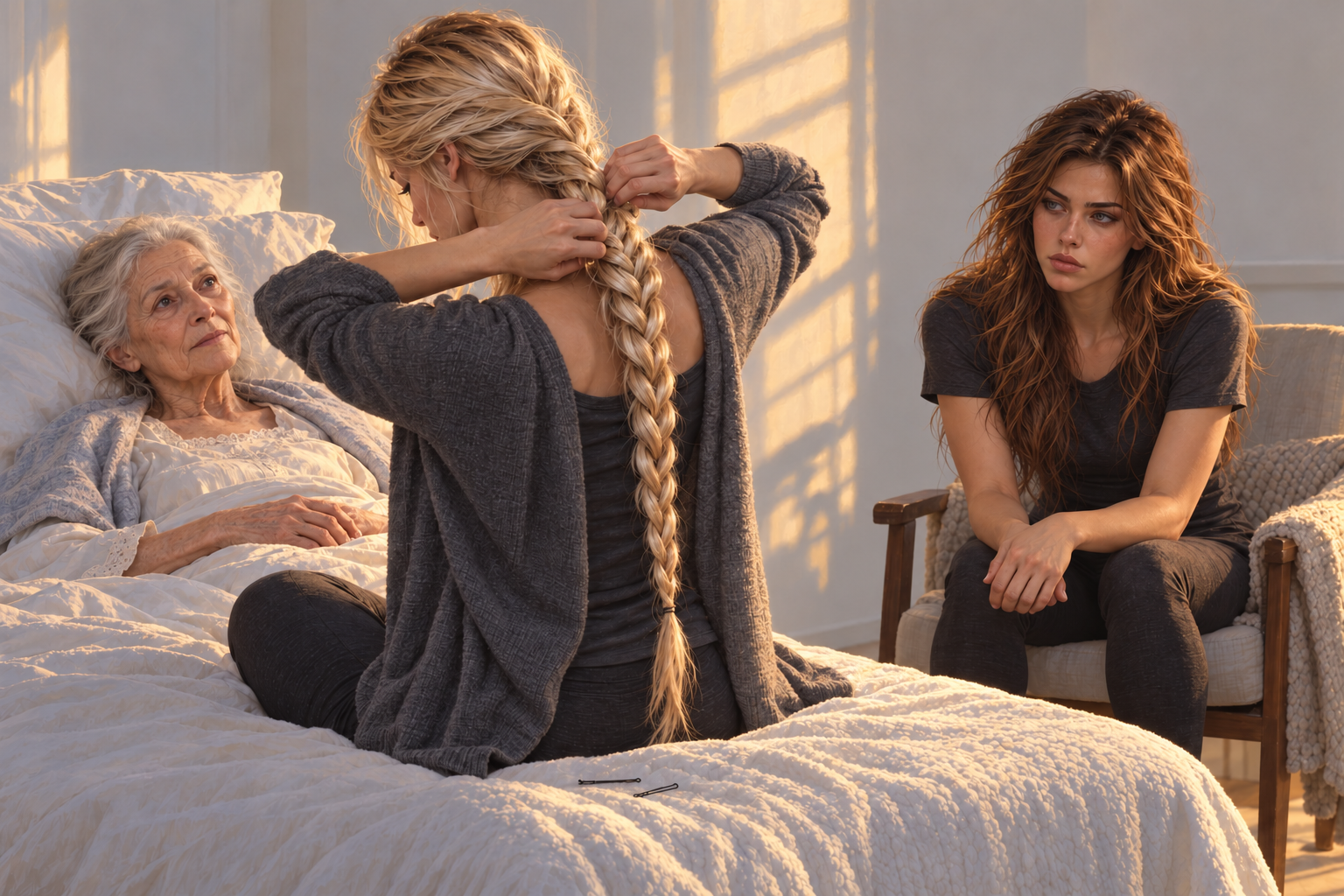
“No,” said Iris, very softly. “Pet. Don’t tease an old woman.”
· · ·
“We’re them,” said Val.
· · ·
Iris looked at her for a moment.
“Oh, pet,” she said gently, and her face was full of something that was nearly pity. “That’s a lovely thing to say. That’s a lovely, kind thing.” She reached out and patted Val’s hand on the blanket. “Lots of women have a braid.”
Val did not move.
“And a lot of women would drive two days to make a dying woman happy, I’m sure,” said Iris. “I’m grateful. I am. But you don’t have to. I’m happy enough.” She smiled up at Val. “Anybody could say they were them. Anybody at all. Nobody’s ever seen their faces. That’s the whole point.”
“Nobody’s ever seen our faces,” Val agreed.
“So how would I ever—” Iris laughed, softly. “How would anybody ever know?”
· · ·
And Kyra laughed.
She did not mean to. She did not decide to. It was the sheer Iris of it. A dying woman in a hospice in the hills, propped up on pillows, very kindly, very patiently, refusing to be lied to by the two people on the planet who were not lying to her — and doing it in exactly the words Kyra had been saying to herself in the car for two days. How would anybody ever know. It came up out of her the way it always came, from somewhere under the ribs, from the bottom of her, and there was nothing she could do about it, and she did not try.
It filled the room.
Loud and warm and helpless and enormous, the laugh she had held in for three hours in row twelve, the laugh that had nearly given them away by a booth with a T-shirt on it, the laugh that came at the very end of every video they had ever made, every one, when Val’s light was going down and Kyra could not help it — the laugh that strangers had argued about in the comments for years, nobody laughs like that, she’s faking, she’s the realest thing on the whole site.
It came out of her and filled the white room to the corners, and went on.
· · ·
Iris went perfectly still.
Kyra saw it happen. She saw the patient, pitying smile stop on Iris’s face, and stay there for a second, frozen, and then go — all of it, at once, the way a held breath goes. She saw the dark eyes go wide. She saw them turn, very slowly, from Val on the edge of the bed to Kyra in the chair, and stay there, and look at her. Look. The way a woman looks who has spent her whole life behind a lens, at a face, in the last minute before the light comes right.
Kyra’s laugh ran down, slowly, and stopped.
The room was very quiet.
“Oh,” said Iris.
· · ·
She did not say anything else for a long time.
She lay against the pillows and looked at Kyra. And then at Val, beside her on the bed, with the braid down her back. And then at Kyra again. Her hand on the blanket had found Val’s hand, and was holding it, very tightly, the knuckles white.
“I know that laugh,” she said at last. Her voice was hardly there at all. “I’ve heard that laugh every Sunday for — I know that laugh. It’s the end. It’s the end of every one. When the light’s going down.” She was staring at Kyra. “Nobody else on God’s earth laughs like that.”

“No,” said Kyra. “I’m told they don’t.”
· · ·
Iris turned her head, very slowly, on the pillow, and looked up at Val.
She looked at her for a long time. At the face, which she had never seen. At the braid, which she had seen a thousand times, from behind. At the long patient hands on the blanket, one of them held in her own.
Her eyes had filled. She did not seem to notice.
And Val looked back at her. She did not look away. She did not manage her face. Kyra watched her not manage it — let it be what it was, in the gold light, in front of a stranger, for the first time on this planet — and saw, for a moment, under the skin at Val’s throat, a very faint wash of something come and go. So faint that nobody would have seen it. So faint that Kyra had to look twice.
“Is she OK?” said Val softly. “That’s what you asked us.”
Iris could not speak.
“She was,” said Val. “Thank you for asking.”
· · ·
Iris Sancai put her free hand over her face and wept.
She did it quietly, the way people do at the end, when there is not much strength left for anything; her shoulders shaking against the pillows, her other hand holding Val’s so hard Kyra thought it must hurt. Val did not take her hand away. She sat on the edge of the bed with her braid down her back and let it be held, and did not say anything, and did not need to.
Kyra came around the bed and sat on the other side, and took Iris’s other hand, gently, away from her face, and held it.
And for a long time, in the white room with the low gold light coming in from the left, the three of them sat like that, and nobody said anything at all.
· · ·
“I don’t want to know your names,” Iris said, after a long time. Her voice was wet and very tired. “I mean it. Don’t tell me. I never wanted to know.”
“We know,” said Kyra.
“I’ll not tell anybody. Not Gus. Not the nurses. Not the priest, if they send one.” She laughed, a little, wetly. “Not that anybody’d believe me.”
“That’s what she said,” said Kyra, and nodded at Val. “At the table. The dying talk, and nobody believes them.”
Iris looked at Val.
“That’s a horrible sentence,” she said.
“It’s a horrible sentence,” Val agreed.
“It’s also true,” said Iris. And then she laughed — really laughed, for the first time, weakly, from somewhere far down — and held on to both their hands.
· · ·
They stayed until the light had gone out of the window. Iris did not let them go before. She did not talk much more. She was very tired. But she held their hands, one on each side, and every now and then she opened her eyes and looked at one of them, and then the other, as if to check they were still there; and then she closed her eyes again and smiled.
Once she said, without opening her eyes: “The chair. Is it really seventeen inches?”
“About,” said Val. “The rest is technique.”
Iris laughed so hard she had to cough, and Kyra had to help her sit up, and the nurse put her head around the door to see if everything was all right. Everything was all right. Iris waved her away, still laughing, with tears running down her face.
· · ·
At the very end, when it was dark outside, and the nurse had come back and said very gently that it was time, Iris opened her eyes one last time and looked at Kyra.
“You,” she said. “The redhead. Come here.”
Kyra leaned down.
“You waited,” said Iris. Her voice was almost nothing now. “For her. Every time. All those years. I watched you do it.” Her hand moved in Kyra’s. “Don’t stop. Promise me. Whatever happens. Don’t you ever stop waiting for her.”
“I won’t,” said Kyra. “I never have.”
“I know you haven’t.” Iris’s eyes moved to Val, on the other side of the bed, with her braid down her back. “And you. Keep your light, pet.”
Val did not answer. She could not. She bent down instead and put her forehead, for a moment, against the back of Iris’s hand, and held it there; and then she straightened up, and let go, and stood.
“Look after each other,” said Iris, and closed her eyes.
· · ·
They signed out at the desk. Valerie M. and Kay M., and the time. The woman at the desk looked up at them both — at Kyra’s face, wet; at Val’s braid, down her back, which had not been there when they came in — and said nothing at all, except, very kindly, “Drive safe.”
They drove north in the dark.
They did not talk. Not for hours. Somewhere in the long valley, among the orchards, Val pulled off the road onto a gravel shoulder under a single high light, and turned the engine off, and sat with her hands on the wheel. And then she put her face in her hands and shook, silently, for a long time; and Kyra undid her seatbelt and leaned across and held her, and said nothing, and let her.

After a while Val lifted her head.
“I said it,” she said. Her voice was almost gone.
“You said it.”
“At the table I said we wouldn’t. I wrote it in the book.”
“I know.”
“And I looked at you,” said Val. “And you were already looking at me.”
“I know,” said Kyra. “I was there.”
· · ·
Gus Marlow posted again nine days later.
It was short.
She went this morning. In her room, with the sun coming in. She’d have hated how much fuss I’m going to make about it, so I’ll keep this short and make the fuss later.
She had a lot of visitors at the end. More than I could count. Some I knew, most I didn’t. She saw every single one. She said she’d rather see a stranger’s face than a wall, and she meant it.
The nurses told me something I wanted to put down here. They said that the week before she went, she had two visitors nobody knew. Two women. Drove down from somewhere up north. Sat with her a whole afternoon. And after they left, she was happier than they’d seen her the whole time she was there. She told one of the nurses that night that she’d met somebody she’d waited her whole life to meet, and the nurse said, “That’s lovely, Iris,” and Iris laughed and laughed and said, “Isn’t it, though. And nobody will ever believe me.”
I don’t know who they were. If you’re reading this — thank you. Whoever you are.
Let it come to you, Iris.
· · ·
There were obituaries. A great many. In the trade papers and the film pages and on the sites where the industry talked to itself; long ones, with photographs of a young woman with a camera on her shoulder squinting into the sun, and lists of films nobody outside the business had ever heard of, and quotations from people who had worked with her for half their lives. The best eye in the business. Never put her name on the front of anything. Taught half of us everything we know.
Not one of them mentioned two women from Oregon.
Not one of them mentioned a channel, or a chair, or a light that came up out of a woman when she was really there.
Nobody ever learned that they had met. Nobody ever would.
· · ·
Kyra read every obituary, at her kitchen table, in the evenings, with the rain on the window. She read them all twice. And then she closed the laptop, and went and found the gray notebook, which Val had left on her table, and opened it at the back, to the columns.
The ticks. Every Sunday, for years. The gaps. The little W. The mark that was not a tick, beside the comma in the wrong place. The last tick, in November, beside the last letter.
And under it, in Val’s small exact hand, a new line. Kyra did not know when she had written it. She had not seen her do it.
It did not say anything about a hospice, or a room that got the morning, or a braid, or a laugh. It was only a date, and beside it, the shortest thing Val had ever written in that book.
Answered.
— end of chapter thirty-five —
Early spring · Kyra’s kitchen
They did not film anything in February.
Nobody decided that. It simply did not happen. They came home from the hills in the dark and the rain, and the next week there was the fire hall and the library and Gus Marlow’s post, and the week after that there were the obituaries, and the week after that there was nothing in particular, except that neither of them said Saturday? at the table, the way one of them always did, and neither of them noticed that the other had not.
Val put a line on the channel at the start of the month. A short break. Back soon. —B. The back room said take care of yourselves and we’ll be here and is everyone ok, and Tallyman made a new row in his spreadsheet that said only Break. Status: waiting, which he had never had to write before in all the years there had been a spreadsheet.
And then it was March, and the cherry tree in Kyra’s yard had buds on it, and they still had not said Saturday.
· · ·
Kyra knew before Val did. Or she thought she did. It was hard to tell, with Val; it was always possible that Val had known for weeks and was waiting at a table somewhere in her head for Kyra to arrive.
She knew on a Thursday night at the end of the first week of March, in her own kitchen, alone. Val was at the library until nine. Kyra had come in from a call — a boy on the ridge, young and stupid and fine, sitting on a rock eating his sandwiches while his mother called out the whole valley — and showered, and made toast, and sat down at the table with it, and opened the laptop out of habit to look at the channel.
She did not read the comments. She had not read them since the autumn. She looked at the front page, the way you look at a house you used to live in when you happen to drive past it. The title. The Girls from Andromeda. The little gray square of the most recent video, from the week before Las Vegas. The chair, from behind, in the lamplight. The cream wall.
And she waited to feel what she had always felt, looking at it.
It did not come.
· · ·
She sat with the toast going cold and tried to understand what she was feeling instead.
It was not sadness. She knew sadness; she had been carrying a great deal of it since the hills, and this was not that. It was not boredom either. She had never once been bored by any of it, not for a single minute in all those years, not even on the long nights with the rings and the color and the sealant, when Val made her stand still for an hour.
It was something more like the feeling she had at the end of a long search, at the very end, when the person was found and the litter was coming down off the ridge in the gray light and she was walking behind it with her pack on, and the radio had stopped, and there was nobody left to look for.
Done. That was what it was.
Not over. Done. The way a thing is done when it has been finished properly, all the way, and there is nothing left in it that wants doing.
· · ·
She thought about why. She sat at the table with the cold toast and made herself think it through properly, the way Val would have, in order, from the beginning.
She thought about a kitchen table, years ago, in the first winter in Calderveil, with the masks lined up on the counter by the kettle and Val’s pencil going down the terms. Why. The real one. And herself, unable to look at her, saying it to the masks. Somebody watching. I want there to be a witness.
She had got her witnesses. More than she had ever imagined. Every single one of them, for years — the ones who argued about the chair and the ones who measured the glow and the ones who said it’s worth it to each other in the comments. Tallyman, with his columns. lux, with his software and his honest threes. A whole theater on its feet in Las Vegas, roaring at a five-second clip of a chair. They had watched, and they had seen, and some of them had seen more than she had ever thought anybody could. She had had more witnesses than any woman on two worlds.
And none of it had been the thing.
She had not known that until the hills. She had not known what the thing was. She had thought it was the watching. She had thought, all those years, that if enough people saw — if the room were big enough, and full enough, and clapped loudly enough — then the place in her where nobody had ever been in the room would fill up, at last, and stop aching.
It had not. Not with all the strangers on the internet. Not with a theater full.
It had taken one woman. In a bed. In a white room with the light coming in too low and too much from one side. Who had looked at Kyra’s face, after her laugh, the way a woman looks who has spent her whole life behind a lens in the last minute before the light comes right — and known. Not guessed. Not argued it in the comments. Known. And held both their hands. And said look after each other.
One person in the room.
That was all it had ever been. That was all she had ever wanted. A room full of people along two walls had never been enough, on Sethal, and all the strangers on the internet had never been enough here; and one woman with silver hair in a hospice in the hills had been enough, entirely, in an afternoon.
And now she was gone. And Kyra did not want any more witnesses.
She had had the one.
· · ·
Val came in at twenty past nine with the rain on her coat and her bag over her shoulder, and stopped in the kitchen doorway, and looked at Kyra at the table with the laptop open and the toast cold, and did not take her coat off.
“Ah,” she said.

· · ·
Kyra looked up at her.
“Sit down,” she said.
Val sat down. She did not take her coat off. She put her bag on the floor and her hands flat on the table on either side of the place where her cup would be, if there had been a cup; and Kyra got up and made the tea, because it was a table conversation and you did not have a table conversation without tea, and brought it, and sat down again.
Val looked at the laptop. At the gray square of the chair. Then at Kyra.
“Go on,” she said.
· · ·
“I think we’re done,” said Kyra.
· · ·
She had thought it would be harder to say. She had thought her voice would go. It did not. It came out plainly, in her ordinary voice, the voice she used to say the boy’s fine, he was eating his sandwiches; and it sat on the table between them like a plain stone, and was exactly the size it was.
Val did not say anything for a long time.
She looked at Kyra across the table. Her face was doing nothing, but it was not the nothing of the theater or the forgery or the bar. It was quieter than any of those. It was the face of a woman who has been waiting at the end of a long road for somebody, and has seen them come around the last bend, at last, and is letting herself look.
Then she said, in her own voice, perfectly level:
“You didn’t say stove.”
· · ·
Kyra felt it go through her.
Stove. The last term. The oldest one. The one Val had written on the first night, at the bottom of the nine-page paper, under the grip and the two taps and gutters. If either of them, at any point, in the room or out of it, says stove, the whole thing ends, everything comes down, and it is never mentioned again. For the basement, in whatever house that was. For a cassette in a stove, watched once and burned, so that one copy of the two of them in a drawer could never be found.
She had never said it. In all those years. Not once. Not on the night of the forgery, or the fake, or the glow index, or the chair in Vernonia. Not even on the bad nights, the very worst ones, when she had lain awake and thought what are we doing, what have we done, there are copies of us on every pirate site on the planet and they’ll be there forever. She had thought the word, once or twice. She had never said it.
And she had not said it now.
“No,” she said. “I didn’t.”
“You could have. It’s there. It’s always been there.” Val did not look away. “One word, and it all comes down, and we never speak of it again. Not one video. Not one night. Not the chair or the syrup or Las Vegas or her. Never again, for as long as either of us lives.” She paused. “That’s what it was for. That’s why it was the last one. So that whichever of us couldn’t bear it any more would never have to talk about it.”
“I know what it’s for.”
“And you didn’t say it.”
“No,” said Kyra.
“Why not?”
· · ·
Kyra put her hands around her cup.
“Because I’m not ashamed of a minute of it,” she said.
She heard it come out, and it was true, and she had not known until she said it how true. She said it again, slower, to be sure.
“I’m not ashamed of a minute of it, Val. Not one. Not the first video, when I was so frightened I couldn’t feel my hands. Not the pink ones. Not the hair. Not the chair or the syrup or the replica, God help us, or the night I laughed so hard at the replica I couldn’t finish.” She was smiling, a little, without meaning to. “Not Las Vegas. Not either time. Not row twelve. Not the bad nights either. Not even the bad nights. Not the forgery, and not the fake. We got those wrong, and we put them right, at this table, and we wrote down why. I’m not ashamed of those either.” She looked down at her tea. “And I’m not ashamed of her. Of the hills. Of the braid. Of what you said.”
Val said nothing.
“And I don’t want to never talk about it,” said Kyra. “That’s the thing. That’s why I didn’t say it. If I’d said stove, we’d have to put it all in the basement with the cassette and shut the door and never once, ever again, sit at a table and say do you remember the night the replica — or do you remember the pink ones — or do you remember Tallyman and the gold row.” Her voice went, at last, a little. “Or her. We’d never be able to talk about her. Not once. For the rest of our lives.”
She looked up.
“I want to be able to talk about it,” she said. “All of it. Forever. I want us to be two old women in a kitchen somewhere, in some century nobody’s thought of yet, in some country that hasn’t been invented, saying do you remember the chair.” She stopped. “So I didn’t say stove. I said we’re done. Because we are. And because it was good. And because I’m proud of it.”
· · ·
Val was quiet for a very long time.
Then she took her coat off. Slowly. She stood up and hung it on the back of the chair, and sat down again, and put her hands on the table; and Kyra saw that they were not quite steady.
“I’ve been waiting for you to say that,” she said, “since the gravel. On the way home. In the dark.”
“You knew.”
“I knew,” said Val. “I didn’t know when. I didn’t know which word you’d use.” She looked at the laptop, at the gray square of the chair. “I was afraid it would be stove. I was afraid you’d come home one night and look at the channel and feel what you felt tonight and not know what it was, and think it was shame, because you’ve carried shame about a bed on another world for so long that it’s the first thing you reach for. And you’d say the word. And we’d put it all in the basement.” She paused. “And I’d never be able to tell you.”
“Tell me what?”
· · ·
Val did not answer at once. She turned her cup a quarter turn on the table, and then another.
“That I liked it,” she said.
Kyra stared at her.
“I liked it,” said Val again, to the cup. “Not at first. At first I did it for you. You know that. I wrote it on the first night. Kyra gets her witnesses. It was yours. I was there to keep the light safe and the money straight and the room nowhere, and I’d have stopped any night you asked, and never minded, and never said.” She was quiet for a moment. “And then somewhere — I don’t know when. Somewhere around the comments. Somewhere around Tallyman, I think. A stranger with a spreadsheet keeping a record of me, so I didn’t have to.” She very nearly smiled. “Somewhere around lux and his honest threes. And the costume historian and her footnote. And the string of letters who found the jaw.” She looked up. “Somewhere in there, I started liking it. For me. Not just for you.”
“You never said.”
“I never said,” Val agreed. “I’m saying it now. At the table. Before. I liked being looked at, Kyra. Carefully. By people who wanted nothing. Who measured me and argued about me and never once tried to find out where I lived. I’ve spent my whole life on this planet making sure nobody looked at me at all. Every lamp on in every room and my back to the window. And for a while, in a room that was nowhere, a great many people looked at me very closely indeed, and saw a true thing, and wrote it down, and loved it.” She stopped. “I liked that. I’m not ashamed of it either.”
· · ·
Kyra got up from her chair, and came around the table, and sat down in the one beside Val, close, and did not touch her yet.
“What else,” she said.
“What else what?”
“What else did you like. Say it. You never get to say it. Say all of it.”
Val looked at her for a long moment. Then she looked down at the table, and Kyra watched her begin, slowly, carefully, the way she began everything, in order.
“The ledger,” said Val. “Every line. Every somebody. All those books.” She turned her hand over. “The day the money turned around. Your face.” A pause. “The first time I saw the gray on the screen and understood it would never be the color, and that nobody would ever know, and that it didn’t matter. The syrup. Getting the pour right. Timing it with the stopwatch.” Her mouth moved, very slightly. “The replica. Not the night. The building of it. All those weeks in the basement with the figures. Knowing it was right before you’d ever touched it.” Another pause, longer. “Mira. I liked Mira. I’d never have believed that. I liked being somebody who smiled.”
“What else?”
“Row twelve,” said Val. “Watching you not laugh. That was the best three hours I’ve had on this planet. Watching you clap for every one of them.” She stopped. “And the elevator.”
“What else?”
Val was quiet.
“Her,” she said at last. “I liked her. The letters. Every Sunday. The ticks in the column. Knowing there was somebody, somewhere, in a kitchen, at three in the morning, who saw.” She looked at her hands. “I’m glad I said it. In the hills. I wrote down that we wouldn’t and I said it anyway, and I’m glad. I’ve never been glad about breaking a term before.”
“It wasn’t breaking it,” said Kyra. “We changed it. In the room. Both of us. You looked at me and I was already looking at you.” She put her hand, at last, flat on top of Val’s on the table. “That’s a table, Val. Any room where we look at each other like that is a table.”
· · ·
Val turned her hand over, under Kyra’s, and held on.
They sat like that for a long time, side by side, in Kyra’s kitchen, with the tea going cold and the rain on the window and the laptop open on the table in front of them, on the gray square of a chair in a room that was nowhere.
“What do we tell them?” said Kyra at last.
“Nothing,” said Val. “Not yet.” She looked at the laptop. “There’s a back room full of people who’ve paid to wait. And a break that said back soon. And Tallyman with a row that says Status: waiting.”
“I don’t want to just disappear on them.”
“No,” said Val. “Neither do I.” She was quiet a moment. “We’ll think about it. At this table. Not tonight.”
“And the money.”
“The money’s mine,” said Val. “It was always mine. It’s the one thing in all of this that was entirely mine.” She looked at Kyra. “I have an idea about the money. It’s not ready yet. It wants a few months.”
“What idea?”
“An idea,” said Val, and would not say any more, and Kyra knew from her face that it was a good one, and did not push.
· · ·
Before they went up, Val took the gray notebook out of her bag, where it always was, and opened it at the back, past the columns and the ticks and the one word under them, to the very last page, where the terms were. All of them. Years of them, in Val’s small exact hand, crossed out and rewritten and added to. The grip and the two taps and gutters. They can pay; they can’t steer. The kiss is never a lid. Never fake with each other. Never touch the light. We go. We do not tell her. — with a single straight line through it, the whole width of the page, which Kyra had not seen her draw.
And at the very bottom, under everything, the oldest one, copied over from the back of the paper in the envelope marked gutters, from the very first winter:
If either says stove, it all comes down, and it is never mentioned again.
Val looked at it for a while. Then she uncapped her pen and wrote, underneath it, small and level:
Not said.

And under that, the date. And under that:
Done. With pride. To be talked about forever.
She blotted it. She closed the book.
“There,” she said.
· · ·
They went up together. They did not light the lamp in the spare room, and they did not go into it, and Kyra did not look at the door as they went past it at the top of the stairs, though she knew Val did.
In bed, in the dark, with the rain on the roof, Kyra lay with her face against Val’s shoulder and said:
“Do you remember the chair?”
And Val, who almost never laughed out loud, made the small breath through her nose, once, and then again, and said:
“Which night?”
“The first one. In Portland. In front of the mirror. When you stood in the doorway.”
“With an expression of grave scientific interest,” said Val.
“With an expression of grave scientific interest.”
“I remember,” said Val. “I’ll always remember.” She turned her head, in the dark, and put her mouth against Kyra’s hair. “Ask me again tomorrow.”
“I will.”
“And the day after.”
“Every day,” said Kyra. “For the rest of it.”
“For the rest of it,” said Val. “We can talk about it now. You didn’t say stove.”
— end of chapter thirty-six —
April · Kyra’s kitchen, and the room that was nowhere, once more
It was Kyra who asked. Of course it was.
She asked at the table, four weeks after stove was not said, on a Sunday morning in April with the cherry tree out in full in the yard and the kitchen full of its light. She had been thinking about it for most of those four weeks. She had been thinking about it in the cache room at the fire hall, counting rope, and on the ridge, and in the shower, and lying awake beside Val in the dark; and every time she thought about it she came back to the same place, the way water comes back to the low ground.
“The back room,” she said. “And the break. And Tallyman with Status: waiting.”
Val, across the table, put her cup down.
“We can’t just go,” said Kyra. “Not after everything. Not after row twelve. Not after keep it for us. They kept it, Val. All of them. They kept the chair and the seventeen inches and the pot for years. They kept us.” She turned her own cup around on the table, the way Val did. “I don’t want to disappear on them in the middle of a break. I want to give them something.”
“What?”
Kyra looked at her.
“The last one,” she said. “Give them the last one.”
· · ·
Val did not answer at once.
She had known it was coming. Kyra could see that. She had known it the way she had known about done, and stove, and the hills; somewhere a long way ahead of Kyra on the road, waiting at a bend. But knowing a thing was coming was not the same as hearing it said at the table, and Kyra watched her take it in, properly, the whole size of it.
“What last one,” Val said at last.
“You know what last one.”
“Say it,” said Val. “At the table. So it’s said.”
· · ·
Kyra put her hands flat on the wood.
“Side on,” she said.
The kitchen was very quiet.
“Us,” said Kyra. “The way we’ve always done it. Since the snow. In every bed in every house. The way the cameras have never once seen.” She did not look away. “Not all of it. Not our faces. Not the kissing — never the kissing, that’s ours, that stays in the room. But the shape of it. The two of us lying there, facing each other, the way we actually are. Once. At the end. So they can see it.” She paused. “So that after all those years of the chair and the costumes and Mira and the show nights, the last thing they ever see of us is true.”
· · ·
Val sat with her hands on the table and looked at Kyra for a very long time.
Then she said, quietly, the thing Kyra had known she would say first, because it was always the first thing:
“It can’t be undone.”
“I know.”
“Once it’s up, it’s copied. Every pirate site. Forever. We’ll never be able to take it back, any more than the forgery.” Val did not raise her voice. “Every other video we’ve made is a show. Even the real nights, the true ones, the honest threes — they’re in the chair, or on our backs, or in costume, with a camera somewhere a camera would be. They’re what this kind of thing looks like. This wouldn’t be. This would be the one thing we’ve kept for ourselves since the beginning. Us. And it would be out there. For good.”
“I know.”
“And you still want it.”
“I want them to have it,” said Kyra. “The ones who watched carefully. Tallyman. lux. The one who found my jaw. The one who wrote I like that it’s from nowhere at the bottom of the chair page.” She stopped. “Her. If she were here. I think she’d have wanted to see it more than anything.”
· · ·
Val looked down at the table.
She was quiet for so long that Kyra began to think she would say no. And that would be all right. Kyra had decided that, in the cache room, counting rope; that if Val said no, it would be no, and they would think of something else, and it would be fine. It was Val’s to give. It was the one thing in all of it that was as much Val’s as Kyra’s.
“At the hospice,” Val said at last, “we told one person who we are.”
“Yes.”
“In a room. In private. With the door shut. We said it.” She turned her cup a quarter turn. “And this would be the other half. Wouldn’t it. Not telling anybody anything. Not one word. Just showing everybody how we are. In public. And never saying what it is.” She looked up. “One true thing said to one person. One true thing shown to everyone. Both of them once. Both of them at the end.”
“Yes,” said Kyra. “That’s it. That’s exactly it.”
Val did not say anything for a moment.
“I’ll do the edit,” she said.
· · ·
Kyra let out a breath she had been holding, she thought, since the cache room.
“You’ll—”
“I’ll do the edit,” said Val again. “That’s my condition. You hold the camera. I decide what’s hidden. Every frame.” She put one finger on the table, flat, the way she did when she was setting a term. “No faces. Not a jaw, not an ear, not the edge of a mouth. No kissing — not even the shape of it, not even the shadow. They’ll see the bodies and nothing above the shoulders. They’ll see the shape of us, and not one thing of the inside.”
“Yes.”
“And the light,” said Val. “Whatever it does. However bright it is or isn’t. I won’t touch it. Not a frame.” She looked at Kyra steadily. “Angle and shadow and crop. Nothing else. If the last thing they ever see of me is a light I’ve touched, then I’d rather they saw nothing.”
“I know,” said Kyra. “I’d never ask you to.”
“I know you wouldn’t.” Val took her finger off the table. “And it goes up free. Not in the back room. On the front. For everyone, the way keep it for us did. No warning, no title that means anything. Nothing in it says goodbye.”
“Nothing in it says goodbye,” Kyra agreed.
“And it’s a real night,” said Val. “We name it now. At the table. Real. Whatever happens, happens.”
“Real,” said Kyra.
Val wrote it in the gray notebook. The date. And beside it, one word.
Real.
· · ·
They did it on the Saturday.
They did everything they had always done, and Kyra noticed every one of them, because she knew she was doing each one for the last time.
The color, first, at Kyra’s kitchen table at seven. The jars, three shades, and the sealant, and the little flat knife. Kyra knelt in front of Val on the kitchen floor and did the ring, slowly, the way she had learned to do it in the first winter — the base shade, and the middle one, feathered at the edges, and the third over the top, and then the sealant, smoothed flat with her thumb, until the small closed ring that Kyra’s hand had put there in the dark above a river a very long time ago was gone under the color, and there was only skin.
Then Val did hers.
Kyra stood still for it. She looked down at the top of Val’s head, bent over her, the pale hair parted in the middle, the long patient hands working the color in, and thought: the last time. And then thought: no. Not the last time we do this. Only the last time anybody sees. And felt something in her chest go loose, and let it.
· · ·
Then the braid.
Val sat on the kitchen chair and Kyra stood behind her and took her hair down out of the county knot, all of it, and brushed it out — the whole long honey length of it, loose, down Val’s back, in the kitchen light — and stood there for a moment with her hands in it and did not braid it yet.
Val said nothing. She sat still with her hands in her lap and let Kyra stand there.
The hair down is mine.
Then Kyra braided it. Three strands, tight, back off the face, down the spine. The way it had been in every video. The way a theater full of people had seen it swing, from behind, on a screen the size of a barn. She tied it off with the band from her own wrist.
“There,” she said.
“There,” said Val.
· · ·
The masks. Val’s, with the open eyeholes. Kyra’s, with the fine dark mesh. Kyra put hers on in front of the little mirror by the back door and saw her eyes go dark behind it, the way they always did, and thought of Iris, in the white room, saying nobody’s ever seen their faces, and thought, she saw mine. In the end. She saw mine.
· · ·
The room that was nowhere.
It was the same. It was always the same. The cream wall. The blanket taped over the window. The lamp, low and warm, from the left. The bed with the white sheets, made tight that afternoon. The chair, in the corner — not in the middle of the floor tonight; in the corner, with nothing on it, facing the wall like a child sent to stand there.
And the camera.
Only one, tonight. Kyra had set it that afternoon with Val beside her, the two of them on their knees on the floor for an hour, moving it an inch at a time. Not above, the way it had always been. Low. At the height of the bed, on its tripod, at the foot, a little to one side. So that it looked along the white sheet, not down on it; so that it saw two bodies lying side by side, face to face, from the waist and the hips and the long line of the legs — and above the shoulders, nothing. The lamp was behind it, low. Above the shoulders, the light fell away into the shadow under the slope of the ceiling, and there was nothing up there at all but dark.
Val had lain down on the bed in her clothes, that afternoon, on her side, and Kyra had lain down facing her, and they had looked at the little screen on the camera together over their own shoulders, in silence. Two shapes on a white sheet. Hips and legs and the curve of a back. And above the shoulders, nothing. Dark.
“Yes,” Val had said at last. “That.”
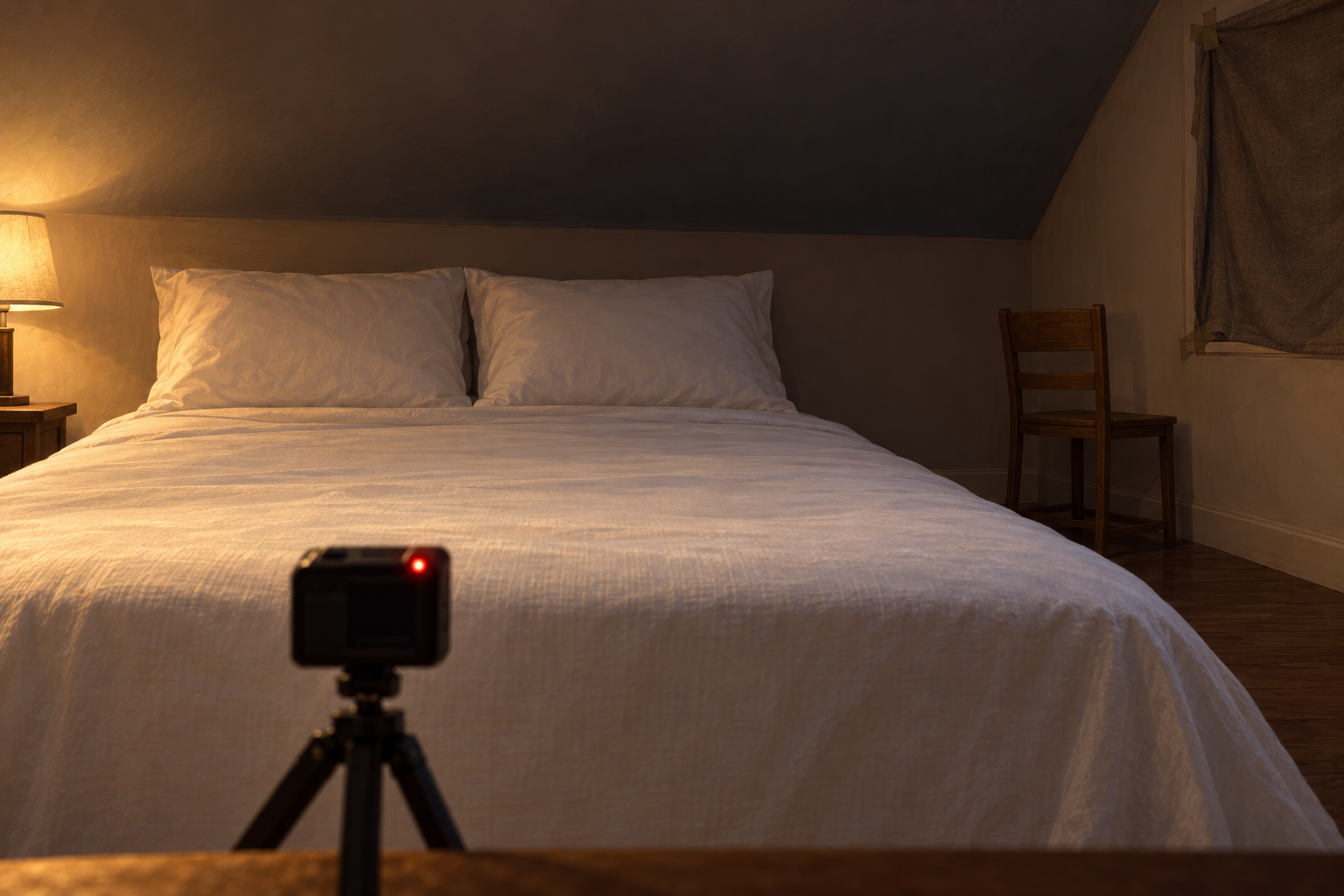
· · ·
Kyra pressed the button on the speaker by the bed, and the music came up — low, slow, mostly strings, the piece Val had always said sounded like a dentist’s waiting room, the piece that had covered the murmur at the end of every live show for years. It filled the room the way it always had.
She turned the camera on. The small red light came up in the corner.
And they lay down.
· · ·
Side on.
Hip to hip, turned in to each other, face to face, on the white sheet in the lamplight. Their legs wound together the way they had wound together in every bed in every house since the snow. Nothing between them and no space at all.
Kyra had thought — she had been afraid, a little, in the week before — that it would feel different, with the camera there. That knowing the red light was on in the corner would make it a show, even this; that she would feel herself performing it, the way she had felt herself performing so many things for so many years, and that the thing that was theirs would turn, under the lens, into something that was only a picture of itself.
It did not.
She looked at Val’s face, an inch from hers, in the shadow above the shoulders where the camera could not see, behind the black mask with the open eyeholes. And Val looked back at her. And there was nobody else in the room. There never had been. The camera was there, at the foot of the bed, recording two bodies on a white sheet; and up here, in the dark, a hand’s breadth above everything it could see, there were only the two of them, the way there had always only been the two of them.
Us.
· · ·
Kyra kissed her.
The camera did not see it. It would never see it. Nobody would ever see it. And Kyra kissed her the way they had always kissed, side on — the whole way through, from the beginning, without stopping — and Val kissed her back, and it was the oldest thing they had, older than the snow, older than the grip, older than the names.
They laced.
The grip came up between them and said here. It said you. It said yes, this, here, you, small and steady and certain, and Kyra answered it, and it answered back. And under the kissing, and under the grip, Kyra talked to her — low, into her mouth, in the half inch between them, the way the wiki said she did and the way she always had — about nothing. About the cherry tree. About the boy with the sandwiches on the ridge. About a woman in a hospice in the hills, whose room got the morning.
Nobody would ever hear it. The music was over it, and the camera was too far away, and it was not for anybody.
· · ·
Val’s light came up.
It came up the way it came when it was real, which was the only way it ever came at all: unevenly, without any order to it, like weather. At the wrists first, tonight — Kyra felt it before she saw it, a warmth against the back of her neck where Val’s hands were. Then low on the belly, where they were pressed together. Then nowhere for a while. Then the collarbones all at once, both of them, and the throat, and up under the braid at the temples, and down the insides of the arms, and through the skin of the chest — until the whole of her was lit, in the lamplight, inches from Kyra, the color of nothing on this world.
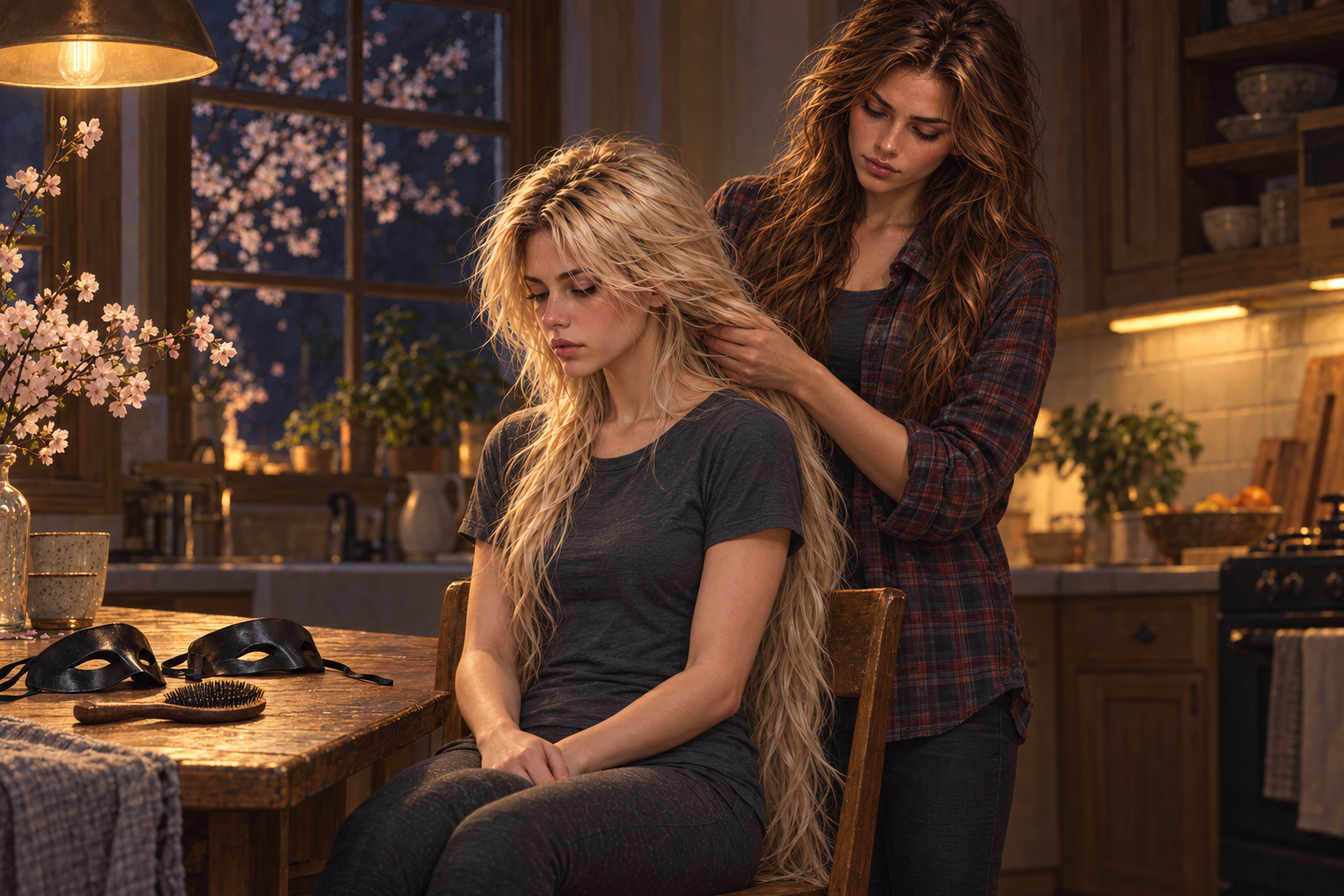
On the camera at the foot of the bed, it would be gray. A soft clean gray bloom along the shape of a woman on a white sheet, rising and rising, unevenly, in no order at all. The way it had risen in every true video the channel had ever made. The way lux had said, once, that’s honestly the thing that convinced me it was real.
Up here, in the dark above the shoulders, where the camera could not see, it was not gray. And Kyra looked at it — at Val’s face in it, an inch away, behind the mask, with her eyes open and on Kyra’s — and felt her own eyes go, all the way, behind the mesh. The gold came up in them like heat through a stove door. Nobody would ever see that either.
· · ·
And at the very top of it Val went: slowly, completely, without a sound, the way she always went, with the light at its brightest and the grip gone wide and white between them, and her forehead coming to rest against Kyra’s in the dark, mask to mask.
Kyra held her through it. She did not stop kissing her; side on, she never had. It was not a lid on anything. It was only the oldest thing they had, going on through everything, the way it always had.
· · ·
The murmur started in Val, low, with Kyra’s name strung through it, and the music took it, as it always had.
And Kyra went after. She always went after. She went the way she always went, loud, helpless, enormous, the whole of her coming apart against Val in the lamplight with the gold all the way up in her eyes — and at the end of it, as it had at the end of every video they had ever made, the laugh came up out of her, from somewhere under the ribs. Warm and loud and helpless, over the strings, filling the room that was nowhere to the corners.
The last laugh. Kyra knew it, even while it was happening. She let it go on as long as it wanted to.
· · ·
They lay there afterward, side on, laced, with the grip gone loose and warm and quiet between them, and Val’s light going slowly down and out, last at the wrists where they lay against the back of Kyra’s neck.
The music went on. The red light went on, in the corner.
Kyra did not turn it off. Neither did Val. They lay there, the two of them, facing each other on the white sheet in the lamplight, and let it record them lying there, doing nothing, for a long time — two shapes on a bed, with the dark above them — until the song ended, and the room went quiet, and Kyra reached past Val’s shoulder for the remote on the pillow and pressed it, once.
The small red light went out.
· · ·
Val did the edit on the Monday night, at her own kitchen table, with every lamp in the house on.
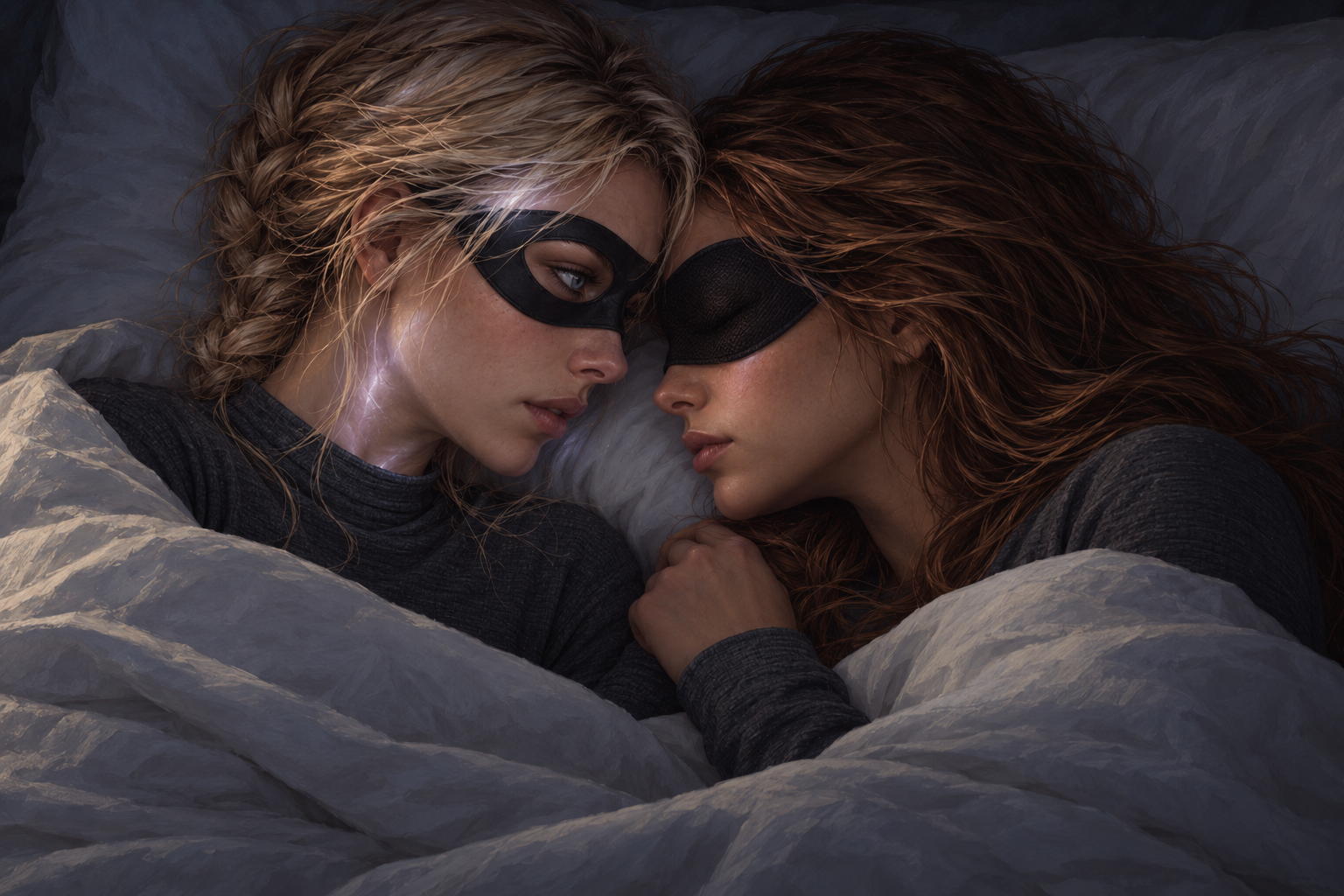
Kyra sat across from her and watched. Val had asked her to. So you can see I don’t touch it. And Kyra sat with a cup of tea going cold in front of her for four hours and watched Val go through it, frame by frame, the whole night from the first frame to the last, with her glasses on and her face quite still.
She cropped. She went through every frame where the camera saw higher than the shoulder — there were not many; they had set it well — and brought the top of the picture down, an inch, half an inch, until there was nothing above the line of the collarbones but dark. She found three frames, in the middle, where Kyra had moved and the edge of a jaw had come down into the light for less than a second, and cut them, and closed the gap so smoothly that Kyra, watching it back, could not find the join.
She darkened the shadow above the shoulders, once, where the lamp had caught the curve of a cheek. Only the shadow. A little.
She did not touch the light.
Kyra watched for it. She could not help watching. She watched Val’s hands on the keys, every time the light came up on the screen — the gray bloom along the shape of a woman on a white sheet, rising in no order, at the wrists and then nowhere and then everywhere at once — and Val’s hands did not move. Not once. Val sat with her hands flat on the table on either side of the laptop and watched her own light rise on the screen, all the way, and go down again, all the way, and did not touch it.

Kyra watched her watch it.
She had seen Val study that light once before, frame by frame, all night, for the wrong reason. She saw her look at it now, the whole way through, for the right one; and her face did not change at all, except once, near the top, when the gray had come up everywhere and the shape on the screen was lit from end to end, and Val’s mouth moved very slightly, and she said, almost to herself:
“There.”
· · ·
“What shall we call it?” said Kyra, near midnight, when it was done.
Val did not answer at once.
“I thought—” Kyra stopped. “I thought, Let it come to you.”
Val looked at her for a long time over her glasses.
“Gus put it in her obituary,” she said gently. “Let it come to you, Iris. Every camera operator in the business says it now. He told you so. And there are people in the comments who read everything.” She shook her head, very slightly. “Somebody would put it together. A channel and a woman who died the same winter, and the same words. They’d go looking.”
Kyra looked at the table.
“You’re right,” she said.
“I wish I weren’t.”
“I know.” Kyra was quiet. “Then what?”
Val thought about it for a while. Then she typed something into the box where the title went, and turned the laptop around so Kyra could read it.
Spring.
“That’s all?”
“That’s all,” said Val. “It’s spring. The cherry’s out. It was a Saturday.” She took her glasses off. “Nothing in it says goodbye.”
Kyra looked at the one word for a long time.
“And when it goes up?”
“Sunday,” said Val. “Ten past three in the morning.”
· · ·
Kyra looked up.
Val was looking at the screen, not at her. Her face was doing nothing.
“That’s when the first one came,” said Kyra slowly. “The first letter. Ten past three in the morning, by the clock on the message. And the last one.”
“I know,” said Val. “Nobody else on earth will ever know that.” She set the time. “That’s the point.”
· · ·
It went up on the Sunday at ten past three, on the front page, free, for everyone, under one word.
Kyra was awake for it. She had not meant to be. She woke in Val’s bed in the dark for no reason at all and lay there, and at ten past three the phone on the nightstand lit up once, quietly, the way it had every Sunday for years, when the letters came. She did not pick it up.
Beside her, in the dark, Val was awake too. Kyra could tell by her breathing.
Neither of them said anything. Val’s hand found Kyra’s, under the blanket, and held it, and they lay there in the dark and listened to the rain on the roof and did not look at the phone, and after a long time they both went back to sleep.
· · ·
The comments, when Kyra finally looked at them, on the Monday — she let herself, once, for this — were not like any comments the channel had ever had.
wait
what is this
I’ve never seen them do this
they’re... side by side? facing each other? I don’t even know what this is called
there’s no chair. there’s no chair. why is there no chair
you can’t see anything above the shoulders. on purpose. she’s cut it on purpose
it’s so quiet
I’ve watched it four times and I don’t understand it and I can’t stop crying
the light. look at the light. look how it comes up. it’s the realest one I’ve ever seen
this isn’t a show. I don’t know what it is but it isn’t a show
”Spring.” that’s it? that’s the whole title?
it feels like a goodbye
it does NOT feel like a goodbye don’t say that
it does though
And one, a little after four in the morning, from a name Kyra knew.
lux_aeterna: I’m not going to score this one. I don’t think it’s for scoring.
Kyra read it at Val’s kitchen table, and closed the laptop, and put her hand flat on the lid, and left it there.
— end of chapter thirty-seven —
Late spring · Val’s kitchen
The back room asked for a week.
Not in words, mostly. In the way a crowd asks, by not going home. They watched Spring — the counter under it went around and around like a meter in a heat wave — and they argued about it, and cried about it, and asked each other what it was, and asked the channel what it was; and then, a few days in, they started asking the other thing. Quietly at first. Then less quietly.
is this it?
is this the last one?
nobody’s said it’s the last one. don’t say it’s the last one
it FEELS like the last one
they’d tell us. they’d say something. Blondie would say something
would she though
she said “technical difficulties” when they skipped a whole video. she said “keep it for us” when they won a whole award. she’ll say SOMETHING
ok but what if this is the something
Kyra read them at Val’s table on the Friday, one after another, with her feet up on the other chair, and did not read any of them aloud.
“They’re waiting,” she said.
“I know.”
“They deserve to know. They shouldn’t have to guess.”
“No,” said Val. “They shouldn’t.” She was writing something in the gray notebook, small, at the back; she did not look up. “They can pay; they can’t steer. But they’re owed the truth about what they paid for. That’s the last term, really. The one we never wrote down.” She finished writing and closed the book. “Even when the truth is nothing more.”
· · ·
She wrote it that night.
Kyra watched her do it, sitting beside her at the table with her chin on her hand. It took a long time, which Kyra had expected. Val wrote a great deal, and deleted it, and wrote a great deal more, and deleted that. She wrote two whole paragraphs about the back room, and what it had meant, and deleted them. She wrote a list of every person in the comments who had ever mattered, by name, and looked at it, and deleted it a line at a time, very slowly, as if she were taking them down off a wall.
At a little after midnight there was one line on the screen.
Val read it out loud. Once.
Kyra was quiet for a moment. Then she said, “Yes.”
“Yes?”
“It’s the same voice,” said Kyra. “It’s technical difficulties. It’s keep it for us.” She put her hand flat on Val’s on the table. “It’s you. They’ll know it’s you before they’ve finished reading it.”
· · ·
It went up on the front page, under Spring, on the Saturday morning, where everyone could see it.
That was the last one. Thank you for watching.
—B
· · ·
Then Val did the other things. She did them that same morning, at the table, while the coffee went cold, with Kyra watching; the plain closing-up things, the things you do on the last night in a house before you go.
She turned off the back room. Not the videos — those stayed exactly where they were, every one, for anyone who had paid to see them, for as long as the site stood. Only the door. No new members. No renewals. Nobody would ever be charged for anything again. The last payment was the last payment, and Val wrote it in the cloth-bound ledger, on the last line of the last page of the last book, small and level, and drew a line under it, and wrote nothing after.
She turned off the private messages.
She did not delete anything. Kyra had wondered if she would. She did not. The front page, the chair videos, the pink ones, the golden syrup, the replica, Spring — all of it stayed exactly where it was, with That was the last one at the top, and the comments open underneath for anybody who wanted to say anything. Like a house with the door left on the latch, Kyra thought, and the lamps still on, after everybody has gone.
“You’re not taking it down,” said Kyra.
“It’s on every pirate site on the planet already,” said Val. “Taking it off ours would only mean the only copy that’s honest is gone.” She closed the laptop. “Let it stand. Let them come and look. We made every frame as though it would exist forever.” She put her hand on the lid. “It will.”
· · ·
Kyra read the comments that night. All of them. She had told herself she would not, and she did, at her own kitchen table, alone, until two in the morning, with the cherry petals coming down past the window in the dark.
It was not like the comments under Spring. It was not like anything. It went on and on, and some of it made her laugh out loud and some of it made her put her face in her hands, and most of it did both.
NO
no no no no no
I knew it. I KNEW it. I said it under Spring. I said it was a goodbye
”thank you for watching” I’m going to throw up
they’re allowed to stop, you know. people are allowed to stop
I know they are I’m just. I’ve watched every Sunday for years and I don’t know what I’ll do on Sundays now
same
same
same
thank you. for everything. for the chair and the light and the waiting

thank you for being the only real thing on the internet
the redhead’s laugh at the end of Spring. I didn’t know it was the last one and I still knew it was the last one
whoever you are wherever you are I hope you’re happy. I hope you’re together. I hope you’re in a kitchen somewhere laughing at all of us
Kyra was. She sat in her kitchen with her face wet, laughing at all of them.
· · ·
And then, a long way down, at the end of a long thread, somebody had started something.
is it worth it?
It was the old question. The one from the door of the back room, years ago, that had turned into a thing the strangers said to each other: one person on the front page asking, Is it worth it?, and somebody from behind the door answering, every time, the same three words. It’s worth it. Kyra had seen it a thousand times. She had stopped noticing it, the way you stop noticing a clock.
And under it, this time, somebody from the back room had answered.
It was worth it.
And under that, another. And another. Down the page, as far as Kyra could scroll, one after another, from names she knew and names she had never seen, all of them the same four words, in the past tense now.
It was worth it.
It was worth it.
It was worth it.
She scrolled until her thumb hurt. They did not stop.
· · ·
The wiki added a page that week. It was the shortest page on the whole site, shorter even than Theory 6. It was called The End, and somebody had written, at the top of it, in the flat neutral prose that tried very hard to sound like an encyclopedia:
On a Saturday in spring, the channel posted the following message, signed B:
”That was the last one. Thank you for watching.”
No further videos have been posted. The back room is closed to new members. The channel remains online. The identity of Copper and Blondie remains unknown.
And underneath, in a different hand, plainly added later by somebody who could not help it:
This page will not be updated.
· · ·
At the bottom of the page called Where Is The Chair From, somebody had added a last line too, under I like that it’s from nowhere.
Me too. Leave it there.
And on lux_aeterna’s own page — the long one, with the methodology and the charts and Theory 6 marked Confirmed — there was one new line at the very top, above everything, in bold.
The Glow Index is closed. Final entry: Spring — not scored. I’ve kept every frame. I’ll keep them for as long as I’m around to keep anything. Thank you, B. Thank you, C. I’ll take an honest three over anything else on earth, and you gave me more of them than I can count, and one I couldn’t score.
Kyra read that one at the fire hall, standing in the bay by the truck, and went out the back and sat on the step for a while in the sun.
· · ·
Tallyman took two weeks.
Kyra had thought he would be first. He was always first; for years, under every video, within the hour, there had been a little gray grid of boxes with his numbers in it. And under Spring there had been nothing. And under That was the last one there had been nothing. Just a gap, in the comments, where he should have been, that the regulars kept pointing at. where’s Tallyman? has anyone heard from the Accountant? he’s never missed one. give him time. it’s a lot of math.
And then, on a Sunday at the end of May, at the very top of the comments, where everybody would see it, a post with a spreadsheet in it.
It was the longest thing he had ever written.
· · ·
Final totals.
I’ve been keeping this since the chair videos. Some of you were here. Most of you weren’t. That’s fine. Here’s all of it.
There followed the spreadsheet. The whole thing, every row, every column, from the first chair video to the week before Spring — the grid of little boxes Kyra had glanced at under every video for years and never once looked at all of, all at once. It went on for screen after screen. Time to Blondie’s first. Copper — long. Strokes, for the syrup show, which had its own section with its own footnotes. Glow (per Index), in the later rows, with lux’s numbers. The live shows, separately, in their own color. The record — the one he had marked rare with three exclamation marks, that first winter, before she had known who he was. The averages. The averages of the averages. A row, struck through, in gray: Video removed by channel. A row in gold, at the top: Best Chemistry: Independent. WON. Not collected.
And at the very bottom, under all of it, a row by itself.
Blondie scream pot: $2,612. Donated. Status: still waiting.
And beside it, in the notes column, one word he had never used before.
Closed.
· · ·
Kyra was reading it aloud at Val’s kitchen table. She stopped there.
She looked up.
Val was looking at her across the table, over her glasses, with her face doing nothing at all — and then, for a moment, very slightly, not nothing.
Once. And nobody heard it but you.
Neither of them said it. Kyra looked down at the screen again, at Status: still waiting and Closed, and felt it come up in her, and let it, and laughed until she had to put the phone down on the table — and Val, across from her, made the small breath through her nose, once, twice, and looked out of the window at the garden, and did not look back for some time.
· · ·
“Read the rest,” said Val, when Kyra could.
There was one more row. The last one. Below the pot, below Closed, set apart by an empty line, as if he had sat for a long time before he typed it.
Spring.
Time to Blondie’s first: —
Copper — long: —
Strokes: —
Glow: not scored (see lux_aeterna).
Notes:
And then, below it, not in the spreadsheet at all. Just a line of plain text, on its own, the last thing in the post.
I’ve counted everything these two ever did for years. I have the numbers for all of it. I could tell you their averages to the second.
I don’t know what I watched.
I don’t know what it was. I don’t have a column for it. I tried to make one and I couldn’t think what to call it.
So that’s the last entry. I’m leaving it blank. Some things you don’t count.
Ledger closed. Thanks for everything, B and C. It was worth it.
— T.
· · ·
Kyra put the phone down on the table between them.
Val did not pick it up. She sat with her hands on either side of her cup and looked at the phone, at the blank row and the line under it, for a long time.
“Some things you don’t count,” she said at last.
“I know.”
“From him.”
“I know,” said Kyra.
· · ·
Val took her glasses off. She folded them and put them on the table beside the phone, and pressed her fingertips into her eyes, and kept them there.
“Do you know what that is?” she said, without taking her hands away.
“Tell me.”
“That’s a record of me,” said Val. “The whole thing. Every column. Time to Blondie’s first. The light, in numbers. The record he marked rare. Years of it. A stranger with a spreadsheet, keeping a record of what my body did, every week, carefully, without one single mistake in it that I’ve ever found, and I’ve looked.” She took her hands away from her eyes. “And it’s finished. He finished it. He drew the line at the bottom and wrote closed.”
“Yes.”
“I didn’t keep it,” said Val. “That’s the thing, Kyra. I didn’t have to keep it.” Her voice was perfectly level and very quiet. “I have kept every record of myself there has ever been. Since a queue at the Vayr. Every name, every town, every face I wore. Every night I couldn’t get there and every night I did. All of it in my own hand, in my own books, in my own head, at two in the morning, checking. Nobody else has ever kept a single line of it. Nobody else ever could.” She looked at the phone. “And for years, somebody did. Somebody I’ll never meet kept a whole column about me, and kept it better than I would have, and never once asked me for anything. And now it’s done. And it’s finished. And it’s right.” She stopped. “And I didn’t have to keep it.”
· · ·
Kyra did not say anything. She got up and came around the table and stood behind Val’s chair and put her arms around her from behind, around her shoulders, and put her chin on the top of Val’s head, and held on.
Val let her.
“For the first time,” said Val, into Kyra’s arm, “in my whole life, there’s a record of me that’s finished. And it isn’t mine.”
“How does it feel?”
Val thought about it. Kyra felt her think about it, honestly, the way she thought about everything.
“Light,” said Val at last.
· · ·
She wrote one reply. Only one. Under Tallyman’s post, at the very end of the thread, that night, after Kyra had gone up. Kyra did not see her do it. She saw it in the morning, at the top of the comments, where everyone else saw it, with a little gray box under it showing how many people had already read it.
It was the only time, in all those years, that the channel had ever answered him.
Thank you for keeping it. —B
And under it, a little later, his. The last thing he ever posted.
B replied. Status: kept.
· · ·
There was a photograph, in June, that somebody posted on the wiki and that went around everywhere after.
It was taken in an office in Las Vegas — the awards people’s office, somebody said, in a building near the airport. A plain room. A filing cabinet, a window with the blinds half down, a coffee machine. And on a shelf above the filing cabinet, between a framed poster and a dying plant, a gold figure on a black base, gleaming in the light from the window.
There was a card leaning against it. Somebody had written on it, in marker, in large careful capitals, so that anybody who came into that room would see.
KEEP IT FOR US.
· · ·
Kyra kept that one. Not on the phone. She had Val print it, at the library, on the good printer, on a Thursday night when the building was empty; and she put it in an envelope, and put the envelope in the drawer of her kitchen table, at the back, with Val’s road map with the pencil circle on it, and the spare batteries, and the takeout menus.
“You’re keeping a photograph,” said Val, watching her do it.
“I’m keeping a photograph.”
“We don’t keep things. We promised. In the snow. Nothing kept.”
“We kept the pink ones,” said Kyra. “We kept the gray notebook. We kept the chair.” She shut the drawer. “And it isn’t us. It’s a picture of a shelf in an office in Las Vegas. Nobody could ever learn a single thing from it.” She put her hand flat on the drawer. “It’s just a trophy that nobody collected. With a card on it. Saying what somebody wanted to say.”
Val looked at the drawer for a long time.
“Keep it for us,” she said.
“They did,” said Kyra. “Didn’t they. They kept it. All of it. Every frame.” She came around the table and sat down. “We asked them to keep it, and they did.”
· · ·
That night, in Kyra’s bed, with the window open on the warm dark and the smell of cut grass coming in from somebody’s yard down the street, Val said, into the dark:
“Do you remember the chair?”
Kyra smiled into the pillow.
“Which night?” she said.
“The night with the replica.”
“Oh, God.”
“You laughed so hard you couldn’t finish.”
“I couldn’t finish,” Kyra agreed. “You had to stop and wait for me. You lay there with that face on—”
“I did not have a face on.”
“You had the face. The grave scientific interest face. Waiting for me to stop laughing at a—”
“It was very well made,” said Val, with dignity.
“It was beautifully made.”
“All those weeks,” said Val. “In the basement.”
“I know,” said Kyra. “I remember.” She found Val’s hand in the dark. “Ask me again tomorrow.”
“I will,” said Val. “And the day after.” She held on. “We can, now. We can talk about all of it. For as long as we like.”
“For the rest of it,” said Kyra.
“For the rest of it,” said Val, and was asleep, a long time later, before Kyra was, with her hand still in Kyra’s, and her face, in the dark, doing nothing at all.
— end of chapter thirty-eight —
Autumn · both kitchens, and an envelope
Val waited until October.
Kyra had known she would wait. She had not known how long, and by the end of the summer she had begun to mind.
“It’s been months,” she said, at Val’s table, in September, with the windows open on the last of the warm evenings and the garden going gold. “Since the hills. Since Gus’s post. You said in March you had an idea about the money. You said it wanted a few months.” She turned her cup on the table. “It’s had a few months.”
“It’s had six,” said Val.
“So?”
“So it wants a few more.”
Kyra looked at her across the table.
“It feels cold,” she said. “Val. I’m sorry. It does. She’s gone, and we were there, and we’ve got all of it sitting in your ledger doing nothing, and every week we don’t—” She stopped. “It feels like we’re waiting to see if anybody’s watching.”
· · ·
Val did not answer at once. She put her cup down, and looked at Kyra in the way she looked at her when Kyra had said a true thing in the wrong shape and Val was deciding whether to fix the shape or let it stand.
“We are,” she said.
Kyra stared at her.
“We’re waiting to see if anybody’s watching,” said Val. “Yes. That’s exactly what we’re doing.” She did not raise her voice. “Think, sweetheart. A woman dies in February. That same month, a channel that’s been running for years goes quiet without warning. In April it posts one last video and says that was the last one. And in May, or June, a great deal of money arrives — in that money, the one nobody else uses, the one the channel was paid in — at a fund with her name on it, from somebody who won’t give a name.”
Kyra did not say anything.
“There are people who read everything,” said Val. “We’ve met them. lux. The one who found your jaw. The one who read ONIA off the bottom of a chair. Gus himself, who isn’t a fool, who stood in a lobby and looked at you and asked if you knew her.” She turned her hand over on the table. “We promised her. In the room. She didn’t want our names, and we didn’t give them, and she said she’d never tell, and she didn’t. The least we can do is not tell for her. Not tie her to us by accident with a bank transfer.”
“So you’re waiting until—”
“Until it’s just one gift among a great many,” said Val. “Until her name’s been in the papers and gone out of them again. Until there have been benefit screenings and memorial funds and every camera operator she ever shouted at has put twenty dollars in a jar. Until a large anonymous gift in her name is a lovely thing that happens, and not a clue.” She paused. “That’s not cold, Kyra. It’s the promise. It’s keeping it.”
· · ·
Kyra looked down at the table.
“I hate it when you’re right,” she said at last.
“I know you do.”
“I hate it more when you’re right and kind at the same time.”
“I know,” said Val. “I’m sorry. I’ll try to be only one or the other in future.”
And Kyra laughed, in spite of herself, and put her hand flat on top of Val’s on the table, and said, “October?”
“October,” said Val.
· · ·
It was late in October when Val brought it to the table.
She had the cloth-bound ledger. All of them, in fact — all the books, from the first one with the tiny number on the first line and Somebody in the margin, underlined, to the last one with the last payment on its last line and nothing after it. She stacked them on Kyra’s kitchen table, one on top of the other, and the stack was higher than Kyra’s teacup, and Kyra had never seen them all together before and was startled by how many there were.
And the laptop. And the gray notebook. And a single sheet of paper, folded in half, in Val’s hand.
“I’ve been through them,” said Val. “All of them. I wanted to find something.”
“Find what?”
“Her favorite,” said Val.
· · ·
Kyra looked at her.
“She never told us,” said Kyra. “Did she? In all the letters. She talked about all of them. The light and the waiting and the lighting and the blonde’s shoulders. But she never once said this one. I’d have remembered.”
“She never said this one,” Val agreed. “Not in so many words.” She opened the gray notebook, at the back, at the columns, and turned back through them, years of ticks, to near the very beginning. “But you remember the third letter.”
Kyra did. She did not have to think about it. She had read it alone, in Val’s bed, in the rain, at twenty to four in the morning, a very long time ago, and kept it to herself for a few hours, and known it by heart ever since.
“I’ve had a long week,” she said. “A long month, really. I won’t bore you with any of it. I watched the one where the redhead steals the pink ones, tonight, twice, and I laughed out loud at the blonde’s face, alone in my kitchen, at half past three in the morning, and I can’t remember the last time I did that.”
“I can’t remember the last time I did that,” said Val.
“The pink ones.”
“The pink ones,” said Val. “It’s the only time in all those letters she ever said she’d watched one twice. And the only time she ever said she laughed.” She closed the notebook. “And she wrote it on a night when she’d had a long month. Before any of the rest of it. Before we even knew she was a she.” She paused. “I think that was her favorite. I think it was the one she went back to. I can’t prove it.”
“You don’t have to prove it,” said Kyra. Her voice had gone a little. “It was. I know it was.”
· · ·
Val unfolded the single sheet of paper and turned it around on the table so Kyra could read it.
It was a figure. One line. In Val’s hand. And under it, in smaller writing, how she had got there: every entry in every ledger, from the night the pink ones went up to the night the back room closed, that had paid to see that video. Every somebody. Added up, and turned from the money nobody else used into ordinary money, at that week’s rate, to the cent.
“Everything it ever earned,” said Val. “Every line in the books that was for that one.”
Kyra looked at the figure.
It was a great deal. It was more than Kyra had ever thought one video could earn, even one of theirs. It was more than either of them earned in years at the library and the fire hall put together. It was a number with commas in it.
“It isn’t enough,” said Kyra.
· · ·
She had not known she was going to say it. It came out of her the way her laugh did, from underneath, before she could stop it.
Val said nothing. She sat with her hands on the table on either side of the stack of ledgers and waited.
“It isn’t enough,” said Kyra again. “Not for her. She watched every one of them, Val. Every single one. For years. She wrote to us every Sunday at three in the morning. She saw the light when nobody else did. She asked is she OK.” Her voice went. “She was the witness. She was the one. And it’s — it’s one video. It’s the pink ones. She didn’t just watch the pink ones.”
Val looked at her for a moment.
“How much?” she said.
“What?”
“How much is enough?” said Val. “Tell me. Say it at the table.” She picked up her pen. “Whatever you say, I’ll write.”

· · ·
Kyra stared at her.
She had expected an argument. She had expected Val to say the ledger is mine, which it was; it was the one thing in all of it that was entirely Val’s, she had written so on the first night. She had expected we have to be careful and a gift that size is a clue too and think, sweetheart. She had been ready for all of it.
Val sat with her pen over the paper and waited, and did not say any of it.
“The chair,” said Kyra slowly. “The first chair video. She wrote about that one. The lighting. Too low and too much from one side.”
Val wrote something under the first figure.
“And the one with the lamp she said not to fix,” said Kyra. “And the one where she said the blonde stopped knowing the camera was there at the very beginning, which was rare. The one she wrote about on the Wednesday afternoon. When her hands — when she was already—” She stopped.
Val wrote. She did not look up.
“And the low one,” said Kyra, very quietly. “The fake. That winter. The one where she asked.”
Val’s pen stopped for a second. Then it moved again.
“And Spring,” said Kyra. “She never saw it. But it’s hers. It’s all hers. Everything we ever showed anybody that was true, she saw first.”
Val wrote one more line. Then she drew a line under all of it, and wrote a new figure under the line, and turned the paper around.
Kyra looked at it.
“That’s—”
“That’s what you said,” said Val. “Every one you named. Everything they ever earned.” She put the pen down. “Is it enough?”
Kyra looked at the figure for a long time.
“Yes,” she said.
“Then that’s what it is,” said Val, and put her hand flat on the paper, and did not say another word about it, then or ever.
· · ·
They split it at the table, the way Val had planned it all along. Half and half.
Half went to Gus Marlow’s fund.
He had started it in March, a month after she died: a fund in her name, for young women who wanted to work behind the camera, who could not afford the gear or the training or the years of carrying cables for nothing that the work asked of everybody at the start. It paid for lenses and light meters and schools. He had written about it on the industry page in his plain way. She’d have hated her name on it. She’d have hated a fund. But she’d have liked the girls, and she spent her whole life telling them to slow down, so here’s some money to slow down with.
The other half went to a foundation that looked for a cure for the thing that had killed her. A big one, with a long name and a building somewhere in the east and a great many people in white coats, the kind that would get a great many gifts in a great many names that year and would never look twice at any of them.
In memory of Iris Sancai, Val wrote, on both.
And in the box that asked for the donor’s name, on both, in her small exact hand:
Anonymous.
· · ·
Kyra watched her press the button. Twice. And then sat at the table and looked at the screen long after the confirmations came up, the two little gray boxes, with Thank you for your gift in them and nothing else.
“That’s it,” said Kyra.
“That’s it.”
“She’ll never know.”
“No,” said Val. “She’ll never know.” She closed the laptop, gently, the way she closed it on things that were sleeping. “But it’s her money. That’s the thing. That’s what I wanted. It isn’t ours. It never was. Every line in those books is somebody who sat up in the dark and paid to see something true. She was one of them. For years. Every Sunday. She paid to watch us.” She looked at Kyra. “Now it goes back. In her name. Against the thing that took her. And to the girls she’d have shouted at.”
Kyra could not answer.
· · ·
Gus Marlow posted about it in November.
It was short, like everything he wrote.
Iris’s fund had a gift last month. I’m not going to say how much. It’s enough that I had to sit down. It’s enough that we can do this properly now, every year, for a long time. It came with no name on it. Just “In memory of Iris Sancai.” I don’t know who it’s from and I’m not going to try to find out. She’d have my head.
Whoever you are — thank you. She’d have hated the fuss. She’d have loved the girls.
First grant goes out in the spring. I already know who I’m giving it to. She came up to Iris in a bar in Vegas this January, scared out of her wits, with a camera bag she wouldn’t put down. Iris told her to slow down. She has.
Under it there was a photograph. A young woman, in black, with a camera on her shoulder, on a set somewhere, squinting into the light. Not frightened. Waiting.
Kyra looked at it for a long time.
Then she turned the laptop around so Val could see.
Val looked at the photograph. At the girl, and the camera, and the light.
“Let it come to you,” she said, very quietly.
“She did,” said Kyra. “Look at her. She’s letting it.”
· · ·
There was one more thing, that night.
Kyra did not know Val was going to do it. She came downstairs late, in her robe, for a glass of water, and found Val at the kitchen table in the dark, with only the lamp over the stove on, and the envelope in front of her.
The envelope marked gutters.
It was the only thing from the first night that they still had. Kyra had nearly forgotten it existed. The terms had all gone into the gray notebook years ago, copied over, crossed out, added to, kept up. But the envelope had stayed where Val kept it, in the back of a drawer in Val’s kitchen, all that time. With the nine-page paper inside it, folded twice, and the terms written on the back in pencil, in Val’s hand, from the very first winter in Calderveil, before there had been a single frame.
Val had it open on the table. She had taken the paper out and unfolded it and laid it flat under the lamp.
Kyra came and stood behind her chair, and looked down at it over her shoulder.
· · ·
It was all there. In pencil, gone a little gray with the years. The masks. No faces. The hair down is mine. Kyra holds the camera, because nothing in that room is Val’s. Val holds the money. The grip, and the two taps, and gutters. Stove, at the bottom, for the basement, in whatever house that was.
And under all of it, very small, the last line of the first night. The one Kyra had said was not a term, with her voice gone.
Kyra gets her witnesses. Val keeps her light.
And under that, in the little space Val had always left, the three sentences from later. The stove ends what we do. It cannot end what we have done. Therefore: every frame as though it will exist forever. Because it will.
· · ·
“What are you going to do with it?” said Kyra quietly.
Val did not answer for a moment.
“When we started,” she said, “I’d have burned it. At the end. You know I would. I burned the cassette. I’ve burned everything we ever had with a date on it, in every house, on the last night, for longer than either of us can count. Nothing kept. That was the promise in the snow.” She touched the edge of the paper with one fingertip. “I’ve been sitting here an hour with the matches in my pocket.”
“And?”
“And I can’t think of a single reason,” said Val. “Not one. I’ve looked.” She was quiet for a moment. “You burn a thing because it’s dangerous, or because you’re ashamed of it. That’s all burning’s ever been for. The tape was dangerous. The years were dangerous. Every pair of gloves with a decade on it.” She looked at the paper. “This isn’t dangerous. It’s a list of rules for a room that doesn’t exist any more, in a town nobody’s heard of, about two women nobody will ever find. And I’m not ashamed of it.” She paused. “You didn’t say stove.”
“No,” said Kyra. “I didn’t.”
“So I’m not going to burn it,” said Val.
· · ·
She folded the paper again. Twice, along the old creases, the way it had been folded on the first night. She put it back in the envelope. She did not seal it.
Then she got up, and took it across Kyra’s kitchen and opened the drawer at the back of Kyra’s kitchen table, where the spare batteries were, and the takeout menus, and Val’s road map with the pencil circle on it, and the photograph of a trophy on a shelf in Las Vegas with a card that said KEEP IT FOR US.
She put the envelope in. At the back. Behind the map.
She stood for a moment looking down into the drawer.
Then she closed it.
· · ·
“There,” she said.
Kyra came and stood beside her, and looked at the closed drawer, and did not say anything for a long time.
“We’ve got a drawer,” she said at last.
“We’ve got a drawer,” Val agreed.
“We’ve never had a drawer. In all of it. Every house. You always—”
“I know.” Val did not take her eyes off it. “We’ve got one now.”
“What’s it for?”
Val thought about it, honestly, the way she thought about everything, with her hand resting on the top of the table above the drawer.
“Things we’re not ashamed of,” she said.
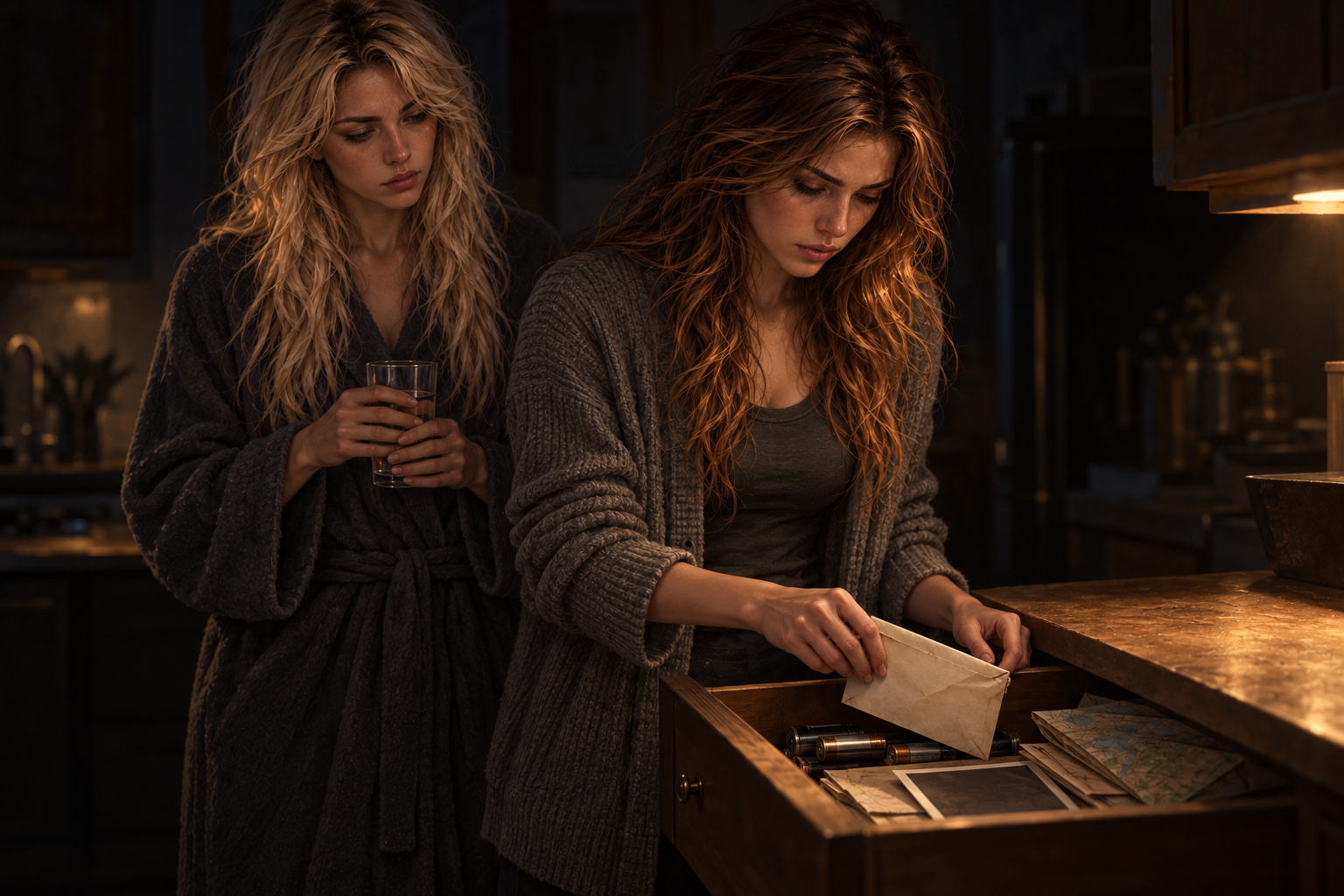
· · ·
They went up together. Kyra did not turn the lamp off over the stove. Neither did Val. They left it burning, in the empty kitchen, the way a lamp is left on in a window so somebody can find the house when they come back up the road.
And in the drawer at the back of the table, behind the map with the circle on it and the trophy that nobody collected, in an envelope marked gutters in Val’s hand, folded twice along the old creases, in pencil gone gray with the years, it was still there, under everything, in very small letters, where it had been since the first winter.
Kyra gets her witnesses. Val keeps her light.
They had. Both of them. All the way to the end.
— end of chapter thirty-nine —
The third autumn · the small house, across the valley
Val’s reason for being in that part of the valley turned out to be a gate.
She had invented it in the spring, in about forty seconds, and sat on it all summer, and Kyra had known the whole time and said nothing, because the inventing was the whole of the gesture. And on a Fourthday at the start of the autumn, with the weather holding and the light going long and gold across the terraces, Val put her coat on after breakfast and said, to nobody in particular, that there was a gate on the road below the small house that had been hung wrong and was going to take somebody’s hand off, and that she had a hinge in her pocket that would fix it, and she was going.
“You have a hinge in your pocket,” said Kyra.
“I have had a hinge in my pocket since the fourth month.”
“And it fits.”
“I measured it,” said Val, “in the fourth month.”
So they went. Four miles across the valley on foot, the long way around by the river, with the hinge in Val’s pocket and Kyra not saying anything about it the whole way, which cost her a great deal and which Val, walking beside her with her hands behind her back, quite plainly knew.
· · ·
The gate took nine minutes.
Kal was at the top of the path when they finished it, in the doorway of the small house, with her arms folded and her shoulder against the frame, looking down at the two of them on the road the way she had looked at people since she was small: quietly, and completely, and giving nothing at all away.
“The gate,” she said.
“It was hung wrong,” said Val.
“It was hung wrong when I took the house.” Kal did not move from the doorway. “Genie said you’d come about the gate. She said it in the spring.”
“Genie,” said Val, “says a great many things.”
“She said you’d invented it in about a minute and you’d have a hinge in your pocket.”
Val did not say anything.
And Kal unfolded her arms, and came down the path, and stopped in front of her mother’s partner on the road, and looked at the new hinge on the gate for a long moment; and then, very briefly, so briefly that Kyra nearly missed it, put her hand on Val’s arm.
“Thank you,” she said. “Come and carry something. Genie’s been here since the third hour and she’s broken a lamp.”
· · ·
The small house was across the valley from Kal’s old one, on the slope that got the afternoon, with three rooms and a long one and a door at the end of the long one that already stood open onto a yard with nothing in it yet. It had been somebody’s for a long time and empty for a while, and it smelled of dust and old wood and, now, of Genie, who was in the long room in the middle of a great many boxes, talking.
“—and I said to her, I said, Kal, you cannot put the books in the same box as the plates, and she said, why not, the way she does, as if I’d said something about the weather, and I said because books are heavy and plates break, and she said then I’ll carry it carefully, and I said—” Genie saw them in the doorway and stopped. “Oh, good. You’re here. Mother, tell her about the books and the plates.”
“Books are heavy,” said Val, “and plates break.”
“Thank you.”
“I’ll carry it carefully,” said Kal, coming in behind them, and went past all three of them to the far end of the room, and picked up the box with the books and the plates in it, and carried it carefully into the kitchen.
Kyra laughed. She felt it come — the warmth at the back of the eyes, like standing too near a stove — and turned her face to the wall before it could get there, the way she had been learning to all year, in rooms with other people in them. Then she remembered there was nobody in this room but her own family, and turned back, and let it come.
Genie looked at her with interest.
“You’re gold,” she said.
“I know.”
“I like it,” said Genie. “Nobody else’s eyes do that.” And went back to her boxes.
· · ·
They carried things for most of the day.
Kyra liked it more than she had expected to. There was a particular pleasure in it that she had not had for a very long time: being in a house with her daughter, being useful, being told where to put things by somebody who had her own ideas about where things went. On the other world it had always been the two of them, moving. Address after address. Boxes in the back of a car on a wet night, and Val going through every room on the last night with a box of her own, taking out everything with a year on it. Nobody had ever told Kyra where to put a chair.
Kal told her where to put a chair. Kyra put it there. Kal looked at it, and moved it about a hand’s width to the left, and looked at it again, and said nothing at all, and Kyra stood in the doorway and was so happy she could hardly breathe.
· · ·
It was late in the afternoon when she opened the wrong box.
She did not mean to. It was not hers to open; none of them were. She was in the small back room, the one that was going to be Kal’s room for sleeping, and there were three boxes against the wall with nothing written on them, tied with string, and Kal had said those go in the press and gone back out to help Genie with a cupboard that would not go through a door. And Kyra had picked up the first one and put it in the press. And picked up the second one, and the string had been tied the way Kal tied string, which was neatly and not very tight, and it had come loose in her hands as she lifted it; and the lid had come up an inch; and Kyra had put the box down on the floor to tie it again, properly, and had looked down, without meaning to, into the inch.
And then had not been able to stop looking.
· · ·
It was paper. A great deal of it. Loose sheets and small bound books, the cheap kind, with soft covers; and on the top of the pile, face up, a page of very fine close handwriting — not Kal’s — and under it, half showing, a drawing.
Kyra knew what it was before she had properly seen it. She did not need to read the handwriting to know what kind of handwriting it was. She had been born on this planet. She had grown up on it. She knew what the account was — the old tradition, the oldest thing a woman on Sethal could give a man: a description, in words, of what she had seen of him, at the extension, at the window, set down plainly and exactly, because he would never in his life be able to see it for himself. A woman’s gift. A private one. Given once, to one man.
And she knew there had always been other accounts. Ones that were not given to anybody. Written down for their own sake, by women who had a gift for it, and copied, and passed about, and sold under a counter in the bad streets of every port town on the coast; with drawings, sometimes, by people who could draw. Every girl at Corran Vayr had seen one by the second year. Nobody had ever admitted to it. That had been a very long time ago, whichever way you counted it, and from the look of the paper in the box it had not changed a great deal.
Kyra looked at the drawing for perhaps two seconds longer than she should have, because it was very good, and then she put the lid down.
· · ·
She tied the string again.
She did it carefully. Not tighter than it had been. Not neater. She looked at the knot before she did it and tied it again exactly as Kal had tied it, the same loop, the same loose pull, the way Val had taught her a very long time ago to put a drawer back in a rented room exactly as she had found it so that nobody would ever know it had been opened.
Then she put the box in the press beside the first one, and the third beside that, and shut the press, and stood in the small back room with her hand flat on the press door for a while, and did not go out.
· · ·
Her heart was going. That was the thing she noticed first. Going hard, the way it went on the ridge at the top of a climb, or on a cliff with a rope in her hands and somebody’s weight at the other end of it.
And the thing she felt was not what she would have guessed.
It was not surprise. Of course Kal had a box. Kal had had her whole grown life on this planet without them. Kal had a house, and then another house, and a life in them that Kyra knew almost nothing about, because she had been on the other side of a smudge in the autumn sky for all of it.
It was not disapproval either. She looked for that, honestly, and could not find it anywhere. She had spent years in a room that was nowhere with a camera in the corner. She was the last woman on two worlds who was going to look into a box like that and feel anything but a kind of fellow-feeling.
What it was — she stood in the back room and turned it over and over until she had it — was fear. For Kal. A fierce, sudden, ridiculous fear, coming up out of her from somewhere very old: that Kal would come in, and see the press, and know somebody had been in it. That Kal would be ashamed. That Kal, who had spent her whole childhood making herself nobody’s business, would find out that her mother had looked, and go quiet, and go away somewhere inside herself where nobody could follow.
Kyra wanted to go out into the long room, right now, and say it’s all right. She wanted to put her arms around her and say I saw, and I don’t mind, and you mustn’t ever be ashamed of it, not for one minute. She wanted to fix it. She wanted to fix it that second, in front of everybody, out loud.
She very nearly did.
· · ·
“Kyra.”
Val was in the doorway.
Kyra did not know how long she had been there. Long enough. Val’s face was still, and she looked at Kyra, and then at the press, and then at Kyra again; and Kyra knew, with the certainty of a very long time, that Val had seen her go into the back room and not come out, and had worked out the rest from the color of her face.
“Not here,” said Val quietly.
· · ·
They did not talk about it in the small house. They finished the cupboard, and the lamps, and the books and the plates; they ate bread that Genie had brought and Kyra said was not as good as the bread on Alberta, and Genie said nothing is as good as the bread on Alberta, you’ve told us, and Kal, at the end of the long table, laughed — very nearly — and then didn’t.
And at the end of the day, in the long gold light, Kal walked them down the path to the gate and stood with her hand on it, testing the new hinge, swinging it a little, watching it close by itself, true.
“It’s right,” she said.
“It is right,” said Val.
Kal looked at her for a long moment over the gate.
“Thank you for coming,” she said, to both of them; and then, as if it had cost her something, which Kyra thought it had: “I’d like you to come again.”
“We’ll come again,” said Kyra.
She said nothing else.
· · ·
She told Val on the road. Halfway home, by the river, with the dark coming up off the water and nobody else on the path in either direction.
All of it. The string. The inch. The handwriting and the drawing. What it was. She told it in English, without deciding to, because it was the language they had done everything that mattered in, and this mattered.
Val listened to all of it walking, with her hands behind her back, and did not interrupt once.
“An account,” she said at last.
“Not an account. A box of them. Bound. Some of them with drawings.” Kyra kicked at a stone on the path. “Good drawings, Val. Somebody who knew what they were doing.”
“Accurate?” said Val.
Kyra stopped dead in the road.
“Val.”
“I’m asking,” said Val, with dignity. “It’s a reasonable question. Most of them weren’t. When we were girls. I read one once, in the second year, under a blanket, with a lamp, and the woman who’d written it had plainly never seen a man in her life. She had the window in the wrong place.” She walked on. “I have always wondered whether anybody ever got it right.”
“I didn’t read it.”
“No,” said Val. “You wouldn’t have.” She was quiet for a few steps. “Go on. There’s more. I could see it on your face in the back room.”
· · ·
Kyra told her the rest. The fear. The thing that had come up in her, standing with her hand on the press door. She’ll be ashamed. I have to tell her it’s all right. I have to tell her now.
“I was going to go out and say it,” she said. “In front of Genie. In front of everybody. I had my hand on the door.”
“I know you did.”
“I was going to put my arms around her and say I saw, and I don’t mind—”
“I know,” said Val. “That’s why I came.”
They walked a little way in silence. The river went by beside them in the dark, doing what it did.
“I just want her not to be ashamed,” said Kyra. “That’s all. That’s all it is. She’s my girl. She’s always been so — careful. Since she was tiny. Making herself small so nobody’d look at her. And I can’t bear—” She stopped. “I can’t bear for her to think, even for a second, that there’s anything in that box she has to hide from me. From us. Of all people. After what we—”
“Kyra,” said Val.
· · ·
She stopped on the path, and turned, and put her hands, very lightly, on Kyra’s arms.
“She has had her whole grown life without us,” said Val. “She chose that house. She chose the box. She tied the string herself, and put it in the back room, and told you which press it went in.” She did not let go. “She doesn’t need protecting from it. She hasn’t needed protecting from anything for a very long time. We missed all of that. We’ll never get it back.”
Kyra did not say anything.
“She doesn’t need us to tell her it’s all right,” said Val. “She knows it’s all right. It’s hers.” She paused. “What she needs is for us not to be ashamed. In front of her. Of anything. She’s never once in her life seen either of us not be ashamed of something. We came home and the first thing we did was spend three days not saying anything in her house.”
· · ·
Kyra stood on the path in the dark with Val’s hands on her arms.
“So what do I do?”
“What you were going to do,” said Val, “in the back room, with your hand on the door. Tell me what that was.”
“Go out and—”
“Go out into a room,” said Val, “with other people in it, and say the thing about her body that she had not said herself. Out loud. To everybody. Because you felt it and it was out of your mouth before you’d thought.” She let that sit for a moment. “Without asking her.”
Kyra went very still.
She knew the story. Everybody in both families knew the story. A hall at Corran Vayr, in the second month, a long time ago, and a girl who said everything, and four men at a table, and a girl who had sat on a thing for twelve days because it was hers to sit on — and then a yard, at night, with the door shut, and two words that had been the whole of it.
Ask me.
“That’s what Genie did,” said Kyra slowly.
“That’s what Genie did,” said Val. “For the best reasons on two worlds. And Kal has never in her life forgotten it.” She took her hands away. “Don’t do it to her again. Not even to be kind. Especially not to be kind.”
· · ·
Kyra put her face in her hands for a moment on the path, in the dark, by the river.
“Then I can’t say anything,” she said, through her fingers. “Can I. I can’t ever tell her I saw. I can’t tell her it’s all right. I just have to — carry it. And never say.”
“You can’t say anything about the box,” said Val. “Never. Not one word. Not a look. Not a joke. If she ever wants you to know, she’ll tell you, and if she never does, then it was never yours to know.” She paused. “That’s not the same as not saying anything.”
Kyra took her hands away from her face.
“What do you mean?”
· · ·
Val did not answer at once. She turned and started walking again, slowly, along the path by the river, with her hands behind her back, and Kyra went with her.
“You wanted her not to be ashamed,” Val said, after a while. “Of a box of paper with drawings in it. You wanted her to know there’s nothing in it you’d hide from, of all people.” She looked at the dark water. “Then don’t tell her hers, Kyra. Tell her ours.”

Kyra stopped again.
Val did not. She walked on two or three steps before she realized, and then stopped, and turned around, and stood on the path looking back at Kyra in the dark.
“Ours,” said Kyra.
“The room that was nowhere,” said Val. “The chair. All those years of it. All of it.” Her voice was perfectly level. “Not the box. Never the box. We give her something instead of taking something. She hears that her mothers were watched by more strangers than live on this whole coast, every week, for years — and were proud of it, and said so at a kitchen table, and never once said stove.” She paused. “And whatever she’s carrying about that press, she’ll put it down on her own. Without anybody ever having pointed at it.”
· · ·
Kyra stood on the path for a long time.
“We’ve never told anybody,” she said at last. “Not here. Not about that. We’ve never told anybody anything true at all, except—” She stopped.
“Except one,” said Val.
“Except one.”
“And she was glad,” said Val. “Wasn’t she. In the end. She held both our hands.” She looked at the river. “I think it’s time we told two more.”
· · ·
They decided it at their own table that night, in the house with the bad roof on the north side, with the door at the end of the long room standing open onto the dark yard.
In English. At the table. With the tea.
Not the box. Never the box. Not the acts; not the things that had happened in the room, except in the most general way. Only the shape of it, and what it had meant, and that it had been good, and that they were proud of it. At Genie’s, on a Fifthday, at dinner, with both of them there. And then whatever came, came.
Val did not write it down. There was nowhere on this planet to write it, and no envelope, and no gray notebook; those were in a drawer in a kitchen in a valley in Oregon, on the other side of a smudge in the sky. And it was a term with only one line in it, and both of them could carry one line.
“How do we start?” said Kyra.
Val thought about it.
“You’ll think of something,” she said. “You always do. From the other side of a room, with no preamble whatsoever.” She very nearly smiled. “Just don’t point at anybody.”
— end of chapter forty —
The third autumn · Genie’s house, at dinner
Kyra changed her clothes three times.
She had not done that since a hotel room in Las Vegas with a green dress at the bottom of the suitcase, and she knew it was ridiculous while she was doing it, and did it anyway. The blue. Then the gray. Then the blue again, with the gray over it, and then the gray off. Val sat on the end of the bed with her hands flat on her knees and watched all three without saying a word, which was the most generous thing anybody had done for Kyra in a month.
“It’s dinner,” said Kyra, to the mirror.
“It’s dinner,” Val agreed.
“At our daughter’s.”
“At our daughter’s.”
“With both of them. Like every Fifthday since the spring.” Kyra took the gray off again. “There’s nothing to dress for.”
“No,” said Val. “Wear the blue.”
· · ·
They walked. They always walked, to Genie’s. It was further than Kal’s, up out of the valley on the hill road toward the town, and it took most of an hour if Kyra did not stop, which she did, twice, once to look at a bird she did not know the name of any more and once for no reason at all except that her heart was going.
“I don’t know how to start,” she said, on the hill road, in English.
“You said that last night.”
“I’m saying it again.”
“You’ll know,” said Val. “You always know. You just don’t know until it’s out.”
“That’s not reassuring.”
“It isn’t meant to be,” said Val. “It’s meant to be accurate.” She walked on a little. Then, without looking around: “If it doesn’t come, it doesn’t come. It doesn’t have to be tonight. We’ve waited longer than anybody’s ever waited to tell anybody anything. Another Fifthday won’t kill us.”
“You’d hate that.”
“I’d hate that,” Val admitted. “I’ve been arranging what to say since the river. I have nine sentences. I’m not going to use any of them. But I’d hate it.”
· · ·
Genie’s house was the opposite of Kal’s in every way that a house could be.
It was full. That was the first thing. Full of things, and light, and noise; every lamp lit, every surface covered, books stacked on the stairs and papers on the chairs and three half-finished arguments pinned to the wall of the long room in Genie’s enormous handwriting, with other people’s handwriting answering them in the margins. People came and went from that house at all hours. Colleagues, students, a neighbor with a dog. Genie had never in her life been in a room she did not fill, and her house was the same.
Tonight there was nobody in it but the four of them. Genie had cleared the long table, which took some doing, and put a cloth on it, which Kyra had never once seen her do, and there was a smell of something cooking in the back that Genie had plainly been at since the afternoon.
“You’ve put a cloth on,” said Val, in the doorway.
“I can put a cloth on.”
“I didn’t say you couldn’t. I said you had.”
“It’s a perfectly ordinary—” Genie stopped. Looked at her mother. Looked at the cloth. “Kal said you’d notice the cloth.”
“Kal,” said Val, “is very observant.”
Kal, already at the table with her hands folded, said nothing at all.
· · ·
They sat down.
Kyra took the chair nearest the door, which was where she always sat at Genie’s, so that she could get up and help with things. Val took the chair across from her, at the end. Genie went back and forth from the kitchen and did not sit at all for the first quarter of an hour, and Kal sat where she always sat, on the long side, by the window, with her back to the dark.
And Val — Kyra saw her do it, and nearly laughed out loud, and caught it, and felt the warmth come up behind her eyes and put it down again — Val did not sit down straight away.
She stood by her chair a moment. She looked at it. A plain wooden chair, like all of Genie’s chairs, armless, with a straight back and a rush seat, the kind every house on that coast had had in every century since there had been houses. She put one hand on the back of it. Then she sat down in it, slowly, and sat very straight, with both feet flat on the floor, and Kyra watched her face do the thing it did when it was measuring something and did not want to be seen measuring it.
Then Val looked across the table at Kyra, and said nothing, and Kyra had to look at her plate for a long time.
· · ·
The dinner was good. Genie was a better cook than either of her mothers, which she knew and said, and which was true. There was fish, from the coast, done in a way Kyra did not remember from before, with something sharp in it; and bread, Vaedom’s bread, which Kyra said was not as good as the bread on Alberta, and Genie said Grandfather brings it specially so you can say that, and Kyra said I know, that’s why I say it; and a jug of something pale and cold that went to Kyra’s head faster than it should have.
And they talked. Genie talked, mostly, the way Genie had always talked, about everything at once. About the faculty, where somebody had said something in a meeting that Genie had answered at a volume that was still being discussed. About a student who had come to her in tears about a proof and gone away laughing. About the roof on her mothers’ house, which her grandfather had complained to her about at length, with figures.
Kal said very little. She ate, and listened, and once — when Genie was halfway through an imitation of the man in the meeting, standing up, with a spoon — she put her hand over her mouth, and her shoulders went, and Kyra saw her very nearly laugh, properly, with her head back, the way almost nobody had ever seen her laugh. And then not.
Kyra looked at that hand over that mouth and felt something go through her that she did not have a name for.
· · ·
She waited for the opening.
She did not know what she was waiting for. She had thought — on the hill road, and in the bed the night before, and standing in front of the mirror in the gray and then the blue — that there would be a moment. A gap in the talk. A place where a thing could be put down on the table. She had thought she would feel it come, the way she felt the gold come, a half second before.
It did not come. The talk went on, warm and loud and easy, around and around the table, Genie and the faculty and the fish and the roof; and every time there was a pause, Kyra opened her mouth and nothing came out of it, and Genie filled the pause before she could find anything; and Val, at the end of the table, sat very straight in her chair and did not help, and did not look at her, and Kyra knew that was deliberate and was grateful and wanted to throw the bread at her.
· · ·
In the end it was Genie who did it.
Not on purpose. Genie had never done anything important on purpose in her life. She had sat down at last, with the fish gone and the second jug on the table, and put her elbows on the cloth she had put out specially, and looked across at her mothers with her chin on her hands and the particular expression she had worn as a small girl when she had been told she could not have a thing and was working out how to have it anyway.
“Can I ask you something,” she said. “Both of you.”
“You’re going to,” said Val.
“I’m going to.” Genie looked from one of them to the other. “You never tell us anything.”
· · ·
There was a short silence.
“About the other place,” said Genie. “Earth.” She said it carefully, the foreign word, the way she had been practicing it since they came home. “You’ve been back all this time. You’ve told us about the seventeen households, and the ship, and the towns. You’ve given us a list of towns. Kal’s got it written down. Every one.” She did not take her chin off her hands. “And you’ve told us you worked. A library. A fire hall. Searching for people. Bridges, once, Mother, you said, the arithmetic of bridges.” She paused. “But you never tell us what you did.”
“That is what we did,” said Val.
“It’s what you did for money,” said Genie. “I mean the rest. All those years of the rest. What did you do in the evenings? What did you do for fun? Did you have friends? Did you—” She waved one hand. “I don’t know. I don’t even know what to ask, because I don’t know what there was. You’ve given us everything that happened to you and nothing that you did.” She looked at them both. “I want to know what you were like. There. Together. When nobody was watching.”
· · ·
Kyra felt it then.
The half second before. The warmth behind the eyes. Not the gold, though that came too. The other thing. The thing she had been waiting for all evening, that had not come in any gap in any talk, and had come instead in the one sentence nobody could have planned for.
When nobody was watching.
She looked across the table at Val.
Val was already looking at her.
· · ·
And Kyra did it the only way she had ever done anything. From the other side of a room, with no preamble whatsoever.
She put her hand on the back of her chair, and patted it, twice.
“A chair like this,” she said.
· · ·
Genie looked at the chair. Then at Kyra. Then at the chair again.
“What?”
“A chair like this,” said Kyra. “That’s what we did. That’s what you’re asking. A chair like this one.”
“I don’t—” Genie looked at Kal. Kal was looking at Kyra, very still. “Kal, do you know what she’s—”
“No,” said Kal.
And Val, at the end of the table, sitting very straight with both feet flat on the floor, said in her own voice, perfectly level, without any expression at all:
“Sixteen and a half inches. I measured it when we came in.”
· · ·
The long room was very quiet.
Genie looked at her mother. She opened her mouth. She closed it. She looked at the chair her mother was sitting in, and then down at the one she was sitting in herself, and then — slowly, as if it might go off — at the one Kyra had her hand on.
“You measured my chair,” she said.
“From the floor to the top of the seat,” said Val. “It’s half an inch short. They’re old. The rush has gone down.” She folded her hands on the cloth. “It would do. At a pinch. The rest is technique.”
· · ·
Kyra could not hold it.
She tried. She had been trying all year, in rooms with other people in them; she had learned how to turn her face to the wall and put it down. But there was nobody in this room but her own family, and the jug had gone to her head, and Val had said the rest is technique at her daughter’s dinner table on the far side of a smudge in the autumn sky, in that voice, the voice she had used to write one flat line under a video a very long time ago that half the internet had put on a T-shirt—
It came up out of her, and the gold came with it, all the way, and she put her head back and laughed until the plates rang.
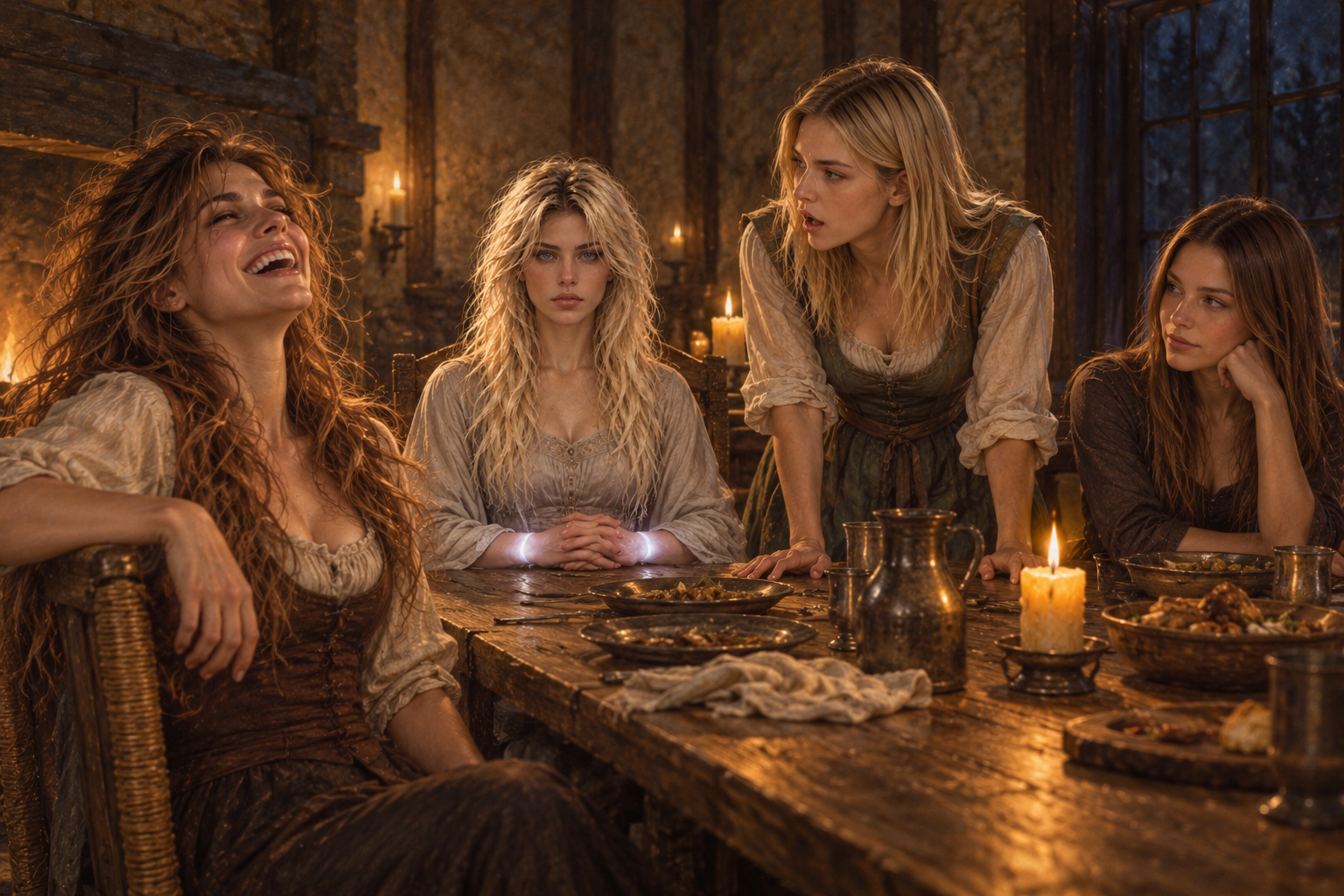
· · ·
Genie stared at her.
Then at Val, who was sitting perfectly straight and perfectly still at the end of the table with her face doing absolutely nothing, while her light — Kyra saw it, through her own tears, and so did both her daughters, because on this planet everybody could — came up, faintly, at the wrists.
Then at Kal.
“Kal,” said Genie. Her voice had gone up. “Kal. What is happening. Why does Mother know the height of my chairs. Why is she lit. Why is your mother—”
Kal was not looking at Genie. She was looking at Kyra, across the table, laughing with her head back and her eyes gone gold; and something was going on in Kal’s face that Kyra, through the tears, could not read at all.
“I think,” said Kal slowly, “they’re going to tell us.”
· · ·
Kyra wiped her eyes with the back of her hand. She put both hands flat on Genie’s cloth, the way Val did at a table when something was going to be said and was going to stay said. She took a breath. She looked at her daughter, and at Val’s daughter, and at the four plates and the two jugs and the bread that was not as good as the bread on Alberta.
And then at Val, at the end of the table. Who had nine sentences, and was not going to use any of them.
Val gave her the smallest nod in the world.
“All right,” said Kyra. “Sit down, Genie. Have some more of that. You’re going to want it.” She turned the chair a little toward the table, and put her hand on the back of it, and left it there. “It’s a long story. And it’s a very good one. And there’s nothing in it either of us is ashamed of.”
Genie sat down.
Kal did not move at all.
“There was a town,” said Kyra, “on the other side of the sky. In a valley, by a river. With nothing open after nine.”
— end of chapter forty-one —
The third autumn · Genie’s house, after dinner
She told it the way she told everything, which was all at once and out of order, with her hands.
The town first. Nothing open after nine. The library that shut early except on Thursdays, and a woman behind its desk who ironed things that did not need it and read the obituaries in three newspapers on a Sunday. A fire hall, and a pager, and a grange hall with a raffle. The diner on the road, and Dee, who called them girls. The rain. A valley by a river, in a range of mountains near the sea, where two women who had lived in more countries than they could count had found themselves, for the first time anybody could remember, bored.
“Bored,” said Genie.
“Bored,” said Kyra. “Out of our minds. You’ve never seen your mother bored. It’s terrible. She alphabetizes things that are already alphabetized.”
“I reshelved the large-print section,” said Val, from the end of the table, “twice.”
“Twice. In one winter.”
“It needed doing.”
“It did not need doing the second time,” said Kyra, and Genie laughed, and Kal did not, but Kyra saw her hands come unfolded on the cloth, a little, and lie flat.
· · ·
And then the other thing. The thing that had come into the town on the internet, the way everything came, on a screen, at a kitchen table.
This was where she ran out of words.
She had known she would. She had been dreading it since the river. There was no Sethal for any of it. There was no Sethal for internet or channel or subscribers or video; there had never been a reason for there to be. The Sethal had words for a window, and an account, and the extension, and the quiet, and a parade hall full of people along two walls. It did not have a single word for two women in masks in a room with a camera in the corner, showing strangers on the other side of a planet what they did in the dark.
So Kyra made one up.
· · ·
She did it the way you would. She took two words that were near it and put them together. The word for an account — the account, the old one, the gift — and the word for a window. A window-account. An account you could look through.
She said it out loud, at the table, carefully, the way you say a word for the first time.
Val, at the end of the table, put her cup down.
“No,” she said.
“What do you mean, no?”
“It isn’t an account. An account is given to one person. The one person who can’t see. A woman describes a man to himself, at the window, because he’ll never see it any other way. That’s what the word means. That’s all it means.” She looked at Kyra. “We did the precise opposite. We showed it to everybody. Every person who could see. And we never described anything to anybody. Not one word. That was the whole rule.” She paused. “If it’s anything, it’s an un-account.”
“There’s no word for un-account.”
“Then don’t use the word for account.”
“Then what do I use?”
“I don’t know,” said Val. “But not that. It’s inaccurate.”
· · ·
Genie had her hand over her mouth.
Kyra looked at her, and then at Val, and then at Genie again, and felt it come up in her again, and did not even try.
“She did this,” Kyra said, through it, to her daughters. “For years. Every word. Every single term. That’s inaccurate. At a kitchen table, with a pencil. We had a whole paper of them. In an envelope.” She wiped her eyes. “You’ve no idea. You think you know your mother. You’ve no idea.”
“I have some idea,” said Genie, very faintly, from behind her hand.
“I would like it noted,” said Val, “that I was right about every one.”
And that did it. Genie put her head down on the cloth she had put out specially and laughed until she shook, and Kyra laughed with her, gold all the way, and across the table Kal sat with her hands flat on the cloth and her face doing something Kyra could not read, and her shoulders, very slightly, going.
· · ·
In the end Kyra used the English. Video. Channel. She said them in English, in the middle of the Sethal, the way you drop a stone you cannot carry any further; and the daughters, who had been learning the foreign words since their mothers came home, took them and turned them over and nodded, and did not ask what they meant. They could see what they meant. It was on Kyra’s face.
And she told it.
· · ·
Not the acts. That had been decided at their own table, in English, with the tea. Not the things that had happened in the room, except in the most general way, and those only as far as the shape of them. Their daughters were grown women with whole lives behind them and nobody at that table was shielding anybody from anything; but it was not about the acts. It had never been about the acts. It was about what they had meant.
So Kyra told them what it had meant.
She told them about the masks. And the color over the rings, three shades and a sealant, so that the one mark each of them had put on the other could never be seen. And a room in her house in that town with a blanket taped over the window and a cream wall and a lamp, which they had called the room that was nowhere, because it had to be. And a chair.
“A chair like this,” said Genie.
“Sixteen and a half,” said Val. “Seventeen, there.”
“And the rest—”
“Is technique,” said Val.
Genie put her face in her hands.
· · ·
She told them about the terms. That had been the thing she most wanted them to have. Not the room. The table. A kitchen table, in the first winter, with a pencil, and a paper folded into an envelope that Val had marked, after some thought, with a word that meant nothing to anybody but the two of them. The masks. No faces, ever. The hair down is mine. Kyra holds the camera, because nothing in that room is Val’s. Val holds the money.
“Of course she held the money,” said Genie.
“And the stop,” said Kyra. “We always had the stop. The old one, the one you’d know, and a word. If either of us ever said the word, it all came down, the whole thing, and we’d never speak of it again for as long as we lived.” She looked at the cloth. “Neither of us ever said it.”
“Not once?”
“Not once. Not in all those years. Not even at the end. Especially not at the end.” Kyra turned her cup. “When we stopped, we stopped at the table. Because we were done. Not because we were ashamed. So that we’d always be able to talk about it.” She looked up at her daughters. “So that one day we could sit at a table like this and tell you.”
· · ·
She told them the rest of the terms. They can pay; they can’t steer. Never fake with each other. The kiss is never a lid. She told them about a night when the forgery had happened and the table where they had put it right, and never touch the light. She told them about a night when they had needed each other so badly that Val had asked for a word, on camera, in her ordinary voice — and Kal’s head came up at that, sharply, because Kal knew what can I have a word meant, every child in either family knew — and Kyra had turned the camera off, and they had never posted a single frame of it, and Val had deleted the half that existed the next morning because it was too true.
She told them about the last one. Side on. Us. The one thing they had never once shown anybody, shown once, at the end, to everybody, with nothing above the shoulders, so that the whole world saw the shape of them and nothing of the inside.
“Why?” said Kal.
It was the first thing she had said since I think they’re going to tell us.
· · ·
Kyra looked at her daughter across the table.
“Because I wanted a witness,” she said.
· · ·
The room was very quiet.
“You know about the parade,” said Kyra. “Everybody knows about the parade.”
They did. Both of them. Kal had grown up with it. A hall, a very long time ago, with a room full of people along two walls, all of them watching, while a girl barely grown was bonded to a man she liked and did not love. The great public ceremony of their mothers’ generation. Kyra had told it at Kal’s bedside a hundred times as a funny story, and Kal had worked out, long before she was grown, that it was not a funny story at all.
“All those people,” said Kyra, “watching me with a man I didn’t love. And all those years with your mother, every night, in every house — and not one person in the room. Not one. Ever. Nobody on two worlds had ever seen the one thing that was true.” She looked at Kal. “I wanted somebody to see it. That’s all. That was the whole reason. I didn’t want them to know who we were. I just wanted them to have seen.”
“And they did,” said Kal slowly.
“They did,” said Kyra. “More of them than live on this whole coast. Every week. For years.” She smiled, a little, crookedly. “The parade, the other way around.”
· · ·
“How many?” said Genie.
Kyra looked at the end of the table.
Val had been waiting. Kyra could see it. She had been sitting there through the whole of it, very straight, with her hands folded, saying almost nothing, letting Kyra tell it; and she had been waiting for that question since the river, and had one figure, exactly one, and had chosen it with great care.
“On the last night the back room was open,” said Val, “two hundred and six thousand, four hundred and eleven people had paid to be in it.”
Genie stared at her.
“That’s the room for the people who paid more,” said Val. “To see more. There was a front room as well. For everybody. I didn’t count the front room.” She paused. “Nobody could have counted the front room.”
“Two hundred and six thousand—”
“Four hundred and eleven,” said Val. “On the last night. To sit in a room they would never see, and watch two women they would never know, in a town they could never find.” She unfolded her hands and laid them flat on the cloth. “And not one of them ever found out who we were. Not one. Ever. It’s the cleanest piece of work I’ve ever done in my life, on either planet, and I’ve done a great deal of clean work.”
· · ·
Genie did not say anything.
Kyra watched it happen. She had never seen it before. In all the years of Genie — and she had had Genie since the day Genie was born, loud from the first breath — she had never once seen that face do this. Genie opened her mouth, and closed it, and opened it again; and nothing came out. Nothing at all. She sat at her own table with her elbows on the cloth she had put out specially, and looked at her mother, and for the first time in her whole loud life she had absolutely nothing to say.
Kal glanced at her sister. Then at Kyra. And Kyra saw, very briefly, at the corner of Kal’s mouth, the specific astonishment of a person who has just found a door in a wall she has walked past her whole life.
· · ·
“What was it called?” said Kal.
Kyra looked at her.
“The — channel,” said Kal, carefully, in English. “You said it had a name. On the door. What was it?”
And Kyra felt it come up in her again, the whole of it, all the way from under the ribs — because she had been waiting for this one, too. She had been waiting for it since the river.
“The Girls from Andromeda,” she said.
· · ·
Neither of her daughters had ever heard the word.
Kyra watched them not know it. She watched Genie say it under her breath, trying the shape. She watched Kal frown, very slightly, the way Kal frowned at a thing she meant to understand.
“It’s a name,” said Kyra. “Their name. On the other side.” She pointed — not up; out, at the window, at the dark beyond the glass, where the autumn sky was coming out over the valley the way it had every clear night of all their lives. “When they look up at night, there, they see a smudge. Long, not round. Fainter than anything near it. The kind of thing that goes out if you look straight at it.” She put her hand down. “They’ve a name for it. They’ve had it for a very long time. They call it Andromeda.”

Kal had gone very still.
“It’s here,” said Kyra. “That’s here. This. Us. The whole of it. Every star you’ve ever looked at.” She looked from one daughter to the other. “That’s what they call home, there. Andromeda.”
· · ·
It was Genie who got there first. Of course it was. Genie got everywhere first.
“You put it on the door,” she said.
Her voice had come back. It came back cracked and high and astonished, like a door opening on a hinge that has not been oiled in a long time.
“You put it on the door. Where you came from. The truth. You put the actual truth on the front of the whole thing—”
“Every week,” said Val. “For years. In large letters. On the front page.”
“And nobody—”
“Nobody believed it,” said Val. “Not one person. They thought it was a joke. Something pretty. Two women from the stars. It’s the safest place to keep a secret that I’ve ever found. On the door, in large letters, where everybody can see it.”
· · ·
Genie looked at her mother as if she had never seen her before in her life.
And Kyra, across the table, watched Val’s light come up.
It came up the way it always came: without any order, like weather. At the wrists first, where it had been since the chair. Then the collarbones, under the high neck of her dress. Then the throat. Then — Kyra saw it, and so did both her daughters, because on this planet everybody could and always had — at the temples, under the pale hair, faint and clear in the lamplight of a long room full of lamps.
The color of nothing on that other world. The color of home.
· · ·
“You’re up,” said Genie.
She said it quietly. Not the way Genie said things. The way Kyra said it. The way Kyra had said it on a headland in the spring, and on a mountain, and in every bed in every house on the other side of the sky for longer than either daughter had been alive.
“I am aware,” said Val, “of what I am doing.”
“I know you are,” said Genie. “I’m telling you anyway.”
· · ·
Kal was looking at it too. She had not taken her eyes off it. She sat at the long table and looked at the light on her mother’s partner, at the wrists and the throat and the temples; and then, after a long time, she turned her head and looked at Kyra.
“There,” she said. “On the screen. On the other side.” She nodded, very slightly, at Val. “What color was it?”
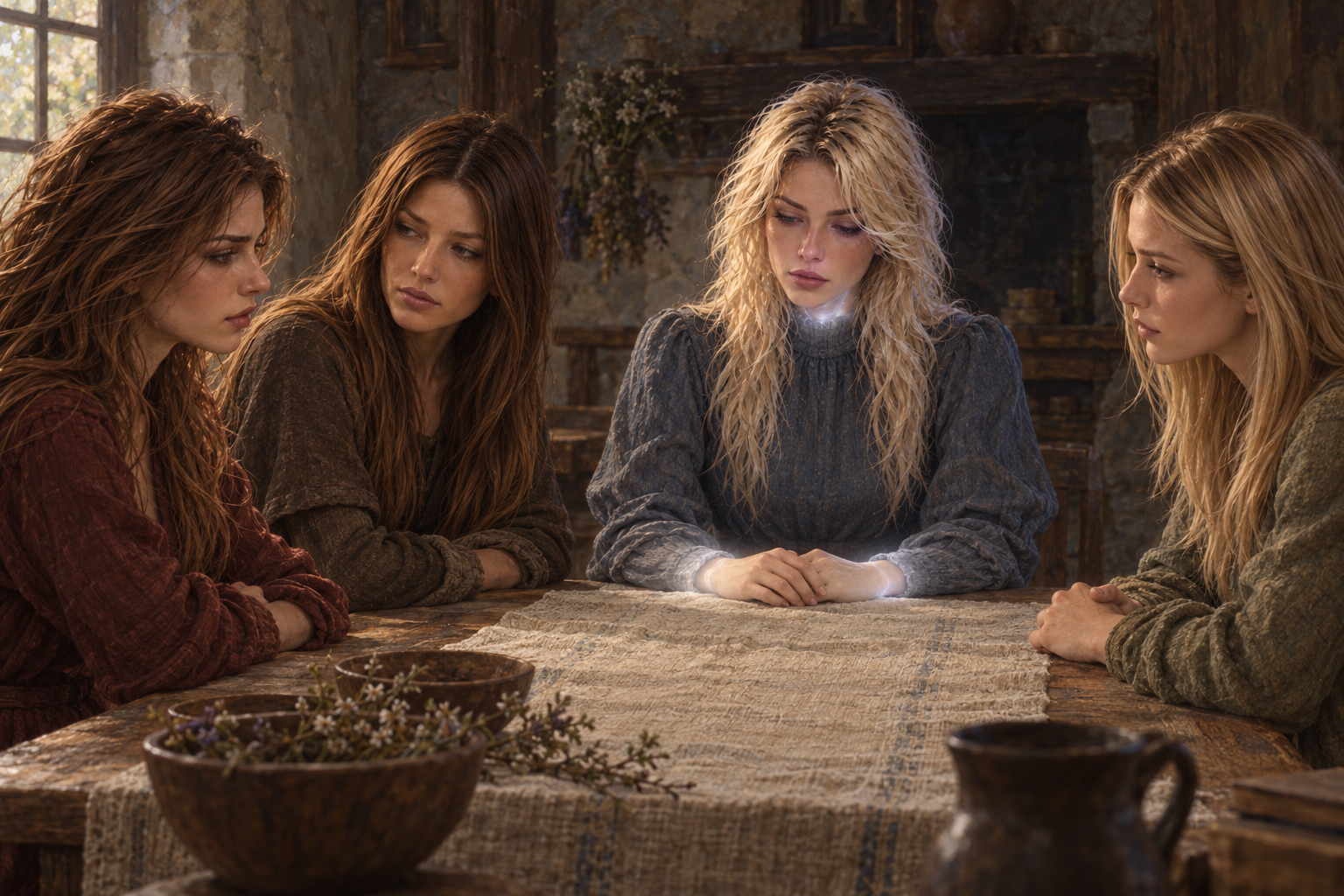
· · ·
Kyra looked at the light.
She had looked at it in every room on two worlds. She had looked at it in the lamp of the room that was nowhere, inches away, in the dark above the shoulders where no camera could ever see. She had watched strangers argue about it in the comments for years, and measure it in lux with software they wrote for the purpose, and give it a score out of ten, and draw a graph of it, and a machine had made it gold once, and got it wrong.
“Gray,” said Kyra.
Kal was silent.
“Gray,” said Kyra again. “All of it. Every single time. Nothing on that whole planet could see the color. Not one machine. Not one person. They had a whole — a whole page, Kal, a page where they argued about what color it might really be, and nobody could win, because nobody had ever seen it.” She looked at the light on Val’s wrists. “All those years. Two hundred thousand people in the back room alone. Everybody looking, as hard as anybody has ever looked at anything. And all they ever saw was a gray smudge.”
She looked at her daughters.
“You’re the first,” she said. “Apart from me. You two. The first who’ve ever seen it both ways — what they saw there, and what it really is.”
· · ·
Nobody said anything for a long time.
Val sat at the end of the table with her light up, at the wrists and the throat and the temples, not managing her face. She did not look away from her daughters. She did not put her hands in her lap. She sat in a chair that was sixteen and a half inches high, in a long room full of lamps, and let the two of them look.
And then Genie — who had nothing to say; who for the first time in her whole loud life had nothing at all to say — got up from her chair, and came around the end of the table, and sat down on the floor beside her mother’s chair, the way she had sat on the floor beside it when she was very small, and reached up, and put her hand flat over her mother’s lit wrist on the cloth, and held it there.
She did not say anything.
· · ·
“Is there anything?” said Kal at last, very quietly. “Left. On the other side. That shows it was real.”
“Everything,” said Kyra. “All of it. Every frame. Copied more times than anybody could count. It’ll be there forever.” She shook her head. “And none of it can come here. Nothing crossed. Not a picture. Not a word. There’s nothing we can show you.” She spread her hands on the cloth. “You’ve only got our word for it.”
Kal looked at her for a long time.
She was a woman who had made herself nobody’s business since she was a child. Who had built her whole life around not being looked at. Who had been told, at a table in her sister’s house, that her mother had chosen to be looked at by more people than lived on that coast, every week, for years; and that it had been the truest thing she had ever done.
“Then that’ll do,” said Kal.
· · ·
Genie, on the floor, with her hand over her mother’s wrist, looked up.
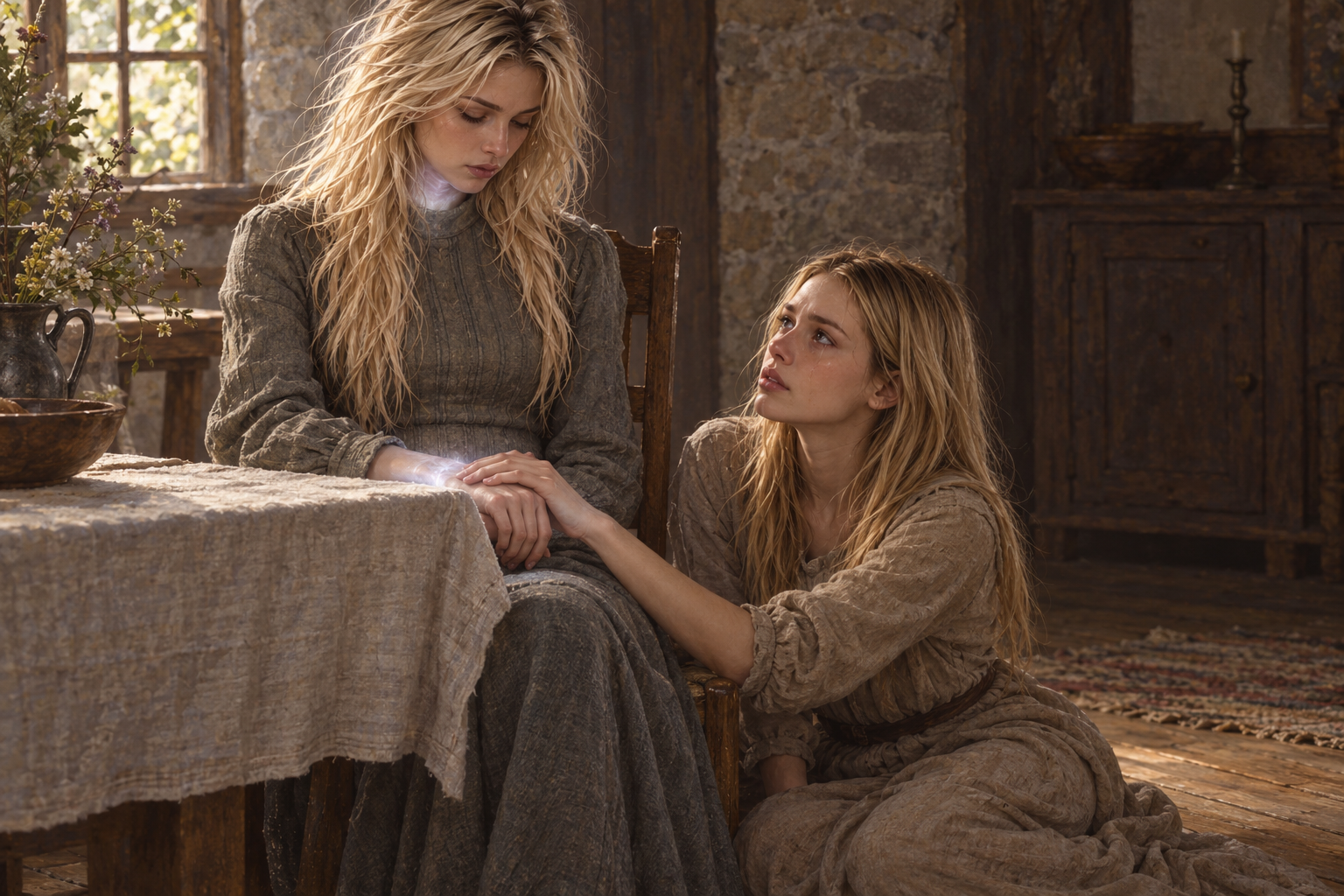
“I believe you,” she said. Her voice was cracked. “I don’t know why. It’s the most ridiculous thing I’ve ever heard. Two hundred thousand people. A chair. A door with the truth on it.” She held on to the wrist. “I believe every word.”
“So do I,” said Kal.
· · ·
Kyra looked at the two of them. At Genie on the floor and Kal at the table. At Val, lit, between them.
There had been a family once, a long time ago and a long way away, that could never be believed. That was what everybody had always said about them, on both worlds. Two women nobody would ever believe, about anything that mattered. With nothing to show for any of it but what they said.
And here were their daughters, at a table, with nothing to go on but their mothers’ word, believing it.
Kyra put her hand over her mouth.
She did not laugh this time. It was not that kind of thing coming up. She sat at her daughter’s table with her hand over her mouth and her eyes gone gold, and let it come, and did not turn her face to the wall.
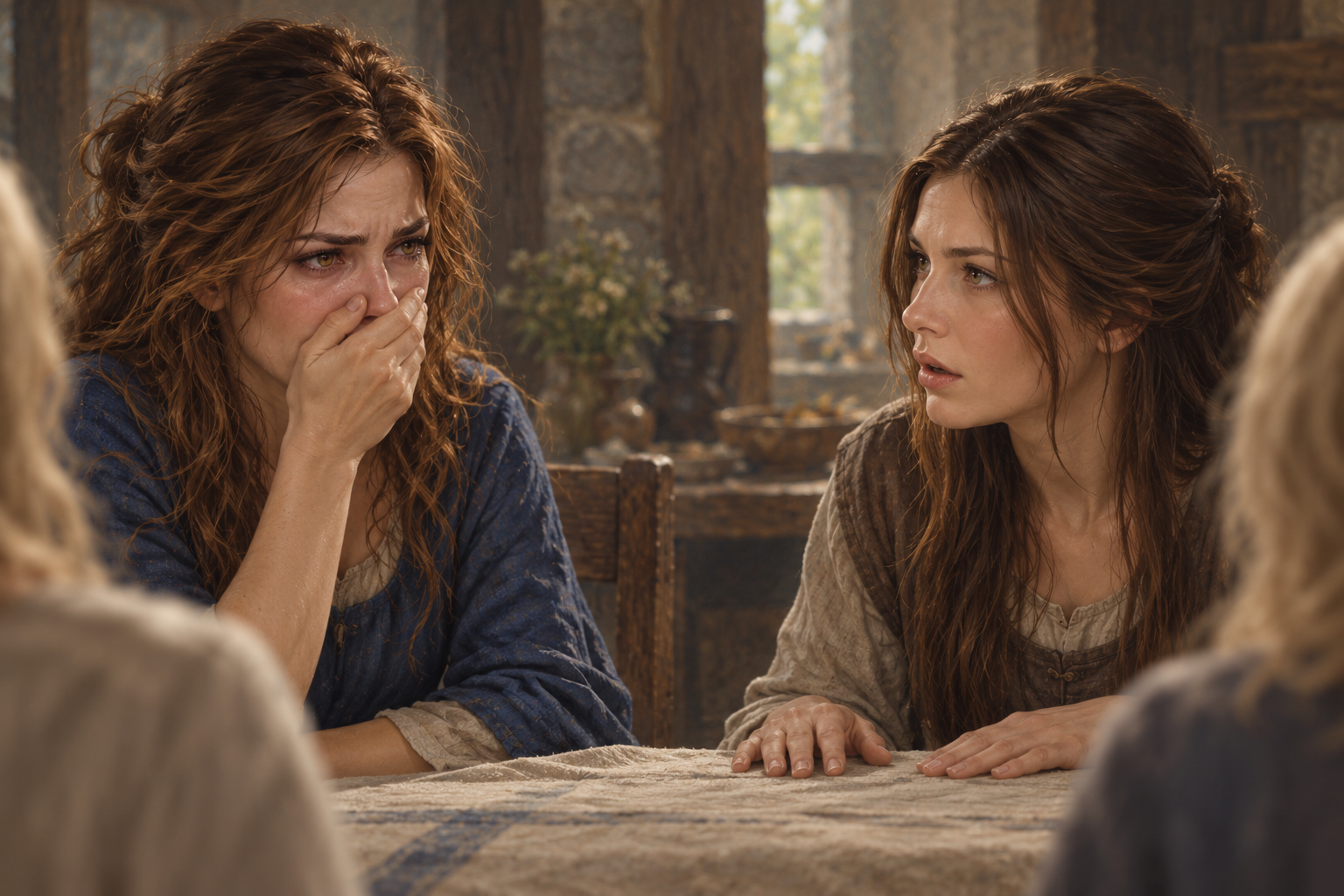
Across from her, Kal watched her do it, and did not look away either.
— end of chapter forty-two —
The third autumn · the house with the bad roof
Kal came on a Fourthday.
That was deliberate, and Kyra knew it was deliberate the moment she saw her on the road. Every Fourthday, all that summer and into the autumn, Val went up to the house above the water and sat on the terrace with her father and argued about a roof, and was gone from the third hour until dark. Everybody in both families knew it. Kal knew it better than anybody, because Kal noticed everything and said nothing, and had done since she was small.
So when Kyra looked up from the yard in the middle of the afternoon, where she had been doing something to the wall that did not need doing, and saw a tall dark figure coming up the road from the valley alone, with her hands in her coat pockets and her head down, walking at the pace of somebody who has decided to arrive and is not in any hurry about it — she knew.
She put down what she was holding. She went in and put the kettle on.
· · ·
Kal stopped in the doorway at the end of the long room, the one that stood open onto the yard from the fourth month to the ninth, and stood there with her shoulder against the frame, the way she had stood at the top of the path at the small house.
“She’s at Grandfather’s,” said Kal.
“Every Fourthday.”
“I know.” Kal did not come in. “I came the long way. By the river.”

“That’s a long way.”
“I wanted it to be,” said Kal.
· · ·
Kyra made the tea. She made it the way Val made it, which she had never done in her life before that afternoon and did not know she was doing until she had done it: the pot warmed first, the leaves measured, the water just off the boil. She put two cups on the table. She sat down at one of them. She did not look at the doorway.
After a while Kal came in, and sat down across from her, and put her hands around the cup, and did not drink it.
They sat.
Kyra did not say anything. It was the hardest thing she had done since a road on the coast with a gate four feet away. Every part of her wanted to fill it — to talk about the wall, or the weather, or Genie, or the dinner, or anything at all, the way she had filled every silence in every room since she was small. She sat on her hands, nearly literally, under the table, and let the quiet be the size it was.
Stop chasing it. Wait.
· · ·
“You found it,” said Kal.
· · ·
Kyra looked up.
Kal was looking at her across the table. Not at the tea. At her. Directly, with the dark steady eyes that had been watching people from the edges of rooms since before she could talk, and that had almost never in her life been turned straight on anybody like this.
“Second box,” said Kyra.
Kal did not move.
“The string came loose when I lifted it,” said Kyra. “The lid came up. I looked for about two seconds longer than I should have. Then I tied it again and put it in the press.” She did not look away. “I’m sorry. It wasn’t mine to see.”
“I know you looked,” said Kal. “I knew that night.”
“How?”
“You tied it back.” Something moved at the corner of Kal’s mouth. “Exactly the way I tie it. The same loop. The same pull. Not tighter. Not neater.” She turned the cup on the table, a quarter turn, the way Val did. “Nobody does that. Genie would have tied it in a bow. Anybody else would have tied it properly. You tied it wrong, the way I tie it, on purpose, so I’d never know.” She paused. “Only somebody who’d been taught to put a drawer back exactly as she found it would think to do that. And there are two of those on this planet, and one of them was fixing my gate.”
· · ·
Kyra laughed. She could not help it; it came up out of her, short and surprised, with the warmth behind the eyes. She put her hand over her mouth.
“She taught me that,” she said, through her fingers. “In a rented room. A very long time ago.”
“I know she did,” said Kal. “You both do everything the same way. You just don’t notice.”
· · ·
They sat for a while.
“And you said nothing,” said Kal.
“I said nothing.”
“You walked home with her by the river. I watched you go. You were talking the whole way — I could see your hands from the gate.” Kal’s own hands were still around the cup. “And then nine days later you came to Genie’s and sat down at her table and patted the back of a chair.”
“Yes.”
“And told us everything.”
“Not everything,” said Kyra. “Not the box. Never the box.” She put her hands flat on the table. “I said everything else.”
· · ·
Kal looked at her for a long time.
“You did that on purpose,” she said. “The dinner. The whole thing. A chair like this. Two hundred thousand people. The door with the truth on it.” She did not look away. “You did it for me.”
“We did it for you,” said Kyra. “Both of us. And for Genie. And for us.” She hesitated. “But mostly for you. Yes.”
“Instead of telling me you’d seen it.”
“Instead of telling you I’d seen it.”
“Instead of coming out of that back room,” said Kal slowly, “and putting your arms around me in front of Genie, and saying it’s all right, I saw, I don’t mind.”
Kyra went very still.
“That’s what you nearly did,” said Kal. “Isn’t it. I could see it on your face at the gate. You were going to come out and say it. In the long room. In front of everybody.” Her voice did not change. “And somebody stopped you.”
“Val stopped me.”
“Val stopped you,” said Kal. She looked down at her tea for the first time. “And then the two of you went home and decided, instead of telling me what you’d found out about me, to tell me the biggest thing you’ve ever found out about yourselves.” She was quiet for a moment. “Nobody’s ever done that. Not once. Not for me.”
· · ·
“I sat with it for nine days,” said Kal. “Before the dinner. Knowing you’d seen. Waiting for you to say something. Waiting to feel—” She stopped. “I’ve felt it all my life. Since I was small. That if anybody ever saw the real thing — any real thing, anything I hadn’t decided to show them — I’d want to go into the wall. Go so quiet nobody could find me.” She turned the cup again. “I waited nine days to feel that. In my own house. With the press shut and the gate fixed. I was sure it was coming.”
“And?”
“And then you sat down at Genie’s table,” said Kal, “and told us that for years, every week, you’d let more people than live on this whole coast look at you. On purpose. And that it was the truest thing you’d ever done. And that you weren’t ashamed of one minute of it.” She looked up. “And I went home that night and opened the press and looked at the box. And waited to feel it.”
“Did you?”
“No,” said Kal. “Nothing. I sat on the floor of the back room for an hour, and it wasn’t there. It just — wasn’t there any more.” She put her hands flat on the table, the way Val did, the way Kyra did. “You did that. Without ever once pointing at it.”
· · ·
Kyra did not say anything. She could not.
She sat across the table from her daughter in the house with the bad roof on the north side, with the door open at the end of the long room and the afternoon going gold in the yard, and felt the gold come up in her eyes and did not turn her face away from it.
Kal watched it come.
“Can I ask you something,” said Kal.
“Anything.”
“Did you like it?” said Kal. “Being looked at.”
· · ·
It was the question. Kyra knew it was the question. She had known since the dinner, since Kal had sat at Genie’s table with her hands flat on the cloth and her face doing something Kyra could not read, that this was the thing Kal had walked four miles by the river to ask.
A woman who had made herself nobody’s business since she was a child. Who had built a whole life — two houses of it — around not being looked at. Who sat at the edges of rooms and was not seen and liked it, and had told her sister on a wall once that the great advantage of being nobody’s business was that nobody made you their business.
And her mother had stood in front of more strangers than lived on that coast, every week, for years, and let them look.
Did you like it?
· · ·
Kyra thought about it properly. Not quickly. The way Val would have, honestly, turning it over to look at the underside, because her daughter had walked four miles to ask and deserved the true answer and not the easy one.
She thought about the first video, when she had been so frightened she could not feel her hands. About the comments, and nobody is that loud, and the long nights reading them at a kitchen table with her feet up. About a theater full of people on their feet, roaring at a chair. About a stranger with a spreadsheet, and a man who measured light in lux, and a woman in a kitchen at three in the morning who had seen what nobody else saw.
And she thought about what it had felt like. Not the watching. The thing underneath.
“Not on my own,” she said at last.
Kal waited.
“I’ve been looked at all my life,” said Kyra. “You know that. I can’t help it. It’s in my face. I walk into a room and I fill it, and everybody looks, and I’ve never minded, and I’ve never once, in all of it, liked it either. It was just weather. It was just what happened when I came in.” She turned her cup. “And the parade was the worst of it. A whole hall looking at me with a man I didn’t love. That’s the most anybody’s ever looked at me, before. And I hated every second.”
“But this—”
“This was different,” said Kyra. “This was with her.”
· · ·
She looked across the table at her daughter.
“I liked being looked at with her,” she said. “That was the whole of it. Not the strangers. Not the numbers. Her. Beside me. In the room. With all of them looking — and for the first time in my life the thing they were looking at was true. Not a woman in a hall with the wrong man. Not a stranger being warm at people across a room. The two of us. The real thing.” She stopped. “I’d never been looked at doing something true before. I didn’t know it was possible. And it turned out it was the only kind of being looked at I’d ever wanted.”
Kal did not answer for a long time.
“But they didn’t see you,” she said at last. “Did they. Not really. The masks. The room that was nowhere. Nothing above the shoulders. They never saw your faces. They never knew your names.” She frowned, very slightly, the way she frowned at a thing she meant to understand. “They were looking as hard as anybody’s ever looked at anything. And they never saw you at all.”
“No,” said Kyra. “They never saw us.” She smiled. “That was the trick.”
· · ·
Kal looked at her.
“They saw everything,” said Kyra. “Everything we did. Every week. More of it than anybody’s ever seen of anybody. The chair, and the light, and the waiting. All of it true. And they never once saw us. Not our names. Not our faces. Not where we lived or who we were or where we’d come from — except it was on the door, in large letters, and they didn’t believe it.” She leaned forward. “Do you see? We gave them the true thing. All of it. And we kept ourselves. Both at once. They had everything and they had nothing. And we had each other, the whole time, the way we always had, and nobody on that whole planet could ever take it.”
· · ·
Something happened in Kal’s face then.
Kyra had seen it once before, at Genie’s table, very briefly, at the corner of Kal’s mouth when Genie had run out of words. The specific astonishment of somebody who has just found a door in a wall she has walked past her whole life.
“You can do both,” said Kal slowly.
“You can do both.”
“You can be looked at and not be seen.”
“You can be seen,” said Kyra, “and keep yourself. It’s not the looking that takes it from you. It’s who’s doing it, and what you let them have.” She put her hand on the table, close to Kal’s, not touching. “You’ve been keeping yourself all your life by not letting anybody look. That works. I know it works. Val did it her whole life. It’s not wrong.” She paused. “But it’s not the only way. That’s all. That’s all I wanted you to know. That there’s another way. And it was the best thing I ever did.”
· · ·
Kal looked down at Kyra’s hand on the table, next to hers. She did not move hers. She did not move it away either.
“Did you keep anything?” she said, after a while. “Of it. On the other side.”
Kyra laughed a little.
“Nothing crossed,” she said. “You know that. Not a thing. Not a picture.”
“But before. When you left. Did you burn it all? The way she always does?” Kal turned her cup. “Genie says she burned everything in every house. Every last thing with a year on it. She told us that the first week. Like it was a sum.”
“She did,” said Kyra. “In every house.” She was quiet for a moment. “Not that one.”
· · ·
And she told her about the drawer.
The kitchen table, in a house in a valley in the Coast Range, by a river, on the other side of the sky. The drawer at the back of it, with the spare batteries and the takeout menus — she had to explain takeout menus, and Kal listened to the explanation with grave attention, the way Val listened to things. A road map of the state, folded along its old creases, with a pencil circle on it the size of a fist, around two towns on the same river. A photograph, printed on the good printer at the library, of a gold trophy on a shelf in an office in a city in the desert, with a card leaning against it that said KEEP IT FOR US. And an envelope, marked with a word that meant nothing to anybody but the two of them, with a paper inside it folded twice, and a list of rules in pencil gone gray with the years, about a room that had not existed for a long time.
“And the chair,” said Kyra. “In the corner of the bedroom. With the laundry on it. Where it always was.”
“You left it.”
“We left it.”
“All of it. Just — in the drawer.”
“Just in the drawer,” said Kyra. “We didn’t burn it. We didn’t take it anywhere. We closed the drawer and walked out of the house and up a mountain, and never went back.”
· · ·
Kal was quiet.
“Somebody’ll find it,” she said.
“Somebody’ll find it,” Kyra agreed. “One day. Somebody’ll buy that house, or clear it, and open that drawer, and find a map with a circle on it, and a picture of a trophy nobody ever collected, and a paper of rules for a room that doesn’t exist.” She smiled. “And a chair.”
“Will they know?”
“Never,” said Kyra. “Not ever. They’ll stand in that kitchen with it in their hands and not understand one single thing. They’ll throw it away, probably. Or put it in a box in a junk shop, with the chair.” She looked at the open door at the end of the long room, at the gold light in the empty yard. “And that’s all right.”
“Why didn’t she burn it?”
“Because there was nothing in it to be ashamed of,” said Kyra.
· · ·
Kal looked at her for a long moment. Then she looked away, at the door, and Kyra saw her throat move.
“That’s the drawer,” said Kal. Her voice was not quite steady. “Isn’t it. That’s what you were telling me at Genie’s table. About the box.”
“I never said a word about the box.”
“No,” said Kal. “You told me about a drawer in another world instead.” She turned back. “With nothing in it to be ashamed of.”
Kyra did not answer.
· · ·
They drank the tea, at last. It had gone cold. Neither of them minded.
And Kyra, who had been quiet for longer than she had been quiet in a room with another person in it for a very long time, felt the quiet go easy between them — not filled; just easy, the way a room goes when two people in it have stopped having to try — and found herself, without deciding to, telling Kal about the awards.
Not the meaning this time. The comedy. Row twelve, and Val in widow’s black, and the chair coming up on a screen the size of a barn. And somebody bellowing SEVENTEEN INCHES from the dark at the back of a theater. And the spotlight going around and around, looking for the winners, and going straight across the two of them and finding nobody. And the woman in silver leaning into the microphone, and letting a little pause go by, and looking up into the dark, and saying—
“Or could they?” said Kyra.
· · ·
And Kal laughed.
Not nearly. Not behind her hand. She put her head back — all the way back, with her eyes shut and her throat bare and her whole long body going with it — and laughed, out loud, in the long room, helplessly, the way almost nobody on that planet had ever heard her laugh and none of them twice.
Kyra stopped talking.
She sat at the table and looked at her daughter laughing with her head back in the gold light from the open door, and something went through her that she had no word for in either language.
Because she knew that laugh.
She had known it all her life. She had heard it in a hall at Corran Vayr, and in a parade, and in a hut in the Tatras, and in more countries than she could count. She had heard it in a theater in the desert, held in by main force for three hours, and let out in a gold elevator for thirty floors. She had heard it at the end of every video for years, in a room that was nowhere, when Val’s light was going down. She had heard it in a white room in the hills, filling it to the corners, and watched a dying woman know it in a second, and say nobody else on God’s earth laughs like that.
It was hers.
· · ·
Kal’s laugh ran down, slowly, and stopped. She opened her eyes. She wiped them with the back of her hand. She looked across the table at Kyra, and saw her face, and went still.
“What?” she said.
Kyra could not answer for a moment.
“That’s mine,” she said at last. Her voice had gone. “That laugh. You got that from me.”

Kal looked at her.
“Genie says it’s the only thing I got from you,” she said.
“Genie’s wrong,” said Kyra. “You got that. And you got the other thing.”
“What other thing?”
· · ·
Kyra looked at her daughter’s hands, folded on the table around the cold cup. The way they had been folded at every table since she was small. Still. Patient. Waiting.
You waited. For her. Every time. All those years. I watched you do it.
“The waiting,” said Kyra. “You wait. You always have. You sit at the edge of the room with your hands folded and you wait for the thing to come to you, and you never once chase it.” She smiled. “Somebody told me, once, near the end, that it was the best thing about me. I didn’t know it was the best thing about me. I didn’t even know I did it.” She reached across the table, at last, and put her hand over Kal’s folded ones. “You do it too. You always have. I just never saw it before.”
Kal did not take her hands away.
· · ·
She left at dusk, before Val came home. That was deliberate too. Kyra walked her down to the road, and they stood at the gate in the last of the light with the valley going blue below them and the first of the stars coming out over the water.
“Thank you,” said Kal.
“For what?”
“For not saying anything about the box.” Kal had her hands in her coat pockets again. “And for saying everything else.”
“Thank Val. It was her idea.”
“I know whose idea it was,” said Kal. “I’m thanking you for doing it. It would have been easier for you to say it. You’d have felt better.” She looked out at the valley. “You didn’t, for me.”
Kyra did not trust herself to answer.
· · ·
Kal opened the gate. She stood with her hand on it, testing the swing, the way she had at the small house.
“If you ever want to know,” she said, without looking around. “About the box. What’s in it. Why.”
“I’ll wait,” said Kyra. “Till you want to tell me.”
Kal turned her head and looked at her.
And something happened at the corner of her mouth — not the astonishment this time; something warmer, something nearly a smile, that Kyra had seen on that face perhaps three times in its whole life.
“No,” said Kal. “Don’t wait.”
Kyra did not understand.
“Ask me,” said Kal.

· · ·
And she went out through the gate, and down the road toward the river, tall and dark against the blue of the valley, with her hands in her coat pockets and her head up, walking at the pace of somebody who has arrived and is not in any hurry about leaving; and Kyra stood at the gate and watched her all the way to the bend, and did not turn her face away from anything.
— end of chapter forty-three —
Late in the third autumn · the small house, and the road home
Kal had them to dinner at the small house when the leaves came down.
It was the first time. Everybody knew it was the first time and nobody said so. Genie came early to help and was told there was nothing to help with, and helped anyway, and broke a cup. Val and Kyra came across the valley on foot, the long way by the river, in the last of the afternoon, and Val stopped at the bottom of the path and opened and shut the gate twice to watch it swing, and Kal, in the doorway at the top with her arms folded, watched her do it and said nothing, and very nearly smiled.
The long room was finished. The boxes were gone. The chair Kyra had put down by the window was a hand’s width to the left of where Kyra had put it, and had a cushion on it now, and the door at the end of the room stood open onto the yard, which had something in it at last: a bench, and a row of something green in the dark earth along the wall, and a lamp on a hook by the step, lit, though it was not yet dark.
Kyra stood in the doorway of her daughter’s house and looked at the lamp on the hook for a long time.
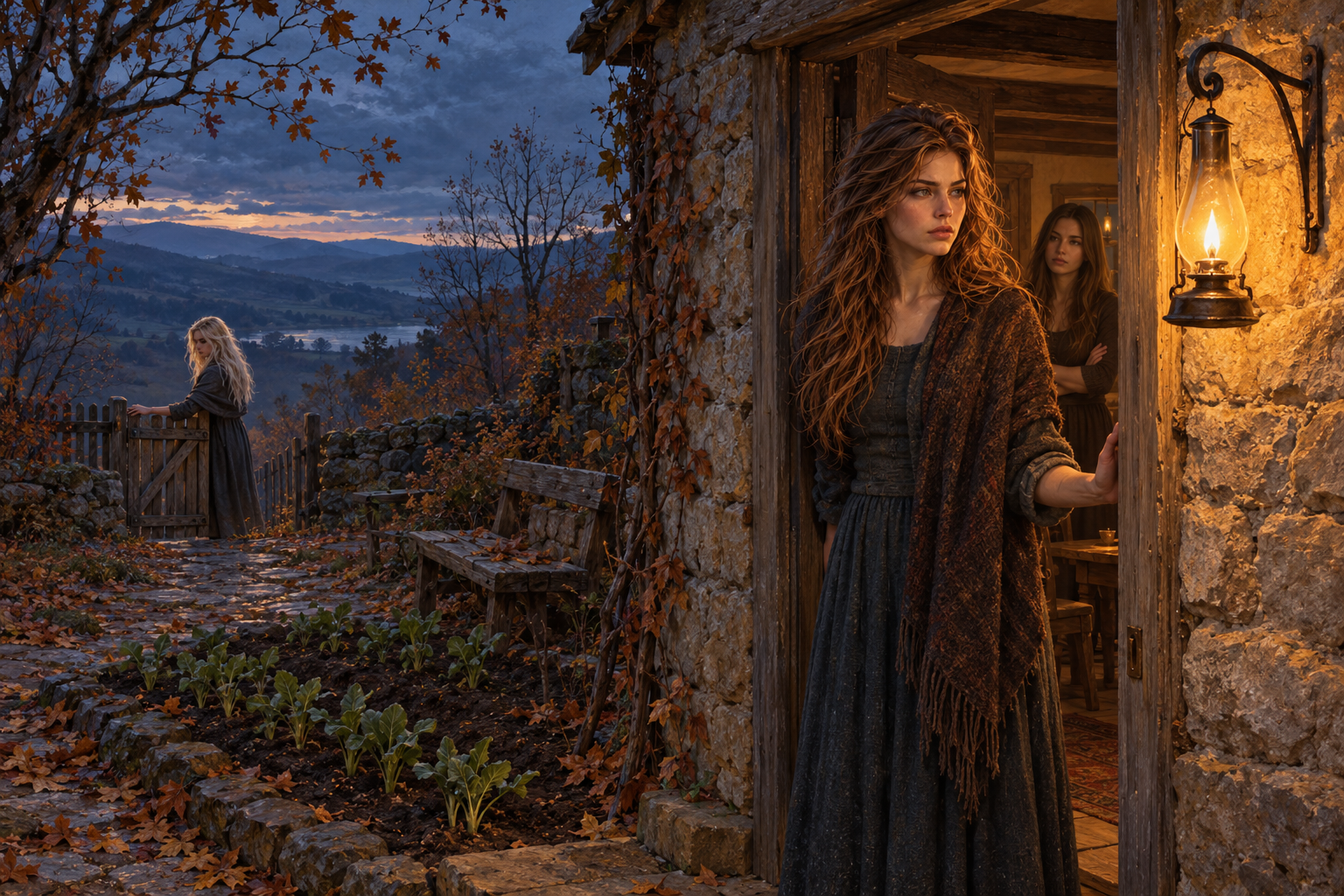
“Somebody might be coming up the road,” said Kal, behind her. “After dark. I like them to be able to find it.”
Kyra could not answer that.
· · ·
The dinner was good. It was not as good as Genie’s, and Genie said so, and Kal said then you can cook next time, and Genie said I cooked LAST time, and Val said that the bread was Vaedom’s and was therefore beyond criticism, and Kyra said it was not as good as the bread on Alberta, and everybody at the table, all three of them at once, said we know.
And they talked. About everything and nothing, the way a family talks at a table when nothing in particular needs to be said, and the lamps were lit, and the door stood open, and outside the dark came up off the valley and the first stars came out over the water.
They did not talk about the chair. Or the room that was nowhere. Or any of it. Nobody had, since Genie’s table, a month before. Kyra had thought it might feel strange — that once a thing like that had been said, it would sit at every table afterward, enormous, waiting to be picked up again. It did not. It had been said, and it had been believed, and now it was simply there, the way the open door was there. Part of the house.
· · ·
It was late, and the second jug was nearly empty, and Kyra was watching the lamp on the hook outside the door, when Genie put her cup down.
“Mother,” she said.
Val looked up.
Genie said nothing else for a moment. Kyra saw her start to — saw her mouth open on the next thing, the way Genie’s mouth had always opened on the next thing, from the first breath — and then saw her stop. Close her mouth. Look down at the table. Look at her sister.
Kal, at the end of the table, did not move.
And Genie looked back at her mother, and said, slowly, the way she said the foreign words:
“Can I ask you something? In front of everybody?” She paused. “You can say no.”
· · ·
Kyra felt it go through her.
She had known Genie since the day Genie was born. She had known her loud and fierce and generous and right, and wrong at volume, and first into every room and every argument and every silence there had ever been. She had heard the story — everybody in both families had heard the story — of a hall at Corran Vayr, and four men at a table, and a girl who had said the thing out loud before she had thought, because the second she felt something it was out of her mouth and in the room and belonged to everybody.
She had never once, in all those years, heard Genie ask first.
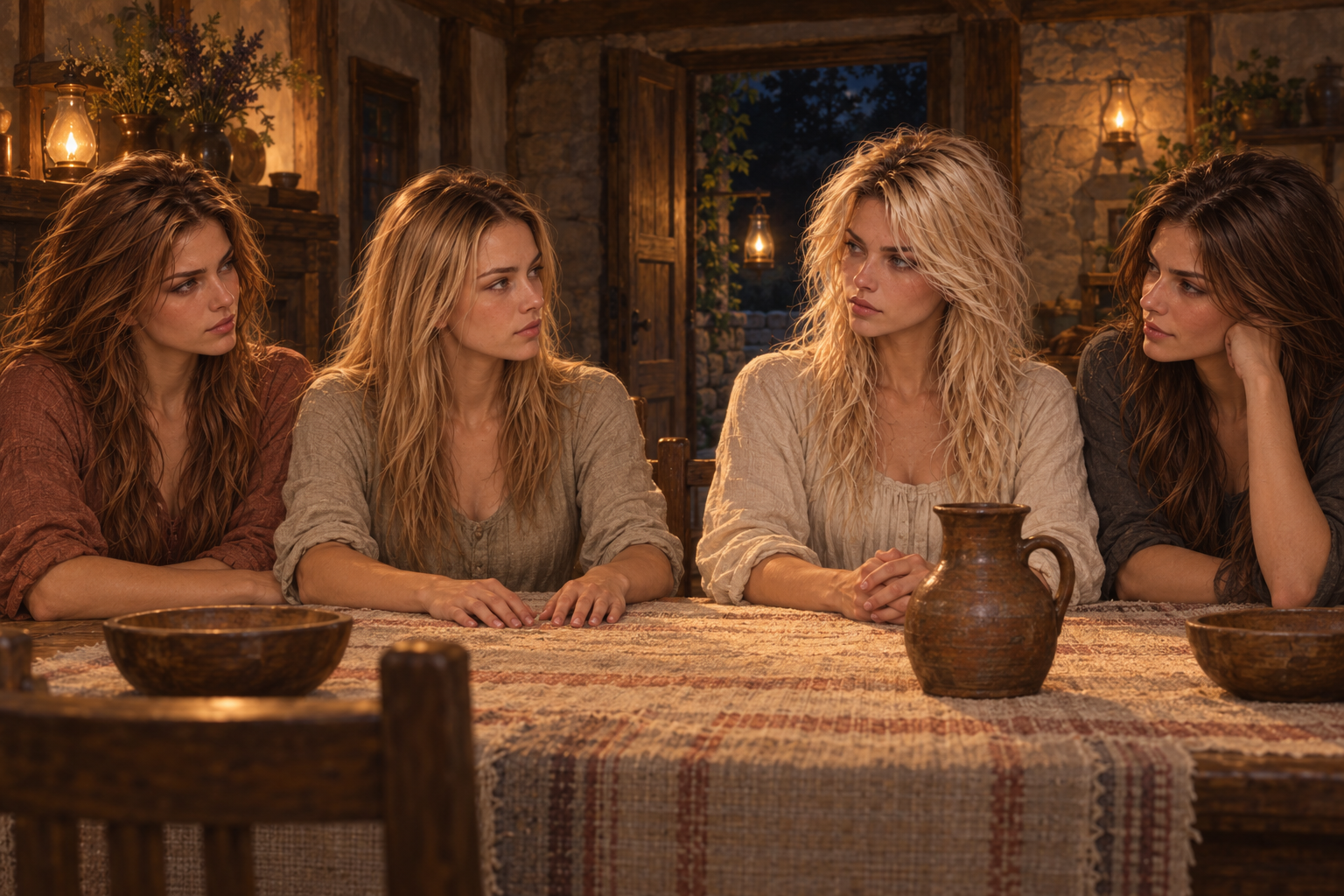
She looked at Kal. Kal was looking at her sister. And at the corner of Kal’s mouth there was something Kyra had seen on that face perhaps four times in its life, and every one of them in the last month.
· · ·
Val had seen it too. Kyra watched her see it. Val sat very straight in her chair at the end of Kal’s table, and looked at Genie for a long moment, and her face did nothing; and then, very slightly, it did.
“Ask,” said Val.
· · ·
Genie took a breath.
“You told us everything,” she said. “At my table. All of it. The town and the masks and the chair and the door with the truth on it. And I’ve been thinking about it for a month, every night, and there’s one thing you didn’t say.” She did not look away. “And I want to know. I don’t know why. It’s not my business. It’s the only thing I want to know.”
“Go on.”
“All my life,” said Genie, “you’ve been quiet.”
Kyra went still.
“Not — not that quiet,” said Genie quickly. “Not the fourth terrace. I don’t mean that. I’ll never mean that, not at a table.” She put both hands flat on the cloth. “I mean you. You. The way you are. In every room. You’ve never raised your voice in your life. You’ve never laughed out loud. Grandfather says you didn’t cry as a baby, you just looked at people, until they did what you wanted.” The corner of her mouth went, a little. “And Kyra told us. At my table. That you were always quiet. Even there. Even then. Even with all of them watching and wanting you to be otherwise.” She stopped. “And I want to know. In all of it. In all that time, on the other side. With her.” She looked at Kyra, and back. “Were you ever loud? Even once?”
· · ·
The long room was very quiet.
Outside, the lamp on the hook by the step burned steady in the dark. The door stood open. Somewhere far off, down the valley, a dog barked twice and stopped.
Kyra did not look at Val. She could not. She looked at the table, at her own hands on Kal’s cloth, and felt the gold come up behind her eyes, and let it, and did not turn her face away.
And Val, at the end of the table, sat very straight in her chair, with her hands folded, and looked at her daughter, who had asked first; and Kyra heard her take a breath, and let it out, the way she let out a breath before a figure she had checked twice from both ends.
“Once,” said Val.
· · ·
Genie did not move.
“Once,” said Val again. Her voice was perfectly level and very quiet. “In all of it. In a room in that town, on a night when we turned the camera off. Without deciding to. Without knowing it was there.” She did not look away from Genie. “It never happened before. It never happened again. It was never on any recording, and no stranger ever heard it, and it was never for anybody but the one person in the room.”
She paused.
“Nobody heard it but your mother,” said Val.
· · ·
She said your mother.
Kyra heard it, and so did everybody at that table. Not Kyra. Not her. Your mother. To Genie. Who was not Kyra’s daughter, and never had been, and had never once needed to be.
Genie heard it.
Kyra watched her hear it. She watched Genie’s face — that loud, open, generous face that had never in its life been able to hide one single thing — take it in. And go very still. And then, slowly, from somewhere underneath, crack open.
· · ·
Genie did not say anything.
She sat at her sister’s table with her eyes full and her mouth shut — Genie, who had said everything — and looked at her mother, and then, slowly, across the table, at Kyra.
Kyra looked back at her. She did not try to say anything. There was nothing to say that would not make it smaller.
And Genie, after a long time, nodded. Once. Very slightly. The way Val nodded at a figure she had checked and found correct.
“Thank you,” she said. Her voice was hardly there. “For telling me.”
“Thank you,” said Val, “for asking first.”
· · ·
Nobody said anything for a while. The lamp burned on its hook outside the door. Kal reached across, without a word, and filled her sister’s cup, and Genie picked it up and held it in both hands and did not drink it.
“You’ve never told me one true thing about yourself,” said Genie at last, to the cup. “That’s what I said. On a wall at Corran Vayr, when I was a girl. To Kal. She’s never told me one true thing about herself. Not one.” She laughed, wetly. “I said it for years. To anybody who’d listen. It was my best complaint.”
“I know,” said Val. “You said it to me too. Several times. At volume.”
“I did.” Genie wiped her eyes with the back of her wrist. “And now you’ve told me two. In a month. The chair, and that.”
“Three,” said Val, “if you count the chair’s height.”
And Genie laughed, properly, the way she laughed at everything, loud and helpless with her head down on her arms on her sister’s table; and Kyra laughed with her, gold all the way; and across the table Kal put her head back, and laughed too, out loud, with her eyes shut, in her own house, in front of everybody, and did not seem to notice that she had.
· · ·
It was Kal who asked the last thing. Later, much later, when the jug was empty and the lamps were burning low, and Genie had gone out into the yard to look at the stars and come back in again because it was cold.
Kal had been quiet for a long time. She sat at the end of the table with her hands folded around her empty cup, the way she had sat at every table since she was small, waiting.
“Did you ever tell anybody?” she said. “There. On the other side.” She looked from one of them to the other. “Not about the — not the channel. About you. Who you were. Anything true.”
· · ·
Kyra looked at Val.
Val was already looking at her.
And Kyra saw it in her face: the sum, run one more time, in the space of a breath. And the end of it.
Val put her hands flat on the table.
“Once,” she said.
· · ·
She told them.
Not all of it. Not the letters, or the columns, or the ticks beside every Sunday for years. Not Las Vegas, or row twelve, or a folding chair on a Friday afternoon. Not a hotel bar, or a sentence said in the one second of quiet there had been all week, or a woman going white in a room with the chain on the door.
Only the room.
A white room, in a house in some hills, at the end of a long road south. A window that faced east, over a garden, so that in the morning the whole room filled with sun. And a bed by the window, and a woman in it, with short silver hair, thin, at the end of her life, who had watched every single thing they had ever made, for years, every week, and written to them on Sundays at three in the morning, and never once asked who they were. Who had said, at the end, to two strangers who had driven two days to sit with her, that she would have liked to meet those women, just once, in ordinary light. Just to be in a room with them.
“So we told her,” said Val.
· · ·
Genie had sat down on the floor by the door, with her back against the frame, the cold coming in around her from the dark yard.
“Did she believe you?” she said.
“No,” said Val. “Not at first. She was very kind about it. She thought we were two women being nice to a dying stranger. She patted my hand.” Something moved at the corner of Val’s mouth. “She said, how would anybody ever know.”
“And then?”
Val did not answer. She looked across the table at Kyra.
And Kyra, who had been holding it in since the word once, could not hold it any longer, and did not try. She put her head back in her daughter’s long room, with the lamps low and the door open and the lamp on the hook burning outside in the dark, and laughed. The laugh. The one from the end of every video. The one a theater had nearly heard, and an elevator had, and a white room in the hills had filled to the corners with.
And Kal, at the end of the table, put her hand over her mouth.
· · ·
“That,” said Val, when it had run down. “That’s how she knew. She’d heard it every Sunday for years. At the end of every one. She said nobody else on God’s earth laughs like that.”
Kal took her hand away from her mouth. Her eyes were wet. She looked at her mother, and Kyra saw her understand — all of it, at once — the laugh that had come out of Kal herself not long ago, at a table in the house with the bad roof, with her head back. That’s mine. You got that from me.
“She was right,” said Kal, very quietly.
· · ·
“And then she cried,” said Val. “And held both our hands. And said she didn’t want to know our names. And said she’d never tell anybody. And she never did. And if she had, nobody would have believed her. And nine days later she was gone, in her room, with the sun coming in.”
Nobody said anything.
“She was the only one,” said Val. “In all of it. On that whole planet. Every town, every name, every person who ever loved either of us. We never told anybody anything true. Not once. Not in all those years.” She looked at her daughters — at Genie, on the floor by the open door, and Kal, at the end of the table, with her hands no longer folded. “Except her.”
· · ·
She was quiet for a moment.
Kyra watched her. Watched her look at the two of them, in the lamplight, in the long room, in a house on the far side of a smudge in the autumn sky from a white room in the hills where a woman with silver hair had held both their hands. Watched her do the sum, one last time, and come to the end of it, and put the instrument down.
“She was the first,” said Val.
Then she looked at her daughters, and her light came up — at the wrists, and the throat, and the temples, in a long room full of lamps, where everybody could see it — and she let them see it, and did not look away.
“You are the second and third.”
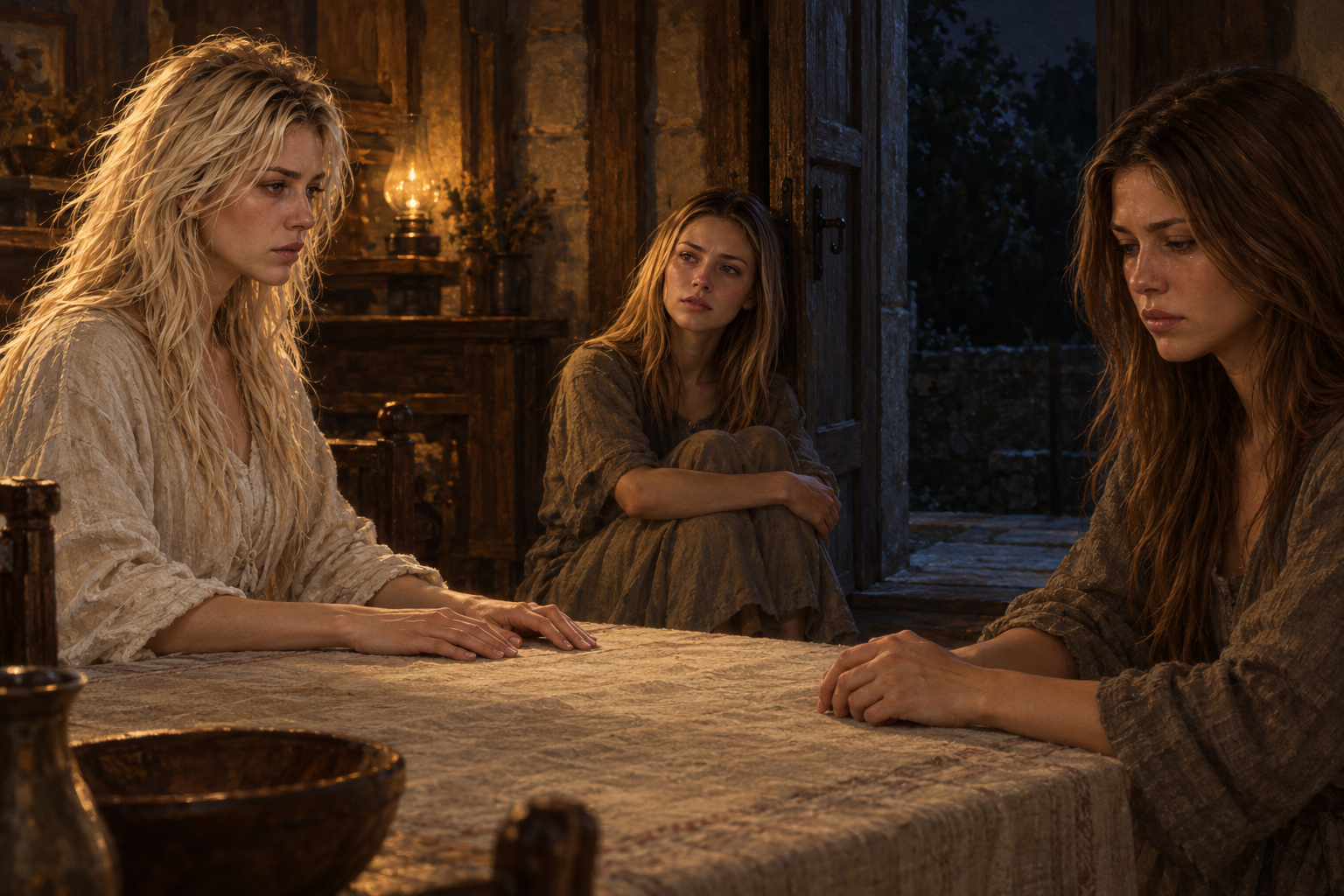
· · ·
Nobody said anything after that.
· · ·
They walked home in the dark.
Four miles across the valley, the long way, by the river, with the stars out over the water and the cold coming up off the fields. Kal walked them down to the gate, and stood with her hand on it, and watched them go; and when Kyra looked back from the bend in the road, the lamp was still burning on its hook by the step at the top of the path, and a tall dark figure was still standing at the gate beneath it, and did not go in until they were out of sight.
They did not talk much.
Somewhere near the river Val’s hand found Kyra’s in the dark, and held it, and did not let go.
· · ·
The house with the bad roof on the north side was dark when they came up the road.
Except for one thing. The door at the end of the long room stood open — it was the ninth month still, just, and it stood open from the fourth to the ninth and neither of them had ever said why — and through it, from the kitchen, there was a light. One lamp. Over the stove. Left burning all evening while they were out, the way a lamp is left on in a window in an empty house at night, so that somebody can find it when they come back up the road.
Kyra had left it on. She did not remember doing it. She had been doing it, she thought, all her life.
They stood in the yard and looked at it for a while.
· · ·
Then they went in, and did not close the door.
And Kyra, in the doorway, with the lamp behind her and the dark yard in front of her and Val’s hand still in hers, turned to her, and said what she said now, most nights, in one language or another, on one side of the sky or the other:
“Do you remember the chair?”
And Val looked at her in the light from the stove, with her own light coming up faint and steady at the wrists, the color of home, and her face doing nothing at all, and not needing to; and said what she always said, because it was the only true answer, and there were so many, and they had the rest of it to tell them in.
“Which night?”
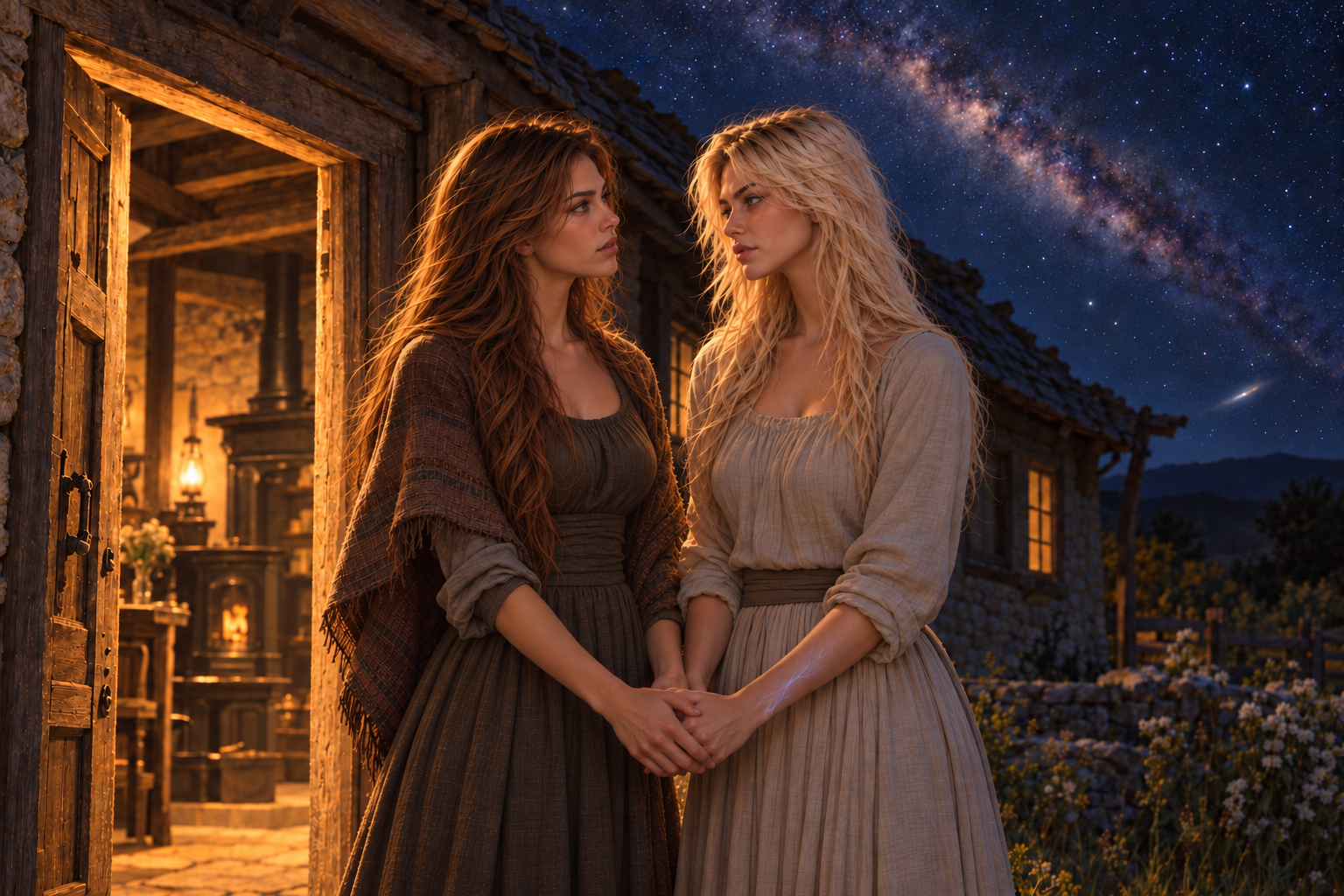
— end of the book —
The Witness — Girls of Andromeda, Book One
Jack Abbott
Contents